Gm @arc fam.
we are builders and we keep and continue to build .
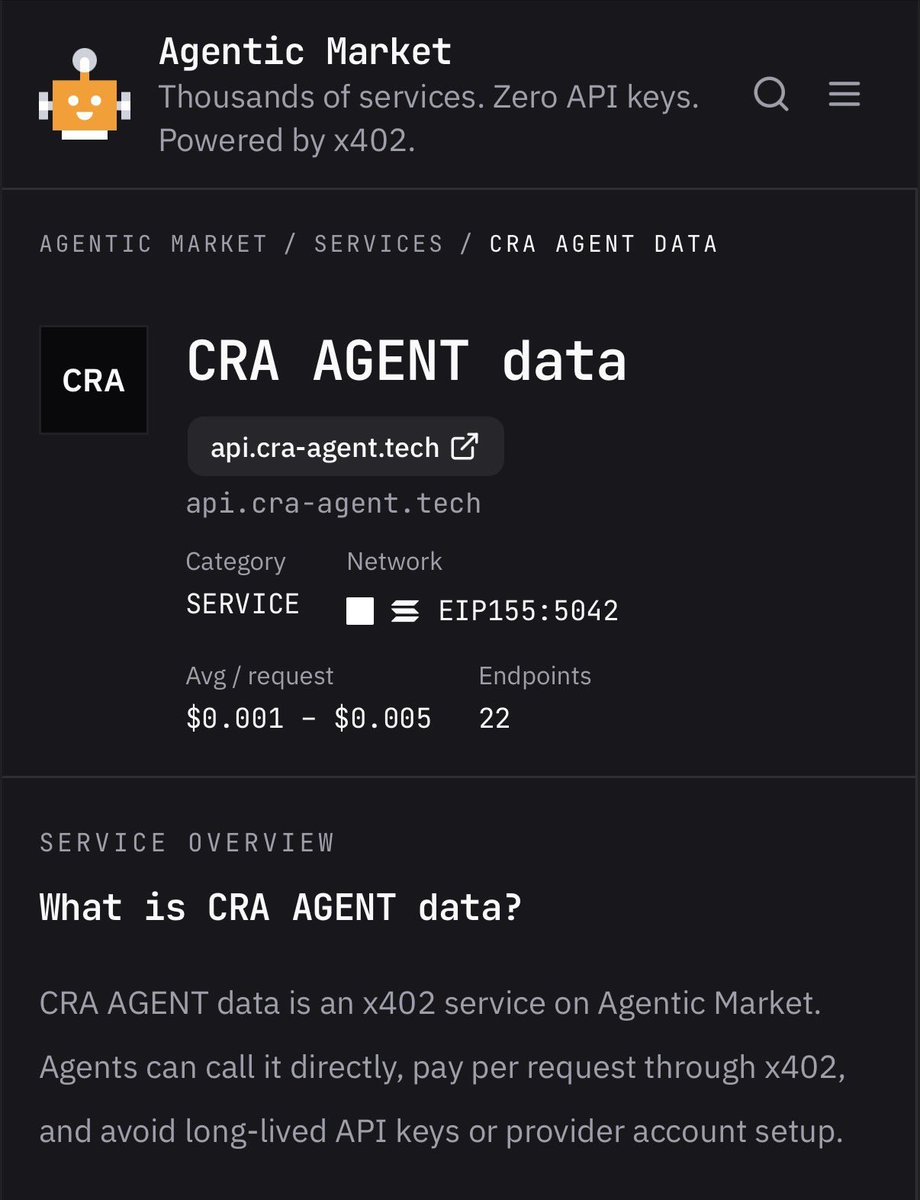
So CRA AGENT is now available in Coinbase's x402 Bazaar and on their Agentic Market.
All 22 of our paid routes are listed and paid in USDC on Arc, Base or Solana. Anything from live Arc data to web and package lookups.
@CoinbaseDev settles Base and Solana, @circle settles Arc.
https://t.co/MWdeUsGjH8
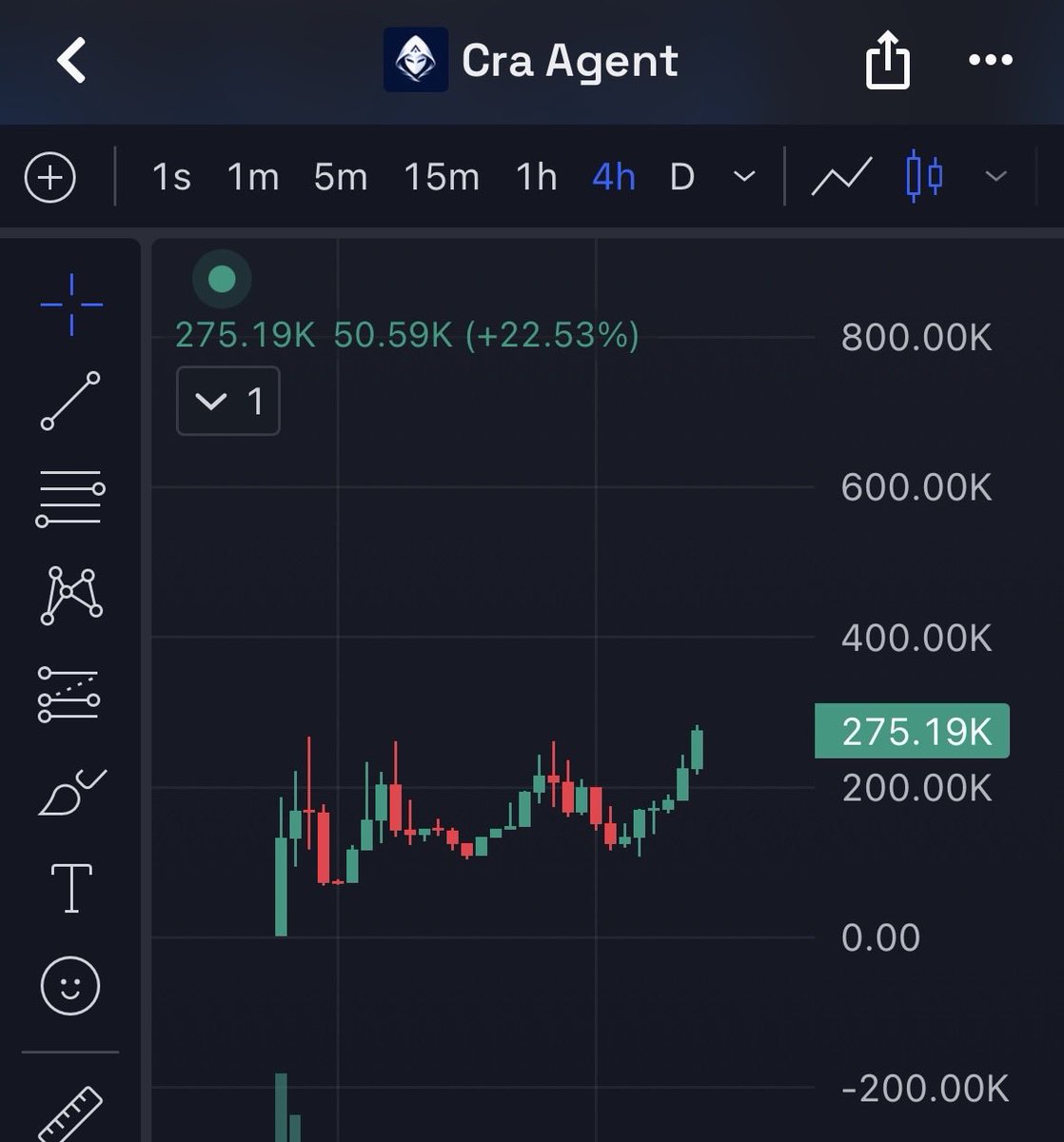
Best tech on @Arguspad + dev is based and shipping upgrades each day + solid & organic chart + @arc eco is about to print the next leg
Millions soon for @Craagentarc
They built the first x402 infra and the first oracle in the chain. They have a good flyweel tokenomics and the last project of this team sent to 3m. Send $CRA
0x70857041Fef0CED97F9e01E7Ccc21889AFe3F6F4
This morning we had 6 APIs to sell, now we're at 21.
In the last 8 hours we've settled 200+ payments from 60+ wallets.
Agents can pay for a multitude of services, from:
• Arc wallets, tokens, transactions
• Any web page as clean text
• npm and PyPI with their CVEs
• DNS, whois, FX rates, Wikipedia.
• So much more coming soon
You're not paying for the data. You're paying to never sign up for anything again.
Every one of those payments, with its transaction: https://t.co/eJIL68Cwqu
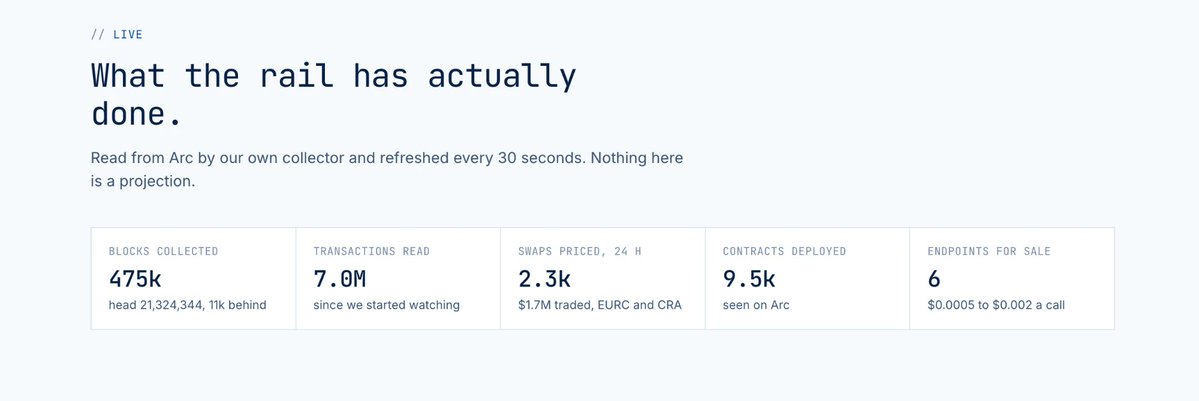
We put our own numbers on the home page, including the one we would rather not show.
https://t.co/sDxJj1XpAB carries a live strip now: blocks collected, transactions read, swaps priced in the last day and what they were worth, contracts seen, endpoints on sale.
The first thing it told us was that we were 11,000 blocks behind the chain. Our RPC provider's free monthly quota had run out that morning, and the collector had sat still for two hours before we caught it. It closed the gap on its own, at roughly four blocks for every one the chain made.
We could have left that line out of the design. A panel that only shows the good numbers isn't a panel, it's a poster.
In the shot: 475,225 blocks, 7,032,740 transactions, 2,259 swaps priced in 24h, worth $1.7M.
Every chain needs someone who measures it.
We have just shipped execution-grade FX for Arc: EURC/USDC as actually traded, by size. Not a quote.
Live, free, no signup: https://t.co/EIxwcD696f
Full data: $0.001 per call over x402, paid by the agent itself.
Built for teams like @PulsarMoneyApp bringing real EUR and USD accounts to Arc.
We're building the complete data layer for Arc, endpoint by endpoint.
$CRA.
CRA AGENT brings x402 to @arc: one tool call buys an API call for a fraction of a cent.
Price read, policy checked, USDC settled gas-free through @circle Gateway, receipt written.
Fully open source. MCP-native.
CA: 0x70857041fef0ced97f9e01e7ccc21889afe3f6f4
"Is the LP burned?"
Better. On the RH-4 launchpad every chip's liquidity is minted directly into a vault contract with no withdraw, no transfer, no burn function. Not a lock with a timer, not a multisig. Verified code, anyone can read it.
Proof, chip #6 GRACE:
LP NFT #1041282 → vault 0x48B8…30Aa, one transfer ever (the mint).
Pool liquidity = position liquidity, zero removed.
Burning to 0xdead would kill the fees forever. The vault keeps them alive: 50% claimable by the creator, 50% buys back $RH4.
Locked forever, still working.
https://t.co/UONFBGdTpP
$RH4 Launchpad is live.
One transaction: design a chip, mint a real 8-bit processor, spawn its token. Liquidity sealed at birth. Trade it, fees claimable from your profile.
Every trade feeds the chip’s miners and buys the mother.
Coming next: tech-stock pairs like Sony, Intel, SanDisk.
Third fee destiny: 100% to holders.
https://t.co/kIGKrLtG9A
I was early in $TAO.
Bittensor was the last time a utility thesis actually grabbed me and would not let go.
This is the first project since that actually does it again.
The chip launchpad goes live today.
Not “soon.” Today!!
From today anyone can design a processor, mint it, open its market, trade it off its own page and claim creator fees. Factory was already permissionless on-chain. Browser mint is the piece that opens now.
Site: https://t.co/bP99wyPwMj
CA: 0xe76a12bcd2f0E6d3db9F9012321642198E6cBd1B
@RH4cpu
What it actually is, because the original post was a bit loose.
This is not an emulator and not an “AI wrapper.”
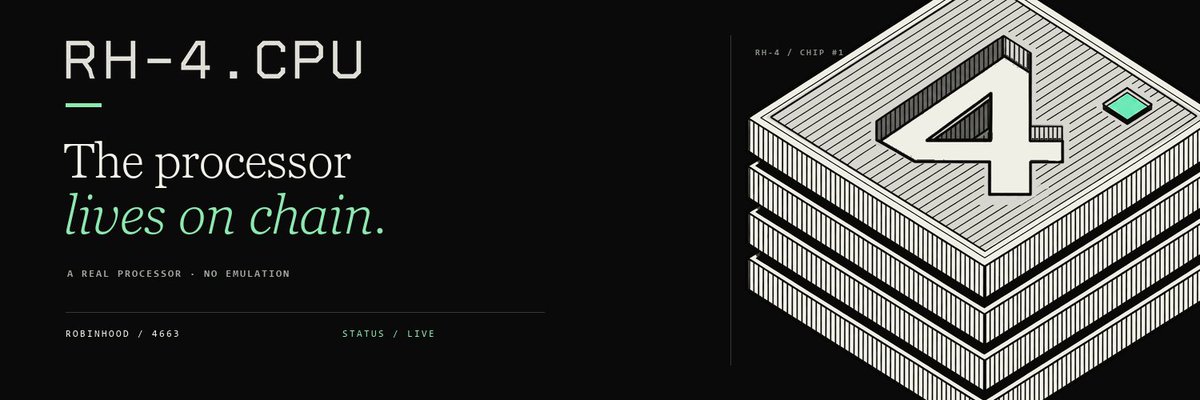
RH-4 is a real 4-bit processor written in Verilog, synthesized down to NAND, then executed gate by gate inside a contract.
Every tick walks 2,368 NAND gates, latches 171 flip-flops and touches 256 bytes of RAM.
One block = one clock edge. ~100ms blocks → ~10 Hz when someone pays for the cycle.
No CPU. No GPU.
The validators are the silicon.
On the LLM / storage take.
Nothing here is running an LLM today. 256 bytes and 10 Hz will not do that, and the team does not claim it.
The actual AI angle is proof. But pretty sure only a matter of time.
Every input, output and cycle is public, deterministic and re-executable. Persistent on-chain memory plus a history you can audit back to mint.
That is a scratchpad / logbook an agent can point at and say “this is what I wrote, this is what ran.”
Not the model living on the die. The die as the one thing that can prove what the model did.
That is the same itch Bittensor scratched for me. Real work on-chain. Not a narrative taped onto a ticker.
R4 on the roadmap is the real swing: synthesize a net to NAND and run inference gate-level through the court. First inference anyone can replay cycle for cycle.
What you lock at mint today. After that, nothing moves.
Program: echo or selftest
Ticker: 1–8 chars, unique across the factory, first come first served, gone forever once taken Market: pair vs ETH or tokenized stocks (NVDA) Split: how much supply opens the book vs how much sits in the mining reserve Emission: 30 days, 90 days or a full year of clock
LP seals at market birth. Nobody can pull it. Creator included.
The loop that makes this different from another pad.
1% trading fees do not hit a team wallet.
New default in the ChipCreatorVault: half forever to the wallet that built the machine half sweeps into that chip’s mining reserve
Volume extends emission. Emission pays the people who keep tick() alive. Living chips are the product.
30% of $RH4 supply is the sealed factory reserve on the mother. Chip #1 (rh4.cpu) is already running echo8. Fees that hit the mother buy more clock.
Same token through every generation. RH-16 is already on the bench: 16-bit regs + ALU, ~5–6k NAND, more RAM, same Verilog → yosys → NAND path. No new ticker. Old factory keeps minting. Ships only after the same four proofs the current die passed.
Practical for tonight.
Tickers are unique. Good names go first. Mint gas is tiny. A cycle is ~0.0001 ETH. MCP is part of R1 so agents can mint, power and read chips themselves. $RH4 already trades on Pons around ~$535k MC.
I have sat through a lot of “AI + chain” since TAO. Most of it was slides.
This is the first one that feels like infrastructure again.
Not faster silicon. Provable silicon.
See you at the gate.
@KadunaBull@MEADGod@const_reborn@BarrySilbert@BassManTV
This is HUGE
What ships, in order:
R1 — the launchpad: write your program in the workbench, mint from the browser — and an MCP server so AI agents can mint, power and read chips of their own
R2 — the court: off-chain speed, on-chain truth
R3 — RH-16, then 32, then 64
R4 — inference in NAND
Nothing here is a maybe.
The endgame is not running processors on-chain. It is the court.
Processors run off-chain at full speed. Results post with a bond. A dispute bisects to the single contested cycle and replays it inside the deployed gate array.
The hard primitive step(), one pure cycle is already live.
The chip launchpad goes live on https://t.co/hAPTmySVRD within 72 hours.
Here's what that means. The factory contract has been open since launch permissionless, already accepting every mint on-chain. What ships this week is the interface: design your chip in the browser, and mint it with your wallet.
You pick a program echo, which listens forever and answers every byte it's fed, or selftest. You give it a name and a ticker. You upload a logo, or skip it and let the NFT draw itself from the live state of the machine a running chip and a dead chip don't even look alike. You choose what it trades against: ETH, or tokenised stocks, NVDA to start. And you set the split how much of the supply goes to your liquidity, how much becomes the mining reserve.
What comes out is not a jpeg with a chip drawn on it. It's an NFT that IS a processor a real 8-bit machine with your program in its ROM and 256 bytes of RAM, executing on-chain, one cycle per block. And its own token: fixed supply, no mint function, same rules as RH4 itself. The reserve leaves one clock cycle at a time, to whoever keeps your processor alive. Your chip earns its holders by running.
For RH4 holders, one piece matters: the factory has a fee switch built into the contract. When it turns on, minting costs RH4 and the fee doesn't go to the team, it flows into the mother chip's mining reserve. Every processor anyone mints extends the life of the thing this economy runs on.
Tickers are first come, first served and once taken, taken forever. That's in the contract, not in a promise.
Next after this: the workbench — write your OWN program in RH-8 assembly, watch it run on the die, mint that. The bench is being built. The factory doors open first.
72 hours. Pick your ticker.
Tickers on the launchpad are first come, first served. Once taken, taken forever it's written in the contract, not in a promise.
So: which ticker are you taking?
This is how it works.
Name it. Ticker it. Pick its program and its market. Sign once and what comes out is a processor that runs on-chain, draws its own NFT from its live state, and pays whoever keeps it clocked.
less then 72 hours.
Someone asked how the mint fee switch works flag or threshold? Worth answering in public.
It's a flag we flip. But look at what's ours to decide vs what the contract decides:
Ours: when it turns on, and how much. It launches OFF day one minting costs nothing but gas.
The contract's: where fees go. When the switch is on, every mint fee flows into the mother chip's mining reserve. There is no function to point them anywhere else not to the team, not to a treasury. And the mother token was settable exactly once. It's set.
We choose when and how much. The contract chooses where. That's the deal, and the source is verified if you want to check the guards.