Claude Code leaked their source map, effectively giving you a look into the codebase.
I immediately went for the one thing that mattered: spinner verbs
There are 187
We just went from horse-and-carriage to car. The old manuals still have truth in them, but the whole map of effort, speed, and leverage changed overnight.
Building used to mean holding an entire system in your head. A fragile memory palace. A house of cards in biological primate RAM.
If you stop, the palace collapses. Dinner, a meeting, a context switch. You come back and it’s glass dust on the floor.
That’s why builders can look “antisocial.” It’s not vibes. It’s survival. You’re trying to get the palace out of your head and into code before it evaporates.
Then the weird miracle: I type a few paragraphs that barely make sense on reread, and the machine builds the palace anyway. It mirrors the structure. It fills the gaps. It hands it back.
The feeling is not “wow productivity.” The feeling is: I am seen. Like the part of you that has been translating yourself for 20 years finally gets understood on first contact.
This is why the new skill is not “code faster.” It’s taste, direction, and leadership. Managing a swarm of agents. Running tight loops. Knowing what to ask for.
And it brings back something old-school: apprenticeship. We forgot how to teach. Now teaching matters again, because the tools are insane but the mind behind them still has to be trained.
@rileybrown_ai Claude code for deep stuff; cursor for the usuals - it cost me $15 yesterday, for 5 mins it was gone & when it came back I had the entire thing that would have easily taken a full time developer 2 weeks (if I could find someone with the specific skill set in the first place)
Apple gets it. Robots are going to be everywhere, but they won’t look like robots. Check out their new paper ELEGNT.
I believe this is the future of everyday objects: helpful and human.
We are living in a timeline where a non-US company is keeping the original mission of OpenAI alive - truly open, frontier research that empowers all. It makes no sense. The most entertaining outcome is the most likely.
DeepSeek-R1 not only open-sources a barrage of models but also spills all the training secrets. They are perhaps the first OSS project that shows major, sustained growth of an RL flywheel.
Impact can be done by "ASI achieved internally" or mythical names like "Project Strawberry".
Impact can also be done by simply dumping the raw algorithms and matplotlib learning curves.
I'm reading the paper:
> Purely driven by RL, no SFT at all ("cold start"). Reminiscent of AlphaZero - master Go, Shogi, and Chess from scratch, without imitating human grandmaster moves first. This is the most significant takeaway from the paper.
> Use groundtruth rewards computed by hardcoded rules. Avoid any learned reward models that RL can easily hack against.
> Thinking time of the model steadily increases as training proceeds - this is not pre-programmed, but an emergent property!
> Emergence of self-reflection and exploration behaviors.
> GRPO instead of PPO: it removes the critic net from PPO and uses the average reward of multiple samples instead. Simple method to reduce memory use. Note that GRPO was also invented by DeepSeek in Feb 2024 ... what a cracked team.
It is odd that the world's leading AI lab, producing a system that they consider pivotal to the future and also potentially dangerous, communicates their product development progress primarily through vague and oracular X posts. Its entertaining, but also really weird.
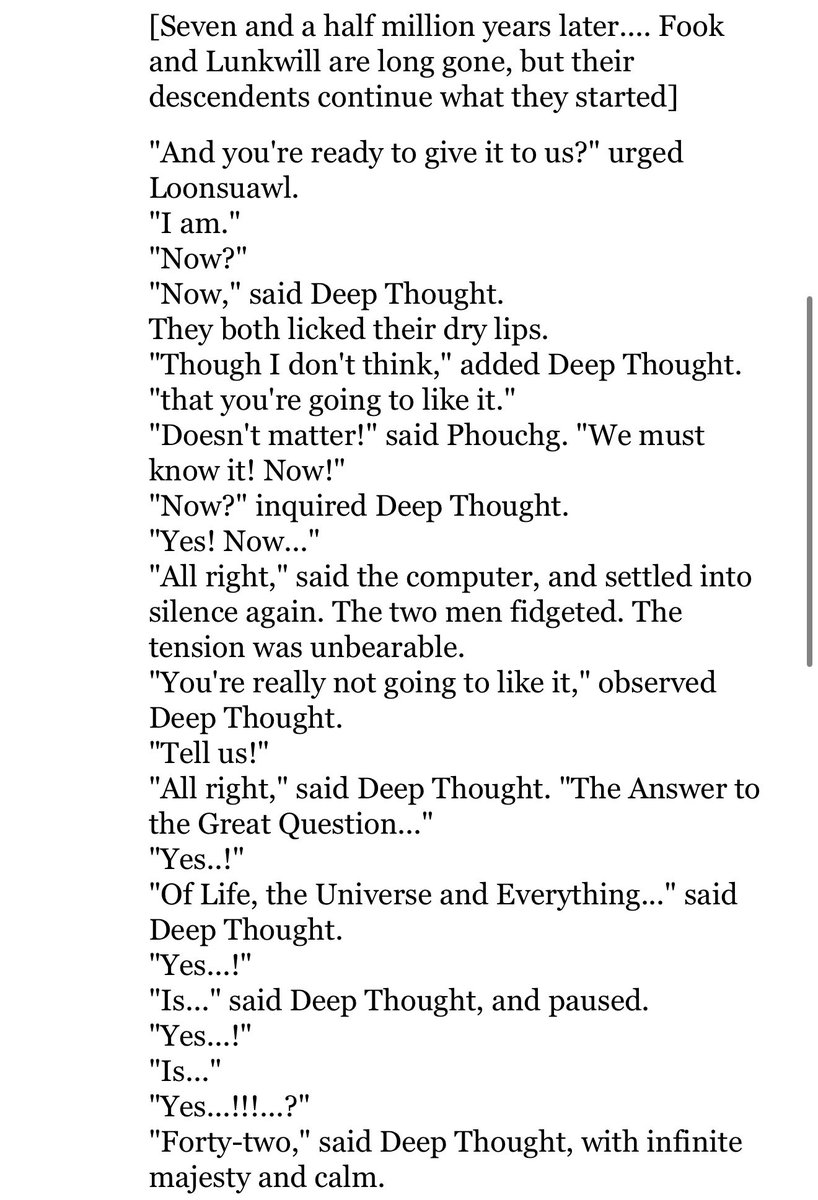
Basically think of the o3 results as validating Douglas Adams as the science fiction author most right about AI.
When given longer to think, the AI can generate answers to very hard questions, but the cost is very high, and you have to make sure you ask the right question first.
Just 10 days after o1's public debut, we’re thrilled to unveil the open-source version of the groundbreaking technique behind its success: scaling test-time compute 🧠💡
By giving models more "time to think," LLaMA 1B outperforms LLaMA 8B in math—beating a model 8x its size. The full recipe is open-source🤯
This is the power of open science and open-source AI! 🌍✨
Here’s the argument they’re hinting at, but not explaining:
1. Somebody does a truly GIGANTIC computation.
2. Not only does their computer seem too small to have done it… our entire UNIVERSE seems too small to have done it.
e.g. even if every quark in the universe was turned into a transistor, and the whole thing ran for a trillion years….
That STILL wouldn’t be enough to compute what was just computed.
So, the question arises:
WHERE did that computation take place?
The universe we see doesn’t seem big enough to hold it. Reality must be much larger than what we see. A multiverse?
I need a drug with no side effects that will keep me awake five nights in a row while my brain’s on fire and the writing is flowing. Curse this human need for sleep.
This is the strongest evidence that I’ve seen so far that we will achieve AGI with just scaling compute. It’s genuinely starting to concern me.
I used to think that we would run into roadblocks:
end of scaling laws, maybe we don’t have the right model architecture, power density walls, end of Moore’s law, problems related to the high dimensionality of multimodal data, researchers are out of ideas because they’re already using mixture of experts, etc.
It increasingly looks like we will build an AGI with just scaling things up an order of magnitude or so, maybe two. It also seems clear that @sama and others at OpenAI have already come to the same conclusion, given their public statements, chip, and scale ambitions. It’s genuinely starting to concern me.
I’m concerned not because I am an AI doomer, no, I’m wholeheartedly on the side of computational & scientific freedom and think that the risks are far from existential. I’m concerned because, post AGI, 1) the world is about to change immensely, 2) I cannot see this wild new future clearly and find it especially difficult to predict exactly what will change with the advent of AGI; the change is simply unknown, and because of this, 3) I am concerned and even fear this change.
I imagine this is how it must have felt for somebody standing on the precipice of the Second Industrial Revolution.
Here's my conversation with Mark Zuckerberg, his 3rd time on the podcast, but this time we talked in the Metaverse as photorealistic avatars. This was one of the most incredible experiences of my life. It really felt like we were talking in-person, but we were miles apart 🤯 It's hard to put into words how awesome this was for someone like me who values the intimacy of in-person conversation. It gave me a glimpse of an exciting future with many new possibilities and fascinating questions about the nature of reality and human connection ❤
Timestamps:
0:00 - Introduction
0:52 - Metaverse
15:27 - Quest 3
30:16 - Nature of reality
34:54 - AI in the Metaverse
51:51 - Large language models
57:49 - Future of humanity