Senegalese footballer Sadio Mané is formally introducing a large-scale agribusiness venture called the Bambaly Agro-Industrial Park in his home region of Casamance, Senegal.
Covering more than 500 hectares and situated just five kilometres from his birthplace of Bambaly, the development will feature a specialised facility for sorting, packaging and processing mangoes and other locally grown fruit.
The park is projected to produce 50,000 tonnes of fruit each year while creating more than 2,500 direct employment opportunities for young people in the area.
🔸When it’s time to buy state of the art, luxury vehicles for themselves, they are never short of money.
When it comes to replacing a rickety ferry that’s the only mode of public transport for an underdeveloped rural community, they are always short of money.
They hate the poor.
We need new leaders.🇿🇼
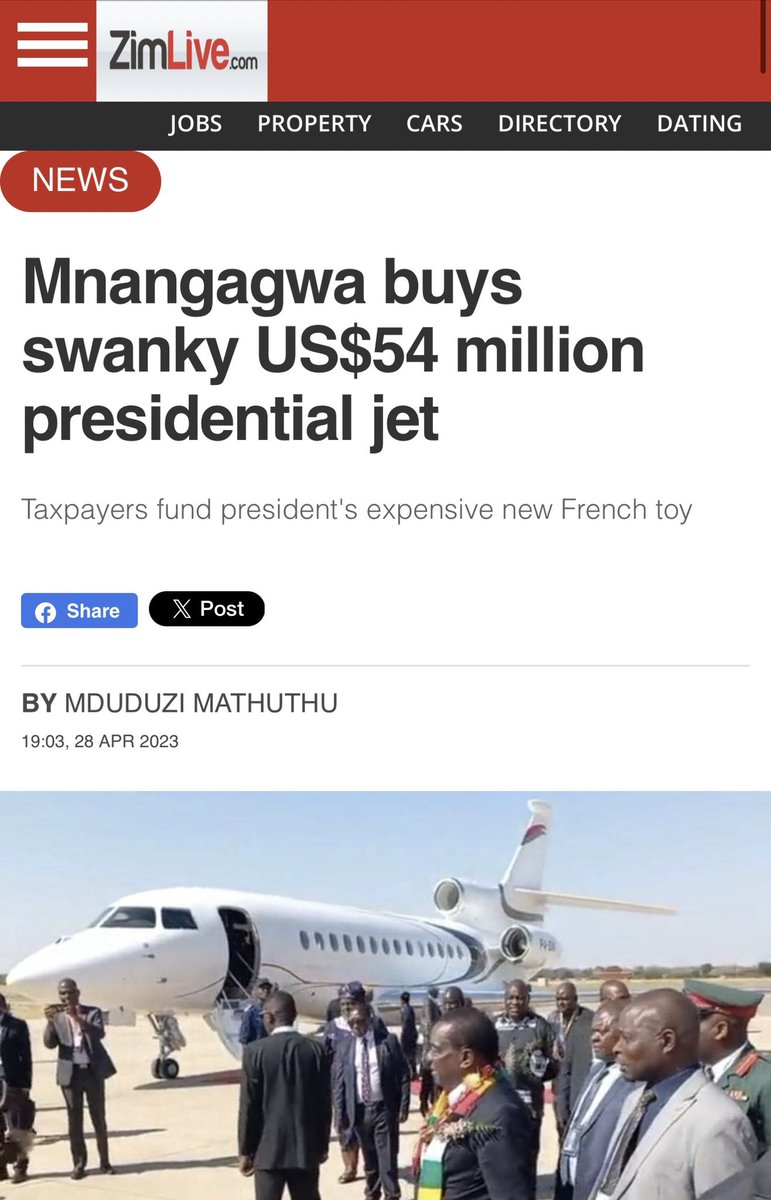
🔸When it’s time to buy state of the art, luxury private jets for themselves, they are never short of money.
When it comes to replacing a rickety ferry that’s the only mode of public transport for a neglected, rural community, they are always short of money.
They hate the poor.
We need new leaders.🇿🇼
🔴She was right! Munenge muchipa vanhu wrong information💔 Seven days later, many people are still yet to be found. The nation is in pain. #FixTheCountry
Charles Mabika, a Zimbabwean commentator, was sacked for focusing too much on Jay Jay Okocha's skills during the 2004 match between Nigeria 🇳🇬 and Zimbabwe 🇿🇼.
Zimbabweans cheered for Jay-Jay Okocha due to his outstanding performance.
Zambian broadcast journalist Alice Mutangala reports that the Electoral Commission of Zambia (ECZ) has ordered all stakeholders to leave the election results totalling centre.
She said that only police officers and Electoral Commission officials have been allowed to remain inside the centre.
The development comes after the Electoral Commission temporarily suspended the counting of votes and the announcement of election results nationwide for 24 hours from today.
The removal of stakeholders from the results centre is likely to raise further questions about transparency and scrutiny of the electoral process, particularly at a time when the counting and announcement of results have already been suspended.
The Electoral Commission of Zambia is headed by Mwangala Zaloumis, who previously served as President Hakainde Hichilema’s personal lawyer.
A well-known Zimbabwean sent me this message after I shared my thoughts on Zimbabwe’s property inflation and what is driving it.
He bought his property for US$100,000 in 2004 and, 22 years later, sold it for US$1.7 million. That is a capital gain of US$1.6 million in just 22 years.
This example helps explain why so many Zimbabweans prefer investing in property rather than the stock market. Property has become one of the few asset classes that has consistently preserved and grown wealth through Zimbabwe’s repeated cycles of hyperinflation, currency changes, and economic instability.
Unlike financial assets, real estate is viewed as a tangible store of value that can also generate rental income while appreciating over time.
In contrast, Zimbabwe’s capital markets have struggled to inspire long-term investor confidence. Years of policy uncertainty, exchange-rate distortions, inflation, currency conversions, trading suspensions, and restrictions on the movement of capital have repeatedly eroded the real value of many financial investments and undermined market confidence.
As a result, many investors have concluded that property offers greater certainty and better protection for their capital.
Equity markets perform their most important economic function when they mobilise savings into productive businesses, allowing companies to raise capital, expand operations, create jobs, and drive innovation.
When investors lose confidence in the stock exchange and redirect their savings into property instead, capital becomes concentrated in existing real estate rather than flowing into productive sectors of the economy.
This reduces the amount of investment available for businesses to grow, weakens entrepreneurship, limits job creation, and contributes to slower economic development.
The irony is that rising property prices are often celebrated as a sign of wealth, yet they can also be a symptom of a dysfunctional investment environment. When property consistently outperforms productive investment, it is often because investors are seeking safety rather than opportunity.
In a healthy economy, capital should flow confidently into both businesses and property. In Zimbabwe, however, the persistent preference for real estate reflects a lack of confidence in the country’s financial markets and broader economic policy environment.
Had this prominent Zimbabwean invested his US$100,000 in the stock market in 2004, that capital could have been channelled into businesses seeking to expand, innovate, create jobs, and generate greater returns for both the companies and their shareholders.
That is the fundamental purpose of a functioning capital market; to direct savings into productive investment that grows the economy.
Instead, the money remained locked in bricks and mortar for 22 years. While that investment generated an estimated capital gain of US$1.6 million, it also produced rental income throughout that period, less maintenance and other ownership costs. From a personal investment perspective, it was an outstanding decision.
The problem is that what makes sense for an individual investor does not necessarily make sense for the economy. When capital overwhelmingly flows into property instead of productive businesses, economic growth slows. Fewer companies can raise capital, fewer factories are built, fewer businesses expand, fewer jobs are created, and innovation suffers.
This is why it is so important for Zimbabwe’s leaders to fix the investment climate. Investors allocate capital where they have confidence that their money will be protected, earn competitive returns, and be governed by predictable rules.
A credible financial system and a trusted capital market encourage savings to flow into productive enterprises rather than being concentrated in real estate. That is how economies attract investment, stimulate growth, create jobs, and build long-term prosperity.
None takes anyone's job. Some companies have relocated to Mozambique. Investors do not come where there is instability and a workforce which is not productive. One is in business to make money and not to occupy employees.
🇳🇬 Two Chinese 🇨🇳 nationals were sentenced to five years in prison after pleading guilty to illegally exporting lithium, mica, and copper-bearing minerals without government approval.
Then there is a country we know where lithium and other mineral resources are given away at the expense of ordinary citizens.
It is the government’s duty to safeguard minerals and make sure they are used for the benefit of all citizens.
#FixTheCountry!
You can see that Emmerson Mnangawa has gone mad.
George Charamba fears death otherwise he's the one who can call you order.
I don't like George Charamba but all I know is that he has institutional memory.