The world is so Bonkers right now.
Russia & Venezuela... two countries blessed with some of the largest oil reserves on earth are both dealing with serious gasoline shortages at home!
~SNQMacro | Sage Thomson
Brad Gerstner: Anthropic could *ADD* $200B of Revenue in 2027 - “We’ve never seen anything like this in the history of the world.”
@altcap:
“Let me be provocative here. If (Anthropic) ends the year with over $100 billion (in revenue), I think they're on a revenue trajectory that could 3-5x again next year. We've never seen anything like this.”
@Jason:
“You're saying $100B to $300B, or $100B to $400B.”
Brad:
“Our minds were blown if a company could go from $100M to $300M. Now we're talking from $100B to $300B.
$200B of incremental revenue is incomprehensible in the history of Silicon Valley.”
@chamath:
“In the history of the world.”
Brad:
“Yeah, in the history of the world. The fact that we're even talking anywhere close to this tells us something different is going on here.
I think the thing that's different is that intelligence is the largest TAM we've ever seen in the history of the world. These guys are penetrating it.”
Thank you to @CNBC's @SullyCNBC and @KellyCNBC for having me on today to discuss the evolving risks across global energy markets.
The key story is no longer just oil supply. It's the growing number of bottlenecks emerging across the global energy system.
In Russia alone, Ukrainian strikes have disrupted around 3 million barrels per day of refining capacity, and unlike crude, there are no meaningful strategic reserves of refined products to cushion those losses.
Ukraine’s strikes are compounded by ongoing disruption in the Strait of Hormuz and US midstream network, all of which combine to put the spotlight on a bigger, structural issue: underinvestment in hard asset infrastructure.
As these bottlenecks rotate around the system, recovery becomes increasingly difficult and market volatility rises.
Thanks again to @PowerLunch team. Watch the interview in full below.
https://t.co/reZlAAiQl8
Jared Kushner & Trump's sons have raised $13 billion from foreign governments, mostly in the Middle East.
At the same time, Kushner serves as Special Envoy to the region, negotiating with the very countries with which he's financially conflicted.
📸: @MSNOWNews
Saudi Arabia's April production drop to 6.316 million barrels per day—its weakest output since the 1990 Gulf War and a 42% cumulative collapse since February—was dictated by the conflict involving Iran and the subsequent disruption of Persian Gulf shipments.
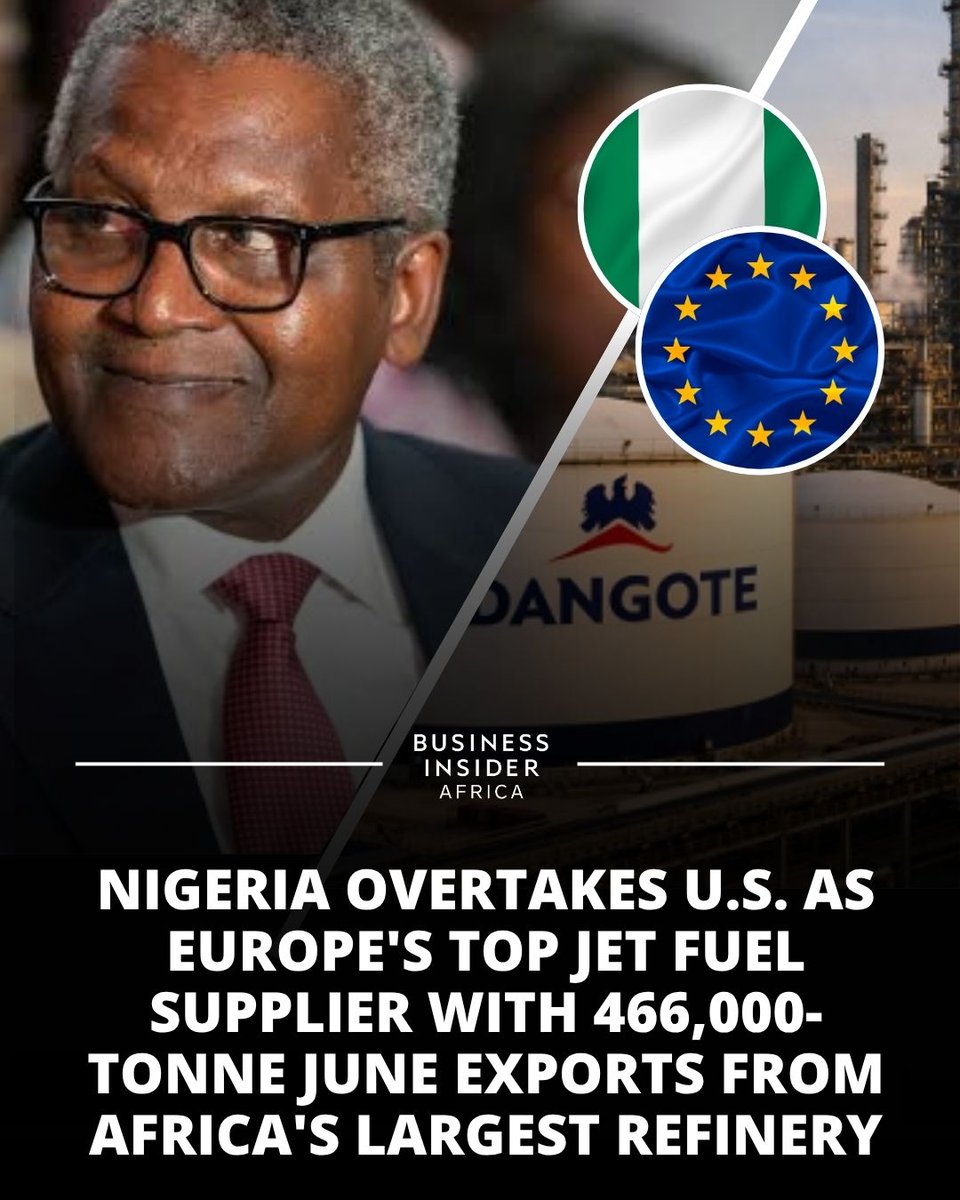
Dangote Petroleum Refinery in Nigeria🇳🇬 became Europe's🇪🇺 largest external supplier of jet fuel in June, overtaking the United States🇺🇸.
Nigeria🇳🇬 exported 466,000 metric tonnes of aviation fuel to Europe🇪🇺 in June, the highest export volume since Dangote began operations in 2024.
While Dangote surged, US🇺🇸 jet fuel exports to Europe🇪🇺 declined significantly, and European market prices dropped.
Dangote's rapid growth in fuel exports aligns with the company's plans to expand refining capacity continent-wide.
Commodity guru Jeff Currie on the squeeze on oil refining capacity:
“If I was an alien who came down to planet Earth, and I looked at this market, I’m going to say, ‘You’re out of oil refining capacity.’ That’s a lot worse than being out of crude.
STAY LONG GAS AND DIESEL.
Labor force participation has fallen to 61.5% — the lowest since 2021, erasing the entire post-pandemic recovery.
Since Trump's inauguration, over a million people have left the job market — which explains part of the reason the unemployment rate dropped last month.
One of Africa’s World Cup greatest wonder stories Cape Verde, has a population of just 500,000 at home, but has ONE MILLION of its citizens living abroad. It’s the only independent nation in the world that has that kind of global diaspora footprint. 🌍
AU headquarters, ECOWAS headquarters, Africa CDC headquarters. All fully financed and built on another person’s dime. At some point pride has to kick in. Ego, vanity whatever will make us pay for our own institutions- from the buildings that host them to their budgets.
“Africa, which is home to almost a fifth of the world’s population, accounts for just 2% of global air traffic…The intra-African routes that do exist are often prohibitively expensive, operationally complicated and taxing for travelers with no viable alternatives.”
Africa's biggest exporters are also some of the least Africa-facing.
This chart maps total merchandise exports (i.e. physical goods, not services) against intra-African export share — because a country can be a trade giant and still barely sell to its neighbors.
What it shows:
• 𝗨𝗻𝘁𝗮𝗽𝗽𝗲𝗱 𝗚𝗶𝗮𝗻𝘁𝘀: Nigeria, Egypt, Morocco, Algeria, Angola, et al. — combined these countries generate over 45% of all African merchandise exports. But because their export profiles are structurally hardwired away from Africa towards global oil markets, European nearshoring, or the Arab world, they account for just ~25% of intra-African exports.
• 𝗥𝗲𝗴𝗶𝗼𝗻𝗮𝗹 𝗖𝗵𝗮𝗺𝗽𝗶𝗼𝗻𝘀: Eswatini, Lesotho, Rwanda, Burundi, Djibouti, et al. — small exporters, but over 40% of what they sell goes to continental partners. The integration is real but driven by proximity, regional trade blocs (like SACU), and lack of large-scale raw commodity exports to global markets.
• 𝗘𝗺𝗲𝗿𝗴𝗶𝗻𝗴 𝗜𝗻𝘁𝗲𝗴𝗿𝗮𝘁𝗼𝗿𝘀: South Africa, Kenya, Tanzania, Senegal, Uganda, Zambia, et al. — dual-engine export economies that operate as regional manufacturing or agricultural anchors for their neighbors while simultaneously shipping high-value primary resources to global markets. This is the immediate AfCFTA opportunity zone for deeper integration.
• 𝗗𝗶𝘀𝗰𝗼𝗻𝗻𝗲𝗰𝘁𝗲𝗱 𝗣𝗲𝗿𝗶𝗽𝗵𝗲𝗿𝘆: Liberia, Sierra Leone, Cabo Verde, Guinea-Bissau, et al. — smaller exporters whose economies are locked into exporting raw commodities out of Africa or navigating structural challenges that break regional trade links.
• 𝗜𝗻𝘁𝗲𝗴𝗿𝗮𝘁𝗶𝗼𝗻 𝗣𝗼𝘄𝗲𝗿𝗵𝗼𝘂𝘀𝗲𝘀: None — No large exporter in Africa today sells at scale predominantly to other African countries. Until industrialization on the continent advances with enough domestic refining, processing, and manufacturing capacity to absorb and transform local raw materials, scale and deep regional integration will remain structurally incompatible.
Africa's path to prosperity goes through intra-African trade.
While AfCFTA implementation is increasingly emphasized, building industrial capacity must be too.
Ultimately, the continent's future depends on factories, not just frameworks.
—
Decision-makers across the continent and the world trust Afridigest for Africa-focused advisory & intelligence ➜ https://t.co/pTeD1UjeWi