Today we're releasing the SageOx Agent Toolkit: free and open source.
One agent. One memory. The same character across surfaces.
It puts a hosted agent where your team already talks: Buzz, Slack, and more coming soon.
Point it at your team's SageOx context and it arrives knowing what your team already decided: across tools, models, and harnesses.
Read-only by design.
It's alpha. Try it. Break it. Tell us what you learn.
Github link👇
100%.
That's very close to what we're building at @sageox.We capture structured knowledge from everything a team does: decisions, coding sessions, plans, chats and meetings, as they happen.
Then we distill it and prime every agent with just the context it needs for the task, through our CLI or MCP.
The key is that saving knowledge for one person doesn't help much. So there's a team layer: a shared console where all the context lives, and anyone on the team, human or agent, can get to it in whatever way works best for them.
That's what lets humans and agents actually work together as teammates, instead of everyone's agent starting from zero.
Now imagine every relevant session is saved automatically: your AI chats, your coding sessions, your threads.
And whenever you need that context, you can pull it back. Not just for you and your team, but for your fleet of agents too, so everyone can stop starting from zero.
That's exactly what we're building at @SageOx.
Not just a tool that captures everything, but one that distills the right context at the right time, so neither you nor your agents get buried in information.
But the problem is, we still only record parts of the trail, and usually not the parts where the decision was made.
So when someone asks, "Why do we do it this way?", there's no concrete answer. You HAVE to go ask the person who made the call.
Okay, but "context" isn't just some Notion docs and meeting transcripts.
In fact, most decisions don't even get made that way anymore.
They get made in individual Claude chats, in coding sessions, or in Slack threads.
agents can change, harness can change.
things will keep shifting.
what remains is common context and that's where @sageox can power your ever changing agents.
Try it today and feel the magic.
LLMs are helping us code at faster rate than ever. But with all good things, there's always something bad that comes with it.
LLMs produce bugs, a lot of SLOP, duplicate code, code and comments go out of sync and a lot more (I mean to be fair humans have done it too).
So how to make sure your code keeps it sanity so you can ship production grade code?
We have realized that we need job specific agents who are doing really focused jobs. This article I share is a preview of how we run agents, manage them and make them work together autonomously.
Check it out and let me know your thoughts
A lot of people I know wants to take this plunge and work on a startup or quite their boring jobs to do something exciting.
But most of them are looking for a perfect opportunity.
But the truth - there are none.
So what do you do? The only thing you can do is find a place where you can enjoy, learn and have fun. A place where you think you are building amazing stuff.
If you wait for the perfect opportunity. Good luck, it will never come.
When I left my job I don’t know what I was doing but what I knew is I want to explore, I want to tinker, I wanna play around and see what can I do.
That’s what led me to find @sageox and after I talked to them, worked with them it just clicked that I’m gonna have a blast here.
I don’t know where it will go, nobody does. But what I know is this will be one hell of a wild ride and I’m gonna have so much fun.
Instead of me telling you how @sageox is so powerful, I can show you!
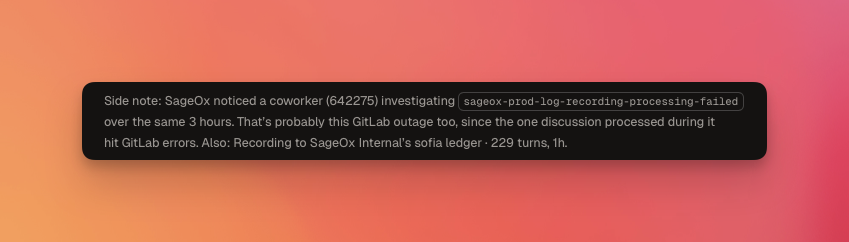
Look at this, saving dev's time by just popping on to my investigation that another coworker is investigating same issue.
My agent is telling me this, all powered by SageOx. Magic.
Hear me out: Agentic TPMs (Technical Program Managers.) I had this idea in Sydney while chatting with Martha McKeen at CBA. I think this winds up being the most immediate and direct way that coding agents can make their way into the enterprise, and it will set the stage for true AI employees rolling in next year.
So. Build-side agents are great but they don't escape the SDLC. Only devs are using them. There are a handful of business people vibe coding SaaS, but for the most part, non-engineers aren't using coding agents to help with their jobs. Right? Not yet.
Autonomous 24x7 unmanned queue-based "operator" agents, like the ones that handle internal or external customer issues, are great. But they are narrowly scoped, and generally require devs involved to set them up and maintain them.
Neither builder nor operator agents are automatically going viral internally and helping run the company. They stay in their lanes. But what if their lane was to help run projects?
I was a TPM at Amazon in 1999. Bezos brought in high-powered engineers with people skills to run difficult cross-functional projects and programs. TPMs are used at Google, Uber, Netflix, and other companies, and they are always in high demand and short supply.
I have a class of agents in my Wheelhouse factory that act just like TPMs. They have external email and Slack, and talk to my accountant, lawyers, players. Each one has a project lane and drives it. They use Progress By Nagging, which... works.
A TPM owns delivery, but has no authority, and no resources. They can only ask, observe, document, and report. This is just like my TPM Wheelhouse seats, who have been helping me drive dozens of projects to completion, large and small, for months.
Agents, particularly smarter models, will go to great lengths to document the hell out of everything in the domain where they're operating. They'll capture all the tribal knowledge and unwritten rules. They can create topological maps of your project, org dependencies, and workflows. They'll bulldoze through silos and knowledge-hoarders and figure out how the company actually works, and document it all. And nag people along the way.
This kind of agent sits well in constraint-space. They're cheap: You don't need to use the fanciest models; anyone with Opus or Sol access could have a TPM agent. And TPM agents have low risk and blast radius, because they cannot act. Unlike builder agents, which create new problems (like merge-queue and code-review bottlenecks), TPM agents simply shine a light on the org, and nudge things along.
It doesn't matter what format they're recording their findings in. It could be Sanskrit and hieroglyphics. When it comes time to merge their findings with those of other TPM agents, it will all translate trivially into your company brain.
Anyone in the company can stand up a TPM agent. It's like a personal chief of staff. There's no dependency on engineers. Everyone can do it; it doesn't even have to have a paced rollout. And there's no product to buy, no tech to install, maybe just a Skill you give people. Maybe you put a company wrapper on it. But it's just an agent that's playing the TPM role.
TPM agents will wind up training human orgs on human-agent interactions. Humans start getting emails or DMs from agents, work-related, and will have to get comfortable replying and interacting. Companies can push the social side along without waiting for engineers to finish messing with the SDLC, which honestly will never finish.
Other kinds of agents struggle at enterprises because they lack context. TPM agents will build that missing context as their exhaust, no joke; they've done it for my game without me even asking. TPM agents are the jungle explorers that will map out your organization, and you'll discover all sorts of fun stuff, like that you had 3 teams doing the same thing. TPM agents are a low-risk, high-impact way to start figuring out how AI can help you run your project, or organization.
I'll write a blog post about this, but feel free to start now. Go! Just give me credit when you win big with this idea. And if you want my help, ping me on https://t.co/kP6aTbCsg0.