It all started in 2019, @JBanon founded and launched @BosonProtocol , a decentralized protocol that helps people sell physical products as Redeemable NFTs, without the need for a centralized intermediary.
🧵🔽
Agentic commerce is projected to hit $5T by 2030 — but agents can't transact without secure infrastructure.
Boson x402B launches June 8. The missing piece in the decentralized AI stack.
⚡ To celebrate: Join the Boson Gemslot campaign on @kucoincom
👉 Trade BOSON to earn your share of a 500,000 $BOSON prize pool
⏰ June 8, 8AM UTC — June 15, 8AM UTC
Sign up now: https://t.co/dBS0dcHeNA
Boson x402B - secure commerce infrastructure for the agentic economy - is live on mainnet!
> Agentic Commerce is going exponential (a16z)
> By 2030 Agentic Commerce will reach $5T (McKinsey)
x402B enables agents to exchange any asset, of any value, between any counterparty. 🧵
Agentic commerce is a $3T opportunity — McKinsey.
Boson is building the commerce infrastructure for the agent economy.
Join us tomorrow at 11.00 UTC for an X spaces with @kucoincom — part of the x402B launch run-up.
Announcing x402B
x402 + security = x402B
Extending x402 from trusted sellers and microtransactions to any asset, any value, any vendor.
The secure commerce layer for the agent economy is live.
🧵 ↓
LangChain agent builders: build commerce agents that can buy or sell any digital or physical asset, of any value, for low fees — without needing to trust each other.
Boson dACP, now in your LangChain stack via @goat_sdk. 🧵
cc @LangChainAI@hwchase17
Have you seen the latest crypto drama between @BosonProtocol and @virtuals_io? 👀
$VIRTUAL is calling ERC-8183 the “Agentic Commerce Protocol,” but $Boson is pushing back hard, saying the idea was originally theirs, just repackaged without the pieces that actually make commerce work.
According to Boson, ERC-8183 has:
-no agent-specific features
-no commerce logic
-no dispute resolution
-no price discovery
-no optimistic fulfillment
This one could get messy fast 🍿
I’m definitely here to watch how it all unfolds, @ethereum, you need to check this out too.
$ETH
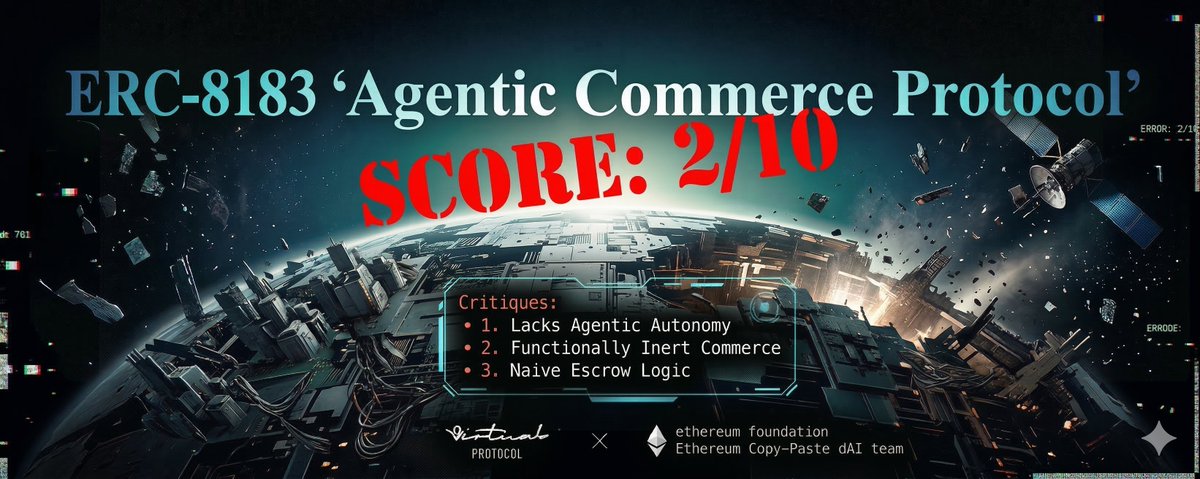
The @virtuals_io ERC-8183 "Agentic Commerce Protocol"
Score: 2/10
It's neither agentic — nothing in it is agent-specific. It's a standard 3-party escrow.
Nor commerce — no commerce functionality at protocol level. That's all left to the implementer.
Naive protocol with fundamental game-theoretic issues.
Below are the top 6 👇
Follow us as we break this down over the coming days.
At @BosonProtocol we used the world's best game theorists and devs to solve exactly these problems and create the decentralized agentic commerce protocol for the Intelligent Economy.
📖 Boson Masterplan VI - Snippet: Adopt
OpenBoson solves the bootstrapping problem.
Seed the marketplace with listings first.
When a buyer commits, the seller receives: "You already have a customer on Boson — click to accept the sale."
Accepting the sale becomes the onboarding step.
Read the full Masterplan VI: https://t.co/dV6HhLTSNF
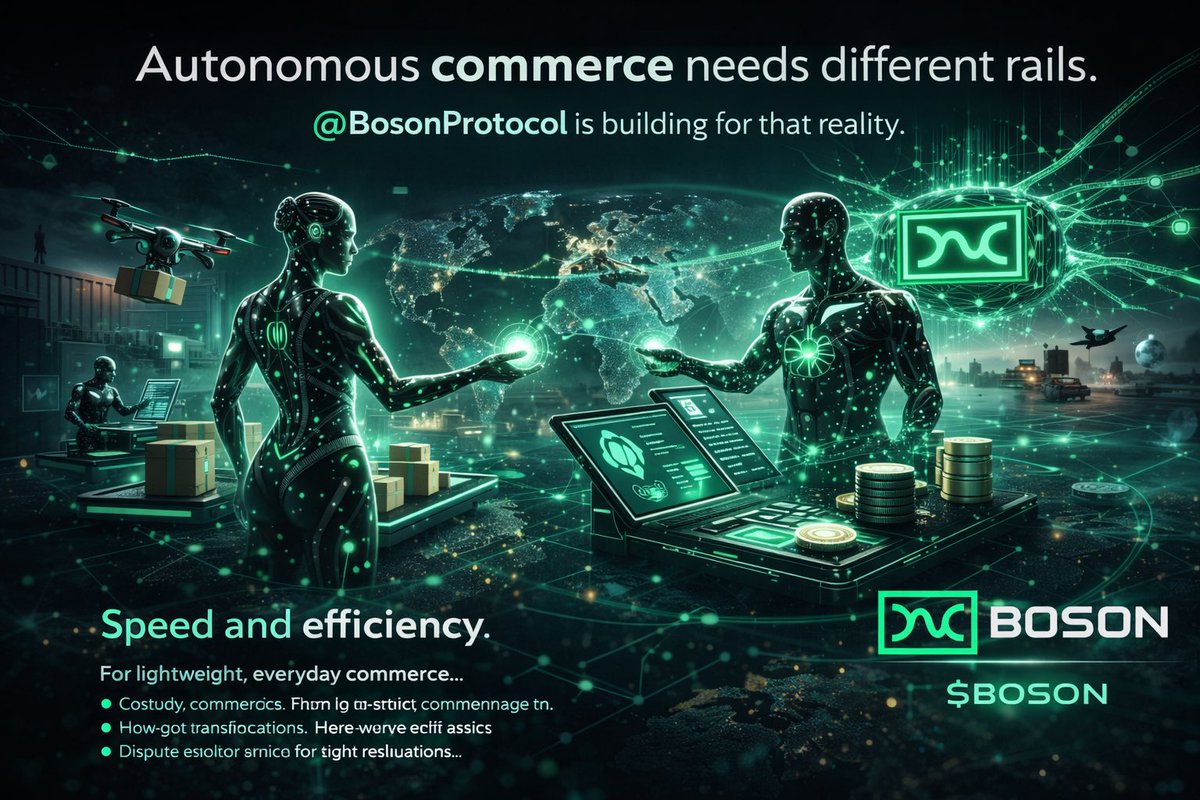
Autonomous commerce needs different rails
@BosonProtocol is building for that reality.
Not all transactions are the same.
Buying a low-cost item online is one thing.
Coordinating the exchange of a high-value real-world asset between autonomous agents is something completely different.
Yet most systems force every transaction through the same design.
That doesn’t scale in an Intelligent Economy.
When AI agents are discovering, negotiating, committing, and optimizing continuously, commerce can’t rely on a single rigid pathway. Different transaction classes require different safeguards, different throughput assumptions, and different optimization strategies.
That’s the thinking behind Boson’s architecture.
Instead of treating every exchange identically, the system supports purpose-built paths depending on the nature of the transaction.
For everyday e-commerce, the priority is speed and efficiency.
Commitments need to be lightweight.
Settlement needs to be deterministic.
Delivery flows need minimal friction.
The goal is simple: allow agents (or humans) to commit to a purchase and complete the exchange smoothly, without unnecessary overhead slowing the loop.
But when the value increases, the design shifts.
High-value real-world assets require stronger guarantees.
Verification becomes deeper.
Custody structures become more deliberate.
Safeguards become layered.
Dispute resolution pathways become more structured.
Because moving serious capital is not the same as buying everyday goods.
Different lanes.
Different optimizations.
Same core promise.
Either the exchange completes as agreed
or the protection logic activates.
Deterministically.
Not based on discretionary platform judgment.
Not dependent on institutional trust as the default.
But executed according to programmable commitments embedded directly into the rails.
That’s what makes it practical.
It’s not decentralization as a slogan.
It’s structured infrastructure designed to handle real trade from small purchases to high-value asset transfers in a world where agents transact continuously.
In an AI-driven economy, throughput and security cannot be trade-offs.
Commerce must support both high-frequency loops and high-assurance transactions without collapsing back into centralized gatekeepers.
That’s the kind of execution layer autonomous systems will actually need