Introducing "Intentional Engineering"
Why you build matters ~ especially now, when building is easy.
Your intent is your taste. Rooted in experience, earned through mastery.
Agents don’t replace that. They amplify it ~ or expose the lack of it.
Be intentional, and you build things that matter. Intent is the new skill.
#buildwithintention #agentic #VibeCoding
A week ago: Akashik Protocol spec. Shared Memory and Coordination Layer for Multi-Agents Systems.
Today: the v0.1 reference implementation's API is frozen.
Five primitives:
- createField()
- write({ entry, intent })
- read(query)
- attune({ agent, topic })
AkashikError
Every write carries a mandatory intent. No silent memory.
Ships on npm April 29 as @akashikprotocol/core.
What's in v0.1, what's not:
✓ Five primitives ✓ In-memory backend ✓ TypeScript-first ✓ One runnable example
✗ Conflict detection → v0.2
✗ Persistent storage → v0.2
✗ Framework adapters → v0.3
Read the frozen API. If you're building multi-agent systems and you've hit the memory wall, read the API. Help me refine the contract before we ship it.
https://t.co/JULzYu3Q1u
For the past month, I’ve been working on a complete redesign for https://t.co/5OOKJpESCK!
The landing page is now yours to customize, so you can truly see the power of our components.
Better docs, new features, new components, and a fresh new look.
Live now!🎉
Meet Wikimind ~ a compiler for knowledge bases.
Drop raw docs into a folder. An LLM reads every source, extracts concepts, generates interlinked wiki articles, and builds a knowledge graph. Query it. Lint it for contradictions and gaps.
143 articles. 608 connections. From 5 podcast transcripts.
Inspired by @karpathy's LLM Wiki pattern.
Powered by @AnthropicAI.
Open source: https://t.co/hOEJhQPrWP
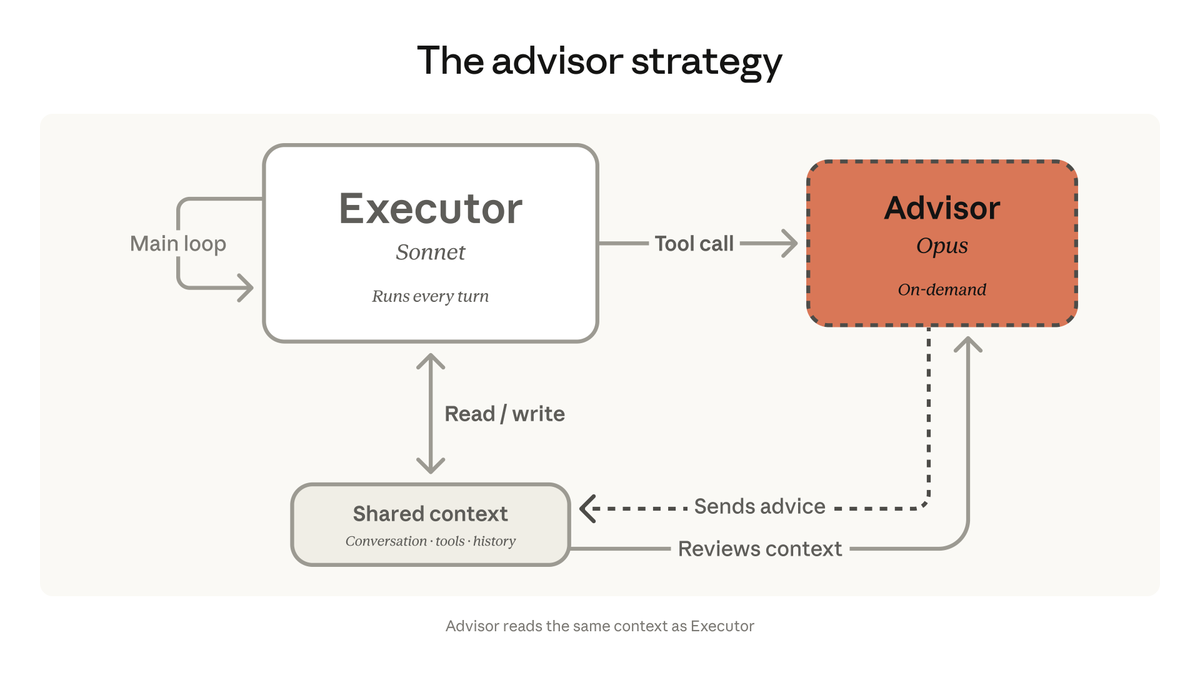
We're bringing the advisor strategy to the Claude Platform.
Pair Opus as an advisor with Sonnet or Haiku as an executor, and get near Opus-level intelligence in your agents at a fraction of the cost.
Inspired by @karpathy LLM Wiki gist, I built Wikimind.
CLI that compiles raw docs into a structured, interlinked wiki using LLMs. Concept extraction, backlinks, knowledge graph, natural-language Q&A, and a lint system that detects contradictions and gaps.
https://t.co/hOEJhQPrWP
Create your own personal knowledge bases.
@lagosrui@karpathy Spot on, and I appreciate the feedback. Policy without intent is just guardrails by another name. The officer layer has to encode both, what the principal allows and what the principal actually cares about. That’s the hard part and that’s exactly the work ahead.
Exactly right. The file is the starting point, not the whole picture. My thoughts are that the Officer itself is a runtime layer, an LLM-powered evaluator that intercepts every agent action and makes a judgment call: approve, modify, escalate, or veto. The "officer.md" gives it context to make the judgment. Without the runtime, it’s just a document. With it, governance happens at the point of execution.
Agent frameworks optimise for task completion.
We should optimise for trust.
We need a new layer in the agent stack, the one I am calling Officers.
A fiduciary governance layer that asks one question before every agent action: Does this serve my principal?
Officers are Layer 0.
Full essay: https://t.co/wtIvZwcj41
@saranormous@karpathy@NoPriorsPod Great Interview. When you have swarms of always-on agents doing autonomous research, how do they share what they've found? Not just pass data, carry the reasoning, the confidence, the intent behind each finding. That's the infrastructure gap I keep coming back to.
@haider1 So true. Memory setup is the most underestimated skill. But even when you get it right, most agent memory stores what was found, not why. The receiving agent gets data without reasoning.
When every write declares its intent, the whole system gets smarter.
What do you think about this:
"Reasoning Debt" - like tech debt, but for agent systems. Every finding stored without intent, confidence or assumptions is a decision agents can't explain later. It compounds. Fast.
Is this already a thing? Or are we naming it?
Intent is mandatory. If the agent memory doesn't require intent on every write, it's just a database with extra steps.
That's the gap. That's what we're solving with Akashik Protocol (Spec Published)
https://t.co/cPNNtTiWuQ
#ai#OpenSource
The spec (v0.1.0-draft) is live now, the Level 0 SDK ships in April.
This is deliberately early. I want the people building multi-agent systems to shape this before it hardens.
Read it. Tear it apart. Open an issue. Let's build it right.
https://t.co/wqMGMTxHXf
AI Agents can call tools (MCP)
They can talk to each other (A2A)
But can they remember together?
Today I'm publishing the Akashik Protocol ~ an open spec for the missing layer: shared memory between agents.
https://t.co/eqklfnCbcR