Convinced that the small cap stock you have bought is headed towards becoming a large cap?
What about all the stories of having identified the next 50/ the next 100 stocks that are set for the big league?
Here's the data!
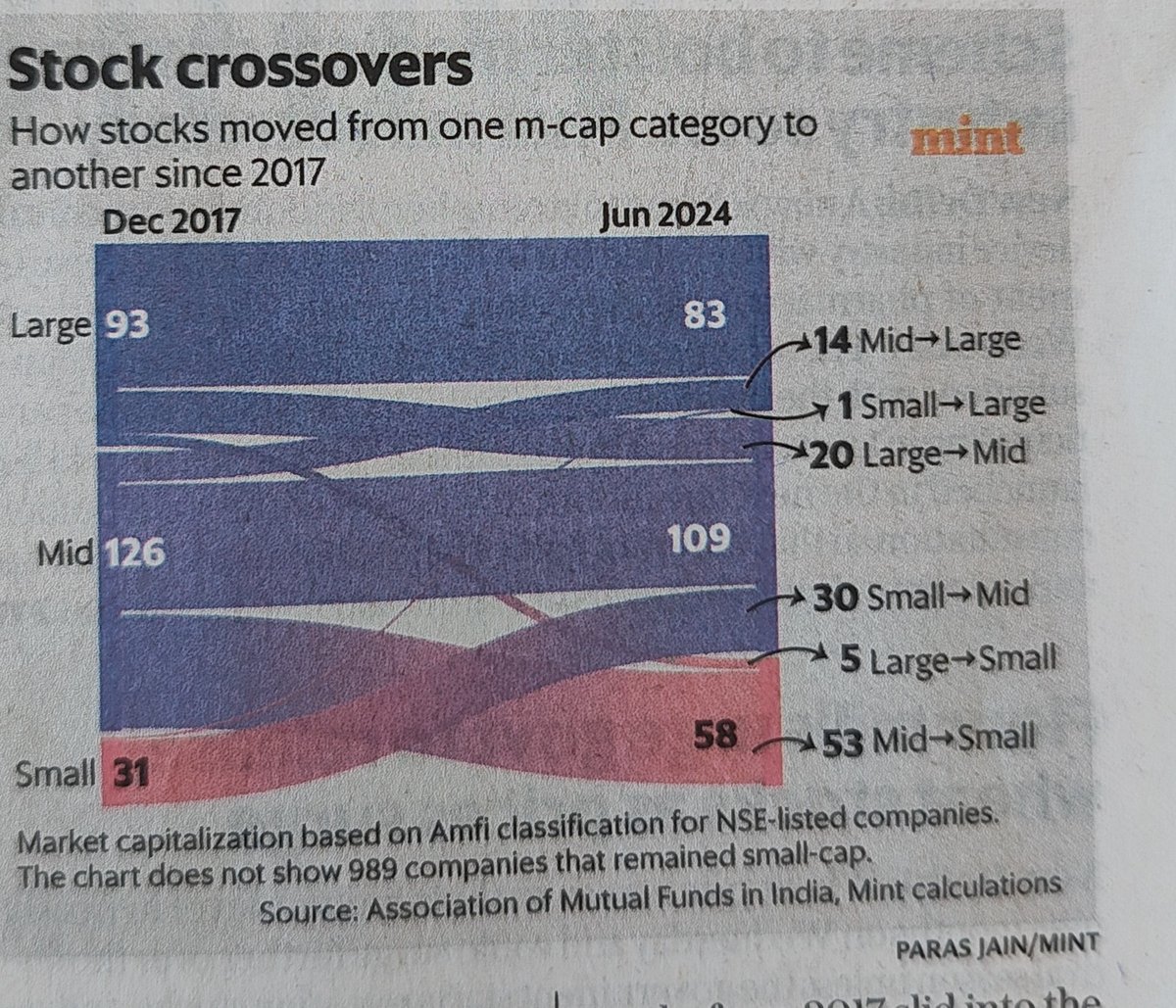
Even after a massive small and mid caps bull run, more companies have moved DOWN from large and midcap to small cap then the other way around!
While 45 companies went up a category (from mid/small to large or small to midcap), 78 went down a category or more. 5 large caps became small caps, 20 became mid caps and 53 mid caps became small caps.
Remember the data is from the period from 2017 to 2024 which had a boom, a bust and then a boom in this smallcap segment. So still not two complete cycles. We will see where the dust settles when the cycle get over.
To repeat a data point I have highlighted in the past, a MAJORITY of companies ever listed on the Indian stock exchanges DO NOT EVEN TRADE anymore.
Yup, a large number of companies have disappeared and many still do, especially in every small cap bubble burst, never to be seen (or traded) again
This is the data...rest are stories, which are admittedly very seductive 🤓
Graphics from @livemint
Glenn Greenwald says corporate journalists are losing their minds over @elonmusk calling out major corporations for stifling free speech because they are in bed with the very corporations they claim to scrutinize.
@ggreenwald explains that we are at a crossroads where journalism, once a watchdog of establishment power, is now shackled by corporate advertisers.
"What went wrong here is not what Elon Musk said. It's so revealing that so many journalists are aghast that anyone would dare tell Disney and major corporations to go f**k yourself when they're trying to limit, censor, and control the flow of political content.
If you aren't willing to say that to corporations who are trying to limit what you can say, don't bother calling yourself a journalist.
We need way more journalists willing to say, go f**k yourself to people who try and limit what they say.
The problem is, is that the people who are hired by these major media corporations, and who thrive in them and succeed in them are people who have the opposite instinct.
Their instinct is to assuage and serve and placate establishment power, not to defy it. Even though the purpose of journalism is to be adversarial to establishment power.
Once journalism started getting corporatized no longer owned by families dedicated to journalism or local communities but by major corporations that have all kinds of other interests besides their media division. And, what kind of attributes are awarded at major corporations?
People who avoid controversy who avoid conflict, who avoid displeasing and angering powerful people. That's the corporate ethos, and the corporatization of media meant that that kind of attribute was imported into journalism.
And that's why almost no one who works for large media corporations or the media corporations themselves has the courage to say this. They're shocked. They think it's a sign that he's unhinged when in reality, it's just a sign of how cowardly and craven they are."
@MTPHereToHelp
Thank you for opening up Delisle Bridge in Lower Parel. However, it's sad and honestly nonsensical to have done this without any supporting traffic management by cops or signals in such a dense area.
It takes 30 minutes to commute 1km.
@MTPHereToHelp urge you to escalate this pls. No improvement been made. Vehicles going in all directions and excessive pedestrian traffic on a vehicular bridge!
Request you to make these changes if they don't conflict with anything else:
- increase green light time for Ganpatrao Kadam Marg signal for traffic flowing towards Worli naka from bridge
- have traffic cops at the bridge T-junction
Thank you.
A young statistician saved their lives.
His insight (and how it can change yours):
During World War II, the U.S. wanted to add reinforcement armor to specific areas of its planes.
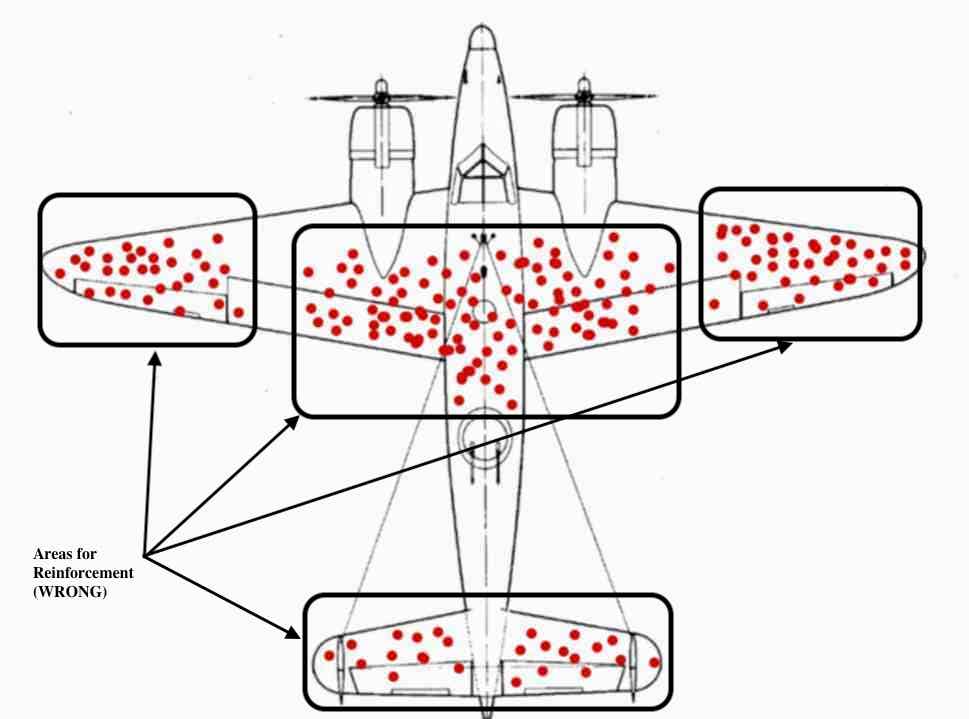
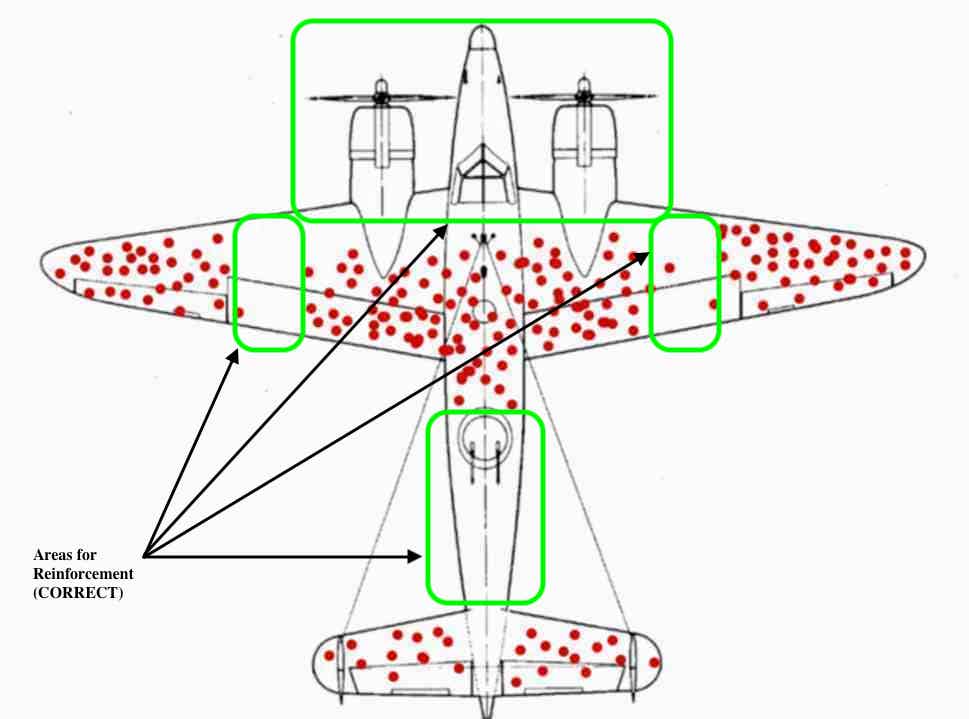
Analysts examined returning bombers and plotted the bullet holes and damage on them (as in the image below).
Based on this analysis, they came to the conclusion that adding armor to the tail, body, and wings would improve their odds of survival.
But a young statistician named Abraham Wald noted that this would be a tragic mistake.
By only plotting data on the planes that returned, they were systematically omitting the data on a critical, informative subset:
The planes that were damaged and unable to return.
Abraham Wald recognized a key fact:
• "Seen" planes had sustained damage that was survivable.
• "Unseen" planes had sustained damage that was not survivable.
Wald concluded that armor should be added to the *unharmed* regions of the returning planes (the areas without bullet holes on the image below).
His profound logic:
Where the survivors were unharmed was actually where the planes were most vulnerable.
Based on his insight, the military reinforced the engine and other vulnerable parts, significantly improving the safety of the crews during combat and saving thousands of lives.
Abraham Wald had identified a cognitive bias called "Survivorship Bias":
The error resulting from systematically focusing on survivors (successes) and ignoring casualties (failures) that causes us to miss the true base rates of survival (the actual probability of success) and arrive at flawed conclusions.
We see examples of Survivorship Bias all around us:
1. We read books on the common traits of successful people, but fail to consider all of the unsuccessful people who possessed those same traits.
2. We applaud the belief when we hear that an entrepreneur took out a second mortgage and succeeded, but fail to consider all of the entrepreneurs who did the same and went bankrupt.
3. We study the cultural strategies of the most successful companies, but fail to consider all of the companies that followed those same strategies and fell apart.
When we fail to consider the range of outcomes and the hidden evidence, we develop a skewed (and often incorrect) view of reality.
It cannot be avoided altogether, because the vast majority of books and history are written by and about the survivors and victors, but wherever possible, consider the unseen evidence.
Remember: What is unseen often has just as much value as what is seen.
***
If you enjoyed this or learned something, follow me @SahilBloom for more in future!
Years ago, a partner at Y Combinator told me the #1 predictor of whether a startup would fail the YC program is the number of months the founders knew each other before starting their company.
If the founders knew each other less than 18 months, they were far more likely to fail.
You spend just as much time with your cofounder as you do your spouse. You have to be able to fight without being hurt. You have to trust each other
Spend time with people you’d like to start a company with now.
The gov’t has about 48 hours to fix a-soon-to-be-irreversible mistake. By allowing @SVB_Financial to fail without protecting all depositors, the world has woken up to what an uninsured deposit is — an unsecured illiquid claim on a failed bank. Absent @jpmorgan@citi or @BankofAmerica acquiring SVB before the open on Monday, a prospect I believe to be unlikely, or the gov’t guaranteeing all of SVB’s deposits, the giant sucking sound you will hear will be the withdrawal of substantially all uninsured deposits from all but the ‘systemically important banks’ (SIBs). These funds will be transferred to the SIBs, US Treasury (UST) money market funds and short-term UST. There is already pressure to transfer cash to short-term UST and UST money market accounts due to the substantially higher yields available on risk-free UST vs. bank deposits. These withdrawals will drain liquidity from community, regional and other banks and begin the destruction of these important institutions. The increased demand for short-term UST will drive short rates lower complicating the @federalreserve’s efforts to raise rates to slow the economy. Already thousands of the fastest growing, most innovative venture-backed companies in the U.S. will begin to fail to make payroll next week. Had the gov’t stepped in on Friday to guarantee SVB’s deposits (in exchange for penny warrants which would have wiped out the substantial majority of its equity value) this could have been avoided and SVB’s 40-year franchise value could have been preserved and transferred to a new owner in exchange for an equity injection. We would have been open to participating. This approach would have minimized the risk of any gov’t losses, and created the potential for substantial profits from the rescue. Instead, I think it is now unlikely any buyer will emerge to acquire the failed bank. The gov’t’s approach has guaranteed that more risk will be concentrated in the SIBs at the expense of other banks, which itself creates more systemic risk. For those who make the case that depositors be damned as it would create moral hazard to save them, consider the feasibility of a world where each depositor must do their own credit assessment of the bank they choose to bank with. I am a pretty sophisticated financial analyst and I find most banks to be a black box despite the 1,000s of pages of @SECGov filings available on each bank. SVB’s senior management made a basic mistake. They invested short-term deposits in longer-term, fixed-rate assets. Thereafter short-term rates went up and a bank run ensued. Senior management screwed up and they should lose their jobs. The @FDICgov and OCC also screwed up. It is their job to monitor our banking system for risk and SVB should have been high on their watch list with more than $200B of assets and $170B of deposits from business borrowers in effectively the same industry. The FDIC’s and OCC��s failure to do their jobs should not be allowed to cause the destruction of 1,000s of our nation’s highest potential and highest growth businesses (and the resulting losses of 10s of 1,000s of jobs for some of our most talented younger generation) while also permanently impairing our community and regional banks’ access to low-cost deposits. This administration is particularly opposed to concentrations of power. Ironically, its approach to SVB’s failure guarantees duopolistic banking risk concentration in a handful of SIBs. My back-of-the envelope review of SVB’s balance sheet suggests that even in a liquidation, depositors should eventually get back about 98% of their deposits, but eventually is too long when you have payroll to meet next week. So even without assigning any franchise value to SVB, the cost of a gov’t guarantee of SVB deposits would be minimal. On the other hand, the unintended consequences of the gov’t’s failure to guarantee SVB deposits are vast and profound and need to be considered and addressed before Monday. Otherwise, watch out below.
The first piece of advice I give every early stage Founder I meet is to ban remote work in their org and call everyone back to Office (except for genuine cases).
In almost every case I get a message a few weeks later saying that this advice was game changing for their org.
It's remarkable how many people who've never run any kind of company think they know how to run a tech company better than someone who's run Tesla and SpaceX.
I recently came across data on who we spend our time with over the course of our lives.
The insights are simultaneously inspiring and depressing.
Here are 6 graphs everyone needs to see:
FB creates worlds greatest ad targeting
FB buys Oculus as next platform after smartphones
Apple launch’s modest ad product
Apple plans AR/VR platform
Apple destroys @facebook tracking on privacy grounds tanks FB revenue/stock
Apple launches personalized advertising 🤌