Ask anyone to name a doctor from ancient India, and you will mostly get Suśruta / Caraka, men who treated people.
Almost nobody will say the name of the man widely regarded as the 1st veterinarian in recorded human history. Not the 1st Indian veterinarian. The 1st one, anywhere, that we have a name and a body of written work for.
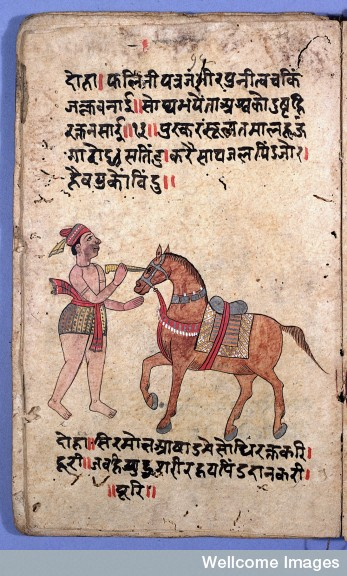
Somewhere around the 3rd century BCE (though some traditional / secondary sources push it much earlier, e.g., ~2350 BCE), in a town called Śrāvastī, what is now Uttar Pradesh, a physician named Śālihotra wrote something the world had not seen before: a purpose-built, systematic medical text, not for people, but exclusively for horses.
It is called the Śālihotra Saṃhitā, and it is not a slim pamphlet. It runs to ~12,000 verses, organized into 8 sections covering equine anatomy, surgery, disease diagnosis, and treatment.
Some of what is in it is genuinely startling for its age.
Śālihotra describes how to judge a horse's age by examining the specific wear pattern and structure of its teeth, a technique still used by working vets and horse-traders today, arrived at independently, with no microscope, no comparative anatomy department, just careful, repeated observation across presumably 100s of animals.
He covers surgical procedures, prognosis by symptom, and in a detail that feels startlingly modern guidance on which physical traits in a horse are auspicious Vs concerning before a buyer commits to a purchase.
It reads, in places, like a cross between a surgical manual and a buyer's inspection checklist....
The text did not stay local. It was translated into Persian, Arabic, and Tibetan, carried along trade and scholarly routes the same way Indian mathematics and medicine moved west.
And it left something behind that almost nobody realizes is still sitting in plain sight: in Marathi and Urdu, to this day, the word for a horse-doctor or veterinary surgeon is "salotri", a direct linguistic descendant of Śālihotra's own name.
Somewhere, right now, someone in Indian sub-continent might refer to calling "the salotri" for a sick horse, using a word that has been quietly carrying one physician's name for over few 1000 years, with almost no one aware of where it came from.
A 15-year-old dream has come true today. I started a PhD with the dream of creating a system that chants any Sanskrit shloka perfectly.
And here I am opening sourcing 𝐕𝐚𝐠𝐝𝐡𝐞𝐧𝐮 - 𝐀 𝐯ṛ𝐭𝐭𝐚 (𝐦𝐞𝐭𝐞𝐫) 𝐚𝐰𝐚𝐫𝐞 ś𝐥𝐨𝐤𝐚-𝐭𝐨-𝐜𝐡𝐚𝐧𝐭 𝐭𝐞𝐱𝐭-𝐭𝐨-𝐬𝐩𝐞𝐞𝐜𝐡 (TTS) 𝐬𝐲𝐬𝐭𝐞𝐦 𝐟𝐨𝐫 𝐒𝐚𝐧𝐬𝐤𝐫𝐢𝐭. This is the world's first vrutta-aware, open-source TTS for Sanskrit Chanting.
The Three-Body Problem refers to the challenge of predicting the motion of three celestial bodies interacting gravitationally, based on Newton's laws of motion and universal gravitation. Unlike the simpler two-body problem, the three-body problem does not have a general analytical solution, due to its complex, chaotic nature.
Initial attempts to solve it historically, highlighted by Isaac Newton, led to the discovery of special cases like the Lagrange and Euler points, and solutions such as the figure-eight orbit. Today, the problem is primarily addressed through numerical simulation, which aids in practical applications such as spacecraft navigation and studying planetary dynamics. The problem exemplifies how small variations in initial conditions can lead to vastly different outcomes, a characteristic of chaotic systems.
@atahasnain53 "The aim is to shape behaviour rather than administer territory." This where the transition is from outet physical world to inner consciousness. First makes you unconscious with physical action, then shakes your conscience, building web, and finally transforms your consciousness.
For centuries, victory in war meant occupation of territory. Contemporary conflict is increasingly challenging that assumption.
Technology, precision strike, drones and long-range coercion are changing the relationship between military power and territorial control.
Some thoughts in my latest article for The Sunday Guardian.
Read here https://t.co/SUP4Jckhqs