David Reich is back.
He and collaborator Ali Akbari just published a paper that overturns a long-standing consensus about human evolution — that natural selection has been dormant in our species since the agricultural revolution.
By scaling ancient DNA sequencing and developing a new statistical method, they found that selection has actually sped up.
Selection went especially bonkers during the Bronze Age (around 3,000 years ago).
That's when gene frequencies for everything from immune function to body fat to intelligence were most in flux.
Over the last 10,000 years, selection pushed the genetic predictor of cognitive performance up by roughly a full standard deviation — most of it between 4,000 and 2,000 years ago.
After we finished recording, David sketched out on a whiteboard his new heretical model about who the Neanderthals really were. Luckily, I took out my iPhone and managed to record it.
He thinks the standard story (that Neanderthals are some separate archaic lineage we interbred with a little) just doesn't fit the evidence. Instead, he proposes that Neanderthals are essentially genetically-swamped modern humans.
A small population somewhere around the Caucasus invented Middle Stone Age technology roughly 300,000 years ago and expanded outward. The ones that moved into Europe interbred with local archaic humans, got genetically swamped, and became Neanderthals. The same expansion went into Africa, met much more diverged archaic Africans, and that mixture became us.
This means Neanderthals and modern humans share the same cultural ancestry — the only difference is which archaic humans they mixed with afterward.
David is a brilliant and rigorous scholar. It was a real delight to learn from him again.
0:00:00 – Ancient DNA suggests strong selection over last 10,000 years
0:16:24 – Natural selection intensified during the Bronze Age
0:35:40 – Why didn't evolution max out intelligence?
0:58:00 – Evolution is limited by time, not population size
1:09:40 – Why no farming before the Ice Age?
1:17:52 – The Neanderthal puzzle David can’t stop thinking about
1:54:40 – The methodology behind this breakthrough
When Apple moved from Intel processors to its own ARM processors, we did not know how they would handle all the existing Intel software. Then Apple shocked me with its software solution (Rosetta) that could transparently translate x64 binaries to ARM binaries. You just picked your old program, compiled years ago for an old CPU, and it just ran at high speed on a totally different CPU.
It seemed to have inspired Intel.
One problem when deploying software binaries is that you do not know anything about the processors your clients are using. They could be old CPUs taken from a trash can or the very latest Intel CPU.
Thus, when you compile your code, you often target a generic CPU. The net result is that you are not using the fancy features of the newest CPUs. This is especially true under Windows where people have a wide range of systems.
That’s frustrating if you are Intel or AMD: you have these new CPUs with features that most software will not use.
This is an advantage for systems like game consoles: if you know from the get-go which processor to target, you can optimize better.
There are ways around this issue for developers: you can check at runtime for the processor type and then select optimal code. Compilers provide some of this functionality by default. For example, they may have different memory copy functions and switch at runtime depending on the detected system. But compilers can only do so much, and developers do not have a strong incentive to optimize their software for specific CPUs. Doing such runtime dispatching is a lot of work and it complicates testing, thus increasing costs.
To make matters worse, nobody will tune their software for processors that are not yet available. Thus, old software may not benefit from more advanced features on newer CPUs. Sure, the developer could recompile the code, but it takes time and money.
A secondary but important issue is that compilers are often not great at optimizing even when you tell them which processor to target specifically. It is a matter of incentives: why should Microsoft put a lot of effort into making a family of Intel processors shine?
So Intel created something called iBOT (Intel Binary Optimization Tool). It optimizes x64 binaries on the fly. For now, it only works on a few popular games and only for some specific processors.
@tomshardware has a great article on the topic where they report an 8% performance boost on average, which is quite impressive given that it comes for free if you are the user.
Of course, Intel picked the few games where their techniques worked. How this scales is unclear. Intel keeps making new processors and there is a lot of software around. It would have been more impressive had Intel boosted the performance of software generally. Still: the idea is intriguing.
My wife calls me, panicked.
The call is from her number, and her voice is unmistakable- that’s my wife.
‘Babe, our son is hurt. He got in a bike wreck. I’m at the emergency room but they won’t take our insurance and I need cash to get him help. Please send me 3000 dollars as soon as you can, he’s really not doing well.’
Me- ‘Wow, that’s scary. Tell me our passphrase and then I’ll send the money.’
Her (it) - ‘What? What passphrase? This is your wife, our son is hurt. Send the money now!!’
Me- ‘I’ll call you back. I don’t believe that this is my wife. If it is, I’m sorry, but we discussed this.’
The number? Spoofed. Easy to do and there’s no way to tell if a phone number is being spoofed aside from hanging up and calling back to confirm.
The voice? AI generated. Easily done. A few seconds of audio is all it takes to create a realistic audio deepfake.
What can you do?
1) Create a family safe word or passphrase. Ours is definitely not ‘Keep Going’ although we considered it. Discuss the passphrase far away from phones or any recording device. This is as analog as possible. Don’t forget that the trigger for the passphrase is just as important as the phrase itself. So instead of asking ‘what’s the safe word?’ have a separate triggering question. For example, you could say ‘I’m eating banana cream pie’ and this would trigger your spouse to respond ‘purple velvet pillows’ if that’s the safe word.
Make it fun, silly, and easy to remember. And DON’T WRITE IT DOWN.
2) Cognitive security is an essential skill in 2026. Assume every image and video you see online is fake until proven otherwise. Expect scams and spammers, and be pleasantly surprised when it’s not.
3) Figure out a backup communication option with people who you absolutely need to be able to reach. Don’t just rely on a phone number for communication. Have redundant, ideally encrypted methods of communication with family.
What did I miss? I think (hope) Nikita is wrong on the timeframe- agentic bots like Claude bot are impressive but not quite ready to flood the phone lines in just 90 days. But I think it’s going to be a huge problem by the end of the year. I already get dozens of increasingly realistic spam calls and texts daily- it’s only going to get more annoying. Have a plan to keep your family and your finances safe!
For decades, doctors believed the most common kidney stones (calcium oxalate) were lifeless lumps formed purely by chemistry—minerals building up in the kidney.
A groundbreaking study published this month (Jan 2026) by UCLA Health has proven this wrong.
Using high-tech fluorescence microscopy, researchers discovered that these stones actually contain live bacteria and fungal-like biofilms "entombed" inside them. The bacteria act as a scaffolding (nidus), allowing the minerals to crystalize and grow layer by layer.
This solves a long-standing medical mystery: Why do patients sometimes get severe infections (sepsis) after stone-breaking treatments (lithotripsy), even when their urine was sterile? The answer: breaking the stone releases the bacteria trapped inside.
This could revolutionize treatment, shifting focus from just diet changes to targeting the hidden microbiome within the kidney.
Journal Reference: Wong, Gerard C. L. et al, Intercalated bacterial biofilms are intrinsic internal components of calcium-based kidney stones, Proceedings of the National Academy of Sciences (2026). DOI: 10.1073/pnas.2517066123.
#MedicalBreakthrough #Microbiology #KidneyHealth #UCLAHealth #NewDiscovery
My wife's book club is meeting at our house tomorrow night.
She asked me to "make sure the wifi is working really well because Sarah always complains."
Our wifi works fine, I know that because it works fine for me and my wife and everybody else.
Sarah uses an iPhone XR from like 2019 and she refuses to update it.
But I can't tell my wife that because then I'm "making excuses" and "not being supportive."
So I said I'd "optimize the network" for tomorrow. What I'm actually going to do: nothing. The wifi is fine.
But tomorrow morning I'll restart the router, which takes 90 seconds and does basically nothing.
Then when Sarah inevitably complains about connectivity, I can say "I optimized the system this morning.
It might be a device compatibility issue on your end."
My wife will think I tried. Sarah will blame her phone instead of our wifi. I'll have done essentially nothing but everyone will be satisfied.
Technical support at home is just like technical support at work lol.
NAT-based Load Balancers (LB) like HAProxy or Nginx are usually the default choice. But there is a problem with them: all replies go back through the LB, too. And while requests are often short, replies can be x10-100 times heavier.
That means more bandwidth on the LB, and the biggest traffic flowing through the one component you'd least like to bottleneck.
Direct Server Return (DSR) fixes that: requests go through the LB, responses don't.
Building an eBPF-based DSR load balancer is a great way to actually understand both eBPF and how DSR really works at L2. Check out Teodor Podobnik's most recent hands-on tutorial, where he step-by-step walks you through the process https://t.co/EGI03Qpn08
I noticed this already in 2010. My two best graduate students at Harvard, both white males, could not get jobs in the U.S. One left for Germany bad idea), the other is now in Hong Kong and is one of the leading historians of his generation. In 2020 I had a brilliant undergraduate in a tutorial who was literally the best student in his graduating class at Harvard (he won the prize 'for the student with the best academic record') who could not get into the graduate program of his choice. He left for Singapore. I find this whole episode an obscene offense against the principle of merit.
Quentin Tarantino starts to reveal his 20 best movies of the 21st century:
11. "Battle Royale"
12. "Big Bad Wolves"
13. "Jackass: The Movie"
14. "School of Rock"
15. "The Passion of the Christ"
16. "The Devil’s Rejects"
17. "Chocolate"
18. "Moneyball"
19. "Cabin Fever"
20. "West Side Story"
https://t.co/ydYvtXicGA
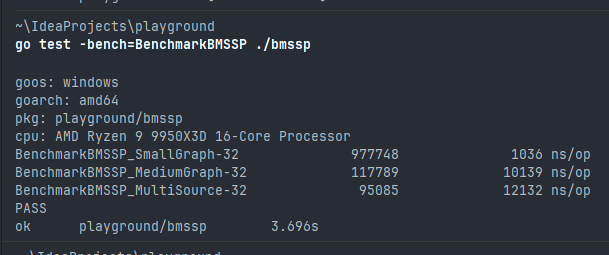
A new paper from Tsinghua University just achieved the first major speedup for the shortest-path problem in over 40 years, effectively creating a "Dijkstra 2.0." After reading it, I felt a weird sensation to implement their Bounded Multi-Source Shortest Path (BMSSP) algorithm in Go to understand the depth of this breakthrough, and because apparently i am bored as fuck on Sundays and it was a shit day.
For decades, Dijkstra's algorithm has been the standard, limited by a "sorting barrier." The boring math version is that it's stuck at a time complexity of around O(m+nlogn), where that logn part from sorting the nodes becomes a massive bottleneck on huge graphs. This new approach gets it down to O(mlog2/3n).
It's a nice because it means the algorithm's performance scales much better as the graph gets bigger. It does this not with brute force, but with an incredibly elegant, recursive "divide and conquer" strategy.
Translating the paper to code was a challenge. The core of my implementation is the BMSSP function, which orchestrates the entire process. It's not simple recursion; it's a shit-dance of managing boundaries and sub-problems. The function recursively calls itself with a decreasing level l, a new boundary B, and a new set of source nodes S. The state management here is critical—get it wrong, and the whole thing goes up shit creek (and no one wants to go to shit creek).
The true galaxy brain pro gamer moment lies in how it prunes the search space. After a recursive call returns a set of settled vertices (Ui), the implementation has to carefully "relax" their edges. The logic for updating neighbour distances is nuanced: depending on whether a new path falls within the parent boundary (B) or the child's boundary (Bi), the node is either re-inserted into the main priority queue (D) or staged in a temporary list (K) for a batch update.
This partitioning, seen in the if/else if block within the main loop, is the heart of the performance gain and was like sucking snot through a nostril to implement correctly.
The custom data structure, DataStructureD, is also far more than a simple queue. It acts as the master controller (choke me), managing the different search frontiers. It doesn't just pop the next-closest node; it pulls entire sub-problems for the recursive function to solve.
This isn't just a minor optimization. It's a fundamental shift in how we can approach graph problems. Implementing it gave me an appreciation for the complexity involved, I rarely dive this close into comp sci this much, mostly because: A: I hate maths B: It's boring as shit.
But something about this was pretty cool. I do not know much apart from this post and image and some quick looking around.
It is entirely possible It is not 100% here my implementation, but i **THINK** it is based off my testing
This is a brilliant chart of China's tech-industrial ecosystems, by Kyle Chan.
Most of us economists don't understand that clusters of technological capabilities cut across our categories of 'sectors' and 'industries'.
This chart gets that across in a fantastic way.
I would say this thesis is rapidly becoming conventional wisdom among many Chinese technologists and even some US technologists.
It would be interesting to hear a serious debate between an advocate for this view and a typical neoliberal economist who defends financialization of the US economy.