Cheddar Man's Y-DNA belonged to an ancient sister branch of modern Haplogroup I2-L38 (I2a2).
NoThe I2a2 subclade is still extant in males of the modern British Isles and across other parts of Europe. The mitochondrial DNA of Cheddar Man was discovered to be haplogroup U5b1 by a Natural History Museum study in 2018 using next generation sequencing.
Some 65% of western European Mesolithic hunter-gatherers had haplogroup U5; today it is widely distributed, at lower frequencies, across western Eurasia and northern Africa. In 1996, Bryan Sykes of the University of Oxford first sequenced the mitochondrial DNA from one of Cheddar Man's molars as U5a using PCR testing. The difference between the older result and the 2018 Natural History Museum result was attributed to the use of older PCR technology and possible contamination.
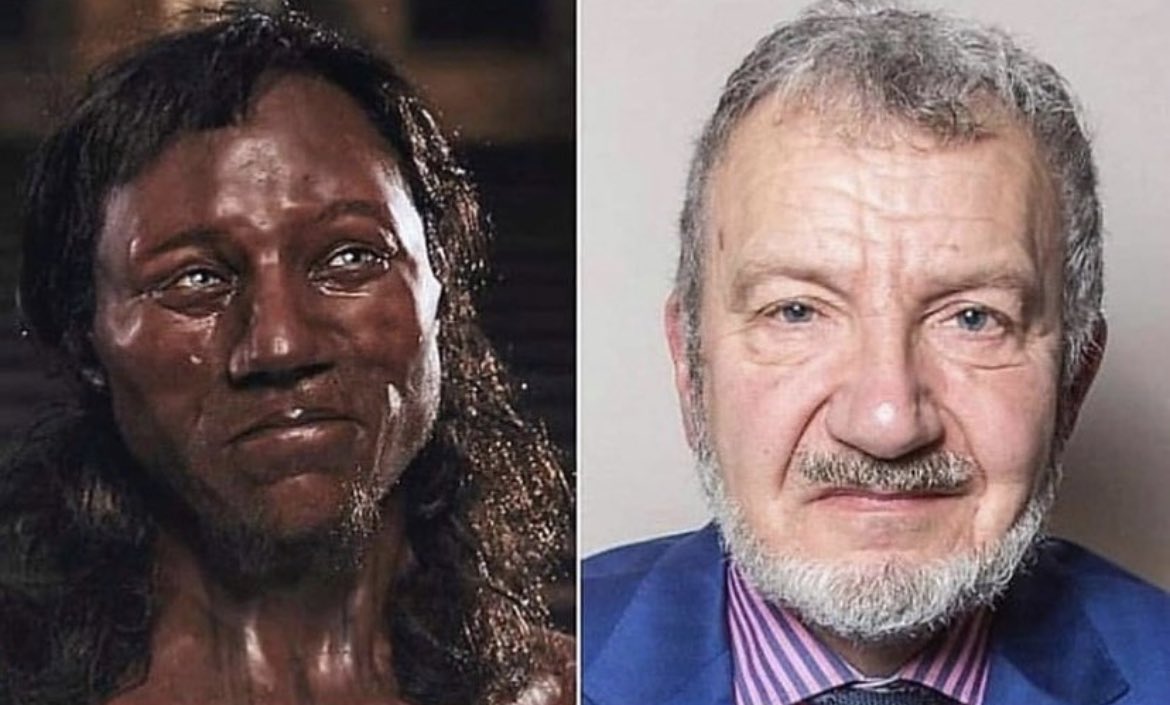
A 9,000-year-old skeleton was discovered inside a cave in Cheddar, England, and was affectionately dubbed "Cheddar Man." DNA testing confirmed that a living relative lived approximately half a mile away, tracing their lineage back nearly 300 generations.
In 1903, while conducting excavations in Cheddar Gorge, Somerset, UK, researchers stumbled upon a remarkable find: the skeletal remains of a Homo sapien who had lived around 9,000 years ago. This individual ranks among the oldest modern humans ever found in Britain. The discovery occurred serendipitously during a drainage renovation within the tourist attraction of Gough's Cave.
Cheddar Man thrived during the Mesolithic period roughly 9,000 years ago. Most likely, he was a hunter-gatherer who passed away in his twenties and stood at a height of approximately 5 feet, 5 inches.
The use of cutting-edge technology has enabled researchers to reconstruct Cheddar Man's facial features, determine his skin and eye coloring, and even discern the texture of his hair. Genetic material extracted from one of Cheddar Man's molar teeth allowed scientists to identify Adrian Targett, a retired history teacher, as a relative.
Upon analysis, it was revealed that Targett's family lineage had endured in the Cheddar Gorge region for approximately nine millennia, with genes passed from mother to daughter through mitochondrial DNA, inherited from the egg.
In simple terms, Adrian Targett and Cheddar Man share a common maternal ancestor.
Spider-like lightning bolts appeared to come out of a volcano when lightning struck near Acatenango Volcano in Guatemala, creating a spectacular optical illusion.
During World War I, a French mime named Marcel Marceau used his acting background to rescue Jewish children and get them to safety. He would smuggle them across the Swiss border, miming to keep them happy while instructing them to stay quiet. He saved at least 70 kids.
Marceau would disguise himself as a Boy Scout leader and lead groups of children on long walks through the countryside to reach the Swiss border. During the journey, he would use his mime skills to keep the children entertained and quiet, so as not to attract attention from German soldiers or collaborators.
Marceau's efforts are estimated to have saved the lives of at least 70 Jewish children. After the war, he continued to perform as a mime artist and became one of the most famous performers in the world. He passed away in 2007 at the age of 84.