@thdxr please add more layered capabilities for enabling agentic type of approach (you already had model pooling which did not work reliably), it is shame)) to have a sort of 'platform' with all possible ai providers and models and not use orchestration between those models))
Without noting that DOGE faced sabotage and resistance from various institutions and lacked the power or leverage to carry out its tasks, yet it attempted to do something that had never been done with U.S. government bodies — namely, to analyze what they were actually doing and where the money was going.
@siantgirl China, I think, repeats it past successful model - help everyone, competition will decide who wins, like with WeChat. I think the same is going with car industry.
The hype around single-purpose AI agents is a trap.
Leading foundation models are already absorbing these narrow tools, turning them into built-in features. What the industry currently calls "agents" are mostly just isolated functions lacking true systemic thinking.
The only defensible moat left for builders is at the system level. The future belongs to orchestrators -systems that don't just execute one task, but manage complex macro-workflows, maintain long-term context, and route logic.
The key here is decoupling. Your system shouldn't be tied to a single foundation model's ecosystem; it must treat models and their built-in sub-agents as pluggable, interchangeable tools. Models will inevitably commoditize narrow agents. The survivors will be the ones building the overarching system, not the disposable tools.
I do not think that this is that simple. The point raised is that data sent by US companies to Chinese models is not governed by US law for unfair use, while data sent to US AI companies is still governed by US laws, limiting ai companies in use of that data. GLM-5.2 is truly a marvel, by all means.
Chinese models are very good (particularly GLM-5.2), no doubt, but I think those CEOs implying certain logic in their decision not to use Chinese models - data sent to US companies, still protected by US law and those US companies could be prosecuted for unlawful use of the data. With Chinese companies data is not protected by US law, data use boundaries are not defined, I believe, and probably no lawful protection for them.
When people evaluate AI models, three important things are usually overlooked.
First: model specialization. Most users don’t really understand the nuances - which model is actually better at what kind of work. The differences exist, but high-level comparisons rarely make them clear.
Second: matching effort to task difficulty. People often turn on heavy reasoning or chain-of-thought mode by default, even for simple tasks. They don’t calibrate how much “intelligence” the model actually needs to apply to the specific problem in front of them.
Third: synthetic benchmarks versus real work. Almost all public ratings and leaderboards are based on curated test sets. They rarely show how well a model will handle the actual, messy, practical tasks that a specific user deals with in their real workflow.
The gap between lab scores and everyday usefulness is often larger than the gap between the models themselves.
Have you noticed this in your own experience?
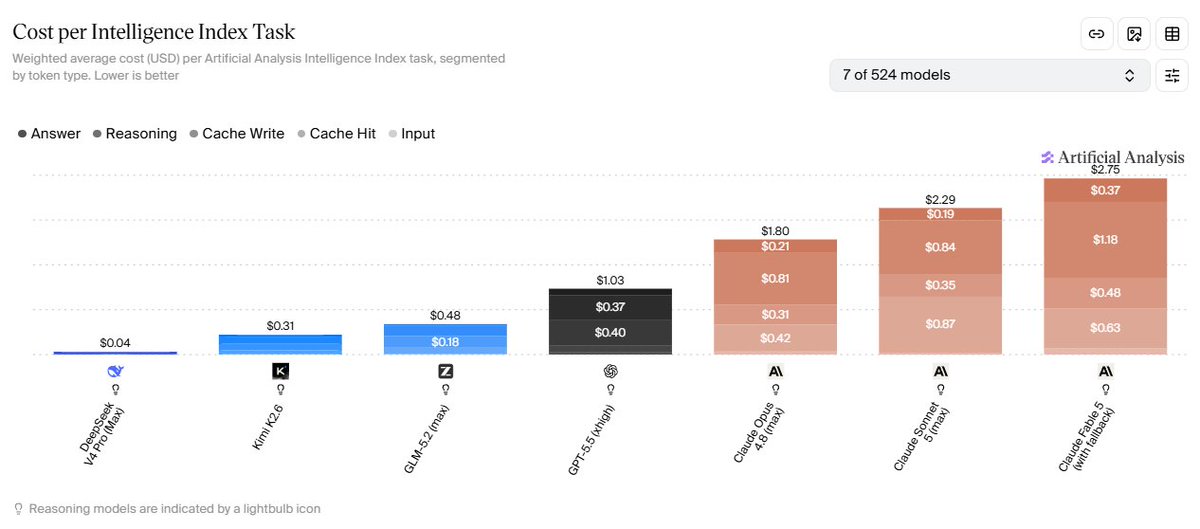
Sonnet 5 goes straight into the garbage bin
> 1.2x more expensive than Opus 4.8 Max
> 2x more expensive than GPT-5.5-xhigh
> 5x more expensive than GLM-5.2
> 7x more expensive than Kimi-K2.6
> 57x more expensive than DeepSeek-V4-Pro
I think you largely underestimating US intellectual sheer power in this scenario. 1) Energy is the only pitfall in US-China competition for AI race. Space DCs might solve that shortage. 2) China is massively undersupplied in compute capacity today. Huawei chips yet have to prove their capacity compared to Nvidia ones. 3) IMHO, US companies still excel at the point where engineering is done - architectural view, system design, creative ideas etc. 4) Banning is targeted only towards distilling Chinese models on top of the frontier ones, I think this is the major concern.
I have a great sympathy towards Chinese models (GLM is in a particular) because they are creating real completion and help to avoid monopoly in technology.
Я (личное мнение) не особо верю в идею создания бизнеса разработчиками (если только не инструменты для других разработчиков типа nginx, openclaw и т.п.). Кардинально другой тип мышления, он не про бизнес (решения проблемы/удовлетворения спроса), он про техническую реализацию. Не исключаю, что может получится, бывает попадание в десятку, но посмотрите кто двигал IT бизнес в прошлом и сейчас и сколько среди них разработчиков.
I think it is not about killing those companies, it is about the fight for the future of technology which will dominate industries and markets. China will win in the race of the cheaper compute because of the massive electricity capacity, but it is not where Antropic and OpenAI win at the moment - it is ideas and brains behind the architecture of the models. I admire Chinese engineers (look how many of Chinese working in those companies), but it is just a different mindset that the one that western engineers have.
"There is no spoon."
New model drops → same script: “This beats everything. The one we’ve been waiting for.”
Gemini 3.1 was heavily promoted but limited for coding in practice. Now GLM-5.2 gets the same treatment.
I value GLM models highly (used them since early versions, rate them top-tier). After years of progress, the belief in one ultimate model still surprises me.
No model is best at everything.
Codex excels at code analysis and programming. Opus understands intent and builds high-level plans. Grok delivers sharp critique and unconventional thinking. Gemini is strong in humanities. GLM-5.2 ranks among the best for coding today. DeepSeek V4 handles broad technical tasks well.
Each has distinct strengths. None replaces the others.
The illusion of “the best model” works exactly like the spoon in The Matrix. It is not the spoon that bends — it is only yourself. Your mind bends, taking the shape of one universal winner.
There is no single model that solves every task. Trying to find it is like using one tool for every job in the workshop. Stop chasing the ultimate model. Match the tool to the task.
Как посмотреть. Протокол предполагает наличие fingerprints, после выявления которых можно их заблокировать. Так произошло с исходным Wireguard. Амнезия пошла по пути обфускации существующего протокола, и весьма успешно. То что сделал автор - он создал еще один "протокол", у которого есть fingerprint возможный для детекции. Фокус в том, что у "блокировщика" нет этого fingerprint - соответственно нет блокировки)). Если автор разовьет идею до уровня конструктора протокола и каждый сможет нагенерить себе устойчивый протокол - оборудование сойдет с ума)). Основной вопрос (кмк) - какие клиентские приложения могут поднять работу такого решения, с сервером я думаю проблем не будет.
протокол существующий в единственном экземпляре наврядли будет кто то блочить - нет сигнатур, другое дело когда про этот проект узнают другие, начнут рассказывать друг другу "нашел впн который не блочат" - тут же образуется плотный граф паттерн, который простым regex ловится и определяется, заливается на сервера - и все. Сложнее поймать паттерн когда применяется обфускация заголовков и тому подобные трюки.
interesting. GLM (particularly 5.2) can run very long autonomous tasks. If we use Codex as a benchmark for code review - GLM delivers close to 100% of the tasks (even Codex can't do 100% 😄). May be reasoning is where GLM looses - but it is very little time from 5.2 launch to judge that.