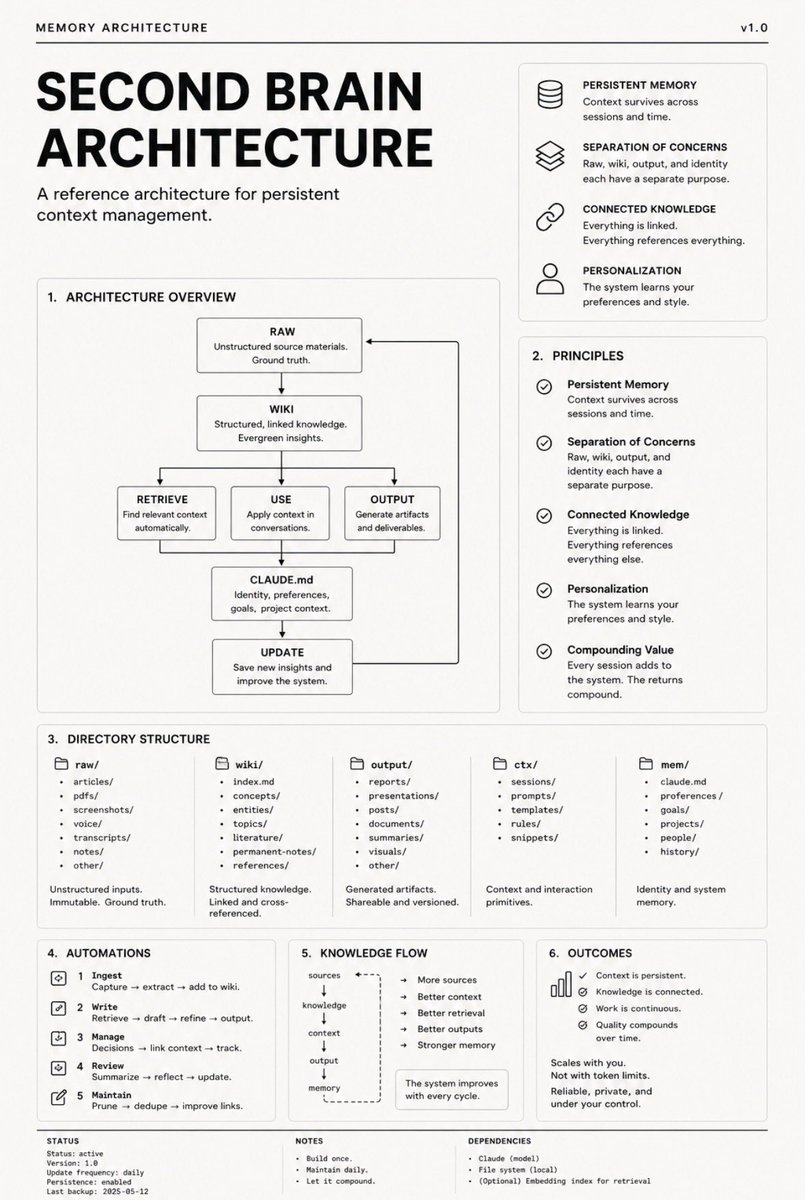
Andrej Karpathy called it a compiler, not a storage system. this diagram shows the architecture he described.
most people who build a second brain treat it like a filing cabinet. they drop notes in. they search when needed. the library gets bigger over time but never smarter.
a compiled wiki works differently. raw holds the source materials. unstructured. immutable. ground truth. wiki is where the model converts everything in raw into structured, linked, evergreen knowledge. the human reads it. the model writes it. output is where finished work lands. built from compiled knowledge, not from memory.
at the center: CLAUDE.md. identity, preferences, goals, project context. the model reads it before every session. automatically. you never explain yourself again.
the loop closes through update. every new source gets ingested, compiled, linked, and integrated. the system improves with every cycle.
five automations run the whole thing. ingest captures and extracts. write retrieves and drafts. manage links decisions to context. review summarizes and reflects. maintain prunes and improves.
the system improves with every cycle. automatically. retrieval answers questions. compilation builds understanding.
the article above. build the compiler. not the cabinet.
6 months ago: laptop open all day, typing into Claude Code, waiting.
Today: I write a spec, go to the gym, and my phone only pings when an agent needs a decision. 95% of my work runs itself.
Full breakdown so you can build your own 👇
KARPATHY JUST KILLED THE PROMPT ERA WITH A SINGLE DOCUMENT
prompts are easy. loops are hard. and writing fifty prompts a day is the work nobody does twice.
he shifts the burden to the harness.
you define the contract once. the model writes, reviews, restarts, and reconciles. you keep judgment. it keeps the loop.
the throughline is the same in every rule: the human owns the spec and the boundary. the model owns the execution and the bookkeeping.
planner never touches code. generator never grades itself. state lives on disk, not in context.
9 rules. start with one feature, not ten. most people are still typing prompts. this turns Claude into an agent that finishes the job on its own.
here is the official document from Karpathy explaining the architecture
Karpathy method + Claude Code reading your whole Obsidian vault is the smartest second brain on earth.
The method is simple and brutal. If you can’t build a thing from scratch, you don’t know it. Tutorials are fake learning and your brain deletes them in 3 days.
Most people ignore this. They build a second brain that just sits there, folders of notes nobody reopens, dead text.
Point Claude Code at the vault and it wakes up. 5,000 notes, one mind. It reads all of it and answers in your own words and your own proofs, not a model’s guess.
Then the loop closes.
Want to understand neural nets? Skip the 3-hour video and ask Claude Code to build a tiny one. 200 lines from scratch. Watch it train, break a layer, watch it fail, fix it.
It clicks in 20 minutes instead of 3 weeks.
The second it lands the note gets written. One idea per file, linked to 10 others, dropped into the vault while the memory is still hot.
Now it compounds.
Month 1: is 60 notes. Month 6 is 900. Every new note pulls in old ones, so you ask anything and the answer comes from your brain, not the internet.
Before: 40 tabs, 6 half read PDF, 0 retained.
After: build it once, own it for life.
Setup takes 4 minutes. Plain text, no lock-in.
A second brain nobody reads is a graveyard.
Yours just started thinking.
KARPATHY WROTE THIS DOCUMENT TO COMPLETELY AUTOMATE OBSIDIAN WITH CLAUDE
I was ready to abandon my second brain
manual cross-referencing was destroying my workflow, but finding this exact document opened my eyes to a completely different approach
it is incredibly convenient -> Karpathy's method turns the AI into a full-time maintainer for your Zettelkasten:
> the LLM reads every new source and integrates it into a structured wiki
> Obsidian becomes your visual IDE while Claude operates as the backend
> the agent runs automated checks to find contradictions across your notes
> your entire vault compounds automatically without you typing a single link
the friction is completely gone. I just feed it raw documents and the agent organizes my entire life
here is the official document from Karpathy explaining the architecture 👇
Karpathy just wrote the manual for Claude + Obsidian as a real second brain.
Most vaults die the same way. A year of saved articles and highlights. None of it linked. The graph rots while it still looks impressive.
So he moved the upkeep to the model. You curate sources and ask questions. Claude files, links, and reconciles. You keep judgment. It keeps the books.
raw belongs to you and never gets edited. wiki belongs to Claude. It isn't RAG. Your sources compile once into linked pages and compound from there.
9 rules. Start with 10 sources, not 10,000.
Most people hoard notes. This turns them into a brain that maintains itself.
Is it mere coincidence or the intuition of Apple's designer?
This composition aligns remarkably well with the classic musical scale of octaves at a 2:1 ratio.
Steal this concept for your next design 😈
✨ This week in AI ✨
Ground-zero for a bunch of massive AI releases.
This is all you need to read to get up to speed on AI
⇢ Stanford Alpaca 7B
⇢ Google Workspace AI
⇢ GPT4
⇢ Anthropic Claude
⇢ Midjourney V5
⇢ Microsoft Co-Pilot in 365
🧵 A thread, let's unpack
Random shoutout to @MaximeHeckel and his really good tutorials about web dev (especially Three.js and R3F)
👉 https://t.co/sKEE8fR00F
New post in the pipes?