On 249th birth anniversary of Carl Friedrich Gauss.
In 1786, a teacher gave his class a problem to keep the students occupied, as they were being particularly noisy.
The task seemed simple:
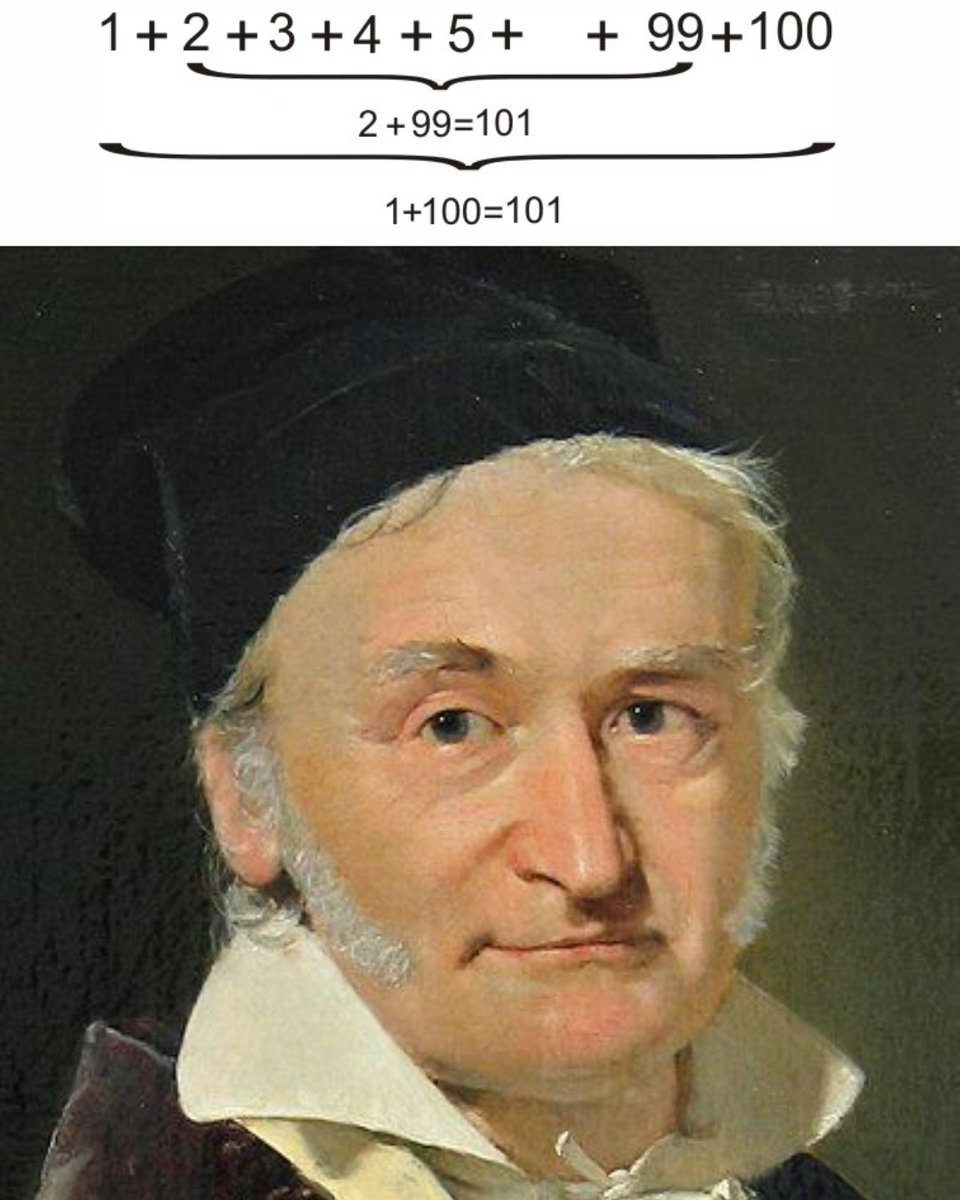
add all the numbers from 1 to 100—that is,
1 + 2 + 3 + … + 100.
It was the kind of problem expected to keep the class busy for quite some time.
However, one student solved it almost instantly. The teacher was astonished—how could anyone arrive at the answer so quickly?
The student used a clever approach. He wrote the sequence twice: once in ascending order and once in descending order:
1 + 2 + 3 + … ... ... + 100
100 + 99 + 98 + … + 1
Then he added the corresponding terms:
(1 + 100), (2 + 99), (3 + 98), (4 + 97), and so on.
Each pair sums to 101. Since there are 100 such pairs, the total becomes:
2S = 101 × 100
Dividing both sides by 2:
S = (101 × 100) ÷ 2 = 5050
Thus, the sum of the first 100 natural numbers is 5050.
That remarkable child prodigy was Carl Friedrich Gauss.
A mind capable of such elegant insight at a young age went on to make profound contributions to mathematics and science.
Johannes Kepler (1571–1630) was a German astronomer, mathematician, and one of the most influential figures of the Scientific Revolution. He is best known for discovering the laws of planetary motion, which fundamentally changed humanity’s understanding of the cosmos and supported the heliocentric theory proposed by Nicolaus Copernicus.
Kepler’s Laws of Planetary Motion
Kepler’s Laws describe how planets orbit the Sun. They are fundamental principles in astronomy and physics:
1: First Law (Law of Ellipses)
Planets move in elliptical orbits with the Sun located at one of the two foci.
This replaced the ancient idea that planetary orbits were perfect circles.
2: Second Law (Law of Equal Areas)
A line connecting a planet to the Sun sweeps out equal areas in equal intervals of time.
This means that planets move faster when they are closer to the Sun and slower when they are farther away.
3: Third Law (Law of Harmonies)
The square of a planet’s orbital period is proportional to the cube of the semi-major axis of its orbit.
In simple terms, planets that are farther from the Sun take much longer to complete one orbit.
Kepler’s discoveries laid the foundation for modern astronomy and physics. His laws not only explained planetary motion but also paved the way for future scientists to understand gravity and the mechanics of the universe....
Max Planck was born 168 years ago today!
When Planck began University at the age of 16 to study Physics he was told by his professor, Philipp von Jolly: "In this field, almost everything is already discovered, and all that remains is to fill a few holes."
Leonhard Euler (1707–1783) was a Swiss mathematician and physicist, widely regarded as one of the greatest and most prolific mathematicians in history. Born in Basel, Switzerland, he made groundbreaking contributions to many areas of mathematics, including calculus, number theory, graph theory, and mathematical notation.
Euler introduced several modern mathematical symbols and concepts, such as the notation f(x) for functions and the constant e (the base of natural logarithms). He is also famous for Euler’s identity:
Throughout his career, Euler worked at the Berlin Academy and the St. Petersburg Academy of Sciences, producing over 800 papers and books. Despite losing his eyesight later in life, he continued to work and publish with remarkable productivity.
Euler’s work has had a lasting impact on science, engineering, and mathematics, shaping many modern fields still in use today...