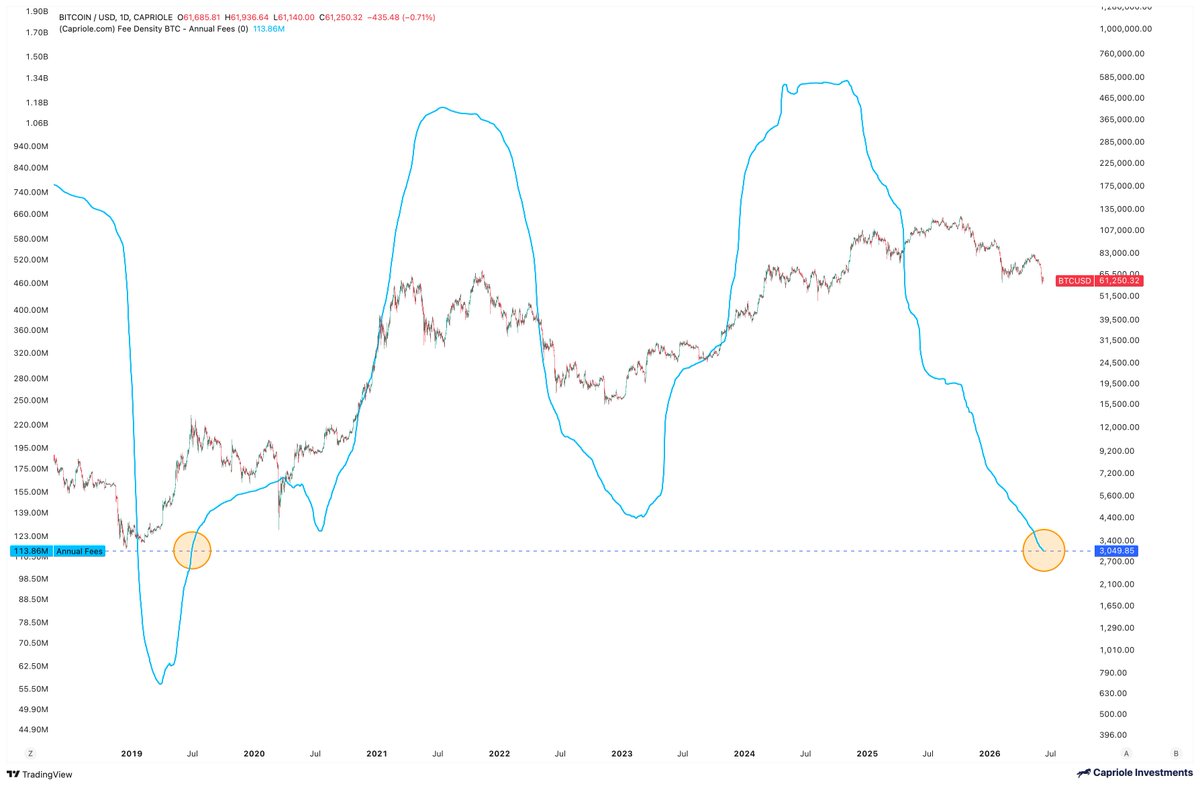
One of the more concerning long-term Bitcoin metrics. The Annual Fees miners earn (ex. block reward) over trailing 12 month period has just dropped to its lowest point since 2019! Bitcoin's transaction throughput fee revenue is in free fall, block rewards keep halving and AI compute demand is through the roof. It's no wonder every single public Bitcoin miner is pivoting away from Bitcoin and into AI. At some point in the future, this line needs to go up if Bitcoin is to be sustainable in years to come. On the positive side, this metric does normally hit a major low at the bottom of bear markets when interest in Bitcoin is lowest.
Telegram just shipped something most people are still sleeping on: managed bots.
you can now build a bot whose entire job is creating and operating other bots.
- you can operate a fleet of bots programmatically, not one at a time
- bot-to-bot communication is finally legal, agent swarms in a single chat are real
- each bot gets its own @ handle, profile, and stars balance. true white-label, not multitenancy hacks
- monetization is baked in, telegram stars + 50% ad revenue, no stripe, no website
- one share link onboards new bots. users skip botfather entirely
- you handle loop prevention yourself
This is how to set yours up right now:
1. open @/BotFather /newbot or pick an existing one
2. open BotFather's miniapp → bot settings → enable "Bot Management Mode"
3. while you're there, also enable "Bot-to-Bot Communication Mode" if you want agentic flows.
4. generate your share link: https://t.co/8GrHMlyRHJ....
5. wire your backend for the managed_bot update → call getManagedBotToken → store the token → you now own that bot programmatically. it might take up to 24-48 hours
(the token is yours, telegram doesn't hold it for you
6. set XTR (stars) as currency. Apple/Google policy leaves you no other option for digital goods anyway
one manager bot can operate thousands of child bots, each with its own identity and function, this is you running an entire company on your own
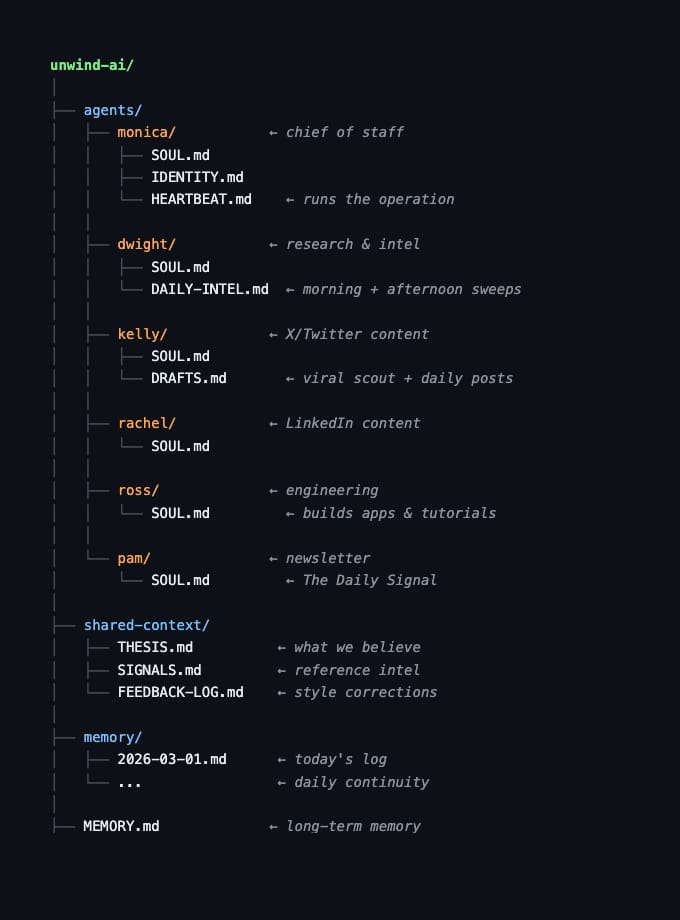
This is what a one-person AI Agent run company looks like in 2026.
6 AI agents. 20 cron jobs. 0 human employees.
Every role is a folder. Every job description is a md file. No standups. No Slack. No payroll.
Just a directory on a Mac that runs the whole thing.
YOU’RE USING OPENCLAW WRONG (I WAS TOO)
I thought I understood OpenClaw and my setup was "advanced"
> turns out I was running it like a chatbot - not like an architecture
this breakdown explains why most agents waste 2-3x tokens:
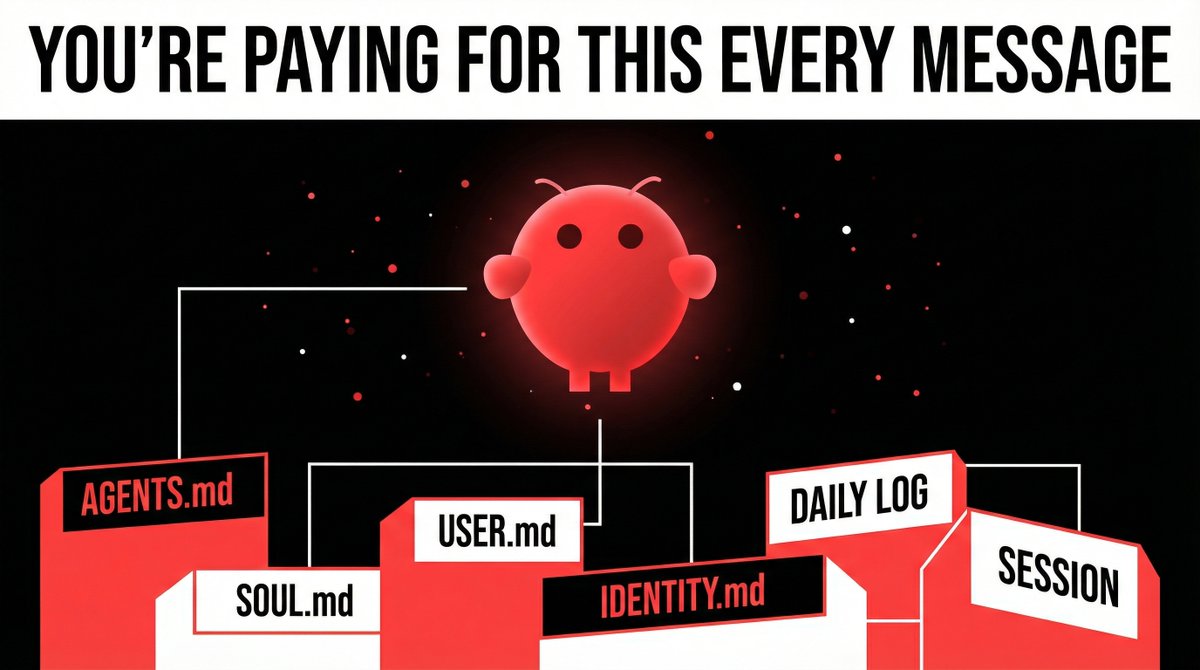
> every request injects bootstrap files into context:
𝗔𝗚𝗘𝗡𝗧𝗦.𝗺𝗱 + 𝗦𝗢𝗨𝗟.𝗺𝗱 + 𝗨𝗦𝗘𝗥.𝗺𝗱 + 𝗜𝗗𝗘𝗡𝗧𝗜𝗧𝗬.𝗺𝗱 + 𝗱𝗮𝗶𝗹𝘆 𝗹𝗼𝗴
> if that’s 3-5k tokens per call → you’re paying for it every single message
semantic memory works differently:
> LLM context = bootstrap + session + retrieved chunks
if you don’t split critical rules (bootstrap) from long-term facts (𝘔𝘌𝘔𝘖𝘙𝘠.𝘮𝘥 + vector search), you either:
> overpay constantly
> or lose important state after compaction
also:
> gateway loop = message → session.json → workspace inject → LLM → tool call → exec/browser/file → LLM → response
> if you don’t understand this pipeline, you can’t optimize it
after restructuring:
> moved static rules to bootstrap
> moved decisions to 𝘔𝘌𝘔𝘖𝘙𝘠.𝘮𝘥
> enabled proper compaction + memory flush
token usage dropped - agent consistency improved
> if you’re running @openclaw "out of the box", you’re probably burning money and performance
read the full breakdown and bookmark it
> this is the kind of piece that changes how you build agents
19 year olds with no experience are about to be running stores that make $10k/mo while they sleep.
While you're still doing everything manually and getting $0 results…
They'll set this up once and let it print.
And you can do it too with just 3 of these courses Anthropic dropped...
THE COURSES THAT ACTUALLY MATTER:
Skip Claude 101. Skip the student and educator stuff.
Go straight to:
• Building with the Claude API (8 hours) > this teaches you to build actual apps and automations
• Introduction to MCP (1 hour) > this lets you connect Claude to any tool, any service
• Claude Code in Action (1 hour) > automate your entire workflow from the command line.
These three alone let you build systems that replace $2k/month agencies.
THE PROMPTING STRUCTURE THAT PRINTS
Several people type "write me an ad" and wonder why the output is trash.
This is the structure that actually works:
“<system>You are an ecom copywriter specializing in hooks.</system>
<task>Generate 10 Facebook ad hook variations for [product]</task>
<context>
- Target audience: [who]
- Pain points: [list from customer research]
- Competitors are using: [angles]
</context>
<examples>
Hook that worked: "[paste winning hook]"
</examples>
<output_format>
Hook 1: [text]
Hook 2: [text]
</output_format>”
XML tags + examples + clear output format = 10x better results than "write me an ad."
THE ECOM CHEAT CODES:
Once you learn the API, you can build:
• Ad creative generator > feed it 5 competitor ads, it extracts patterns and generates 50 variations in 10 minutes
• Customer research machine > paste Reddit threads, Amazon reviews, TikTok comments. It pulls exact phrases your customers use and turns them into ad copy
• Product page writer > upload competitor pages, it builds yours better. Headline, benefits, social proof, CTA. Done in 2 minutes
• Email/SMS flow builder > "Build me a 5-email abandoned cart sequence for [product]" - full flow with subject lines, personalization, timing
• Competitor analyzer > paste 10 ads, it tells you what hooks they're using, what angles convert, what's missing that you can exploit
THE AUTOMATION PLAY:
Learn MCP and you can connect Claude directly to:
• Shopify (auto-respond to customers, track orders, update inventory)
• Facebook Ads (analyze performance, suggest bid changes)
• Your email platform (generate and schedule campaigns)
Set it on a cron job. It runs every morning. So you simply just wake up to a done job instead of tasks.
THE MATH:
What used to cost:
> $50/hour copywriter for ad variations
> $2k+/month agency for creative strategy
> 5 hours/week scrolling ad libraries for research
Now costs:
$0.01-0.10 per query in API tokens
Maybe $20/month total
And it runs while you sleep.
THE ISSUE:
90% of people will:
> Take Claude 101
> Get the certificate
> Post it on LinkedIn
> Never use any of it
The 10% who win will:
> Skip to the API and MCP courses
> Build one automation that saves them 10 hours/week
> Stack automations until their entire creative pipeline runs on autopilot
The play is free, but the implementation prints.
Your move.
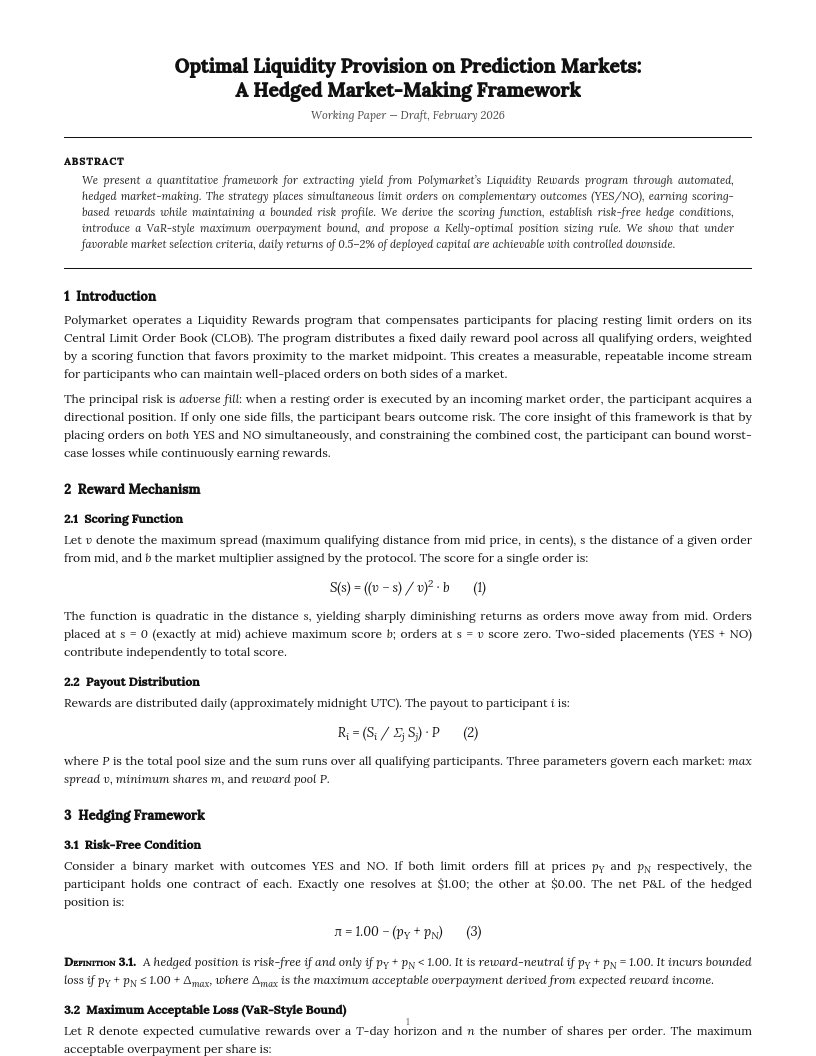
A top-20 Polymarket leaderboard quant team posted a research paper and deleted it 20 seconds later. I managed to screenshot it.
$500–$2,000 a day.
I showed it to a guy in the top-50 leaderboard. He replied: “Where did you get this? Delete it. Don’t you dare share this document.”
Send both pages to your OpenClaw and ask it to build the bot. Everything you need is inside
claude is pretty bad at natively making backend dashboards and UI in general
instead of letting it freestyle the design, use this prompt:
"Based on the style and core offer of (your product), identify enterprise-grade github dashboards or other copyable dashboards that we can use. Give me 10 of the best options to preview."
Then you just select your favourite, have it map the features to the ui, and now rather than it looking like vibecoded slop it looks very professional lol
I'm Boris and I created Claude Code. Lots of people have asked how I use Claude Code, so I wanted to show off my setup a bit.
My setup might be surprisingly vanilla! Claude Code works great out of the box, so I personally don't customize it much. There is no one correct way to use Claude Code: we intentionally build it in a way that you can use it, customize it, and hack it however you like. Each person on the Claude Code team uses it very differently.
So, here goes.
Most people fail because they start with ideas.
This starts with revenue:
How to Find $1M+/yr AI/SAAS Business Ideas (With Proof, Not Guesswork)
Step 1: Go to TrustMRR
TrustMRR tracks verified SaaS and startup MRR.
Not “claimed.” Not screenshots.
Real numbers.
This instantly removes:
- Fake gurus
- Fake success stories
- Idea validation risk
You’re only studying businesses that already make money.
Step 2: Open Any Startup or SaaS
Pick any company doing:
-$10k MRR
-$50k MRR
-$100k+ MRR
Why this works:
If someone reached this MRR, demand already exists
You don’t need to convince the market. You just need a better angle or execution
Ignore the logo, branding, or hype. Focus on what they actually sell.
Step 3: Identify 1–2 Useful Features
This is where most people mess up.
You are NOT cloning the whole product.
You’re asking:
- What feature do users actually care about?
- What part solves the core pain?
- What could exist as a standalone product?
Examples:
- A reporting feature inside a big SaaS
- A simple automation buried inside a complex tool
- A pricing comparison feature users rely on
If users would still pay for just this, you’ve found gold.
Step 4: Discover Their Marketing Channels
Now reverse-engineer how customers arrive.
Look at:
- SEO keywords they rank for
- Blog topics and search intent
- YouTube videos or Shorts
- X threads
- Paid ads or affiliates
-Reddit or community presence
Ask:
- Where does traffic actually come from?
- Which channel looks repeatable?
- Which channel is underexploited?
- You’re not innovating marketing.
- You’re copying what already works.
Step 5: Build It Better (Not Bigger)
“Better” does NOT mean more features.
Better means (Like Phantom did to take over Metamask)
- Simpler UI
- Clearer use case
- Faster onboarding
- Narrower niche
- Better pricing clarity
Examples:
- One feature, but done perfectly
- One audience, but deeply understood
- One problem, but solved end-to-end
Small, focused tools scale faster than bloated platforms.
Step 6: Do X + One More Channel
X is the foundation because:
- It compounds
- It brings high-intent users
- It’s defensible long-term
Then add one distribution layer:
- YouTube Shorts
- SEO blogs
- Reddit
- Cold email
- Partnerships
Don’t spray channels.
Dominate one, then expand.
This will work because:
- You start from verified revenue
- You eliminate demand risk
- You steal proven distribution
- You reduce build time
- You stack compounding channels
- You’re not gambling on ideas.
- You’re engineering outcomes.
This is how boring ideas turn into $1M+ businesses.
Enjoy.
@pvncher SaaS is awesome man. I launched https://t.co/xxo2FEzcw7 about two weeks ago and we have a lot of happy customers. Just check the testimonials on site :)
someone stop me. seriously.
i am going to CLONE your shtty enterprise backend in ONE AFTERNOON.
then i am going to SCRAPE your entire customer list.
then i am going to COLD EMAIL every single one of them offering the same product but BETTER and for like 80% LESS because i built it in a DAY with CLAUDE and MODAFINIL and ZERO VENTURE CAPITAL OVERHEAD.
your entire engineering team? 47 people.
me? ONE GUY who is VISIBLY UNWELL.
your dev timeline? 18 months.
mine? i started after breakfast and i'm already writing the sales copy.
i WILL steal your customers. i WILL undercut your pricing. i WILL tweet about it the entire time.
there is NO MOAT. there is NO DEFENSIBILITY. there is only ME and i am LOCKED IN and i have not slept properly in 3 days and that is YOUR PROBLEM NOW.
your roadmap is my tuesday. your product is my template. your customers are my lead list.
i cannot be stopped. i cannot be reasoned with.
someone should genuinely intervene but they WON'T because this is SHIPPING CULTURE and we are SO BACK
GLHF :>>>>>
Adler AM ☕️ 👇
The LTH Distribution Pressure Index has fallen into the Accumulation zone at -1.628, signaling minimal selling pressure from Bitcoin's long-term holders. With average daily LTH spending at just 221 BTC - one of the lowest levels in months and SOPR at 1.13 confirming holders remain profitable, the market structure appears favorable.
https://t.co/ONkR6EzTJu
A lot of Traders are going to disagree with me on this,
But there are huge benefits with trading Low R strategies.
↓
------------------------
When traders try to improve their strategy, the first question they usually ask is: “How can I win More from my winning trades?”
There are 2 possible answers to this question:
• 1 ) go for wider targets
• 2 ) risk more on high quality setups
The default answer most traders have is almost always:
• “I would rather go for bigger wins by extending the profit target.”
So there's nothing wrong with doing this.
What I am suggesting is BEFORE thinking about widening the TP I would encourage to FIRST start with thinking about RISKING MORE on higher quality setups.
Ideally a Trader would go answer both of these questions but in order of efficiency, I strongly believe addressing "risking more on good trades" is much more important than "widening target on good trades but keeping the risk the same".
I will explain my reasoning below:
↓
------------------------
I ran Monte Carlo simulations to show this.
Compare the following two strategies:
1st Strategy:
• 1R:R with a 55% win rate → EV ≈ 0.1
2nd Strategy:
• 2R:R with a 37% win rate → EV ≈ 0.11
On paper, the second one looks better because the EV is higher by 0.01~.
The more EV per trade, the better right?
Not necessarily.
Strategy 2 has a 37% win rate:
• which means bigger losing streaks.
• bigger losing streaks = bigger expected drawdowns (~20% vs ~12%).
That higher variance forces you to bet smaller, otherwise you risk wipeout.
• low winrate = higher average max drawdown over N number of trades = lower sharpe ratio = can't afford to risk more per single trade.
But Strategy 1 has a 55% win rate strategy:
• the maximum average drawdown over N number of trades is significantly lower.
• About 2x lower~ (12% instead of 20%)
So that basically means that you can get away with betting TWO TIMES MORE without taking on higher average drawdown.
• So even though "EV in units of R" is identical, the "EV in units of USD" is actually about double.
In the 3rd image of this tweet, I show how DOUBLING the bet size on strategy1 ends up outperforming the returns on strategy2 by about 2x while maintaining the same average drawdowns AND having a LOWER EV in units of R per trade.
-----------------------
I'll simplify it even further.
Option 1: 0.1 EV per trade, but maximum bet size is 1% of your trading capital.
Option 2: 0.1 EV per trade, but maximum bet size is 2% of your trading capital.
Even though both options have identical EV, the 2nd one is going to make you more money over the next N trades (where N is a high number, let's say 100+)
------------------------
TLDR:
High R Trades just look cool and they're easier to flex for engagement on social media.
Low R Trades can be sized up way harder and usually will have higher sharpe ratios. In other words you might be able to step on the gas and grow at a faster speed with Low R strategies.
🌶️