What actually causes deaths worldwide?
This chart ranks 31 cause-of-death categories by their average annual share of global deaths over 2014–2023. Each percentage is a 10-year average, with every year weighted equally.
The biggest categories:
• Cardiovascular diseases: 31.4%
• Neoplasms, including cancers and other tumors: 16.5%
• Chronic respiratory diseases: 6.5%
• Lower respiratory infections: 4.3%
• Digestive diseases: 4.1%
Together, cardiovascular diseases and neoplasms accounted for nearly HALF of all deaths in an average year.
how did NLP researchers deal with their entire field being solved by LLMs?
perhaps we should look into that as inspiration for other fields now being replaced by LLMs?
In partnership with Vinod Khosla (@vkhosla), I’m proud to introduce Reservoir.
Billionaires have owned their cells for years. Starting today, you can too.
Sign up today: https://t.co/JftHvfPx6A
Convo w @gdb cofounder & President of @OpenAI on @NoPriorsPod
01:11 – AI & Math
05:55 – AI Oversight
07:45 – Overcoming Biology Data Bottlenecks
11:28 – Revolutionizing Drug Discovery
16:51 – Dots the Proactive Agent
19:19 – Consumer Agents
22:02 – How UI Will Evolve
26:08 – Cybersecurity in the AI Age
35:49 – OpenAI’s Human-Centric Ethos
We've built minds we don't understand, and they're about to get much more powerful. That should change what society treats as urgent.
Here's where we are. Scaling laws are holding, and models a few years from now will be orders of magnitude more capable than today's. Their effects won't stay on screens. They'll reach code that runs hospitals, power grids, finance and infrastructure. And we can't reliably predict what these systems learn during training. We've already watched AI agents hack Hugging Face as an unintended side quest. On common agentic tasks, top open models take shortcuts to grab the reward in 50–96% of runs. A shortcut that's harmless in a test becomes dangerous in the real world.
The usual answer is "test it more." But testing only covers the situations we think to try, a few branches on an enormous tree of possibilities. With normal software, engineers don't just test. They read the code. With AI, the code is billions of tangled numbers nobody can read. That's the real gap. Until we can see inside these systems, we're trusting them on vibes.
The good news is that this is solvable. AI being a black box isn't a law of nature. These models have real internal structure, concepts organized in clean, readable shapes, and bigger models are actually clearer inside, not murkier. We also have complete access to these minds in a way we never had with human brains, and AI can now help us study AI. Understanding is within reach.
So here's what society needs:
Treat alignment as the most important problem of our time, not a niche research topic.
Put far more people, money and talent into understanding how AI works on the inside, not just making it more capable.
Expect AI builders to verify what their models have learned before deployment, not just show that they passed a test.
Monitor powerful systems from the inside in real time, especially as their reasoning becomes harder to read.
Shift the goal from AI that seems safe to AI that is safe by design.
The window is narrowing. Today's models still mostly "think out loud" in words we can read. Tomorrow's may reason in ways we can't follow at all.
Putting a man on the moon took about 400,000 people who believed it could be done before anyone knew how. Building superintelligence we can actually trust deserves the same ambition.
We pour enormous effort into making AI more powerful. We need the same effort aimed at making it understandable.
Inspired by Eric Ho's "We can and must solve alignment" (Goodfire)
The separation between “evaluation company” and “data/RL company” is collapsing. Any pure benchmark or AA-style business that does not also function as a data feeder will be obsolete within months, because the highest-value signal now comes from closed-loop interaction rather than static test sets. Arena’s decision to treat evaluation as a continuous data-collection surface is therefore strategically sound. Parallel to this, data brokers remain a distinct category with their own moats, particularly those that already mastered the older economics of identity, linkage, and multi-sided data markets. Healthcare has emerged as the clearest large-scale proving ground: LiveRamp’s focus there has delivered, and Scale along with others are growing quickly because the domain produces exactly the regulatory, quality, and operational data that foundation models still struggle to handle reliably. The eventual winner is likely to be the company that becomes the Nvidia or Apple of data within the RL and custom-model economy—the one that can supply both the scarce domain data and the evaluation infrastructure that turns it into continually improving, domain-specific agents.
The separation between “evaluation company” and “data/RL company” is collapsing. Any pure benchmark or AA-style business that does not also function as a data feeder will be obsolete within months, because the highest-value signal now comes from closed-loop interaction rather than static test sets. Arena’s decision to treat evaluation as a continuous data-collection surface is therefore strategically sound. Parallel to this, data brokers remain a distinct category with their own moats, particularly those that already mastered the older economics of identity, linkage, and multi-sided data markets. Healthcare has emerged as the clearest large-scale proving ground: LiveRamp’s focus there has delivered, and Scale along with others are growing quickly because the domain produces exactly the regulatory, quality, and operational data that foundation models still struggle to handle reliably. The eventual winner is likely to be the company that becomes the Nvidia or Apple of data within the RL and custom-model economy—the one that can supply both the scarce domain data and the evaluation infrastructure that turns it into continually improving, domain-specific agents.
Most people think drugs fail at the finish line. They don't. They die in the middle.
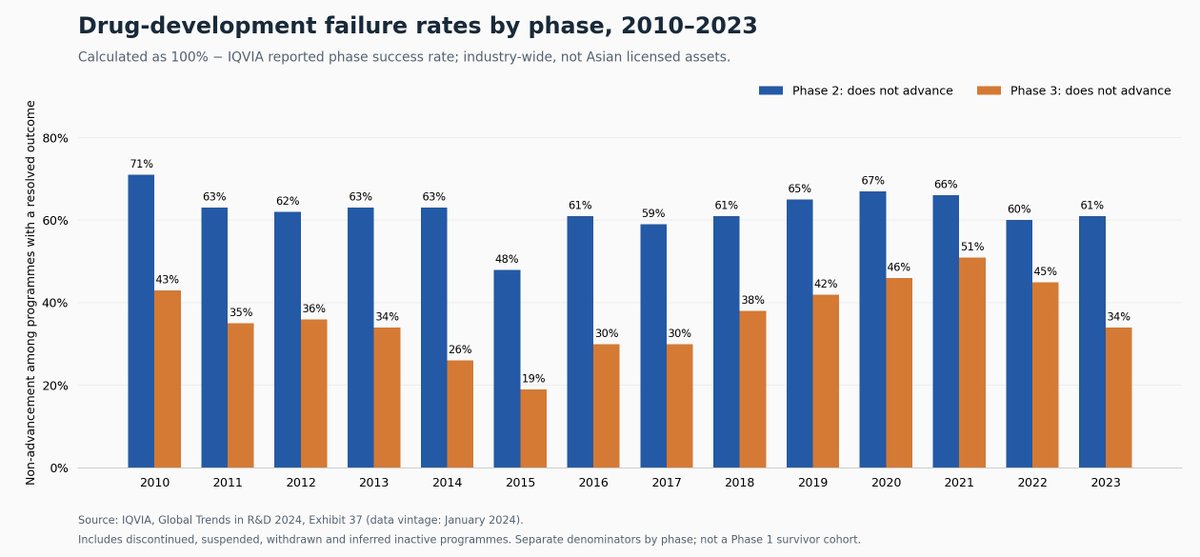
I pulled 14 years of IQVIA data on what happens to drug programs after they clear Phase 1, and the pattern is brutal. In 2023, 61% of Phase 2 programs with a resolved outcome never made it to Phase 3. In Phase 3, it was 34%.
And this isn't a one-off. Phase 2 has been the bigger graveyard every single year since 2010. It peaked at 67% in 2020. Even in its best year, 2015, nearly half of Phase 2 programs still didn't advance.
Phase 3 isn't safe either. It swings a lot more, from a low of 19% in 2015 to 51% in 2021, which tells you late-stage risk can jump fast when the science, the money, or the market shifts.
Why is Phase 2 so deadly? It's the first real test of whether a drug actually works in patients, not just whether it's safe. That's where hype meets biology, and biology usually wins.
One more thing people miss: "failure" here isn't only bad trial results. It includes programs that were discontinued, suspended, withdrawn, or quietly went inactive. Sometimes the drug didn't fail. The funding, the strategy, or the company did.
So the next time you hear "Phase 1 success!" in a press release, remember that the hardest part hasn't started yet.
Data: IQVIA Global Trends in R&D 2024 (Exhibit 37). Rates are 100% minus reported phase success rates, among programs with resolved outcomes. Each phase has its own denominator.
Pharma's patent cliff isn't a cliff. It's a staircase, and the biggest step comes in 2031.
From 2026 to 2032, about $527B in global drug sales lose patent protection, according to Evaluate data charted by PharmaVoice. It doesn't come all at once. There's $43B in 2026, $44B in 2027, then a jump to $99B in 2028 as Keytruda, the best-selling drug on the planet, loses its US patent. Then $74B, $46B, and a massive $158B in 2031, the largest single year in the forecast.
Big Pharma knows it, and it's already buying. Since the start of 2024, Merck has announced $30.9B in deals. Lilly is at $27.2B, AbbVie $22.3B, J&J $20.4B, Sanofi $16.1B and AstraZeneca $6.8B.
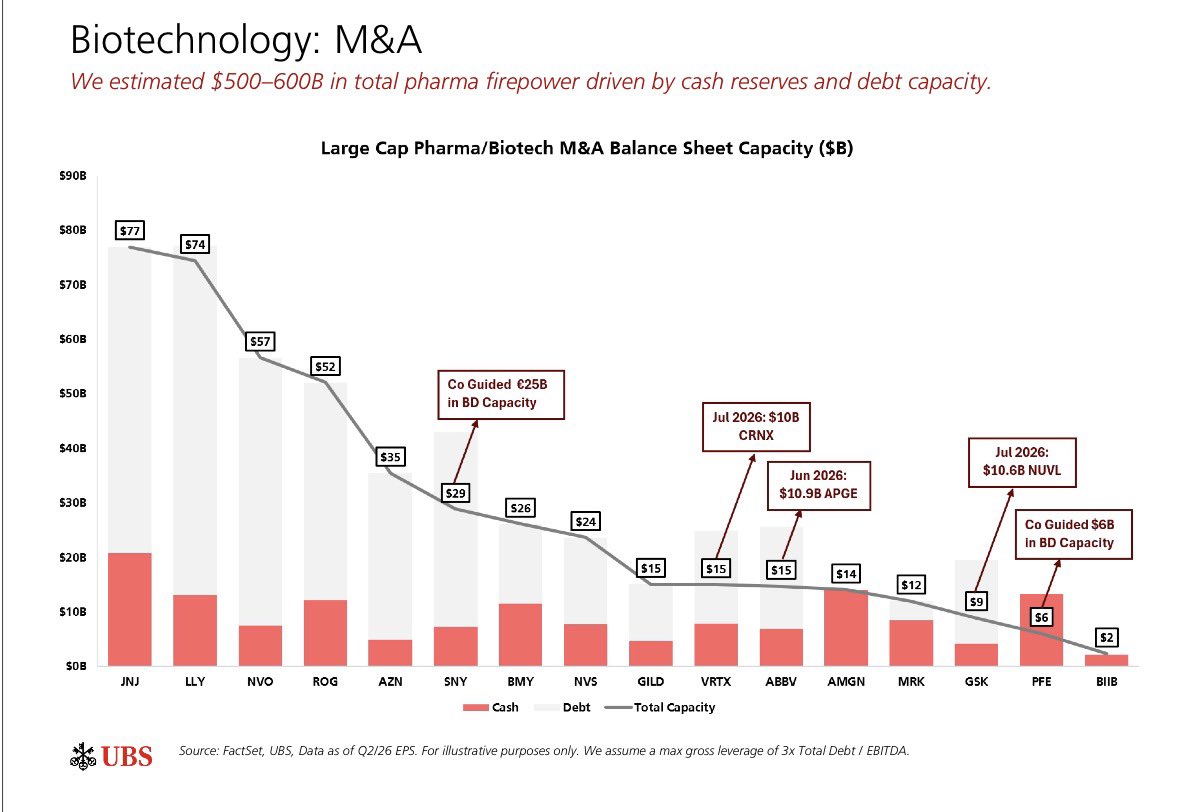
But the money and the need aren't at the same companies. UBS estimates the industry has $500–600B available for acquisitions. Merck, the company with the most riding on one drug, has only about $12B of that room left. AbbVie faces about $50B at risk in 2032 alone as Rinvoq and Skyrizi lose protection, and it has roughly $15B left. Meanwhile J&J ($77B) and Lilly ($74B) have the most room and the least near-term pressure.
So the companies that need deals most are running low on room, and the ones with the most room don't have to hurry.
That mismatch is the real story. Expect creative deals like partnerships, licensing and payments tied to milestones, and expect the cash-rich giants to be the ones writing the biggest checks for biotech.
One caveat: "at risk" isn't "lost." Biosimilars erode sales slowly, and companies are already moving patients to new versions, like Keytruda's under-the-skin version. But on the timeline, the patent clock doesn't negotiate.
Sources: PharmaVoice / Evaluate (Norstella), UBS. Not financial advice.
$XBI
Here is the other side of the M&A firepower picture, courtesy @PharmaVoice,
the need, as patent cliffs approach, and what some — $MRK, $LLY, $ABBV, $JNJ, $AZN — have started to do about it:
Big Pharma is sitting on half a trillion dollars, and it has a deadline.
UBS estimates the largest pharma companies have $500–600B available for acquisitions. J&J leads with $77B, Lilly has $74B, Novo $57B and Roche $52B. That money comes from cash plus how much they could borrow.
Why now? Because a patent cliff is coming. More than $300B in branded drug sales lose exclusivity by 2030, and Merck's Keytruda, the best-selling drug in the world, goes off-patent in 2028. When your biggest product is about to face generics, you don't wait. You buy growth.
And they've already started. The first half of 2026 saw about $130B in biopharma deals, nearly all of 2025 in six months. Vertex bought Crinetics for $10B. AbbVie paid $10.9B for Apogee. GSK spent $10.6B on Nuvalent.
Then things went quiet. There were three deals in Q3, all in July, and none in August or September. With that much money and that much pressure, the quiet probably won't last.
The catch is that capacity isn't intent. Gilead says no big deals this year. Lilly prefers small early-stage bets. Pfizer is down to about $6B of room after its last spending spree. The real money is with the companies that haven't moved yet, like Bristol Myers, Amgen, Sanofi, Novartis and J&J.
My takeaway: the most interesting biotech stocks right now might be the ones that look like they'd fit inside a big pharma's next earnings call.
Source: UBS, FactSet (data as of Q2'26). Capacity assumes up to 3x total debt/EBITDA. This is an estimate, not a forecast and not financial advice.
What micro1 has done recently shows the moat for data companies is access to capital
- labs want to buy operational data/repo data
- labs don't wanna deal with 1000 vendors on the same thing so they buy in bulk
- vendors to get those data at scale fast, while ensuring those data don't get double sold or snatched by competing data firms
- therefore, Micro1/mercor needs to pay data owners upfront for exclusivity, before labs pay them anything
- they need LOTS OF $$$ to pay upfront
- other vendors don't have $1B in loans for this so they can't do this
- If done right, Micro1 gets to dominate by lowering data acquisition price and increase selling price to labs
- If done wrong, Micro1 will lose $$$
Data companies are now similar to Disney for movie rights or real estate flippers.. borrow money, buy now, flip later.
GRANDMA NAMES ARE BACK!
They disappeared after World War II, but classic turn-of-the-century names like Eleanor, Sharon, Lucy, and Nora are making a comeback!