During the conflict in Tigray, Ethiopia, that began on 4 Nov 2020, troops supporting the federal government have committed widespread rape against ethnic Tigrayan women and girls.
How Abiy Ahmed’s Government Engineered Genocide in Tigray
A former senior official in Ethiopia’s federal government has publicly admitted that the 2020 war on Tigray was deliberately provoked to target and purge ethnic Tigrayans, lending powerful confirmation to long-standing accusations by Tigrayan leaders and international human rights groups.
Taye Dendea, a former Minister of Peace and senior member of Prime Minister Abiy Ahmed’s Prosperity Party, said in a recently published interview that the federal government intentionally initiated the war in order to single out and remove Tigrayans from the Ethiopian National Defense Forces (ENDF).
“Do you think it is TPLF who started the war? It is us who deliberately started it. We had no other way to single out ethnic Tigrayan members of the national army,” Taye said during an interview with Horn Observer, recorded shortly before his arrest.
He added that the attack on the army’s Northern Command, which the government had blamed on the Tigray People’s Liberation Front (TPLF) to justify its military assault, was used as a pretext to justify a mass purge of Tigrayan soldiers and an ethnic campaign that soon extended far beyond the military.
Taye’s admission echoes a previously leaked audio recording of Brigadier General Tesfaye Ayalew, a senior ENDF commander, who was heard saying:
“We had to clean out our insides… Even if there may be good people among them, we can’t differentiate… so we excluded them from doing work. Now the security forces are completely Ethiopian.”
According to verified reports, more than 17,000 ethnic Tigrayan soldiers were disarmed, detained, or expelled from the army in the first weeks of the war. Simultaneously, ethnic Tigrayans across Ethiopia were subjected to widespread profiling, mass detentions, dismissals from public and private employment, and in many cases, disappearances.
Throughout the war, Prime Minister Abiy Ahmed and senior officials insisted the conflict was a “law enforcement operation” triggered by an alleged TPLF attack on Northern Command bases in November 2020. The government framed the military campaign as an effort to restore constitutional order.
However, human rights groups, UN investigators, and independent journalists have documented a very different reality one of systematic ethnic targeting, mass killings, sexual violence, forced starvation, and the displacement of millions of Tigrayans.
The government’s narrative now appears increasingly hollow in light of multiple recent revelations.
From the outset of the war, Tigrayan leaders and civil society maintained that:
. The war was a premeditated genocidal campaign, prepared months in advance.
. Tigrayans in the army, civil service, and society were systematically purged, imprisoned, or killed.
. The federal government used siege warfare, coordinated attacks with Eritrean and Amhara forces, and blocked humanitarian aid to deliberately inflict suffering on Tigrayan civilians.
.Independent investigations, including those by the United Nations and international NGOs, have consistently supported these claims.
Taye Dendea’s testimony reinforces calls for the international community to act decisively:
1. Demand full accountability for war crimes and crimes against humanity committed during the conflict.
2. Insist on the safe and dignified return of displaced Tigrayans, especially those from Western Tigray, still under illegal occupation.
3. Push for full implementation of the Pretoria Agreement, which remains stalled due to the Ethiopian government’s lack of compliance.
Taye’s admission provides a stark reminder of the true nature of the war on Tigray a war driven not by constitutional concerns but by ethnic hatred and political calculation.
As millions of Tigrayans remain displaced and waiting for justice, and as the Pretoria peace process falters, the world can no longer look away. The victims deserve recognition, justice, and restoration.
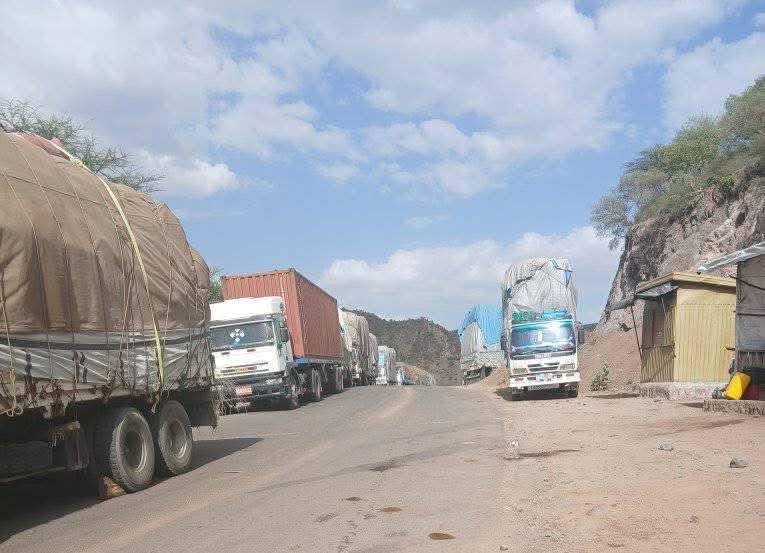
Breaking News: Trucks Blocked from Entering Tigray Near Weldiya Amid Federal Restrictions
May 28, 2025 A new wave of roadblocks is preventing dozens of trucks loaded with essential goods from entering Tigray, as federal customs authorities reportedly halted them at the route of weldya-Chifra checkpoint, just outside Weldiya, without providing official explanation.
Eyewitnesses say the trucks, which had already passed Weldiya and were on route to Tigray, were ordered to stop and are now stranded near a federal customs post. Authorities have also prohibited the drivers from turning back, further complicating the situation.
This latest incident follows a series of similar roadblocks, dating back to September 2024, where multiple trucks were detained in Afar’s Adaitu area. Now, vehicles attempting to access Tigray through Serdo are facing the same fate.
Sources confirm that many of the stranded trucks are carrying highly perishable goods, including fresh produce, risking massive losses. Beyond the economic cost, truck owners report financial distress, with many facing pressure from unpaid bank loans and family obligations.
Despite the growing impact, neither the Ethiopian Customs Commission nor federal authorities have publicly disclosed the reason for the blockade.
Observers warn that not only does the restriction threaten livelihoods, but the deliberate prevention of return routes may signal an intentional effort to cripple commercial access to Tigray. The move is being seen by many as a destructive act with potentially dire humanitarian consequences.
Follow us for more updates on this developing story.
#Ethiopia: Eight IDPs die over three months from hunger, lack of medicine in #Tigray; humanitarian conditions deteriorate in #Amhara following #USAID suspension
At least eight internally displaced persons (IDPs) have died in the past three months in Axum town, Tigray region, reportedly due to “hunger” and “lack of medicine,” according to Kahsay Asayehegn, coordinator for displaced persons in the Axum Cluster of the Western Tigray Zone. Speaking to Tigray TV, Kahsay said the living conditions of thousands remain dire, with people now exposed to “cold, illness, and the risk of flooding” amid heavy rainfall. Displaced communities, he added, have urged authorities “to save them from the risk of death” and appealed for “secure shelter, at least until the rainy season ends.”
In Amhara, the suspension of humanitarian assistance by USAID has contributed to deteriorating conditions in displacement sites, Deutsche Welle (DW) reported. A displaced individual cited by DW said there is “no food,” while shelter tents have collapsed and essential supplies including “flour, oil or clothing” are no longer being delivered. Mihret Melaku, head of the Waghimra Zone Food Security and Disaster Prevention Office, said the situation affects not only displaced people but also others who had relied on monthly aid, adding that the challenge now extends to wider communities.
https://t.co/Fx0QPSlBwE
News: Up to 40% of #Tigray still occupied by external forces; ensuring territorial integrity a priority: Interim President
Speaking during a meeting with Jens Hanefeld, German Ambassador to Ethiopia and Permanent Observer to the African Union, President Tadesse Werede of Tigray’s interim administration stated the critical need for urgent intervention in the region's worsening territorial and humanitarian crisis. “Forty percent of the Tigray regional state’s territory is under the control of invaders,” Tadesse stated, stressing that the administration’s foremost responsibility is to restore the region’s constitutional borders and facilitate the safe return of displaced people.
He specifically highlighted the dire conditions in Tselemti, a district in Western Tigray, and acknowledged the failure of previous efforts to return residents: “The poor security situation has led to further displacement and suffering,” he said. “We must start working with the federal government as much as possible to help our people, who are forced to live in indescribable conditions, return to their homes before winter.”
Western Tigray, which remains occupied by forces affiliated with Amhara region and the federal governments, is where some of the devastating atrocities were committed during the two-year brutal war in the Tigray region, prompting the US State Department to designate the crimes as “crime against humanity" compounded by forcible transfer of civilians and acts of ethnic cleansing.
https://t.co/hzatNhoawI
The article is now fully open access.
"Ethiopian regime's framing of the conflict as a “law enforcement operation” served to justify its actions & dehumanise its victims, portraying Tigrayans as threats rather than as civilians enduring immense suffering"
https://t.co/bOYEQezUJz
Amid fragile security and deteriorating humanitarian conditions, especially in health and nutrition, the people of Irob and Zalambessa in Tigray, Ethiopia, continue to be harassed and intimidated by Eritrean forces, including to forcibly change their identities.
Lasting peace cannot be achieved until people’s basic rights are assured and they are allowed to live freely and autonomously.
Happy international women’s day to all women. Happy March Eight to the Tigrayan woman in particular-the epitome as she is of fortitude, perseverance & of the un-breakable spirit of defiance & unshakable resolve against all forms of injustice. Tigray owes much to the hardy woman!
Ethiopia: UK warns of food crisis triggered by war and drought. “"There are serious indicators of the danger of famine. If you ask me, 'Is there a famine taking place now in Ethiopia?' I say no, and we have the power to stop it.” Andrew Mitchell https://t.co/H16mxGXTcz
The International Spectator on the Tigray war & how the European Union often fails to act effectively and consistently in a highly fragmented context. "As a result, the EU adopted an inconsistent and ineffective approach toward the conflict." https://t.co/RU1JkSNpRH