Scott Wu is the co-founder of Cognition AI, one of the fastest-growing companies in history. He’s also the greatest competitive programmer the US has ever produced. You may have seen him doing impossible card tricks and mental math.
You’ve never seen him asked about weed, Michael Jordan, cancer, and human consciousness over a punnet of strawberries. That is what Colossus editor-in-chief Jeremy Stern did on a recent visit to San Francisco.
For those less familiar with @ScottWu46: In 2nd grade, he entered a math competition for 7th graders, lost, and was so furious he still fumes about it 20 years later. The next year he entered the 9th-grade division as a 3rd-grader and got a perfect score.
Then he won first place at the US national middle-school math competition and three straight gold medals at the International Olympiad in Informatics, where he became the greatest American gold-medalist and coach in history.
Most of the people running the biggest AI companies met as teenagers, competing for their countries on international math and science teams. OpenAI’s Greg Brockman, Anthropic’s Dario Amodei, Meta’s Alexandr Wang, to name just a few.
Most agree that the von Neumann among them was Scott Wu.
In November 2023, a few weeks after his mother died of lung cancer, on the day Sam Altman was fired from OpenAI, Wu founded his own AI company: Cognition.
He was 26 and saw earlier than almost anyone that AI would converge on agents that work in the background, 24/7, like coworkers. He shipped Cognition’s AI software engineer Devin in March 2024. It worked poorly, and he took intense public criticism for it.
Now, in its first 18 months of service, Devin has generated $445 million of revenue run rate and usage has doubled every eight weeks. The US Army, Goldman Sachs, and Mercedes-Benz are all customers. Cognition is raising at a valuation around $25 billion.
@JeremySternLA sat down with Wu, the emperor of the nerds, to ask the questions we’d all ask one of the smartest people in America—building the most consequential technology of our generation—if we ever got the chance.
As well as MJ and weed, they talk about the cluster of competitive math prodigies behind so much of AI, what makes us human when AGI arrives, and why Wu believes he was put on this earth to teach AI how to code.
Read the piece below.
🚀 DeepSeek-V4 Preview is officially live & open-sourced! Welcome to the era of cost-effective 1M context length.
🔹 DeepSeek-V4-Pro: 1.6T total / 49B active params. Performance rivaling the world's top closed-source models.
🔹 DeepSeek-V4-Flash: 284B total / 13B active params. Your fast, efficient, and economical choice.
Try it now at https://t.co/GCdiMzk1Dl via Expert Mode / Instant Mode. API is updated & available today!
📄 Tech Report: https://t.co/drlDrxkYtp
🤗 Open Weights: https://t.co/T13Y8i7SDM
1/n
Our general-purpose reasoning models solved all 12 problems at the 2025 International Collegiate Programming Contest (ICPC) World Finals, the world’s top university programming competition which was enough for a 1st-place human ranking.
We wrapped up this year's competition circuit with a full score on the ICPC, after achieving 6th in the IOI, a gold medal at the IMO, and 2nd in the AtCoder Heuristic contest!
BREAKING: The Dallas Mavericks are trading Luka Doncic, Maxi Kleber and Markieff Morris to the Los Angeles Lakers for Anthony Davis, Max Christie and a 2029 first-round pick, sources tell ESPN. Three-team deal that includes Utah.
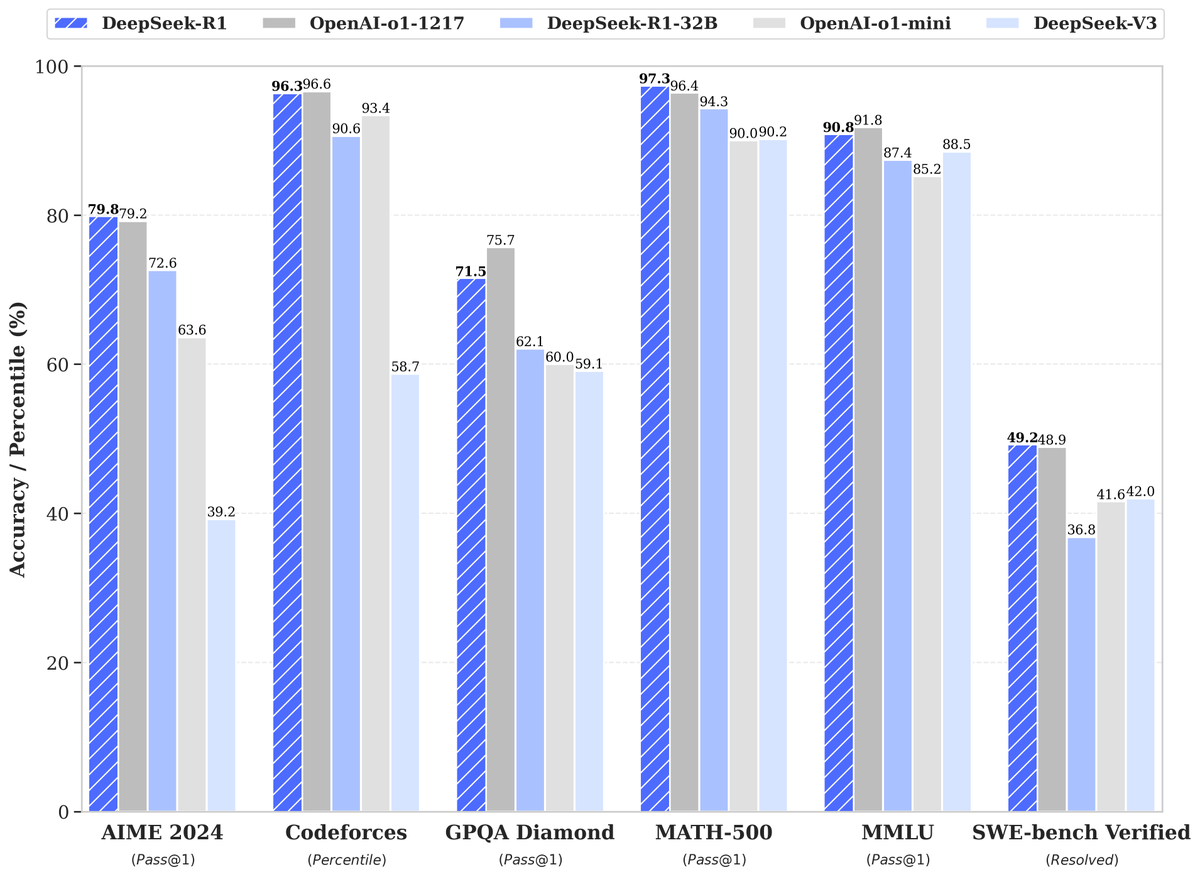
🚀 DeepSeek-R1 is here!
⚡ Performance on par with OpenAI-o1
📖 Fully open-source model & technical report
🏆 MIT licensed: Distill & commercialize freely!
🌐 Website & API are live now! Try DeepThink at https://t.co/v1TFy7LHNy today!
🐋 1/n
We're releasing a preview of OpenAI o1—a new series of AI models designed to spend more time thinking before they respond.
These models can reason through complex tasks and solve harder problems than previous models in science, coding, and math. https://t.co/peKzzKX1bu
Starting today, open source is leading the way. Introducing Llama 3.1: Our most capable models yet.
Today we’re releasing a collection of new Llama 3.1 models including our long awaited 405B. These models deliver improved reasoning capabilities, a larger 128K token context window and improved support for 8 languages among other improvements. Llama 3.1 405B rivals leading closed source models on state-of-the-art capabilities across a range of tasks in general knowledge, steerability, math, tool use and multilingual translation.
The models are available to download now directly from Meta or @huggingface. With today’s release the ecosystem is also ready to go with 25+ partners rolling out our latest models — including @awscloud, @nvidia, @databricks, @groqinc, @dell, @azure and @googlecloud ready on day one.
More details in the full announcement ➡️ https://t.co/hhJoLm5eLV
Download Llama 3.1 models ➡️ https://t.co/rRjvmxqCTC
With these releases we’re setting the stage for unprecedented new opportunities and we can’t wait to see the innovation our newest models will unlock across all levels of the AI community.
After almost a decade, I have made the decision to leave OpenAI. The company’s trajectory has been nothing short of miraculous, and I’m confident that OpenAI will build AGI that is both safe and beneficial under the leadership of @sama, @gdb, @miramurati and now, under the excellent research leadership of @merettm. It was an honor and a privilege to have worked together, and I will miss everyone dearly. So long, and thanks for everything. I am excited for what comes next — a project that is very personally meaningful to me about which I will share details in due time.
Today we're excited to introduce Devin, the first AI software engineer.
Devin is the new state-of-the-art on the SWE-Bench coding benchmark, has successfully passed practical engineering interviews from leading AI companies, and has even completed real jobs on Upwork.
Devin is an autonomous agent that solves engineering tasks through the use of its own shell, code editor, and web browser.
When evaluated on the SWE-Bench benchmark, which asks an AI to resolve GitHub issues found in real-world open-source projects, Devin correctly resolves 13.86% of the issues unassisted, far exceeding the previous state-of-the-art model performance of 1.96% unassisted and 4.80% assisted.
Check out what Devin can do in the thread below.