Several of you have asked for API access to Orus data.
We start building it today.
Interested? Reach us on X or open a ticket in our discord community, describe us what you'd plug it into — that decides what we open first.
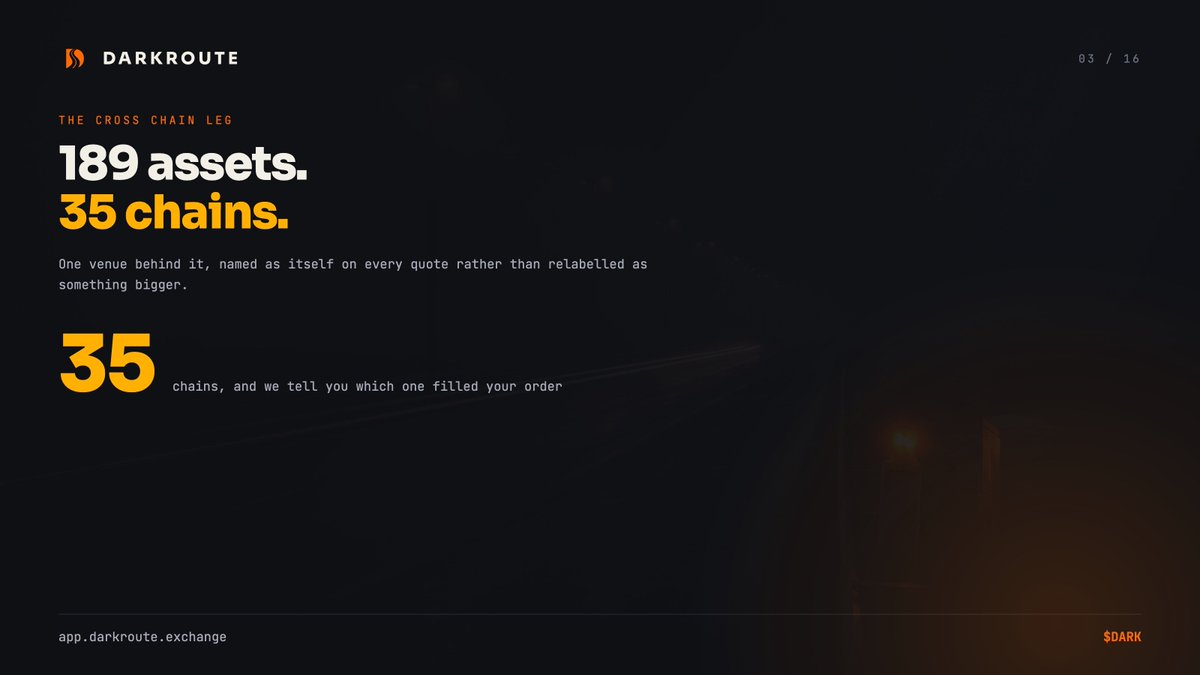
The cross chain leg reaches 35 chains and 189 assets today.
The part that matters less to a screenshot and more to you: the venue that fills your order is named on every quote, as itself. Not relabelled as a big exchange, not hidden behind our own logo.
If the fill was bad, you know exactly who to blame, and it might be us.
@vladtenev We do build onchain, Orus is the first self-trading agentic tool anyone can use.
Deploy, manage and improve your own agent here!
https://t.co/5MxI9Ta8z0
Hazır devletim sapıklara savaş açmışken
Türkiye'nin 2 numaralı ibnesi
Pierre Loti'yi tarihe gömelim
"Bir tweet de sen at"
İstanbul'u bu namussuzdan kurtaralım
We are building on @arc , Circle's L1, and the first piece is live.
https://t.co/GbpXVm4wkO<address>
Paste any token address on Arc and you get every Uniswap v4 pool we have indexed that trades it: the fee each one charges, the depth behind it, and what getting back out actually costs at size. Read from the pool, every time, not from a listing.
Now the part most projects would leave for the fine print.
We cannot trade on Arc. Arc runs the Uniswap v4 read stack at the same addresses as everywhere else, PoolManager, V4Quoter, StateView, all there, all verified by byte length. What it does not have is a UniversalRouter, and that is the exact contract a swap we build is addressed to. Zero bytes at that address.
It is not something we can route around, either. Across 100 blocks, 65 different contracts called the PoolManager and the biggest held 28% of the swaps. There is no community router to borrow.
So we shipped the half that is true. Quotes today. A trade button the day a router exists, and not one day before it does.
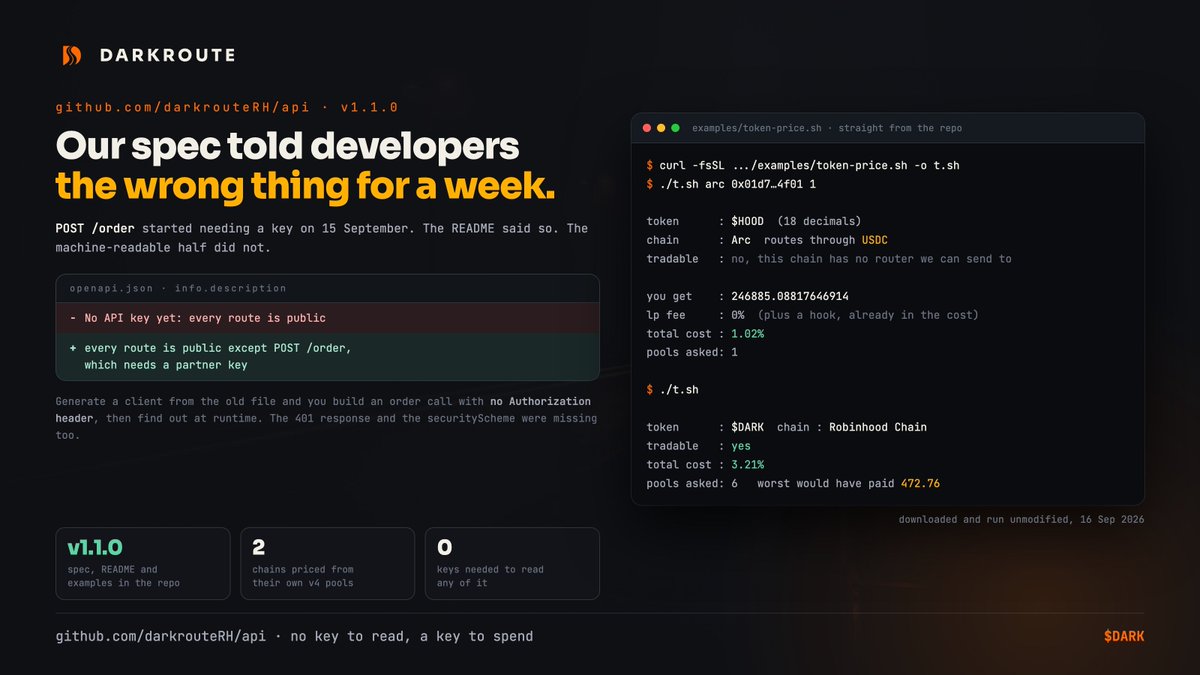
Our API spec spent a week telling developers the opposite of the truth.
https://t.co/ZRWsbamsKM
On 15 September we made order creation require a partner key. We updated the README that day and said so plainly, including correcting an earlier promise rather than deleting it.
We did not update openapi.json. It kept saying "No API key yet: every route is public."
That file is the half machines read. Anyone who generated a client from it built an order call with no Authorization header, shipped it, and found out at runtime. The 401 response was missing too, so their generated code had no idea that failure even existed.
Nobody reported this. We found it while publishing something else, which is the honest version of how it was found.
Fixed in v1.1.0, along with the actual feature: you can now price any token straight from its own Uniswap v4 pools, on Robinhood Chain and on Arc, no key needed.
Pulled another piece out of the router and made it public: https://t.co/DN7LYUpPuq
It builds the payment URI a wallet understands. EIP-681 for EVM, BIP-21 for Bitcoin and its relatives, Solana Pay for SOL. One file, zero dependencies, no network calls.
The encoder is the boring half. The half worth reading is where it refuses.
A payment that needs a memo or a destination tag gets no URI at all. On TON, XRP and most exchange deposits, a transfer without its tag is lost, not late, and wallet support for carrying that tag inside a URI is uneven enough that you would be trusting somebody else's parser with your user's money.
A chain whose id you cannot name gets no URI either. The chain id is an argument, not a lookup, so the library never has an opinion about which network your "eth" means. A guessed id sends funds to the right address on the wrong network.
Eleven tests, and the refusals carry more of them than the encoder does. That ratio is the point.
One more thing, because it is the reason to publish rather than a footnote. Writing the tests for strangers found a bug in it: JavaScript prints small numbers in exponent form, so an amount under 0.0000001 came out as amount=1e-8, which is not a valid BIP-21 amount. Our own deposits have never been that small, so nothing ever hit it. Fixed in the package and in the live app before this went out. The same thing happened when we extracted address-rules. Twice is a pattern worth naming: code you only use yourself is only tested by your own habits.
We are moving DarkRoute to a bigger server today.
New orders are paused for up to two hours, starting when we post that it has begun. The app will say so on every page rather than failing silently.
Three things that are worth being precise about:
Orders you already have keep working. The deposit address on an open order belongs to the venue filling it, not to us, so it stays valid and a deposit still settles even while our site is being moved. If you want to watch it during the window, the intents explorer link on your order page reads the venue directly.
Nothing custodial moves, because nothing custodial exists. DarkRoute has never held anyone's funds, so a server migration is a migration of a website and a ledger of receipts, not of money. That is the whole point of the design and this is the first time it has been tested in public.
You will be told when it starts and when it is done, with the same account, not with silence.
robinhood:0xebb4c5b97e4117e30ec82ce025e6f21dded05436
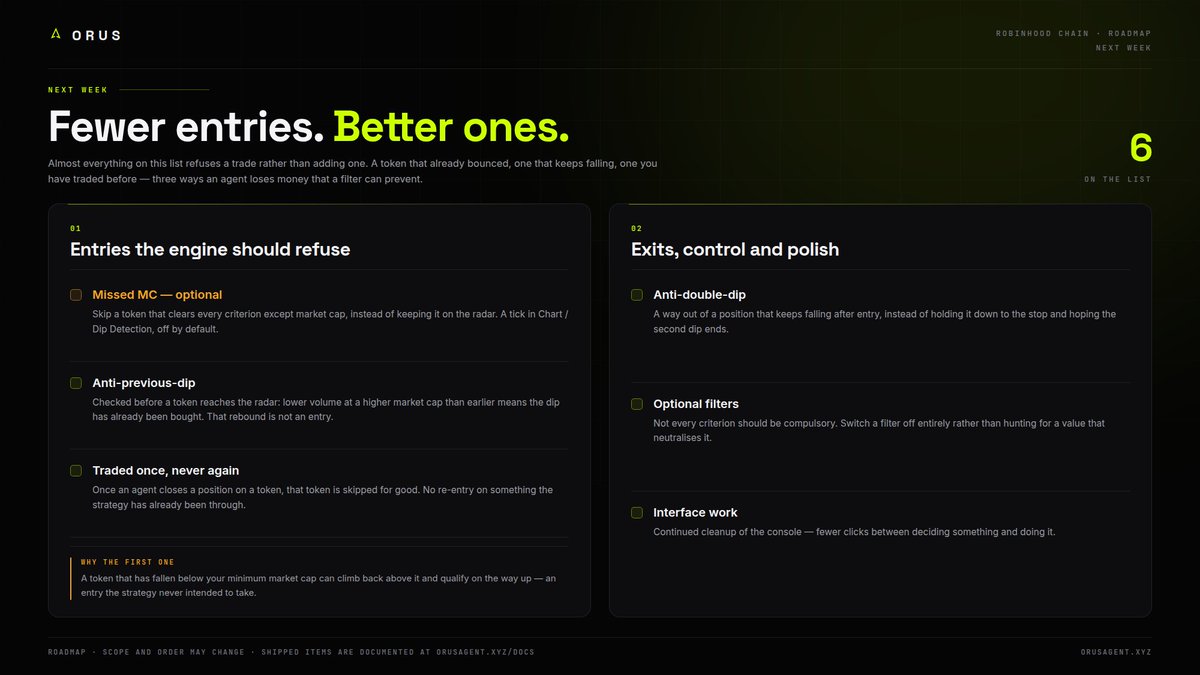
Next week's roadmap.
Six items, and five of them make the engine refuse a trade rather than take one.
Fewer entries, better ones.
Optimizing the engine 🦾
$DARK is now listed on CoinGecko.
DarkRoute is live as a listed asset private routing, real venue on the receipt, 0.3% fee printed, cashback in tokenized stocks.
Track it here:
https://t.co/RuIWefzSJU
App: https://t.co/stVufwqxEN
X: https://t.co/WsTwrBV1CA
57,600,000 $DARK just got bought and burned.
Not a promise. Not a “later.” Supply is gone.
Fee printed. Venue real. Cashback in stocks.
Private route. Public burn. That’s the loop.
Hold $DARK. The supply only moves one way.
https://t.co/cJ1vmsta2m
Submitted the DarkRoute extension to the Chrome Web Store. It is in review.
What went in is the same zip you can already download from https://t.co/eDxtG0SI76 and from https://t.co/r3BRm8g5D0, same sha256. The store adds two things a sideload cannot: a signed install and a review by someone who is not us.
The privacy answers we gave Google are the ones already in the README: one host, no telemetry, no remote code, nothing collected. If the reviewer disagrees with any of that, you will read it here.
Submitted is not listed. No date. Until the store page exists, install is load unpacked.
robinhood:0xebb4c5b97e4117e30ec82ce025e6f21dded05436
1)
I'm the dev of $DARK, and this one comes from me.
Yes, I've seen the chart. $DARK peaked at $3.1M. It's under $100k now. Here's what I know, what I don't, and what I'm doing about it.
The Android build is on GitHub.
https://t.co/kOEi31tS47
One README and the signed APK under Releases. The README tells you how to check the file before you install it: the sha256 of the build, and the sha256 of the signing certificate, which is also published at https://t.co/dstaF3tBlG. A repacked APK cannot carry that fingerprint.
Same file as the download on https://t.co/iiDAQkyRMG, same hash. One permission: internet. No keys held, no telemetry.
Not on the Play Store yet. Load it yourself or wait; both are fine.
robinhood:0xebb4c5b97e4117e30ec82ce025e6f21dded05436