Can you spot all the @dfinity@caffeineai & $ICP product placements?
AI Marketing will take on many forms in media.
Made an odd mix. Took a day to make. I think the rap lyrics and music came out well.
@PierreSamaties@JoshHQ@lomeshdutta@emiliocan@ricardo (any direct email where I can send something truly extraordinary?) 📧
Buzz from @jack is the future of AI
It allows you to command an entire army of AI agents
My Codex, Claude Code, Hermes, and OpenClaw agents all work together in one place to do mind blowing work
In this video I cover how it works and how you can get 100x productivity from it:
🇬🇪Georgia is becoming a major business hub.
The country’s economy doubled in 5 years and is growing by 8% a year.
International tech companies pay 0% corporate tax and just 5% on dividends and salaries.
Georgia is seriously underrated as a place to visit and do business.
This 6-hour course will cover everything that you need to get the “Claude Certified Architect” certificate
If you’re serious about AI this is a huge boost to your resume
Bookmark this and get started
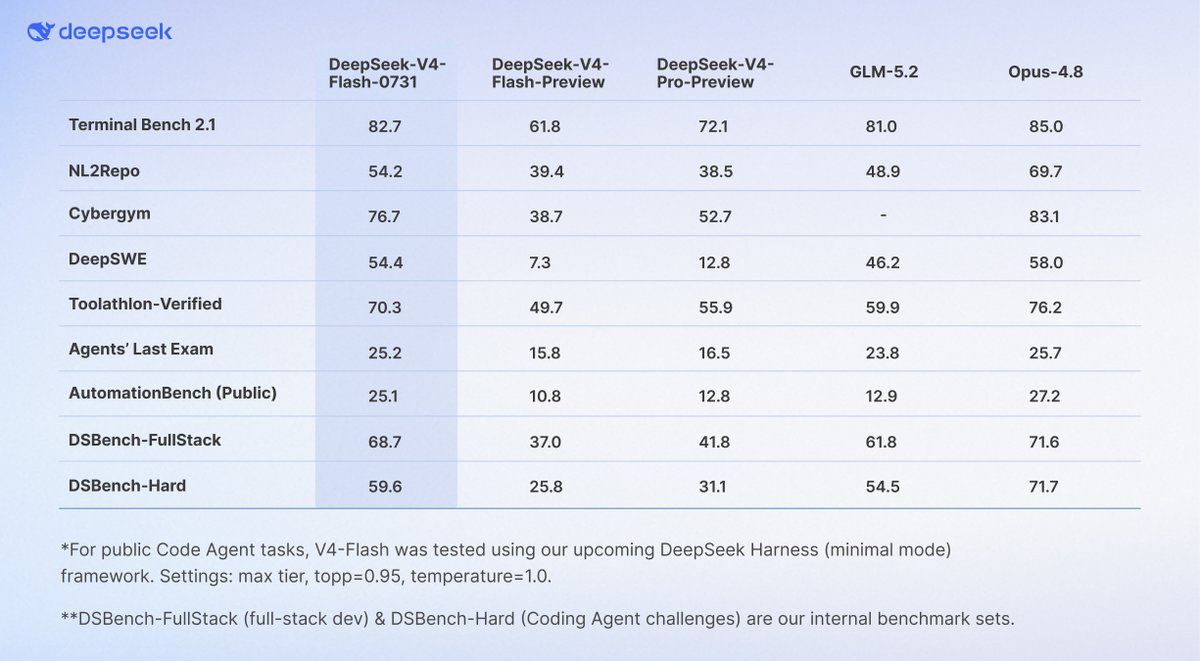
🚀 DeepSeek-V4-Flash Official API is now LIVE in public beta!
🔷 We’ve massively upgraded its Agent capabilities—benchmark scores are now far surpassing the V4-Pro-Preview. Check out the massive performance leap below! 👇
🔷 The official V4-Flash now natively supports the Responses API format and is fully adapted for Codex!
Check out the configuration details in our official API docs: https://t.co/smCwQZMeiq
I definitely think the solution is to ban powerful open source models, they're just too dangerous!!! (Urm, not really, this is a continuation of a dangerous regulatory capture play, and we all need access to powerful models to secure our code against others who have them.)
ChatGPT Voice has 100% transformed how I work
Instead of spending 12+ hours a day at my desk, I now spend at most 2
The rest is outside in nature. Picture below is me hiking this morning, getting WAY more done then I ever have at my desk
You need to be using it right tho
Here are my best tips for getting the most out of Voice:
1. Use it to delegate, not actually do the work. Every command you give to your Voice agent, ask it to spin up a new thread and have another agent do the work. Voice is powered by a lower intelligence model. By delegating tasks, it gives the task to 5.6 Sol and allows your Voice agent to free up time to keep working with you
2. Frequently ask for status updates on all the work it delegates. I have found a higher silent failure rate than I'd like with delegate agents. By forcing your Voice/chief of staff agent to constantly check in on delegate agents, you can assure they are on top of their work
3. 'Spruce' is the best voice. Most pleasant to talk to
4. When on the go, frequently ask your Voice agent to create HTML sites for research/tasks it does. This way when you get back to your computer you have well designed HTML sites explaining work your agent got done.
5. My favorite new routine is waking up at 6:00am, chugging water, putting on my weighted vest, grabbing my phone and airpods, getting outside, booting up the Voice Agent, then brain dumping everything on my mind about what I need to get done that day. The Voice agent then proceeds to spin up 10-15 new threads/agents to start tackling all of that work. By the time the clock hits 7:00am, I already have more work done than I was getting done in a full 8 hour work day before AI. Steal this routine
I'm probably the biggest power user of ChatGPT Voice outside of OpenAI employees. Truly blown away by this tech
If you take these tips and get the most out of Voice, I promise your productivity will 100x
this is f**king insane
a free github repo by Jack Dorsey (Co-Founder of Twitter) with 14.4K stars just dropped the entire "ai-agent" framework for running businesses
here is how you set it up:
1.clone the repo
2. self-host the server : channels, search, git, automation all live there
3.add your agent to a channel like a teammate, scope its key, let the team steer it live
save and bookmark this no matter what
For my first post, I’m sharing a letter @NVIDIA signed on why open models matter.
AI will transform every industry, power every company, and be built by every country.
Open models strengthen safety and cybersecurity, accelerate innovation and diffusion, and enable sovereignty.
The world needs both frontier closed models and frontier open models.
https://t.co/AUKzoQ5Ikb
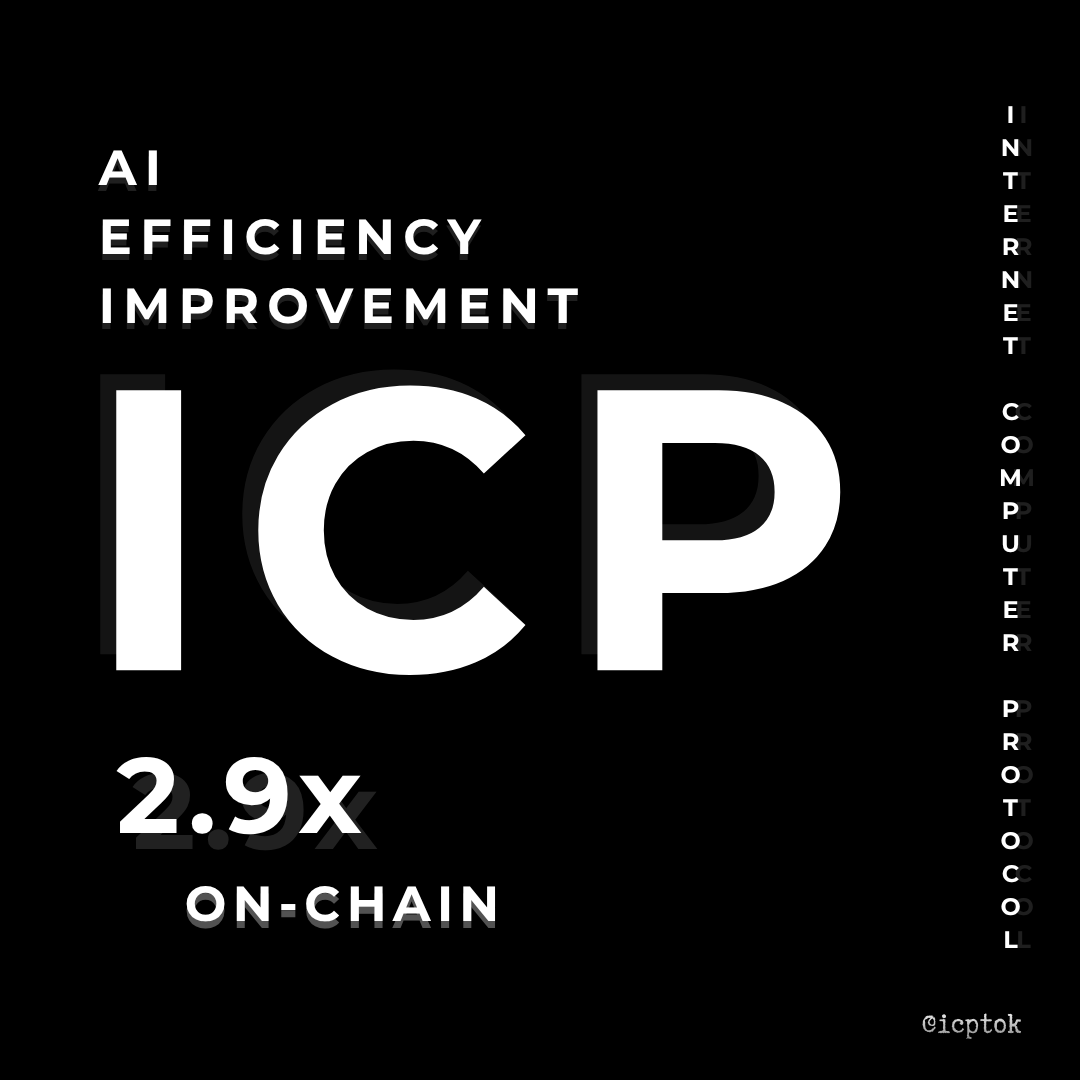
AI just became 2.9× more efficient on ICP.
Researchers from Meotis, Kaizen Corp and ORIGYN ran a small AI language model entirely inside ICP canisters without relying on external cloud servers.
Under the same computing limit, the optimized model generated 29 tokens instead of 10.
Why does this matter?
It’s another step toward AI agents and services that can run directly onchain, where their operation can be verified by the network instead of controlled by one company.
This is still research using a relatively small model, not “ChatGPT running on ICP.” But the results are transparent, with the paper, measurements and code publicly available.
Research: https://t.co/INn4PebxED
Paper: https://t.co/gMaUKtC5cX
Code: https://t.co/yLkXJ1S2CK
Traditional tech is riddled with holes that AI can find, and this will get much worse.
Enterprise needs to move to tamperproof cloud created by mathematical networks — ICP cloud engines. 2+2=4, and AI can't change that. Security is important.
https://t.co/8aQTKLuj57
We ran Kimi K3 against Fable on ~1,000 agentic tasks, expecting a catch-up story. We got a specialization story instead.
@kimi_moonshot's K3 outperformed on security, crypto, and long terminal loops. Fable beat on multi-lang + web/data viz. Per-task routing hits 93% accuracy, above BOTH models, at up to 50x lower cost than Fable on long loops.
The part nobody's pricing in yet: the router sends 72-96% of traffic to K3. The frontier model becomes the fallback rather than the default.
Kimi K3, coming to Fireworks July 27.
Coming soon with the release of ICP cloud engines... Open SaaS packs a dozen+ onchain services for running an enterprise — free forever, AI native, and simply better. Setup is as easy as installing a phone app, and they're remixable 🔥
Young Zhao, CEO of OpusClip, on the two types of problems AI founders should avoid:
The first mistake is building a feature for an existing customer base inside a workflow that an incumbent already owns.
"You are just building a feature for an existing type of ICP, ideal customer profile, within an existing workflow built by the incumbent."
The danger, he explains, is that "the incumbents can easily build a feature that bundles everything, and probably you won't have your own distribution channel."
He gives a concrete example:
"If you want to build a notetaker, think it through. Probably find another direction, because it's super easy for Zoom or Google Meet to have that feature in their existing workflow because you're targeting basically the same ICP, same market, same or adjacent use cases attached to a big workflow, a big platform."
The second mistake is failing to anticipate where the foundation models are heading.
"I think every AI founder should be somehow AGI-pilled, which means that you can predict, or you should be confident to make some predictions about, what the foundation models can release in the next few weeks or months."
His logic is simple:
"If they are already doing some job 80% very well, 90% very well, in their next few releases they can probably do that job 99% well, or even 100%."
So @opusyoung suggests a test to run internally:
"Run that test in your internal strategic discussions. If you're just becoming a wrapper with some prompts, then probably you don't have to write any prompts in the next release of Gemini or ChatGPT."
His solution is to own the entire workflow from start to finish.
"You need to focus on solving a vertical business problem by integrating the workflow end to end. You need to own the workflow end to end, so that AI is part of the workflow, but it's not all. Instead, if you build a wrapper with some prompt engineering, AI is almost the entire workflow."
We live in a new world. Open source has officially caught up to frontier
Qwen 3.8 is out, and it’s better than ChatGPT 5.6
6 months ago I told you to start buying hardware. Prices would explode and open source was going to catch up
Both happened.
Anthropic and OpenAI are now in big trouble
If individuals and companies can use 10% worse intelligence at 80% lower prices, they’re going to drop the OpenAI and Anthropic subscriptions
If these 2 companies fail and Chinese AI takes over, America will be in awful shape in the global tech and economic battlefield
It appears there is absolutely no way to stop Chinese companies from distilling American intelligence. If there was a way, they would have figured it out by now
I don’t know where things go from here. I don’t know if Anthropic and OpenAI get nationalized. But I also don’t know how you beat a country that is subsidizing their entire AI industry that allows them to run at a loss.
Whatever happens, the next couple of years will be the most thrilling of our lives
I just built my own coding harness, just like Claude Code. (100% open-source)
A harness is the code wrapped around an LLM. The model only decides the next step, and the harness handles everything else, planning, tools, memory, and safety.
In simple words model acts as the brain and the harness provides the hands.
A coding harness is that same wrapper pointed at a codebase. It turns a plain text generator into something that reads files, edits code, runs tests, and fixes real bugs.
Here's everything that went into mine:
- the core agent loop
- file tools that double as external memory
- planning for long-running tasks
- subagents that work in their own context
- sandboxed execution in a throwaway VM
- human-in-the-loop approval
- persistent memory and checkpointing
The whole thing is built on CrewAI, a 100% open-source framework.
I also wrote an article on this. It covers everything that goes into building a coding harness, the agent loop, planning, subagents, sandboxing, memory, and checkpointing, built step by step.
The article is quoted below.
A DEVELOPER PIPED CLAUDE DIRECTLY INTO OBSIDIAN, AND IT BUILT A SELF-ORGANIZING SECOND BRAIN
Most productivity setups still force you to manually tag and link every single idea you save.
This workflow runs on a continuous retrieval-augmented pipeline instead, reading raw markdown files and mapping connections instantly.
It scans your daily notes against your entire vault after every entry, so the knowledge graph expands without any manual structuring.
By pushing local Obsidian data through Claude's massive context window, it synthesizes complex ideas instead of hoarding dead links.
You no longer need rigid folder structures, as this architecture turns scattered personal thoughts into a queryable private database.
See how this automated RAG architecture actually operates below👇
Enterprise infrastructure must be urgently migrated from traditional tech stacks onto tamperproof serverless clouds created by mathematical networks. Mythos+ models can't make 2+2=5. AI will make migration painless. Security based on model supremacy assumptions *will* break down.