I signed this petition to improve diversity in conferences on computational topology - the significant impact of underrepresented minorities in this field should be accurately portrayed in its conferences https://t.co/fDIAtfpR04
Excited to share NeuMapper, our new computational framework for neuroimaging data analysis based on the Mapper algorithm from topological data analysis. Led by @calebgeniesse & @samircwrites Just out in @netneurosci https://t.co/OJ1NaZKcXm
In our Annual Letter, @BillGates and I reflect on the hard work, heroism, and global cooperation that brought us closer to ending this pandemic, and why prioritizing equity must come next.
I hope you’ll read it. https://t.co/dGxiepq0Zm
@DrBiden has a long record of kindness, empathy, and public service, and she’s continuing that moving forward. @WSJopinion, on the other hand, is clearly going a different way...
"Make time to rest or the world will steal it from you"
Ominous title, but really an encouraging weekend read
https://t.co/cRsS7fX5VT via @financialtimes
By automating the parameter selection procedure and providing new posthoc analysis tools for the Mapper algorithm (that does not average across subjects), we hope to move closer toward clinical translational applications. (5/n, n=5)
#OHBM2020 attendees: Come check out poster 1114 at #OHBM2020Posters for our take on how insights on behavior and neurobiology can be revealed using topological data analysis and optimal transport. Joint w/ @calebgeniesse@manishsaggar. Tweetstorm incoming (1/n)
@OHBM [2/6] Next-gen mapper: improvements include: (1) introducing a new nonlinear Mapper framework, (2) automating parameter selection, and (3) showing how optimal transport can reveal novel insights about neurobiology and behavior. @calebgeniesse@samircwrites
These constructions are derived from a new, nonlinear implementation of Mapper that stays in the high-dimensional ROI/voxel space... and its parameters are optimized via an automated procedure that relies only on the autocorrelation structure of the time series data
@geometricdog sure! beyond the references provided in that paper, an excellent reference is the Computational OT book: https://t.co/zIdM04gJIz
Tom Needham and I also released a followup work (with more code!) recently: https://t.co/3spugK16fc
For #CVPR2020 attendees: #diffcvml workshop happening now: https://t.co/ADsdjwiVPL
Exciting list of keynote speakers + short orals + flash poster presentations. Lots of TDA talks! Full program here as well: https://t.co/nU5LM55Xx2
Postdoc opening in the current market with exciting multi-lab collab opps🤯🤯🧬📈 combining math training with empirical science context has been instrumental in helping me clarify the societal implications of my research q. Apply if you think this could be a good fit!
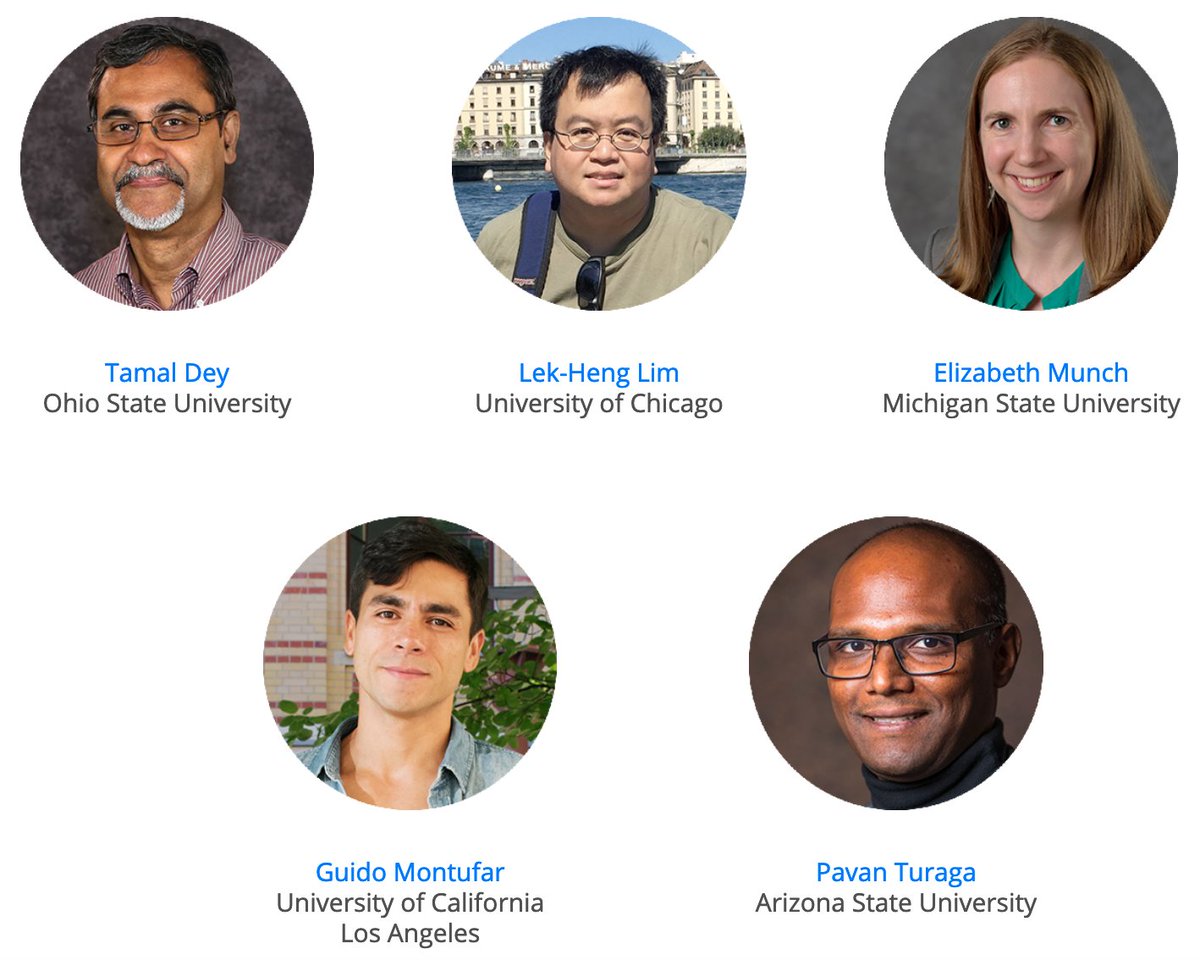
Register now for the next MBI and TGDA@OSU virtual workshop on July 27-31! Optimal Transport, Topological Data Analysis and Applications to Shape and Machine Learning. https://t.co/xE3OdlU5Xg
If there are infinitely many parallel timelines, there are exactly (measure) zero where I will miss the nightmare of removing comments line-by-line before arxiv upload




![manishsaggar's tweet photo. @OHBM [2/6] Next-gen mapper: improvements include: (1) introducing a new nonlinear Mapper framework, (2) automating parameter selection, and (3) showing how optimal transport can reveal novel insights about neurobiology and behavior. @calebgeniesse @samircwrites https://t.co/sGgogA8DCt](https://pbs.twimg.com/media/EbNqCqtUwAEgVQ_.jpg)


