CEO @ Veloxy | Helping Field Sales Teams 2X Productivity in 30 Days, 3X Pipeline in 60 Days, and Shorten Sales Cycles by 30% in 90 Days | 100% Free for Q1
Who wants a copy of my new eBook?
I analyzed all 7 State of Sales Reports (Salesforce Research) over the last 11 years so you don't have to.
Follow me & drop in my Chat.
Workbook included. Make REAL progress these next 5 months and walk into 2027 with more confidence and acknowledgement than ever before.
What are you reading this weekend?
Comment "PARADOX" and I'll send you the book and its complimentary workbook.
PS. It's only July, but this book will help sales leaders walk into 2027 with MASSIVE amounts of confidence.
🚨 Wake Up Call 🚨 “Regulated industries are moving fastest with AI… healthcare, financial services, and life sciences."
Why? 👇
Years of investing in data security, governance, and data quality are finally paying off.
They’re using private, high-value data to build useful #AI agents, automate real work, and leapfrog older digital transformation efforts.
The lesson for sales leaders: clean, trusted #Salesforce data may be the key to unlocking AI success.
https://t.co/2XkkPiunK0
79% of sales teams increased revenue. 84% of reps had missed quota the prior year. Most leaders celebrate the first number, and here's why that's a problem...
I focus on the warning buried in the second number, because it tells you something revenue alone cannot.
Revenue can rise while the sales model breaks underneath it.
Those percentages describe different respondent populations, so I would not treat them as a direct comparison. But the tension matters BIGTIME.
If you only ask, "Did we grow?" your system may look healthy.
I would ask a harder question: "What did growth cost us?"
How much rep time did it require?
How much manager intervention?
How many internal meetings?
How much sales ops cleanup?
How much discounting?
How much of the forecast had to be rebuilt manually?
How many deals depended on a top rep or executive saving them?
A healthy sales system does more than produce revenue. It produces revenue repeatedly, with enough selling time, trusted Salesforce data, useful coaching, clean handoffs, and less dependence on heroics.
An unhealthy system can still hit the number. It just becomes more expensive and harder to repeat every quarter.
Your revenue result tells you what the system produced. The operating cost tells you whether the system is built to do it again.
I wrote "The Sales Productivity Paradox" and its workbook to help you inspect that cost and identify the first constraint to remove.
Comment "HEALTH" and I'll send you the eBook + workbook.
Just make sure we're connected first.
Sales teams have more tools, data, dashboards, and AI than ever.
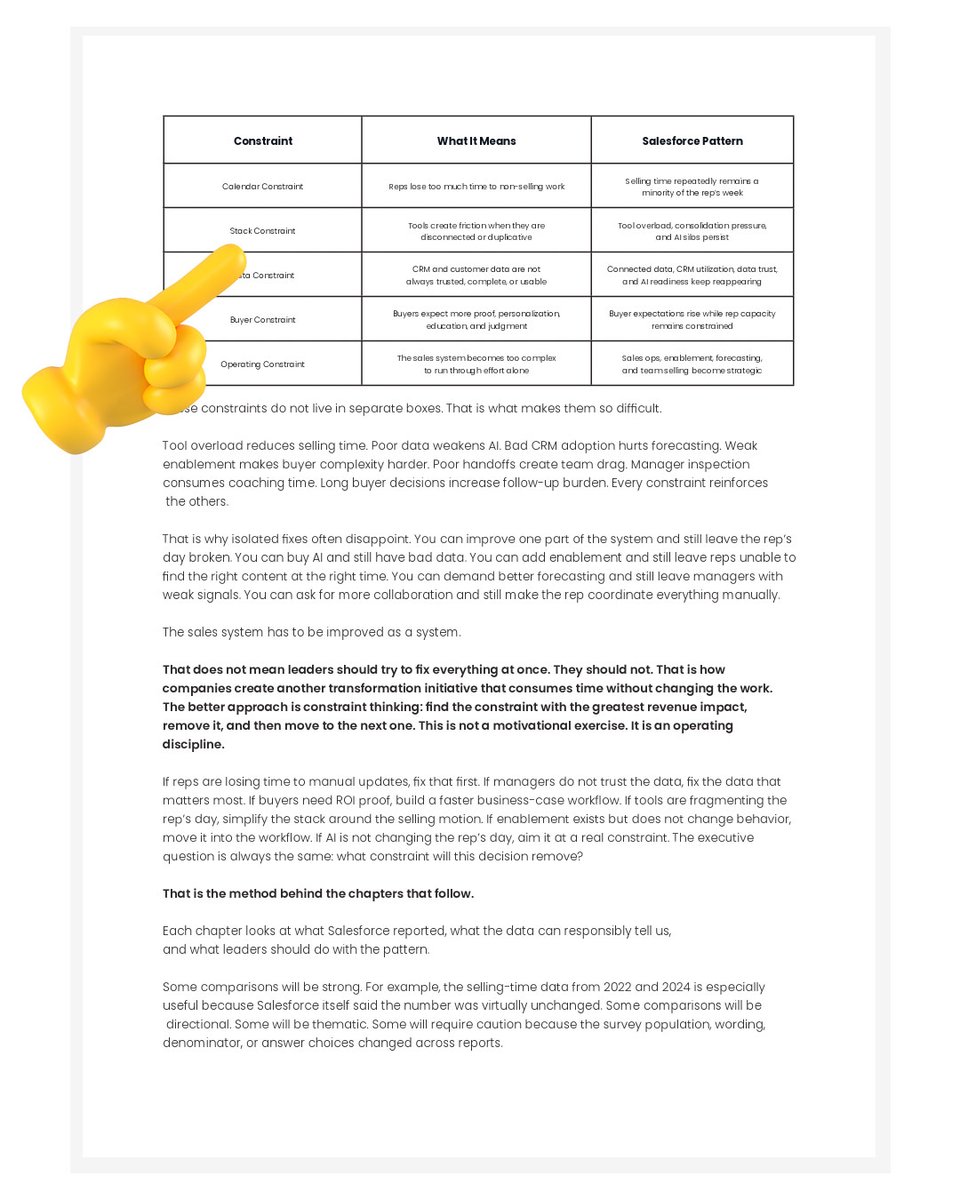
Yet the same 5 constraints keep showing up 👇
I believe most leaders are fixing the visible symptoms while the real bottleneck survives underneath.
The 5 constraints are:
1. Calendar: your reps lose too much time to non-selling work.
2. Stack: disconnected tools create duplicate work and context switching.
3. Data: Salesforce is updated, but not always trusted or useful.
4. Buyer: expectations rise faster than your reps' time and context.
5. Operating: coaching, forecasting, enablement, handoffs, and AI do not work as one simple system.
I've seen leaders attack 1 symptom while another constraint keeps the system stuck.
You can buy AI and still have weak data... You can add enablement and still make reps hunt for the right content... You can demand better forecasts while managers rebuild the truth manually... You can add collaboration and make the rep coordinate every handoff.
That is the "Sales Productivity Paradox". We keep adding capability without removing constraint.
My advice is simple: do not try to fix all 5 at once. Find the 1 constraint with the greatest impact on revenue, rep capacity, and the buyer. Remove it first. Then move to the next one.
I built a Fast Diagnostic and 5 constraint scorecards into The Sales Productivity Paradox workbook to help you identify where to start.
Comment "CONSTRAINTS" and I'll send you the eBook + workbook.
Just make sure we're connected first. Thank you
Sales leader: “We need more calls, more meetings, and more pipeline reviews.” It sounds decisive, But...
One question reveals whether the plan will improve sales productivity or make the system heavier.
Most teams never ask it.
What work will you remove first?
Pressure creates motion. It gives leaders something to announce Monday morning. But it rarely removes the work blocking the sale.
Ask reps for more calls while most of the week disappears into non-selling work, and the capacity problem remains. Ask managers to coach more while their calendars are consumed by inspection and forecast reconstruction, and the coaching problem remains.
Launch hashtag#AI while Salesforce data is incomplete or scattered across tools, and the intelligence problem remains. Ask reps to act like trusted advisors without enough account context, proof, or preparation time, and the buyer problem remains.
Before prescribing more activity, let's diagnose the system:
• Where is productive work getting trapped?
• Which meeting, field, update, or handoff is adding friction?
• What is leadership asking reps to do that the system should remove?
• Which constraint has the greatest revenue impact?
Pressure treats the symptom. Diagnosis identifies the constraint. Leadership removes it.
I turned this shift into a 45-Minute Executive Diagnostic in The Sales Productivity Paradox workbook.
Comment “DIAGNOSE” and I’ll send the eBook + workbook.
Across 7 Salesforce reports, 1 sales productivity problem kept returning.
Most leaders kept trying to fix it with more tools, dashboards, pressure.
But the clearest evidence was hiding in 1 place few sales leaders inspect.
The rep’s calendar.
A dashboard can show an active pipeline. Salesforce can be full. Revenue can be growing. But the calendar reveals what the system is actually demanding from reps.
I’ve seen the same pattern across 500+ sales organizations across 10 years: reps are busy but not always selling; managers are informed but not always coaching; Salesforce is updated but not always trusted; and new tools or AI are added without old work disappearing.
The problem rarely looks dramatic. It looks like 20 minutes cleaning up notes, a spreadsheet for the “real” forecast, another dashboard, or a buyer waiting while the rep searches for ROI proof.
Each task seems reasonable. Together, they consume revenue capacity.
Across the reports that measured selling time, reps repeatedly spent most of the week away from direct selling. The studies were not identical, but the recurring signal is hard to ignore.
Before adding another tool, meeting, field, or activity target, inspect 1 rep’s actual week. Look for duplicate work, updates happening outside Salesforce, and technology that adds steps instead of removing them.
A dashboard tells you what the system reported. The calendar tells you how the system works.
Want a copy of my new book "The Sales Productivity Paradox" and the complimentary Workbook that shares all observations, takeaways, and action items from the 7 State of Sales Reports?
Comment Paradox and make sure we're connected. I'll send them to you.
46% of sellers using AI agents say bad data is hurting sales.
Here's the 5-minute @Salesforce trust test I'd run before buying another AI tool:
Pull 10 open opportunities. For each one ask:
1. Does the stage match where the buyer actually is?
2. Is there a specific next step, owner, and date?
3. Are the real decision-makers in Salesforce?
4. Is the latest customer conversation captured?
5. Is the close date based on buyer commitment or seller hope?
If your team debates most of those answers, AI is not the first problem.
I've spent 10+ years around Salesforce-powered sales orgs, and the pattern is familiar.
Reps do the real work with the customer. THEN they record it later... if they have time.
Managers do not fully trust the record, so they ask for the "real update" in Slack, a spreasheet, or the forecast meeting.
Now the same deal exists in three places.
And the AI only sees one of them
That is why 1 chapter of my upcoming Ebook, "The Sales Productivity Paradox", is called:
AI Readiness is CRM Hygiene with a New Name
The Ebook looks at recurring patterns across 7 Salesforce State of Sales reports.
I'm releasing it with a free workbook for sales leaders who want to identify where their system is stealing selling time, data trust, and revenue capacity.
1 of the tools inside is a CRM Trust Audit
It helps leaders inspect which Salesforce fields reps actually use, which ones managers trust, and which data AI depends on before making recommendations.
For field teams, this usually starts with the workflow.
Can the rep capture the meeting, next step, and deal risk while the conversation is still fresh?
Or
Does Salesforce become homework at the end of the day?
Because the longer the update waits, the more context disappears.
And
AI cannot act on customer truth the system never captured.
Before adding another agent, pilot, or dashboard,, run the trust test on 10 opportunities.
You may discover that your most important AI project is fixing the workflow feeding it.
Comment DATA and I'll send you the ebook and workbook when they're ready.
Sales Leaders...
Do you have time to read 7 State of Sales Reports, ie 301 pages of Salesforce Research findings and recommendations spanning 11 years, in only 31 days?
No one does! Which is why I did all of the heavy-lifting for you by writing an Ebook and designing a complimentary Workbook.
The two together will help your Sales Org double productivity and pluck 10 friction points or more from your sales process.
Who wants the Ebook and workbook?
No form fill required.
Just comment "PARADOX" and connect with me.
And Happy Friday!
2:14 PM - a field rep leaves a customer meeting.
2:46 PM - Salesforce is already behind his reality.
Here's what happened in those 32 minutes...
2:16 PM - gets back to the car
2:18 PM - checks notes before the next visit
2:20 PM - opens Salesforce from the phone
2:22 PM - updates the account
2:25 PM - updates the opportunity
2:28 PM - logs the activity
2:31 PM - creates the next step
2:33 PM - checks quote status
2:36 PM - sends the follow-up
2:39 PM - texts his manager, "Good meeting, next step Friday."
2:41 PM - updates his spreadsheet because, "that's where I live."
2:46 PM - leaves for the next account.
Look familiar?
None of this looks ridiculous in isolation.
That's the problem.
Every step has a reason.
Salesforce needs clean data. The manager needs visibility. The buyer needs follow-up. The forecast needs updating. The quote needs tracking. The team needs context.
But together, they turn the rep into the integration layer.
That is the Stack Constraint.
Not “too many tools” in the abstract. A real workflow where the rep has to keep Salesforce, email, notes, forecasting, quoting, manager updates, and side spreadsheets aligned after every customer conversation.
I’m releasing a FREE ebook + implementation workbook next week called "The Sales Productivity Paradox"
I wrote it for sales leaders who see this gap every day: Field activity happened. But Salesforce does not show the truth fast enough.
The workbook includes a Before & After Meeting Workflow Map. It does not start with: “What tools do we own?”
It starts with: “What happens before and after one customer meeting?”
Then you audit:
- tools touched
- duplicate updates
- manual handoffs
- delayed Salesforce updates
- side-channel manager updates
- spreadsheet workarounds
- work to remove, simplify, or automate
Because the goal is not fewer tools.
The goal is a cleaner path from field activity to Salesforce truth.
That is also Veloxy's lane:
Make Salesforce Work for Field Sales.
- In the car.
- Between visits.
- Right after the meeting.
- Before the conversation gets cold.
P.S. Comment STACK and I’ll send you the free ebook + workbook when they’re ready.
Ross Perot hit his entire annual IBM sales quota by January 19, 1962.
Want to hit your annual quota before Q4 EVERY year?
Reserve time on my calendar. I'll show you how.
Your dashboard can look healthy while the rep’s week is broken.
Here’s the calendar audit I put in the free workbook:
The ebook is called "The Sales Productivity Paradox"
I’m releasing it next week with a free implementation workbook for CEOs, CROs, VPs of Sales, RevOps, Sales Ops, Enablement, Salesforce leaders, and field sales leaders.
The first constraint in the workbook is the one most leaders skip:
The Calendar Constraint.
Because the dashboard tells you what the system captured,
but the calendar tells you what the system cost.
I’ve seen this pattern inside Salesforce-driven sales orgs for 10+ years.
- The pipeline report looks active.
- The CRM has records.
- The forecast meeting has updates.
- The manager has dashboards.
- The rep has activity.
From far away, the system looks productive. Then you look at the rep’s actual week. That is where the truth usually shows up.
- Internal meetings.
- CRM updates.
- Follow-up cleanup.
- Quote approvals.
- Forecast prep.
- Manager check-ins.
- Research across scattered systems.
- Notes entered after the field visit.
- Opportunity updates at the end of the day.
One task does not look dangerous. The accumulation is the problem.
A rep does not lose the week all at once. They lose it 12 minutes at a time.
That is why the workbook includes a Rep Week Audit.
It asks leaders to map where time actually goes:
- customer conversations
- prospecting
- follow-up
- CRM/admin
- internal meetings
- approvals/quotes
- research/preparation
- training/coaching
- tool management
Then every activity gets judged against 1 question: Does this help the rep create buyer progress?
Not all non-selling work is waste.
- Planning can help.
- Coaching can help.
- CRM updates can help.
- Research can help.
But every activity should earn its place in the week.
Especially for field sales teams.
If Salesforce becomes something reps update later, leaders end up managing yesterday’s truth. That is when pipeline visibility gets fuzzy. Forecasts get weaker. Managers ask for side updates. And reps get even more admin.
(can you tell I'm passionate about this stuff???)
The first move is not more pressure.
It is a cleaner calendar.
P.S. Comment CALENDAR and I’ll send you the free ebook + workbook when they’re ready.
I read 7 Salesforce State of Sales reports so you don't have to.
Here's the pattern that kept showing up.
Sales teams keep adding capability,
but reps still spend most of their week not selling.
That sentence bothered me enough to turn the research into an ebook and workbook.
The ebook is called: The Sales Productivity Paradox
and
The workbook is the implementation guide
and
It's yours. All you have to do is ask.
It helps leaders diagnose which constraint is stealing the most selling time, trust, clarity, and revenue capacity.
Here’s the pattern I saw across the reports:
In 2017, reps spent 36% of their time selling.
In 2018, 34%.
In 2022, 28%.
In 2024, 30%.
(You comfortable with reps spending 1,331 to 1497 hours a year NOT selling?)
At the exact same time, Sales Orgs kept adding:
- CRM workflows
- dashboards
- forecasting systems
- sales engagement tools
- enablement platforms
- automation
- AI
- more process
- more inspection
- 10 tools to close deals & 20+ tools overall.
All meant to help,
but not always designed to remove busywork.
THAT is the paradox.
We keep adding capability.
We do not always remove constraint.
The problem is rarely that reps are lazy. The problem is usually that the sales system keeps pulling capable reps away from capable buyers.
That is why the workbook focuses on 5 constraints:
1. Calendar
2. Stack
3. Data
4. Buyer
5. Operating
The goal is not to fix everything at once. The goal is to find the first constraint, prove it with evidence, and remove it.
The ebook and workbook will be available soon.
P.S. Comment PARADOX below and I’ll send you both when they’re ready.
3 AI mistakes field sales & outside sales teams should avoid.
AI is everywhere right now. But most AI conversations in sales are built around the desk.
More emails, faster. More sequences, faster. More scripts, faster. More messages, faster.
That may help some teams.
But field sales & outside sales has a different problem.
The rep does not need 200 more words written by a robot.
They need to know:
Who should I visit?
Who should I follow up with?
Which account matters most right now?
What did I forget after the last meeting?
What action will move revenue today?
That is where AI... specifically AI for Sales should help.
Not by making field sales less human.
By removing the work that keeps reps from being human with customers.
Here are 3 key mistakes I woulud avoid:
1️⃣ Using AI only to create more outreach
Volume without priority creates noise.
2️⃣ Using AI as another dasboard
Reps do not need more places to look
3️⃣ Using AI outside the workflow
If AI is not connected to Salesforce, activity, accounts, timing, and follow up, it becomes another disconnected tool on a tech-stack begging for consolidation.
The best AI in Sales is not louder outreach.
It is better prioritization.
Better timing.
Less manual work.
A rep's best hour should be spent with customers.
Not digging through systems to decide what to do next.
Want to chat about AI and Field/Outside Sales? Find my Calendly link on my LinkedIn Profile (under Experience > Veloxy).
Blue pill: your reps need more CRM training.
Red pill: your CRM needs to fit how reps sell
This is one of the biggest mistakes I see in field sales.
A team struggles with Salesforce adoption.
So leadership adds: more training, reminders, required fields, dashboard reviews, and pressure from managers.
But the real issue is usually simpler.
The workflow does not match the job.
Field reps do not live in Salesforce all day.
They live in territories. They move between accounts. They follow up from the road. They make decisions with partial information, changing schedules, and small windows of opportunity.
So when Salesforce becomes something they update after selling is finished, the CRM is already one step behind the business.
That is not a motivation problem. That is a design problem.
the best adoption strategy is not forcing reps to use a tool that slows them down.
It is making the tool useful before the manager asks for the update.
Can the rep see who to visit next?
Can they follow up without switching tools?
Can activity be captured as a byproduct of selling?
Can Salesforce become a source of action, not just a place to store records?
That is the shift.
Do not ask field reps to fit the CRM.
Make the CRM fit the field.
What pill did your team select?
5 signs Salesforce is slowing your field sales / outside sales team.
It's not because Salesforce is bad. Salesforce is the best CRM on the planet.
But field sales and outside sales does not happen at a desk.
It happens between meetings. In territories. On the road. In the short window when follow up still matters.
And that is where many CRM workflows break.
Here are the 5 signs the problem is workflow, not motivation.
1️⃣ Reps update Salesforce after the day ends.
That means the system is already late.
2️⃣ Managers chase updates before they coach.
That turns visibility into admin pressure.
3️⃣ Reps use notes, spreadsheets, and memory before Salesforce.
That means the CRM is not helping in the moment.
4️⃣ Activity data looks clean only after cleanup.
That usually means the workflow is too hard to trust.
5️⃣ Follow up depends on reminders, not priority.
That creates noise instead of action.
The answer is not more training. It is not more dashboards. It is not another meeting about adoption.
The answer is to make Salesforce more useful while the rep is selling.
Less admin. Cleaner data. Better next actions.
That is what field ready Salesforce should feel like.
Comment FIELD and I'll send you a workbook on the 7 Secrets to Sales Success when you have Salesforce CRM.
AI won't replace sales reps.
It's impossible. It's foolhardy. It's a fad.
It will, however, improve reps' performance and morale like never before.
The average rep spends 60% of their day (1,248 hours a year) on work they do not want to do. Morale crushing, boring, redundant work.
Data entry. CRM updates. Follow-up reminders. Lead shuffling. Admin.
That's not sales... I mean, that's not trusted advisement or relationship building, which are cornerstones of the sales profession.
It's sales prevention, and that's exactly what AI should be used to eliminate.
The non-human side of sales.
Let AI handle the boring work, and let human sales reps handle the work that actually moves deals.
Building trust. Reading the room. Drop-ins. Advising the buyer. Personalized follow-up. Improving the pitch.
The best reps don't want to work less.
They want to waste less.
AI won't replace great salespeople.
It will reveal them.
Be more human. Let AI do the rest.
Imagine choosing Gut Instinct over Sales AI...
Not something coded on Claude...
Actual Artificial Intelligence designed by Quota-Crushing Sales Pros, that works 24/7/365, discovering and analyzing all the right buyer signals to push the most ready-to-buy leads to the top of your outreach every single morning.
Your gut chooses the wrong candy bar from the vending machine 66% of the time when your hangry.
Don't leave your Q2 or EOY Quota to chance.
Start using Sales AI today, and fall in love with sales all over again.