Hélas, France Info reprend la fake news des 50 cl déjà débunkée 8000 fois depuis 3 ans. Et se plante également en beauté sur l'emploi généré par les datacenters, comme si les emplois locaux étaient les seuls à prendre en compte.
Un moteur de voiture électrique moyenne : environ 200-250 kW
Un ordinateur avec GPU : ~1 kW
Un calculateur de voiture autonome : conso similaire
Méconnaître ces chiffres, c'est potentiellement prendre de mauvaises décisions en politiques publiques.
I have been saying it several times already, but let me say it again:
Neoclouds can’t be a profitable business; actually, they were never meant to be a profitable business. As long as Nvidia maintains a strict target of a 70% margin and prices its GPUs at current levels, and probably higher, while the costs of components continue to rise, neoclouds can’t be profitable.
Now then, if they can’t be profitable, what’s the point of neoclouds?
1. To provide demand for Nvidia GPUs. Therefore, if you are a neocloud, considering opening a neocloud, or thinking about transitioning your shoe store, parking lot, or crypto mining business into a neocloud, give Jensen a call. He will help you with A to Z: financing, clients, everything. You will be rich. I’m not sure about your investors, but that doesn’t matter, because they know it and will aim to IPO the neocloud so they can exit. Also, don’t worry about bankruptcy. Nvidia needs you. You will be part of their Special Forces of Demand. They will help you survive, secure financing, and keep purchasing their GPUs for as long as possible.
2. To make sure that Nvidia’s Balance Sheet is as clean as possible. Nvidia doesn’t want any loan, debt, financing. they want clean balance sheet. therefore they outsources all to Independent SPVs.
Exemple concret: un actif en emploi ayant un niveau de vie très modeste contribue une part plus importante de son revenu disponible au financement de l’assurance maladie qu’un retraité très aisé. Alors que le second a un niveau de vie plus de trois fois supérieur.
À niveau de vie comparable, les actifs contribuent le double.
First time I have seen $NVDA's Jensen having some issues in explaining $NVDA's moat vs ASICs like $GOOGL TPUs and $AMZN Trainium.
Why does Anthropic use TPUs and Trainium?
Jensen: "Anthropic is a unique instance, not a trend"
I really got to tip my hat to @dwarkesh_sp; he is one of the rare interviewers who first gets extremely well-prepared for an interview and, secondly, is true to his viewers more than the guests and asks tough questions, even though the interviewee might not like that.
"Les datacenters ne sont pas une anomalie du monde contemporain. Ils en sont l’une des conditions de fonctionnement. Les désigner comme un problème isolé, sans intégrer leur rôle systémique, revient à produire une lecture partielle, donc inopérante". Très bon billet de @stertrais
The people in this photo aren't friendlier than you. Their apartments are just smaller. So small that Parisians basically gave up on living indoors and moved their living rooms onto the sidewalk. And that was the whole plan.
In the 1850s, a city planner named Baron Haussmann tore apart medieval Paris and rebuilt it. He widened streets into boulevards, capped every building at five stories, and added one rule that explains this entire photo: the ground floor of every building had to be a café, a bakery, or a shop. The apartments above were intentionally tiny. Some were single rooms carved out of old mansions. No garden. Barely any sunlight. A private balcony was something most Parisians would never have.
So the café became home. You ate breakfast there. Held meetings there. Received your mail there. By the late 1700s, Paris already had close to 2,000 of them. In 2002, there were still 1,907. Even now, after years of closures brought that number to about 1,410, the coverage is absurd: a 2020 city study found 94% of Parisians live within a five-minute walk of a bakery. When COVID shut indoor dining in 2020, Paris ripped out parking spaces, turned them into outdoor terraces, and let 9,800 cafés and restaurants keep them permanently.
An American sociologist named Ray Oldenburg wrote a book in 1989 called The Great Good Place. He had a name for spots like the Parisian café: "third places." Not your home, not your office, but the casual in-between spots where you actually get to know people. Cafés, pubs, barbershops, the corner store where the owner knows your name. His whole argument was that American suburbs were built with only two zones, your house and your job, connected by a car. No sidewalk café, no place to bump into a neighbor by accident.
The U.S. Surgeon General declared loneliness a national health epidemic in 2023. Being alone all the time is as bad for your body as smoking 15 cigarettes a day. Half of American adults say they feel lonely. Weekly socializing dropped from 5.5 hours in 2003 to just 4 hours in 2023, and it never bounced back after COVID. Americans between 15 and 29 now spend 45% more time alone than they did in 2010.
The scene in this tweet looks like a personality trait. It is a 170-year-old engineering project that works exactly as designed.
Le niveau d’ingérence et d’infantilisation que les Français acceptent dans leur vie quotidienne, ainsi que la complexité qui en découle, sont absolument grotesques.
Rien ne l’illustre mieux que ce délire qui consiste à verser une partie des salaires en tickets trucs, chèques machins et comptes à la con, au lieu de simplement laisser les gens dépenser librement leur salaire net.
Memory is taking over Hyperscaler CapEx.
In CY23 and CY24, memory was ~8% of total Hyperscaler spend. We estimate it hits 30% in CY26 and moves higher in CY27. That's a near-4x shift in just four years. (1/4) 🧵
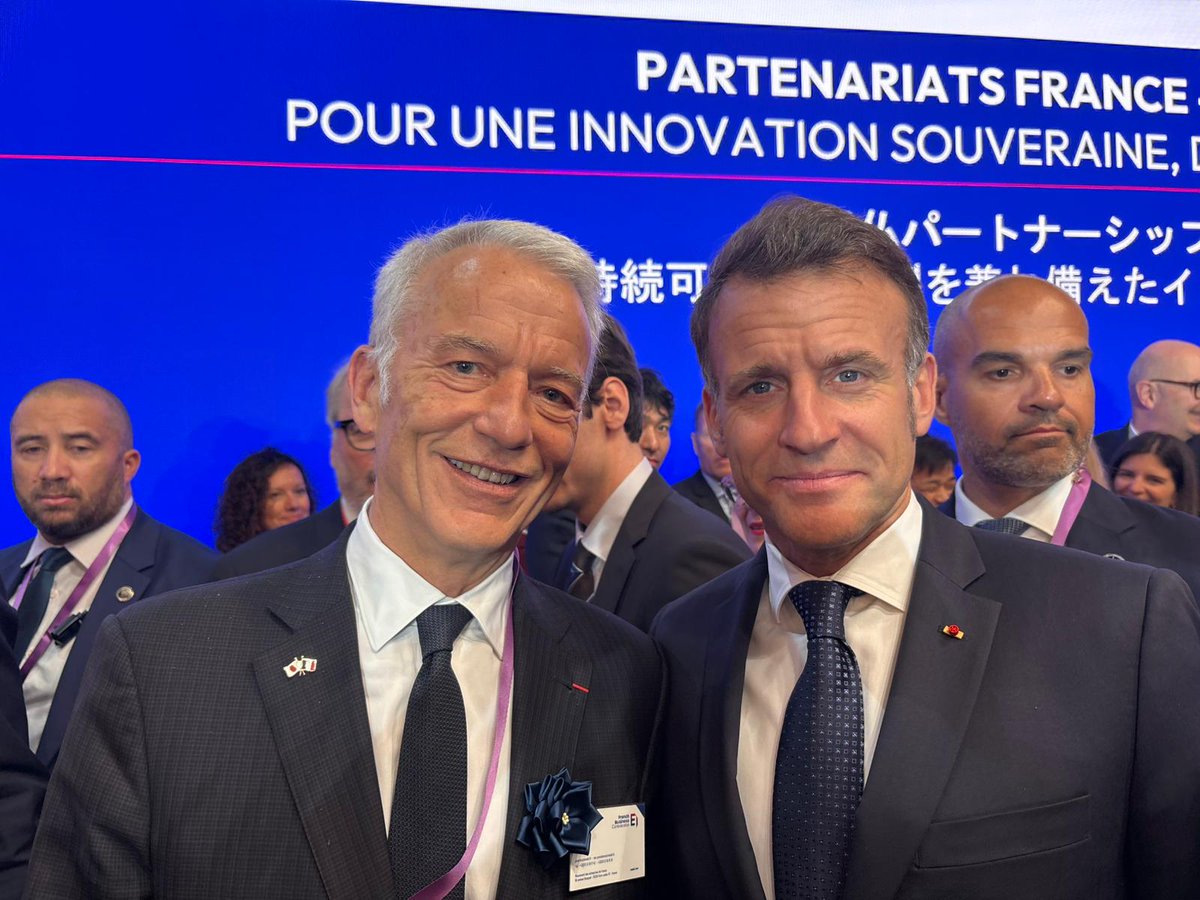
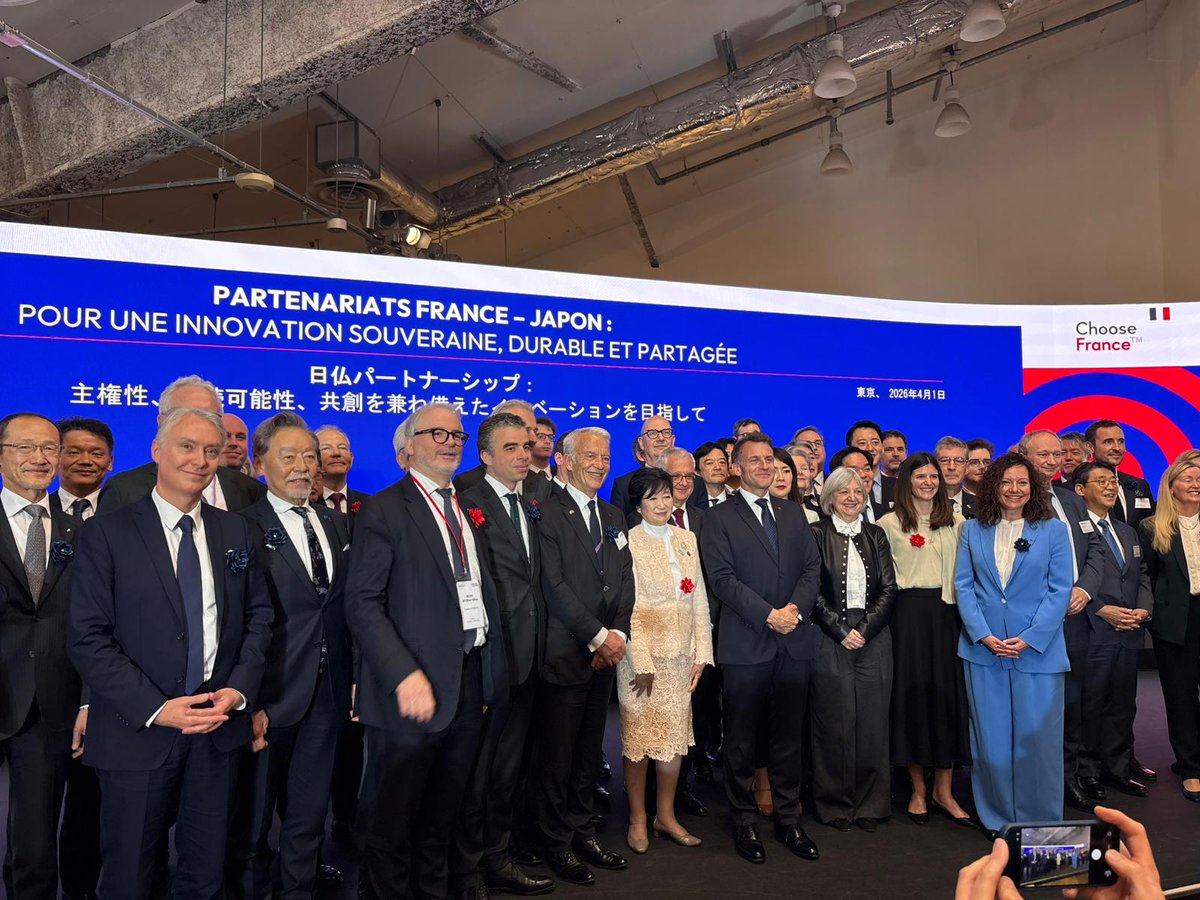
De retour de Tokyo, encore un peu jetlagué 🇯🇵, où je suis intervenu au forum économique sur la coopération 🇫🇷🇯🇵 dans les secteurs stratégiques, dans le cadre du déplacement du Président @EmmanuelMacron.
Une conviction s’impose : nous changeons d’échelle.
Industrie, innovation, souveraineté technologique, décarbonation : nos entreprises ont tout pour construire des partenariats puissants et durables.
Dans un monde plus instable, le partenariat franco-japonais n’est pas seulement utile, il est stratégique. Un levier de confiance, d’investissement et de compétitivité.
Kamehameha ! 🇯🇵🇫🇷 La souveraineté numérique s'écrit aussi en japonais :
La visite officielle de @EmmanuelMacron au Japon concrétise une vision ambitieuse dans l’IA, le cyber, le quantique ou encore le spatial :
👉Déclaration conjointe sur l'IA, accord entre CurrentAI x Sakana AI, Mistral AI x NTT DATA, Exotrail x Astroscale et tant d’autres.
👉Une première mondiale : un message chiffré par ADN synthétique entre Paris et Tokyo au LIMMS.
L'axe franco-japonais trace une troisième voie pour notre avenir numérique.
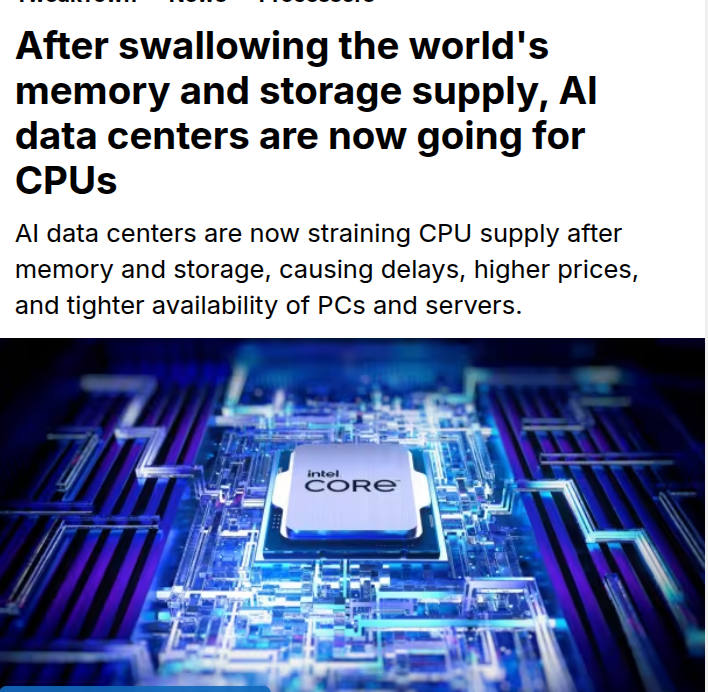
AI data centers just pushed the hardware crunch beyond DRAM and NAND and into the CPU market.
AI clusters do not only need GPUs, because they also need huge numbers of general-purpose CPUs to feed data, run storage stacks, schedule jobs, handle networking, and keep those GPU systems busy.
That extra pull is now colliding with normal PC and server demand, so manufacturers say Intel and AMD are not shipping enough processors, lead times have stretched from 2 weeks to months, and system prices could rise by 10% to 15%.
The interesting twist is that Arm may gain ground, because a shortage in x86 server CPUs gives buyers a reason to test alternative chips built specifically for AI-heavy data centers.
---
tweaktown. com/news/110685/after-swallowing-the-worlds-memory-and-storage-supply-ai-data-centers-are-now-going-for-cpus/index.html
J'ai vu le replay.
Reportage de 25 mn, typique de la ligne éditoriale anti-tout des médias généralistes FR.
9 mn 30 presque neutres sur des gros datacenters dans le Nevada et en Virginie
Puis 15 mn 30 de procès à charge où tout y passe en termes de nimby, jusqu'aux antinukes.
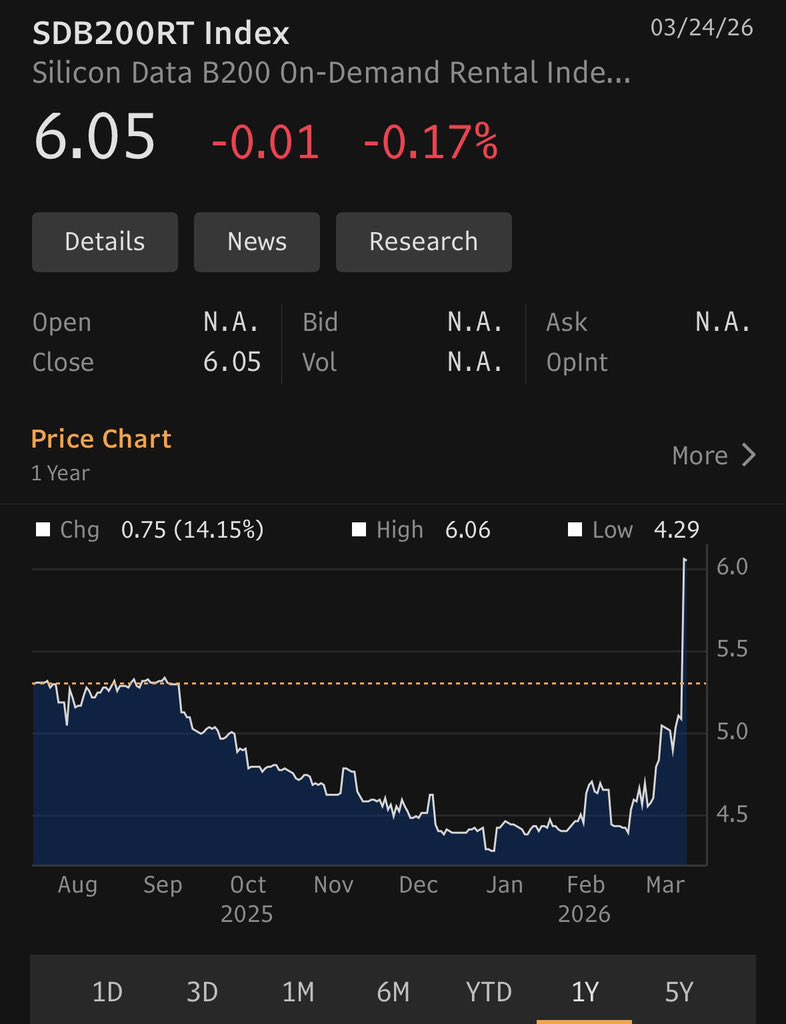
GPU spot rental rates are ripping. B200 on-demand up 50% in a month(!) , while the 3 year old H100s +20% since November.
🚀
These are spot aggregates, not transaction prices of course. But if you think the direction of travel doesn’t matter here, I don’t know what to tell you.
$NVDA
ASML's EUV scanners will be the last machines on Earth to lose helium. Party balloons will be the first to go. Helium is not manufactured. It is a byproduct of uranium and thorium decaying deep underground over billions of years. Vent it and it escapes to space. Permanently. A third of the global supply went offline when Qatar's Ras Laffan plant was hit on March 2. The rationing has already started. Here's what happens:
Day 1. Party balloons. Distributors cut retail supply immediately.
Day 7. Industrial welding and pressurization. National allocation kicks in. Switch to argon where possible.
Day 14. Routine fab leak detection switches to hydrogen. Ultra-sensitive qualification still needs helium.
Day 21. MRI machines. Older systems that vent helium cannot get refills. Elective scans delayed.
Day 45. Global buffer depletes. Fabs enter conservation mode. Non-critical depositions switch to nitrogen.
Day 60. Backside wafer cooling on older etch tools. Nitrogen conducts heat six times slower. Throughput drops.
Day 90. High-power etch. Advanced memory and logic nodes cannot run without helium-grade cooling. Wafer production drops.
Day 120. ASML's EUV lithography tools. $200 million scanners making the highest-value wafers on Earth. Leading-edge chip production stops.
Day 240. $700 billion in data centers are being built this year. Higher GPU prices, delayed cluster expansions, slower scaling.
Four months from birthday balloons to AI chip shortage.
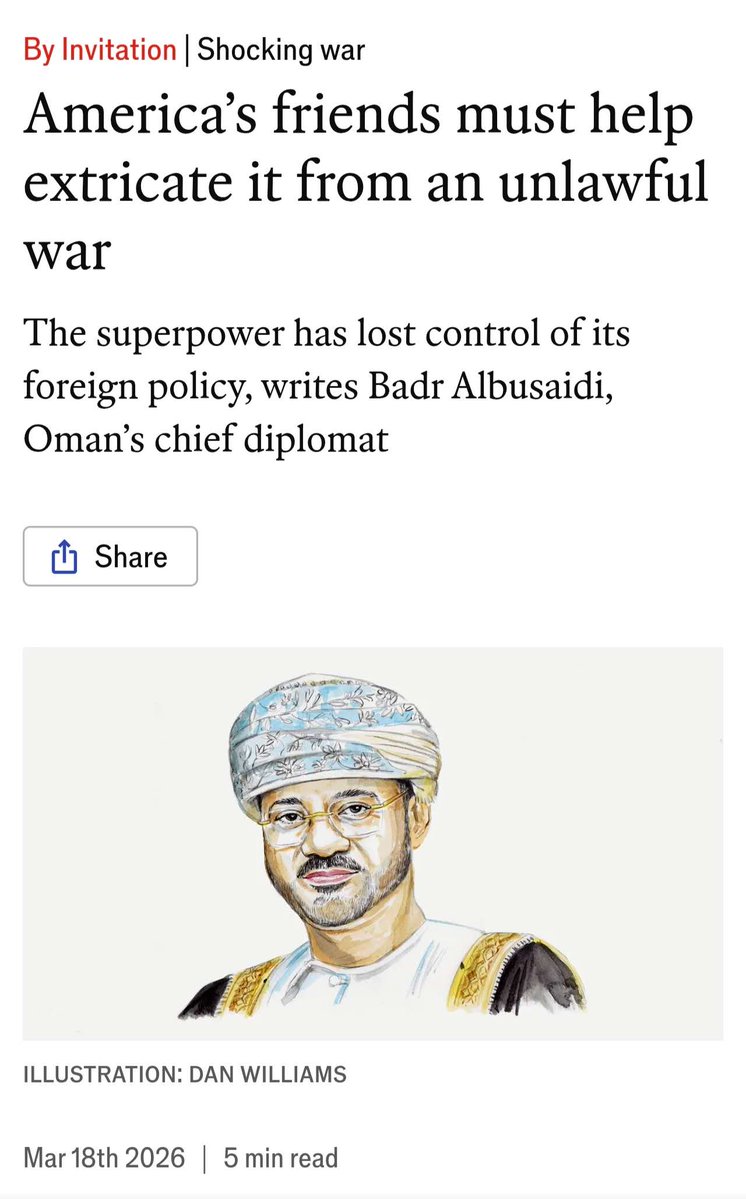
This is probably the most important article of the month: an op-ed by Oman's Foreign Minister, who mediated the talks between the U.S. and Iran, in which he writes that the U.S. "has lost control of its foreign policy" to Israel.
He repeats that a deal was possible as an outcome of the talks (something confirmed by the UK's National Security Advisor, who also attended: https://t.co/XkfSpkMjCf) and that the military strike by the U.S. and Israel was "a shock."
Interestingly, given he is one of Iran's neighbors and given that Oman has been struck multiple times by Iran since the war began (https://t.co/IXNdwD6f3j), he writes that "Iran’s retaliation against what it claims are American targets on the territory of its neighbours was an inevitable result" of the U.S.-Israeli attack. He describes it as "probably the only rational option available to the Iranian leadership."
He says the war "endangers" the region's entire "economic model in which global sport, tourism, aviation and technology were to play an important role." He adds that "if this had not been anticipated by the architects of this war, that was surely a grave miscalculation."
But, he adds, the "greatest miscalculation" of all for the U.S. "was allowing itself to be drawn into this war in the first place."
In his view this was the doing of "Israel’s leadership" who "persuaded America that Iran had been so weakened by sanctions, internal divisions and the American-Israeli bombings of its nuclear sites last June, that an unconditional surrender would swiftly follow the initial assault and the assassination of the supreme leader."
Obviously, this proved completely wrong, and the U.S. is now in a quagmire. He says that, given this, "America’s friends have a responsibility to tell the truth," which is that "there are two parties to this war who have nothing to gain from it," namely "Iran and America."
He says that all of the U.S. interests in the region (end to nuclear proliferation, secure energy supply chains, investment opportunities) are "best achieved with Iran at peace."
As he writes, "this is an uncomfortable truth to tell, because it involves indicating the extent to which America has lost control of its own foreign policy. But it must be told."
He then proposes a couple of paths to get back to the negotiating table, although he recognizes how difficult it would be for Iran "to return to dialogue with an administration that twice switched abruptly from talks to bombing and assassination."
That's perhaps the most profound damage Trump did during this entire episode: the complete discrediting of diplomacy. If Iran was taught anything, it is: don't negotiate with the U.S., it's a trap that will literally kill you.
The great irony of the man who sold himself as a dealmaker is that he taught the world one thing: don't make deals with my country.
Link to the article: https://t.co/FZxtqV3RC4
I'm going to make some obvious points.
(1) Blowing up all the oil infrastructure in the Middle East is an insane idea, and may well result in a global economic crash and humanitarian crisis unrivaled in the lives of those now living. We're talking about the price of everything everywhere rising, from food to gas, at a moment when inflation was already high. All of that will be laid at the feet of the authors of this war.
(2) The antebellum status quo of Feb 27, 2026 was just not that bad, but we're unlikely to return to it. Expect indefinite, long-term, ongoing disruptions to everything out of the Middle East.
(3) Also assume tech financing crashes for the indefinite future. The genius plan to get the Gulf states caught in the crossfire has incinerated much of the funding for LPs, for datacenters, and for IPOs. Anyone in tech who supported this war may soon learn the meaning of "force majeure" as funding gets yanked.
(4) Many capital allocators will instead be allocating much further down Maslow's hierarchy of needs, towards useful basic things like food and energy.
(5) It's fortunate that all those progressives yelled about the "climate crisis." Yes, their reasoning about timelines was wrong, and much of the money was wasted in graft, but the result was right: we all need energy independence from the Middle East, pronto. It's also fortunate that Elon and China autistically took climate seriously. Now they're going to need to ship a billion solar panels, electric vehicles, batteries, nuclear power plants, and the like to get everyone off oil, immediately.
(6) It's not just an oil and gas problem, of course. It's also a fertilizer problem, and a chemical precursor problem. Maybe some new sources will come online at the new prices, but it takes time to dial stuff up, particularly at this scale, so shortages are almost a certainty.
That said, China has actually scaled up coal-to-chemicals[a,c] (C2C), and there's also something more sci-fi called Power-to-X[b] which turns arbitrary power + water + air into hydrocarbons. But all of that will need to get accelerated. I have a background in chemical engineering so may start funding things in this area.
(7) Ultimately, this war is going to result in tremendous blame for anyone associated with it. It's a no-win scenario to blow up this much infrastructure for so many people. Simply not worth it for whatever objective they thought they were going to attain. But unless you're actually in a position to stop the madness, the pragmatic thing to do is: scramble to mitigate the fallout to yourself, your business, and your people.
[a]: https://t.co/ITat4tmAFd
[b]: https://t.co/bWwiSQcgyt
[c]: https://t.co/FQCqMhy5d3
The useful life of a GPU is 3-5 years. The useful life of a frontier model is what, 6 months? Has this been taken into account in depreciation math or are we still vibe accounting?













![balajis's tweet photo. I'm going to make some obvious points.
(1) Blowing up all the oil infrastructure in the Middle East is an insane idea, and may well result in a global economic crash and humanitarian crisis unrivaled in the lives of those now living. We're talking about the price of everything everywhere rising, from food to gas, at a moment when inflation was already high. All of that will be laid at the feet of the authors of this war.
(2) The antebellum status quo of Feb 27, 2026 was just not that bad, but we're unlikely to return to it. Expect indefinite, long-term, ongoing disruptions to everything out of the Middle East.
(3) Also assume tech financing crashes for the indefinite future. The genius plan to get the Gulf states caught in the crossfire has incinerated much of the funding for LPs, for datacenters, and for IPOs. Anyone in tech who supported this war may soon learn the meaning of "force majeure" as funding gets yanked.
(4) Many capital allocators will instead be allocating much further down Maslow's hierarchy of needs, towards useful basic things like food and energy.
(5) It's fortunate that all those progressives yelled about the "climate crisis." Yes, their reasoning about timelines was wrong, and much of the money was wasted in graft, but the result was right: we all need energy independence from the Middle East, pronto. It's also fortunate that Elon and China autistically took climate seriously. Now they're going to need to ship a billion solar panels, electric vehicles, batteries, nuclear power plants, and the like to get everyone off oil, immediately.
(6) It's not just an oil and gas problem, of course. It's also a fertilizer problem, and a chemical precursor problem. Maybe some new sources will come online at the new prices, but it takes time to dial stuff up, particularly at this scale, so shortages are almost a certainty.
That said, China has actually scaled up coal-to-chemicals[a,c] (C2C), and there's also something more sci-fi called Power-to-X[b] which turns arbitrary power + water + air into hydrocarbons. But all of that will need to get accelerated. I have a background in chemical engineering so may start funding things in this area.
(7) Ultimately, this war is going to result in tremendous blame for anyone associated with it. It's a no-win scenario to blow up this much infrastructure for so many people. Simply not worth it for whatever objective they thought they were going to attain. But unless you're actually in a position to stop the madness, the pragmatic thing to do is: scramble to mitigate the fallout to yourself, your business, and your people.
[a]: https://t.co/ITat4tmAFd
[b]: https://t.co/bWwiSQcgyt
[c]: https://t.co/FQCqMhy5d3](https://pbs.twimg.com/media/HDujYp7bwAA5DuR.png)


