Exod.12.13 Now the blood shall be a sign for you on the houses where you are. And when I see the blood, I will pass over you; and the plague shall not be on you to destroy you when I strike the land of Egypt. (NKJV)
APGA | Ticketmaster | Lerry | Hebrew | Anthony Joshua | Abefe Industry Chef EP | GTA 6 | GTA VI | Enioluwa | Lucia | Districts | Vice City | Dear Lord | Pedri | Mandy | Putin | Diana London | #Russia | Soludo | President Bola Tinubu | RenewedHopeinAnambra | South East
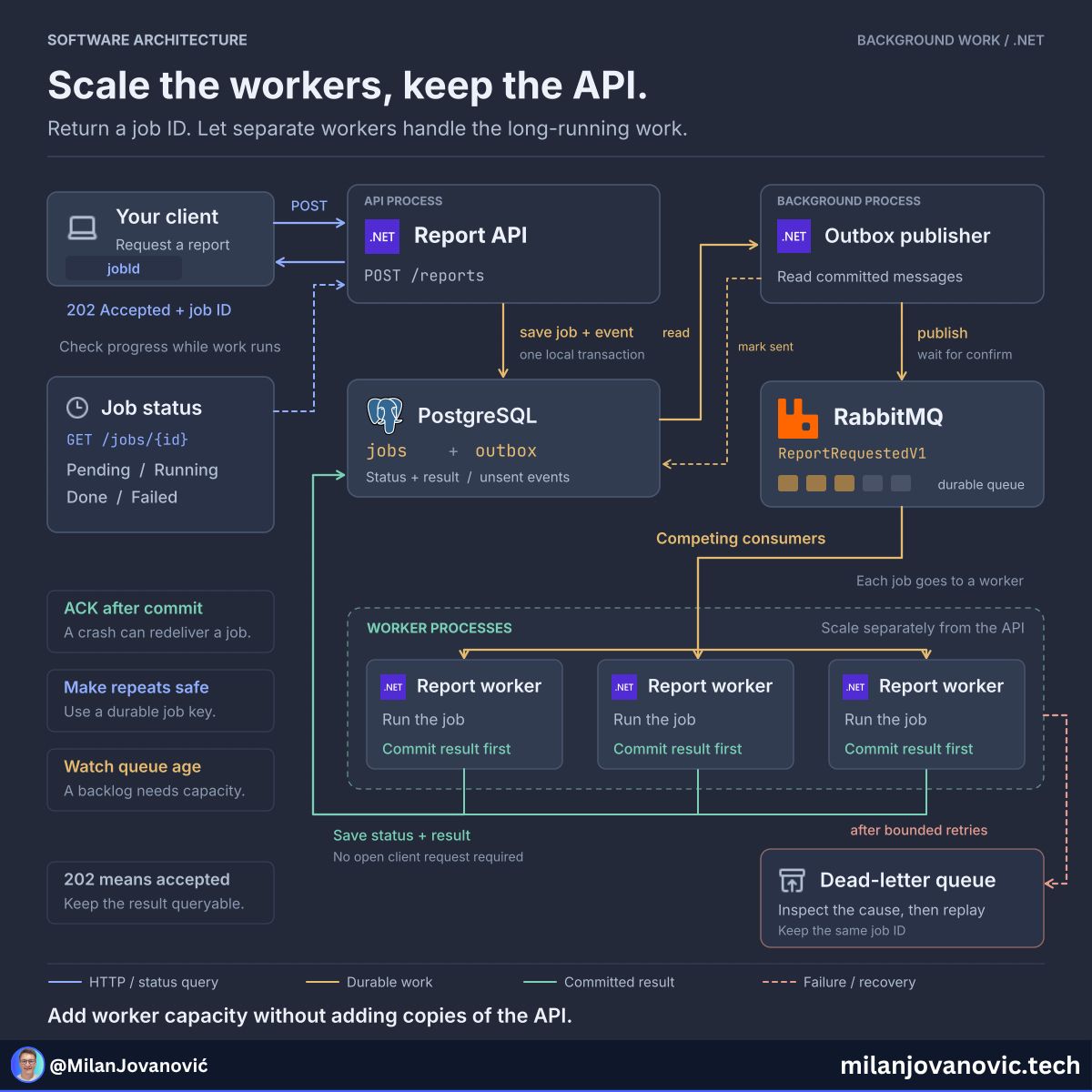
A report that takes minutes should not need an open HTTP request the whole time.
I'd save the job first, then return 202 Accepted with its ID. The user can check its progress while a worker does the work.
At first, that worker can run in the same app. But it still shares CPU and memory with the API.
When those jobs slow down normal requests, put the worker in its own process behind a queue. You can then add workers without adding copies of the API.
Watch how long jobs wait, handle failed jobs, and make it safe to retry a job. A queue can hold a burst of work. It cannot fix a permanent lack of capacity.
I walk through each step and its cost here:
https://t.co/3vIe3ueslk
P.S. Join my newsletter for more .NET guides. Start with a reading path that fits your goals:
https://t.co/X09ZA9UOYp
🚨Leave Netflix tonight.
Watch this 2 h 34 min Stanford class.
It's the clearest, most complete, and brutally honest explanation out there on how ChatGPT and Claude are really built.
From Tokenization and BPE to the Transformer architecture, the training pipeline, and the next-token decoder. No fluff. No marketing. Just the truth.
Doesn't matter if you've never touched a line of AI code or if you spend your days launching Agents: by the end, you'll suddenly connect a ton of pieces you've been trying to fit together for years.
The real core boils down to this:
How text turns into numbers the model can "eat" (BPE tokenization)
The sole mission of a language model: predict the next token
How the Transformer uses Attention so tokens can pass messages to each other
In training, the NLL loss pushes the probability of the entire sequence
In generation, the decoder builds the response token by token
The big-picture view that takes most people years to form… this class delivers it to you complete in one sitting.
Free up your time.
This could be, no exaggeration, the most valuable class you watch this month.
Software architecture is pointless if it's easy to break.
Here's how you fix this.
I use 3 approaches to enforce architecture:
- Compiler, static analysis
- Architecture testing
- Code reviews (with AI)
The compiler is your best friend. It won't let you make a mistake. If you write code that doesn't compile, your builds crash. Instant feedback.
How does this help you enforce software architecture?
In .NET you can:
- Use the internal access modifier to hide types from other assemblies
- Organize your code into separate projects (assemblies) to enforce isolation
But that doesn't scale well because you end up with too many projects.
Static analysis is powerful. But I don't like writing custom Roslyn rules. Although you could try this out with AI. I reckon it will do a pretty good job at it.
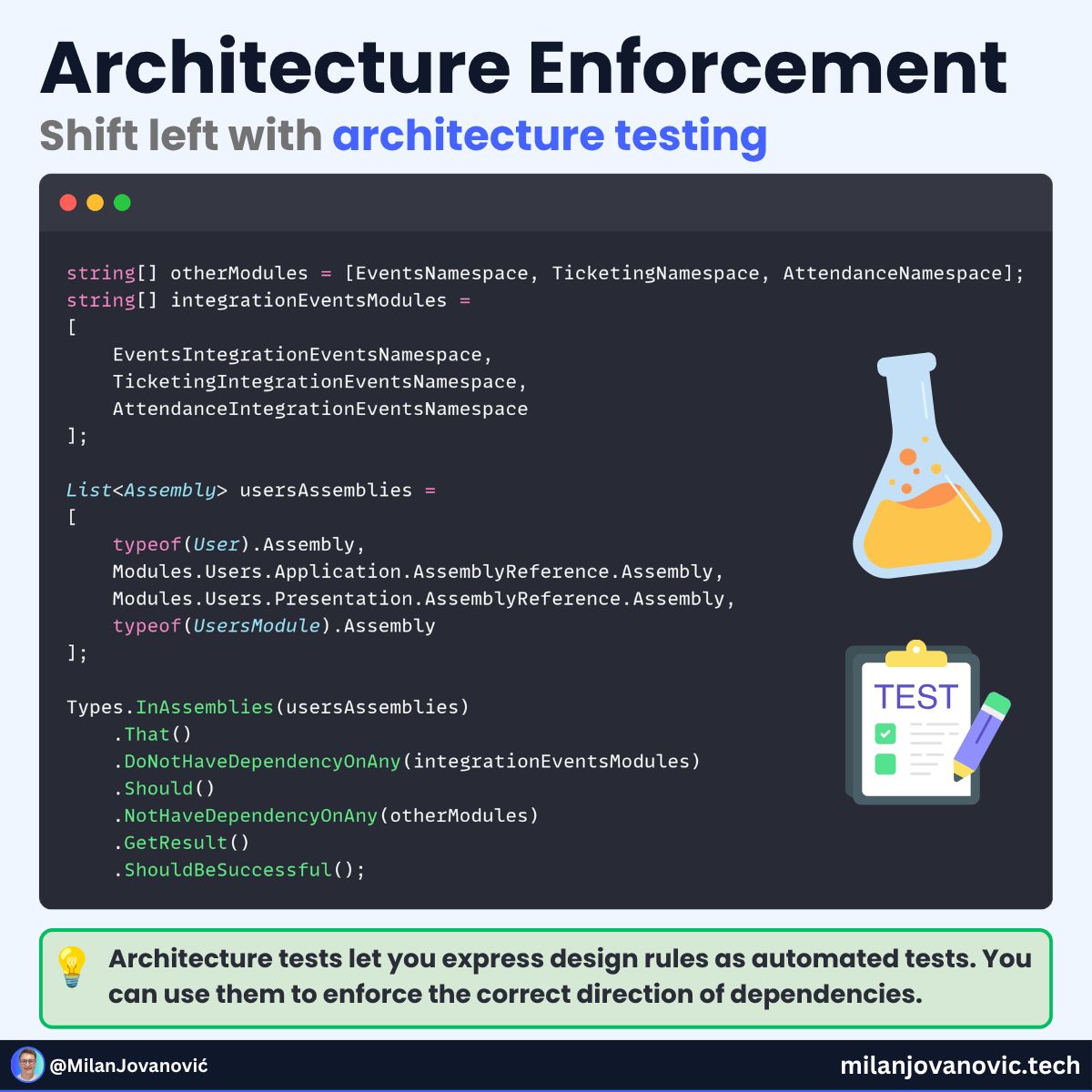
I prefer architecture testing. Architecture tests let me express my design rules as automated tests. I can use them to enforce the correct design.
For example, in a modular monolith, each module can only reference the public API of other modules.
Here's how architecture testing can help you "shift left": https://t.co/0kKfBjXxTp
Lastly, code reviews. This should be self-explanatory. Someone has to review the code and approve it manually. But with AI-generated PRs this is not a good use of your time. I'd use manual review with AI as a helper to speed this up.
Most developers have good intentions. Time pressure, misunderstandings, and resistance to rules can turn a codebase into slop.
Even the most well-planned software projects decay because of technical debt.
Architecture testing acts as a safeguard.
𝗪𝗵𝗮𝘁 𝗶𝘀 𝗮 𝗪𝗲𝗯𝗵𝗼𝗼𝗸?
Here's an example to help you understand it.
You have an application, and you want it to automatically do things without you having to trigger them manually.
That's where webhooks come in!
Webhooks are like messengers, allowing one system to send a message to another whenever a specific event happens. It's like getting a notification on your phone when someone comments on your social media post or when you receive an email.
Webhooks work similarly but for systems and applications.
Here's the basic flow:
1) Service A exposes a webhook
2) Service B subscribes to the webhook from Service A
3) Service A writes down the subscription
4) The event occurs in Service A
5) Service A sends the webhook request to Service B
There are many ways that webhooks can be helpful.
For example, you can use webhooks to automatically update a database or trigger an action when a form is submitted on your website.
They can also be used to send notifications or alerts, such as when a new user signs up for your service or when an error occurs in your system.
I once implemented a webhook in a text-to-speech API.
The application exposes an endpoint to upload a text file, and you can also pass in a webhook URL. An AI model will process the text file in the background and convert it into an audio file. When the audio file is complete, the application will trigger the webhook. The client can then download the audio file or do something else.
Did you have a chance to build something cool with Webhooks?
NEW: Another clip that likely shows the final moments of a man’s life after he jumped into a tiger enclosure at Yorkshire Wildlife Park in England. Police say he climbed in around 1:35 p.m. Saturday, and the tiger attacked. First responders rushed in, but he couldn’t be saved. His family has been notified, and police are now helping them through it. The park was cleared out, and the tiger wasn’t harmed.
Should security be tightened up after seeing something like this happen!
Containerization is at the heart of modern software development.
In this in-depth course, Eissa teaches you Docker from the ground up.
You'll learn about containers, Dockerfiles, images, Docker Hub, networking, volumes, Docker Compose, and more - plus real-world deployment workflows.
https://t.co/wHGCwkdTtN
Best C# book I have ever read
That 99,9% of new developers will never read
It's "CLR via C#" by Jeffrey Richter.
The last edition came out in 2012.
And it still explains how your .NET code really runs better than most new courses (and AI).
Today too many developers skip books like this.
Why read another book when AI can write the code for you?
Here's my answer:
↳ AI is just a tool. Software engineering is so much more than writing code.
Tools change every year. Fundamentals and the way you think stay the same.
👉 𝗔𝗜 𝗺𝘂𝗹𝘁𝗶𝗽𝗹𝗶𝗲𝘀 𝘄𝗵𝗮𝘁 𝘆𝗼𝘂 𝗮𝗹𝗿𝗲𝗮𝗱𝘆 𝗸𝗻𝗼𝘄
✅ Expert + AI → better software, shipped faster
❌ No fundamentals + AI → more bugs, shipped faster
AI makes mistakes. It makes bad choices that look fine in a code review.
It can block a thread, box value types in a hot loop, or forget to dispose a connection.
If you don't know how the runtime works, you won't see these problems.
📌 𝗪𝗵𝗮𝘁 𝘁𝗵𝗲 𝗯𝗼𝗼𝗸 𝘁𝗲𝗮𝗰𝗵𝗲𝘀 𝘆𝗼𝘂
1. Value vs reference types
↳ Why boxing creates hidden allocations, and when a struct hurts more than it helps
2. Garbage Collection
↳ Generations, the Large Object Heap, and why some objects live longer than you expect
3. IDisposable and finalizers
↳ What happens when you forget to dispose, and why finalizers keep objects in memory longer
4. Threading and async
↳ Thread pool, Tasks, and why blocking on async code can freeze your whole app
5. Generics
↳ How the CLR shares code for reference types and creates new code for each value type
Yes, some chapters are outdated. Like AppDomains and parts of .NET Framework that are gone in modern .NET.
But the core ideas still apply to .NET 10 today.
👉 𝗪𝗵𝘆 𝗶𝘁 𝗺𝗮𝘁𝘁𝗲𝗿𝘀 𝗳𝗼𝗿 𝘆𝗼𝘂𝗿 𝗰𝗮𝗿𝗲𝗲𝗿
To stay relevant in the job market right now, you need to work with fundamentals, trade-offs, system design, and architecture.
AI doesn't know your traffic, your budget, or your deadlines.
You do.
Use modern tools. I use AI every day.
But a .NET or Java expert who uses AI to amplify his work will build better software. He will go faster and further than anyone who never learned his main stack in depth.
AI can write the code. You still need to know if it's right.
Do you know any other more modern C# book that is really in-depth lik Richter's?
➕ Follow me to improve your .NET and Architecture Skills
VDM, VeryDarkMan come and take your flower on this #DemocracyDay. Something happened in 2018 in our political space that Omoyele Sowore destroyed.
But I need us to do it again, Nigerian youths watch this 2 minutes video and share it far and wide! We need to take back our country by all means...
The reason Kenneth Okonkwo went with Atiku the same reason all this Atiku boys are with him. He pays their rent and feedings
Fola Okocha Blord #DemocracyDay#RenewHope
Oba Femi has officially signed the contract for the rematch with Brock Lesnar at Clash in Italy!
Eid Mubarak Lifi Arojinle Wike ZTTW May Allah Barka da Sallah Tinubu Nigeria Gordon Zlatan Seyi Amen 39billion Sporty Atiku #verydarkman#ChildrensDay Wishing Wizkid Amaechi #WWE #