Sheel: So if I send $1,000 from the US to my cousin in India via stablecoins, what would she get in INR?
Brian: She'd get ₹83,000 worth. And the best part — it's basically free.
Sheel: Basically free, or free?
Brian: Free. Stablecoins make remittance fees go to zero.
Sheel: Cool. So how does she actually get rupees? She lives in a village.
Brian: Easy — she just offramps the USDC into INR through a local exchange.
Sheel: And the exchange does this for free?
Brian: Well, there's a small spread. But it's tiny.
Sheel: Right. And how does she get from "INR balance on a crypto exchange" to "rupees she can buy rice with"?
Brian: She withdraws to her bank account via IMPS.
Sheel: Which has a fee.
Brian: A small one.
Sheel: And the exchange charged her KYC-compliance overhead, and took an FX spread on the USDC→INR conversion, and someone has to pay for fraud monitoring, and customer support when the transfer fails…
Brian: Yes, but the blockchain part is free.
Sheel: The blockchain part. The 0.3 seconds where the token moves between two wallets.
Brian: Correct. That's where the $60 billion in fees disappears.
Sheel: The other 99.7% of the process — the part with humans, banks, regulators, FX desks, and last-mile cash-out — that's also free?
Brian: That's, uh, a separate question.
Sheel: But you said remittance fees go to zero.
Brian: With stablecoins, yes.
Sheel: Right. So when Wise charges 0.5% all-in for the same corridor, end to end, including the rupees landing in her bank account…
Brian: That's because they're not using stablecoins.
Sheel: And if they did use stablecoins on the backend, which some of them already do, the fee would be…
Brian: Zero.
Sheel: It's currently 0.5%.
Brian: I'm not sure I understand. Could you repeat the question?
Sheel: Thanks for your time.
How can stablecoins reduce remittance fees to zero?
makes no sense to me whatsoever.
The bulk of remittances $ is migrant workers sending money to family, from US->Mexico, US->India, Gulf->India
Stablecoins can make the money-movement leg much cheaper/near-zero but that isn't the bulk of the cost!
You still need cash-out, FX, compliance/KYC, fraud controls, customer support, and distribution.
When I send money to my cousin in a village in India, there is nothing he can do with USDC. He needs to get the money out into INR and that last mile is where most of the cost lies.
Stablecoins can make remittances much cheaper but nowhere near zero.
Much fun talking with @natefoster about networks, BGP, programming languages, formal methods, and what it's like being a visiting researcher at Jane Street.
"Singapore does not have trial by jury. The country completely abolished the jury system in 1969. All trials, including capital cases and those carrying life sentences, are heard and decided solely by a single judge."
1/1 multisig.
Lee Kuan Yew abolished trial by jury in Singapore after determining that it was too easy for defence lawyers to appeal to racial and religious biases of juries in multicultural Singapore.
He writes in his memoirs how as a young lawyer he was able to get three clients acquitted who he was sure did commit murder. LKY writes that he "worked on the weaknesses of the jury -- their biases, their prejudices, their reluctance really to find four Muslims guilty of killing in cold blood or in a heat of great passion, religious passion, an RAF officer, his wife and child."
He writes "The judge was thoroughly disgusted. I went home feeling quite sick because I knew I'd discharged my duty as required of me, but I knew I had done wrong.”
Study after study shows that in multi ethnic societies, there is significant in-group bias on juries.
SpaceX has almost finished writing V1.0 of an in-house AI training stack in C that exact-maps to 220k GB300s with 800G NICs, making heavy use of pipeline parallelism and getting as close to bare metal as possible.
The potential speed improvement vs JAX for large training runs is over an order of magnitude.
@victorzh@OpenPasskey How/when/where does the merchant specify what end currency they want?
If the merchant wants AUD, of course the off-ramp is part of the payment settlement..
“a malicious E could simply claim it never received I's value and essentially censor I. The fix is for I to broadcast its value to all validators”
In practice can’t you just have the clients drive this broadcast? Then you get CR for 0 rounds latency.
Client -> local node -> leader
Client -> bunch of nodes’ IL -> leader
“a malicious E could simply claim it never received I's value and essentially censor I. The fix is for I to broadcast its value to all validators”
In practice can’t you just have the clients drive this broadcast? Then you get CR for 0 rounds latency.
Client -> local node -> leader
Client -> bunch of nodes’ IL -> leader
"The historical winners in each generation pretty much follow Moore's-law-like reasoning: when storage was mechanical and slow, SCSI's transport-agnosticism plus rich command set won; when storage became flash and the bottleneck shifted to per-command overhead, NVMe won by being designed for that regime"
Just realized why @martinkl says "CAP is crap".
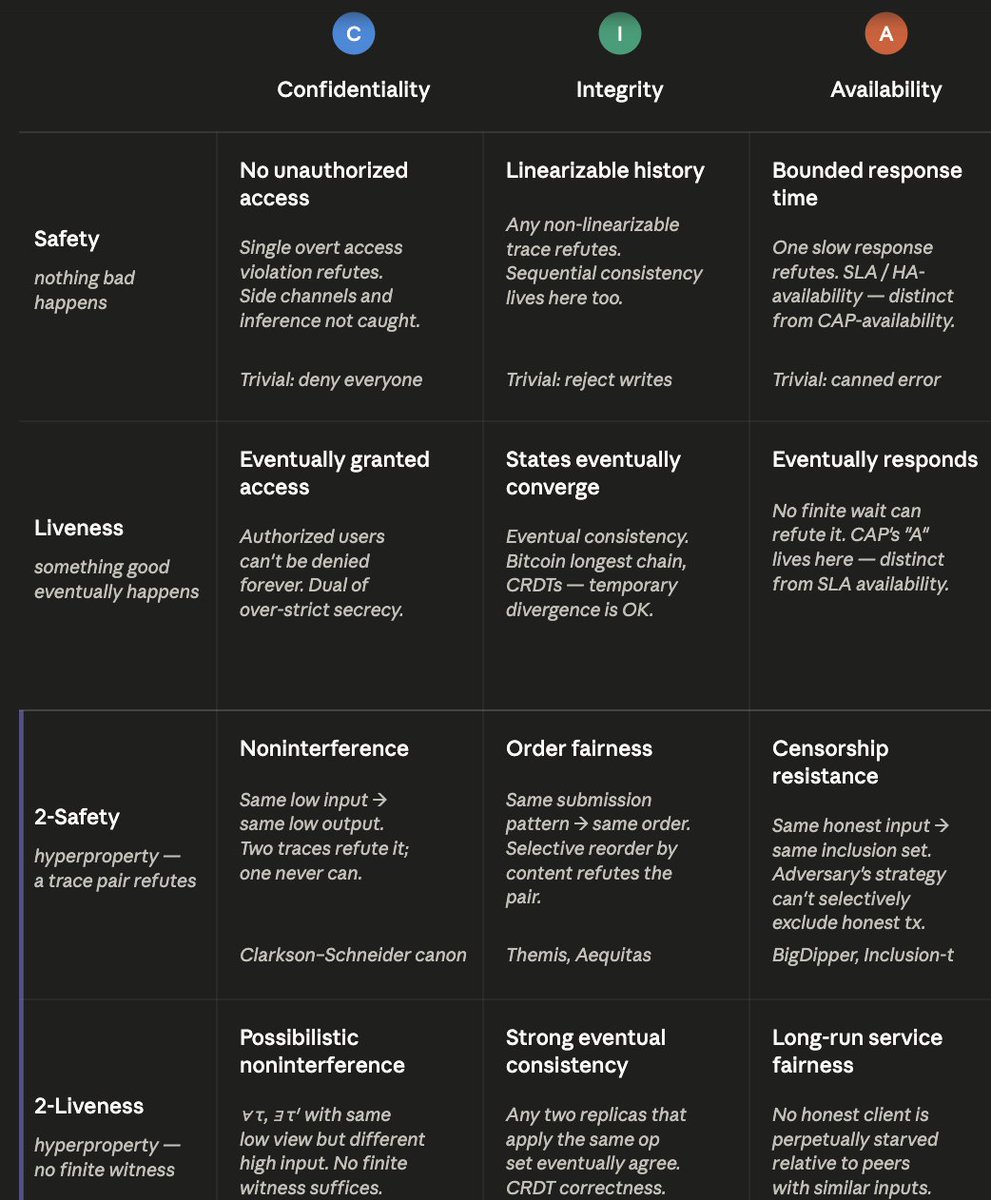
Ive associated integrity with safety and availability with liveness because of CAP for so many years. Just now realized that all 3 features of the CIA triad can actually be required from a safety OR liveness form.