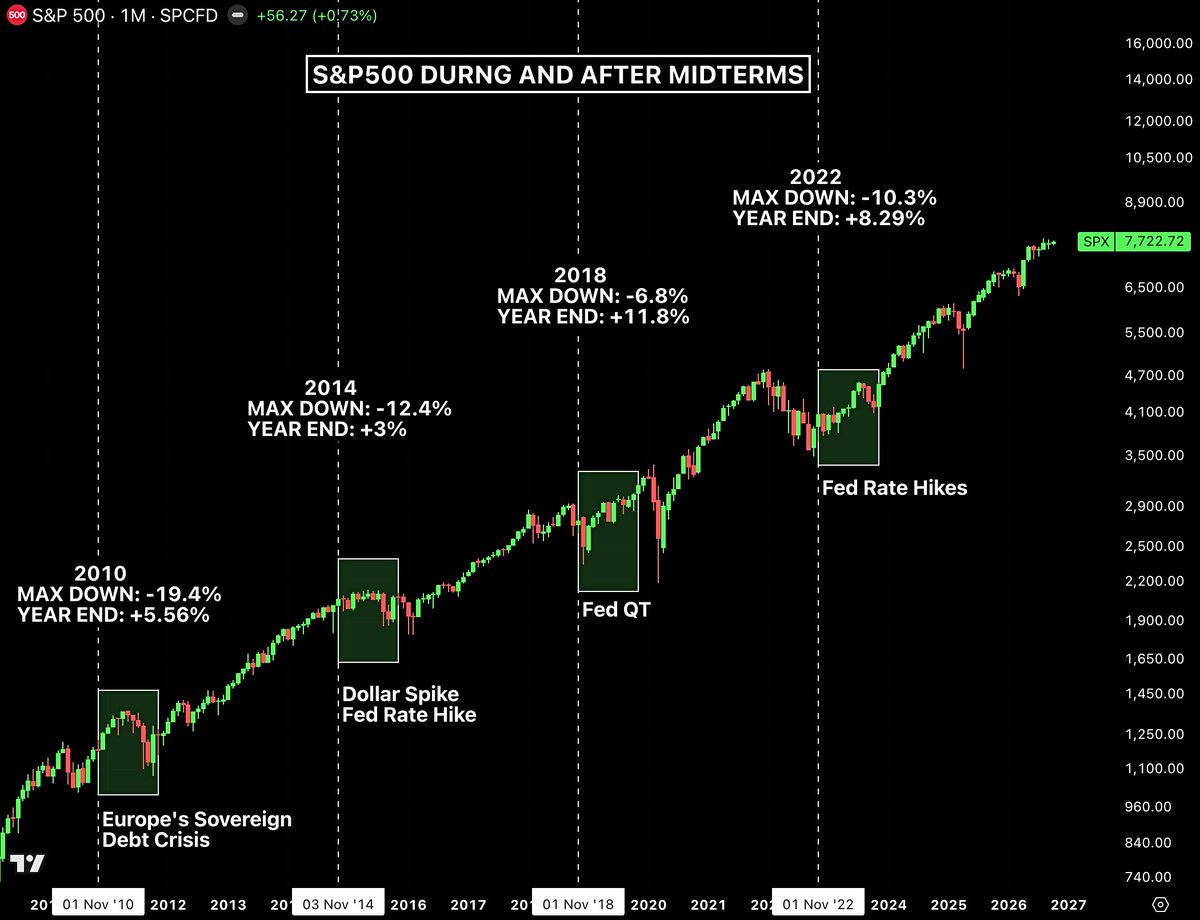
HISTORY SAYS THE NEXT 12 MONTHS COULD BE VERY BULLISH FOR S&P500
Since 1950, the S&P 500 has gone up in the 12 months after every single US midterm election.
A separate dataset going back to 1942 finds the same thing in the November to June window after a midterm: 21 for 21, also positive every time.
Year 3 of the presidential cycle, the year right after the midterm, has also historically been the strongest year of the entire 4-year cycle.
Fidelity's 1961-2024 data puts the average at 18.7%.
Here's why this keeps happening.
Before an election, markets have to price every possible outcome at once: who controls Congress, which taxes get cut or raised, which regulations pass or die.
Nobody can commit real money when 5 different futures are still live.
That's why midterm years are historically the weakest part of the 4-year cycle, averaging just 3.8% from 1945 to 2025, compared to 10.9% in the other three years, with an 18% average drawdown along the way.
Once the result is locked in, that entire range of outcomes collapses into one.
Markets don't need the winner to be market friendly. They just need the unknown removed, and removing the unknown alone lowers the risk premium investors demand to hold stocks.
This pattern has survived completely different crises, for completely different reasons, every single cycle:
After the 2010 midterms, the US was still digging out of the financial crisis.
The Fed launched $600 billion of QE2, buying long term Treasuries to push yields down and force money into riskier assets.
It worked, until 2011, when the US debt ceiling standoff led to the first-ever downgrade of US credit, and Europe's sovereign debt crisis exploded at the same time.
The S&P fell almost 19% at its worst point that year. It still finished the year positive.
After the 2014 midterms, the US economy and labor market looked fine, but oil prices collapsed and the dollar spiked, gutting earnings across the entire energy sector.
Then in 2015, China devalued its currency and its economy slowed sharply, triggering a global risk off panic, right as the Fed prepared its first rate hike since 2006.
The S&P barely survived, finishing up just 3%, the weakest year in the entire 76 year record.
But It still didn't break the streak.
After the 2018 midterms, the Fed had hiked rates 4 times that year and was still shrinking its balance sheet.
Trade war fears with China pushed the S&P to the edge of a bear market by Christmas Eve.
Then Fed Chair Powell reversed course in early 2019, signaled patience, stopped hiking, and eventually cut rates 3 times.
Big tech earnings stayed strong and the US and China moved toward a trade truce. The S&P went on to gain nearly 29% that calendar year.
After the 2022 midterms, inflation had just peaked at 9.1%, the Fed was still raising rates, and most of Wall Street was calling for a recession.
A cooler than expected inflation report landed right after Election Day, convincing investors the Fed was close to done hiking.
Stocks can explode while a central bank is still raising rates, because markets price where policy is heading, not where it sits today.
Through 2023, the expected recession never came, the Fed slowed down then paused, and a generative AI boom sent Nvidia and the rest of mega cap tech into one of the biggest rallies in years.
Four different decades.
Four completely different crises, a debt downgrade, an oil crash, a trade war, and the fastest rate-hiking cycle in 40 years.
The S&P 500 closed positive after every single one.
The LARGEST vaccinated vs. unvaccinated birth cohort study EVER done shows vaccinated children are FAR SICKER across ALL 22 chronic disease categories:
Autism: +180%
Cancer: +54%
Neurodevelopmental disorders: +1254%
Autoimmune disease: +1120%
Motor disability: +810%
Speech disorder: +803%
Mental health disorders: +696%
Asthma: +553%
Developmental delay: +412%
Atopic disease: +386%
Seizure disorder: +216%
Food allergy: +128%
Neurological disorder: +26%
Any chronic condition: +250%
ADHD: ONLY in vaccinated children
Diabetes: ONLY in vaccinated children
Brain dysfunction: ONLY in vaccinated children
Behavioral disability: ONLY in vaccinated children
Learning disability: ONLY in vaccinated children
Intellectual disability: ONLY in vaccinated children
Tics: ONLY in vaccinated children
Other psychological disability: ONLY in vaccinated children
Our peer-reviewed reanalysis of the landmark Henry Ford birth cohort study found 22 out of 22 chronic disease categories were proportionally higher in vaccinated children... ZERO exceptions.
🚨 AMERICANS ARE LOSING IT AFTER SEEING TUCKER CARLSON FILL AN ENTIRE GROCERY CART IN RUSSIA FOR $104
In a resurfaced video, Tucker Carlson walked into a Russian grocery store and filled an entire cart with what he said a family of four would buy for a week.
Fresh bread.
Coffee.
Cookies.
Cheese.
Wine.
Even familiar Western brands like Snickers and Twix.
Tucker says they weren't hunting for bargains or carefully checking prices. They simply threw in what they would actually eat.
Before checking out, Tucker and his crew guessed what a similar haul would cost them back home in America.
Their estimate?
Around $400.
Then the Russian total appeared.
$104.
Tucker said he went from being amused to “legitimately angry.”
Meanwhile, viral videos in America have shown expensive cuts of meat secured with anti-theft devices at Walmart with some steaks priced around $45.
When was the last time YOU walked out of an American grocery store with an entire cart for $104?
Mom: ''Trading is gambling.''
Dad: ''Stop wasting your life, son.''
Brother: ''It'll never work. Get a real job, bruh.''
Sister: ''You're crazy.''
Cousin: ''You'll lose all your savings.''
Random stranger: ''Keep showing up, dude. I believe in you.''