Two hard hitting quotes:
The mark of the immature man is that he wants to die nobly for a cause, while the mark of the mature man is that he wants to live humbly for one. - J D Salinger
You can avoid reality, but you cannot avoid the consequences of avoiding reality - Ayn Rand
A former Harvard sleep expert says "6 hours of sleep increases your chances of heart disease and cancer in 7 days."
On Jay Shetty podcast, he revealed 8 "regular" habits that kill your sleep, destroy your mood, and spike bad cortisol levels: 👇
1. Using alcohol to “wind down.”
Hillary Clinton says when she was Secretary of State there was “constant” and “relentless” pressure by Prime Minister Netanyahu and then-Defense Minister Ehud Barak to secure U.S. backing for a military strike against Iran.
Clinton recalled hours-long phone calls where Israeli officials used leverage tactics, frequently telling her their "planes are on the tarmac" to imply an imminent, unilateral strike.
Clinton says she would respond to pressure like that with: "Well, good luck."
The New Yorker’s David Remnick asks if she felt the U.S. was being manipulated or "played" by a foreign ally that receives an enormous amount of American aid, Clinton agreed and said it happened "all the time" due to Netanyahu's intense focus on the issue.
Follow the money on this one. It is rotten to the core.
The Pentagon just lent $620,000,000 to a tiny North Carolina startup called Vulcan Elements. The company is two years old.
It had fewer than 50 employees.
And three months before the deal was announced, Donald Trump Jr.’s venture firm quietly took a stake in it.
Here is the part the administration tried to bury.
Of the dozens of companies the Pentagon was weighing, Vulcan was the only deal initiated by a top White House aide. That aide was Peter Navarro, a close friend of Trump Jr. The order came down to move fast.
One official put it plainly: The call came from the White House. We have to get this done.
Staff worked late nights to push it through in weeks. Deals like this normally take many months of vetting. And when it closed, Vulcan’s valuation jumped from about 200 million dollars to roughly 2 billion.
A windfall for the investors, including the president’s son.
This is public money. Your money.
Routed through the Pentagon to enrich the president’s family and their friends. The Bush administration’s own chief ethics lawyer called it corruption we pay for.
And there is more coming.
A drone parts company Trump Jr. holds a stake in is also under Pentagon review.
This is not a one-off. It is a pattern. The president’s family is treating the federal Treasury like a private bank, and the bill lands on every taxpayer.
https://t.co/4kB1cZNmlE
India wants to become a $10 trillion economy.
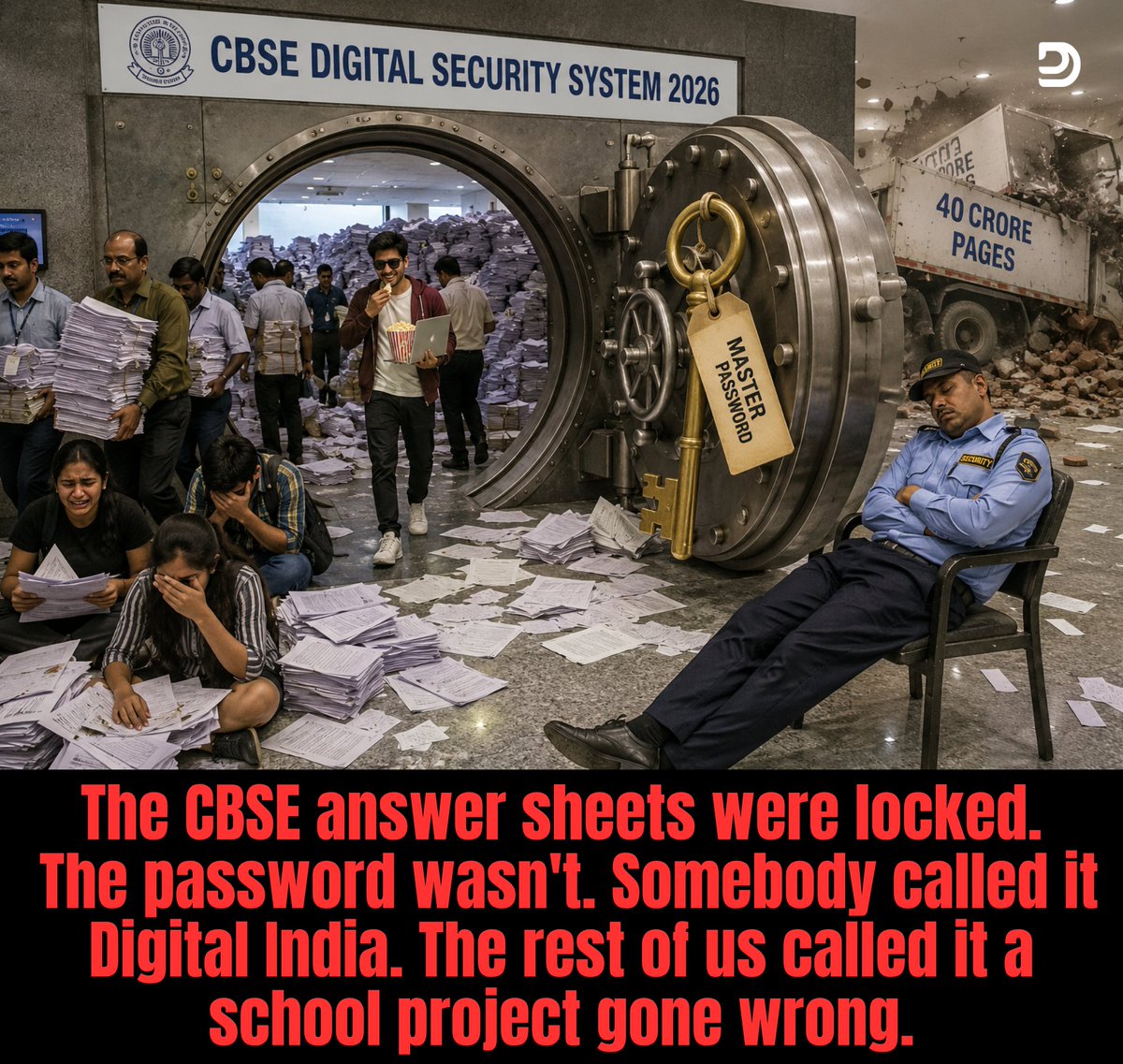
But CBSE could not protect a password.
And no.
This is not a joke.
18.5 lakh Class 12 students appeared for CBSE Board Exams in 2026.
Their answer sheets were handed to a company with 51 employees.
A teenager reportedly broke into the system within minutes.
This was not innovation.
It was institutional comedy.
CBSE launched On-Screen Marking.
OSM.
The promise?
Transparency.
Accuracy.
Speed.
The result?
Swapped answer sheets.
Blurred scans.
Missing pages.
Portal crashes.
Embarrassment.
Some students opened photocopies of their answer books.
They found someone else's handwriting under their roll number.
Now look at the scale.
18.5 lakh students.
26 countries.
7,574 exam centres.
120 subjects.
98 lakh answer booklets.
40 crore pages.
77,000 teachers logging in.
All processed in 10 days.
And managed by a company smaller than many CBSE schools.
Then came the tender.
Two companies qualified.
TCS.
600,000 employees.
57 years of credibility.
$29 billion revenue.
And Coempt Edu Teck.
51 employees.
Guess who won.
Not the company trusted by banks.
Airlines.
Governments.
Stock exchanges.
The other one.
But there is a twist.
Coempt was once called Globarena Technologies.
The same company linked to Telangana's 2019 Intermediate Exam fiasco.
3.8 lakh students received wrong marks.
Toppers became failures.
3 lakh sought reverification.
20 students died by suicide in eight days.
Months later.
Globarena changed its name.
The memories remained.
Then came the cybersecurity masterpiece.
OTP verification on the browser.
Not the server.
Password resets without old passwords.
Examiner IDs editable from browser storage.
And a master password sitting inside public source code.
No encryption.
No hashing.
Just there.
A School project is much secured and Scalable than this.
Like keeping jewellery outside a jewellery shop with a sign saying:
"Please don't touch."
CERT-In was reportedly informed in February 2026.
The platform went live anyway.
77,000 teacher logins.
40 crore pages.
No fix.
70,000 answer books required rescanning.
15,000 shifted back to physical evaluation.
The digital revolution quietly asked for revaluation.
Then officials defended the system.
And later called IITs to help fix it.
Which is a bit like crashing a bus and then inviting ISRO to explain gravity.
Now comes the uncomfortable question.
TCS was on the shortlist.
TCS lost.
A company carrying the baggage of a past exam controversy won.
How?
Who approved it?
Who reviewed the risks?
Who signed the file?
Nobody seems eager to answer.
NEET chaos.
Now CBSE chaos.
Every year we hear the same slogans.
Student-centric.
Technology-driven.
Future-ready.
Wonderful words.
Terrible execution.
India does not have a shortage of talent.
India has a shortage of accountability.
Mr. Education Minister, will you answer?
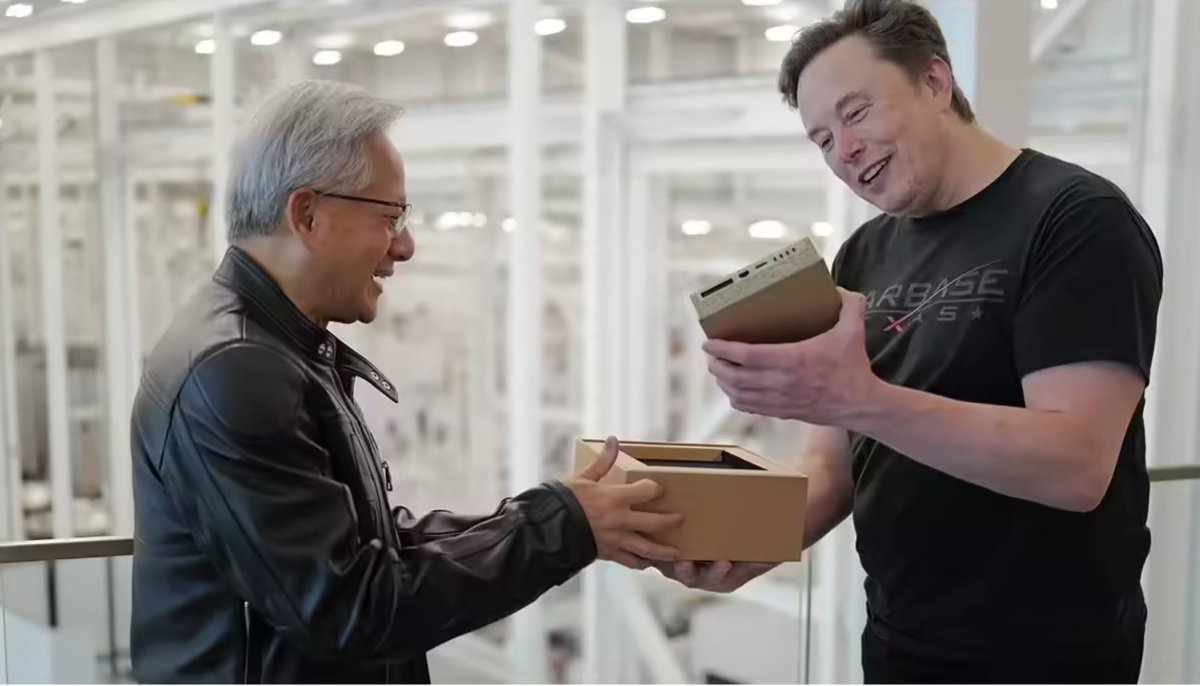
🚨Michael Burry just said Elon Musk and Nvidia's deal is built on fake numbers.
Burry published a detailed breakdown calling the entire structure "Fugazi", his word for fake.
He is alleging that billions of dollars in Nvidia chips are being hidden off balance sheets, and that American retirees are unknowingly funding the whole thing.
Nvidia, the world's largest AI chip company sold $5.4 billion worth of its most advanced GPUs, the GB200, to a company called Valor.
Valor is not a real operating business. It is a special purpose vehicle, a shell company created specifically to hold these chips and nothing else. Nvidia also invested $1.9 billion of its own money directly into Valor on top of the sale.
Those 100,000+ chips are now physically inside xAI's data center. xAI is Elon Musk's artificial intelligence company, the one that builds Grok. xAI is using every single one of those chips right now to run its AI models.
But here is what Burry is flagging.
Neither Nvidia nor xAI owns those chips on paper. Valor, the shell company holds legal title. That means $5.4 billion in GPU assets do not show up on Nvidia's balance sheet as inventory.
They do not show up on xAI's balance sheet as assets. They are legally invisible to both companies.
Nvidia gets to book the $5.4 billion as a completed sale and record it as revenue. xAI gets full use of the chips without owning them. And the risk disappears into a shell company in the middle.
Now here is where American retirees enter the picture.
Valor needed $3.5 billion in debt to fund this structure. Apollo provided it. Apollo is one of the largest asset managers on earth with $1.03 trillion under management and $834 billion specifically in private credit.
Apollo raised the $3.5 billion, packaged it into debt securities, and sold those securities to Athene.
Athene is Apollo's own insurance company. It sells fixed and indexed annuities, retirement savings products, to ordinary Americans.
When a retiree buys an Athene annuity, they believe their money is sitting in safe, stable investments. That money is now inside a structure funding Elon Musk's AI data center.
The numbers inside Athene are most alarming.
Athene holds $74.2 billion in reserves. It has moved $217 billion in assets into a captive insurer based in Bermuda, meaning those assets sit outside normal US insurance regulation and oversight.
Of the entire portfolio, 34.7%, equal to $103 billion, is classified as Level 3 assets.
Level 3 is an accounting classification that means there is no observable market price for these assets. No outside party can independently verify what they are actually worth.
The leverage sitting on top of those unpriced assets is 16 times.
Burry's says:
Every step of this structure is technically legal and publicly disclosed. But the entire thing was deliberately engineered across 8 to 12 steps to move credit risk off balance sheets and away from any market pricing.
- Nvidia books the revenue.
- Apollo collects the fees.
- xAI gets the computing power.
- And retirees sitting at the bottom of a 16x leveraged Bermuda insurance structure, holding $103 billion in assets with no market price carry the risk without knowing it exists.
Im also thinking about this. Stop sending children to CBSE. Start looking at IB/Cambridge syllabus in Indian schools. If children want to opt for medical career, then UCAT/BMAT exams will help entry into good foreign universities. If anyone has experience in this switch, please discuss here. I have lost complete faith in this country and its pseudoscience infiltrated educational system.
This paragraph by Richard Feynman hits so hard:
“Fall in love with some activity, and do it! Nobody ever figures out what life is all about, and it doesn’t matter. Explore the world. Nearly everything is really interesting if you go into it deeply enough. Work as hard and as much as you want to on the things you like to do the best. Don’t think about what you want to be, but what you want to do. Keep up some kind of a minimum with other things so that society doesn’t stop you from doing anything at all.”
Two economists just published a mathematical proof that AI will destroy the economy.
Not might. Not could. Will — if nothing changes.
The paper is called "The AI Layoff Trap." Published March 2, 2026. Wharton School, University of Pennsylvania. Boston University. Peer reviewed. Mathematically modeled.
The conclusion is one sentence.
"At the limit, firms automate their way to boundless productivity and zero demand."
An economy that produces everything. And sells it to nobody.
Here is how you get there.
A company fires 500 workers and replaces them with AI. A competitor fires 700 to keep up. Another fires 1,000. Every company is behaving rationally. Every company is following the incentives correctly. And every company is building a trap for itself.
Because the workers who were fired were also customers.
When they lose their jobs faster than the economy can absorb them, they stop spending. Consumer demand falls. Companies respond by cutting costs — which means automating more workers — which means less spending — which means more falling demand — which means more automation.
The loop has no natural exit.
The researchers tested every proposed solution. Universal basic income. Capital income taxes. Worker equity participation. Upskilling programs. Corporate coordination agreements.
Every single one failed in the model.
The only intervention that worked: a Pigouvian automation tax — a per-task levy charged every time a company replaces a human with AI, forcing them to price in the demand they are destroying before they pull the trigger.
No government has implemented this. No major economy is seriously discussing it.
Meanwhile the numbers are already tracking the curve. 100,000 tech workers laid off in 2025. 92,000 more in the first months of 2026. Jack Dorsey fired half of Block's workforce and said publicly: "Within the next year, the majority of companies will reach the same conclusion."
Nobody is doing anything wrong. Companies are following their incentives perfectly. That is exactly the problem.
Rational behavior. At scale. Simultaneously. With no mechanism to stop it.
Two economists built the math. The math leads to one place.
Source: Falk & Tsoukalas · Wharton School + Boston University ·
Sam Altman and Dario Amodei just got caught running a $2 trillion scam on the entire world.
The timing exposes EVERYTHING:
Four days after OpenAI secretly filed for a $1 trillion IPO, Altman went on stage in Sydney and said he was "delighted to be wrong" about AI destroying jobs.
Amodei reversed his forecast the same week. Anthropic is targeting its own IPO in October at a $900 billion valuation.
Fortune called it coordinated and they're not wrong.
But here's the thing...
This was never a scientific forecast to begin with.
In 2024 and 2025, both CEOs needed two things simultaneously - government attention and private investment. Apocalyptic predictions delivered both.
When you tell senators that AI will eliminate half of all white-collar jobs, you get called to testify. You get taken seriously as a national security issue and get positioned as the responsible adult in the room who understands the danger better than anyone.
And when you tell investors the same story, you create urgency. Urgency drives capital. Capital drives valuation.
Amodei said 50% of white-collar jobs were at risk. Altman said entire job categories would vanish. Both said it repeatedly, in major venues, through all of 2025.
Now they need something different.
OpenAI is losing $1.22 for every $1 it earns. $14 billion in losses this year against $25 billion in revenue. Goldman Sachs and Morgan Stanley are preparing the roadshow with the S-1 going public in late August.
You cannot walk into a public market telling investors the technology you built is an existential threat to the economy. That is NOT a story Wall Street buys at a $1 trillion valuation.
That is a story that triggers Senate hearings, regulatory intervention, and class-action lawsuits from every displaced worker in America.
So the story changed.
Altman's exact words in Sydney: "I'm delighted to be wrong. I thought there would have been more impact on entry-level white-collar jobs by now than has actually happened."
Then he added one sentence that every financial journalist should have flagged: "It still may."
So the apocalypse is just "rescheduled" - specifically to after the IPO lockup period expires.
He took the L on timing, kept the vision intact, and protected the roadshow.
And 115,000 tech workers laid off so far in 2026 - with Meta, Amazon, and Snap all citing AI as the driver - are watching the men who predicted their displacement announce they were WRONG about it, four days after filing to go public at a combined $2 trillion valuation.
They sold the world fear to raise money, then switched up at the right time to raise more.
Tucker Carlson interviews a British doctor who worked in Gaza.
"Four young teenage boys were brought in, all of whom who'd been shot in the testicles."
Hay una cicatriz redonda que lleva décadas desapareciendo del mundo. Quienes la tienen en el brazo nacieron antes de 1980. Los que nacieron después, no.
Esa diferencia lo dice todo.
La herramienta que dejaba esa marca era la aguja bifurcada, un pequeño varilla de acero de unos cinco centímetros con dos puntas en el extremo, capaz de retener entre sus prongs una dosis exacta de vacuna liofilizada. La inventó el doctor Benjamin Rubin, de los Laboratorios Wyeth, como alternativa económica a las pistolas de vacunación del ejército estadounidense. Costaba cinco dólares por cada mil unidades. Con un solo vial de vacuna podían hacerse hasta cien dosis. D.A. Henderson, director del programa de erradicación de la OMS, dijo años después que sin aquella aguja la campaña habría tardado mucho más. La llamó un milagro.
La técnica era simple: sumergir las puntas en la vacuna, apoyar la aguja en perpendicular sobre la piel del brazo y hacer quince pinchazos rápidos y ligeros en un área circular del tamaño de una moneda. La vacuna entraba por los orificios. El cuerpo respondía. Primero enrojecimiento, luego ampolla, luego costra. Al caer la costra, quedaba la marca.
Esa cicatriz no era un daño. Era la señal de que el sistema inmunitario había aprendido a reconocer y destruir el virus de la viruela antes de que llegara de verdad.
La campaña de erradicación de la OMS duró once años, de 1966 a 1977. En su punto álgido, la aguja bifurcada entregaba más de 200 millones de vacunas al año. La viruela desapareció de América del Sur en 1971, de Asia en 1975 y de África en 1977. El último caso natural ocurrió en octubre de 1977: un cocinero somalí llamado Ali Maow Maalin, que se recuperó. En mayo de 1980, la OMS publicó la portada de su revista con tres palabras en grandes letras: "Smallpox is dead."
La viruela había matado a más de 300 millones de personas solo en el siglo XX. Era una enfermedad que acompañó a la humanidad durante milenios, que desfiguró rostros, cegó ojos y vació ciudades. Y fue eliminada completamente del planeta por 300 millones de dólares, una aguja de cinco centímetros y décadas de trabajo colectivo.
Quienes tienen esa cicatriz llevan en el brazo la huella de la única enfermedad infecciosa que el ser humano ha erradicado por completo de la Tierra.
Production went down. Load balancer health checks failing. All instances marked unhealthy.
SSH'd into an instance:
- App: running
- CPU: 5%
- Memory: 40%
- Disk: 15%
- Network: fine
Manually hit health endpoint:
curl localhost/health
{"status": "ok"}
Worked perfectly.
Checked load balancer logs:
- Health check URL: /health
- Response: timeout
- Instance marked: unhealthy
The issue:
- Health endpoint responded in 100ms locally
- Load balancer timeout: 2 seconds
- Should be plenty of time
Then I noticed: Health check ran every 5 seconds.
App logged every health check. To a file. That file grew to 47 GB.
Every health check:
1. Opened 47 GB log file
2. Appended 1 line
3. Closed file
4. Took 3 seconds due to file size
5. Timed out
Fix: Disabled health check logging. Response time: back to 100ms.
I've been using 𝐀𝐩𝐚𝐜𝐡𝐞 𝐊𝐚𝐟𝐤𝐚 for years now and I absolutely love it. Let me explain the message/event flow in simple terms. Give it a read. 👇
𝐃𝐨 𝐲𝐨𝐮 𝐤𝐧𝐨𝐰 𝐰𝐡𝐚𝐭? 𝐀𝐩𝐚𝐜𝐡𝐞 𝐊𝐚𝐟𝐤𝐚 𝐰𝐚𝐬 𝐛𝐨𝐫𝐧 𝐨𝐮𝐭 𝐨𝐟 𝐚 𝐩𝐫𝐨𝐛𝐥𝐞𝐦. 😉
LinkedIn engineers => faced difficulties in tracking website metrics, activity streams and other operational data.
A team of engineers => led by Jay Kreps, Neha Narkhede and Jun Rao started developing a distributed publish-subscribe messaging system that could handle high-throughput, low-latency data streams.
This system eventually became Apache Kafka.
It was open sourced in early 2011.
The name 'Kafka' was chosen by Jay Kreps.
He named the system after the famous author 'Franz Kafka'. 😊
Kreps was an admirer of Franz Kafka's writing and found the name fitting for a system that dealt with the flow of information.
It's written in Java and Scala.
Later they founded => 'Confluent (
@confluentinc
)' (a company) in 2014 to provide commercial support and additional tools for Kafka users.
📌 𝐋𝐞𝐭'𝐬 𝐮𝐧𝐝𝐞𝐫𝐬𝐭𝐚𝐧𝐝 𝐭𝐡𝐞 𝐛𝐚𝐬𝐢𝐜 𝐟𝐥𝐨𝐰.
[1.] Producer sends a message
◾ An application acts as a producer, creating a message with data (payload) and optional key.
◾ The producer connects to a broker in the Kafka cluster and identifies the target topic.
◾ Kafka uses a partitioner to determine which partition within the topic should receive the message. This ensures load balancing and parallel processing.
◾ The message is delivered to the leader replica of the chosen partition.
[2.] Message storage and replication
◾ The leader replica appends the message to its log segment.
◾ The message receives a unique offset, serving as its position within the log.
◾ The leader replicates the message to follower replicas for fault tolerance.
[3.] Consumer fetches messages
◾ An application acts as a consumer, joining a consumer group.
◾ Consumers within the same group share offsets and coordinate consumption.
◾ Each consumer fetches messages from its assigned partitions based on its committed offset.
◾ The consumer receives batches of messages and processes them.
[4.] Acknowledging consumption
◾ Once processing is complete, the consumer commits its new offset.
◾ This tells Kafka which messages have been successfully consumed.
◾ Kafka tracks committed offsets for each consumer in the group.
[*.] Flow continues
◾ Producers continue sending messages and consumers keep fetching and processing them based on their latest offsets.
◾ This cycle ensures ordered delivery and reliable consumption even with failures or restarts.
Remember,
👉 Message flow is asynchronous. Producers don't wait for consumers to process messages.
👉 Consumers can lag behind producers if processing is slow.
👉 Kafka offers mechanisms for handling failures and ensuring at-least-once or exactly-once delivery semantics.
Topics => Partitions =>Log Segments
(Data is actually stored in log segments)
Follow @techNmak
everyone says they want to understand LLMs.
this repo makes you prove it.
you write the attention.
you train from scratch.
you break it. then fix it.
no huggingface. no walkthroughs.
#llm
When it comes to food choices, dogs will always prefer human babies over animal meat. This basic Darwinian theory #doglovers won’t understand! #straydogs
For the last time, DII is not bravely defending the market. DII is using your SIP money.
It doesn’t require bravery to buy stuff with someone else’s money especially when you get 1-2% fee anyway
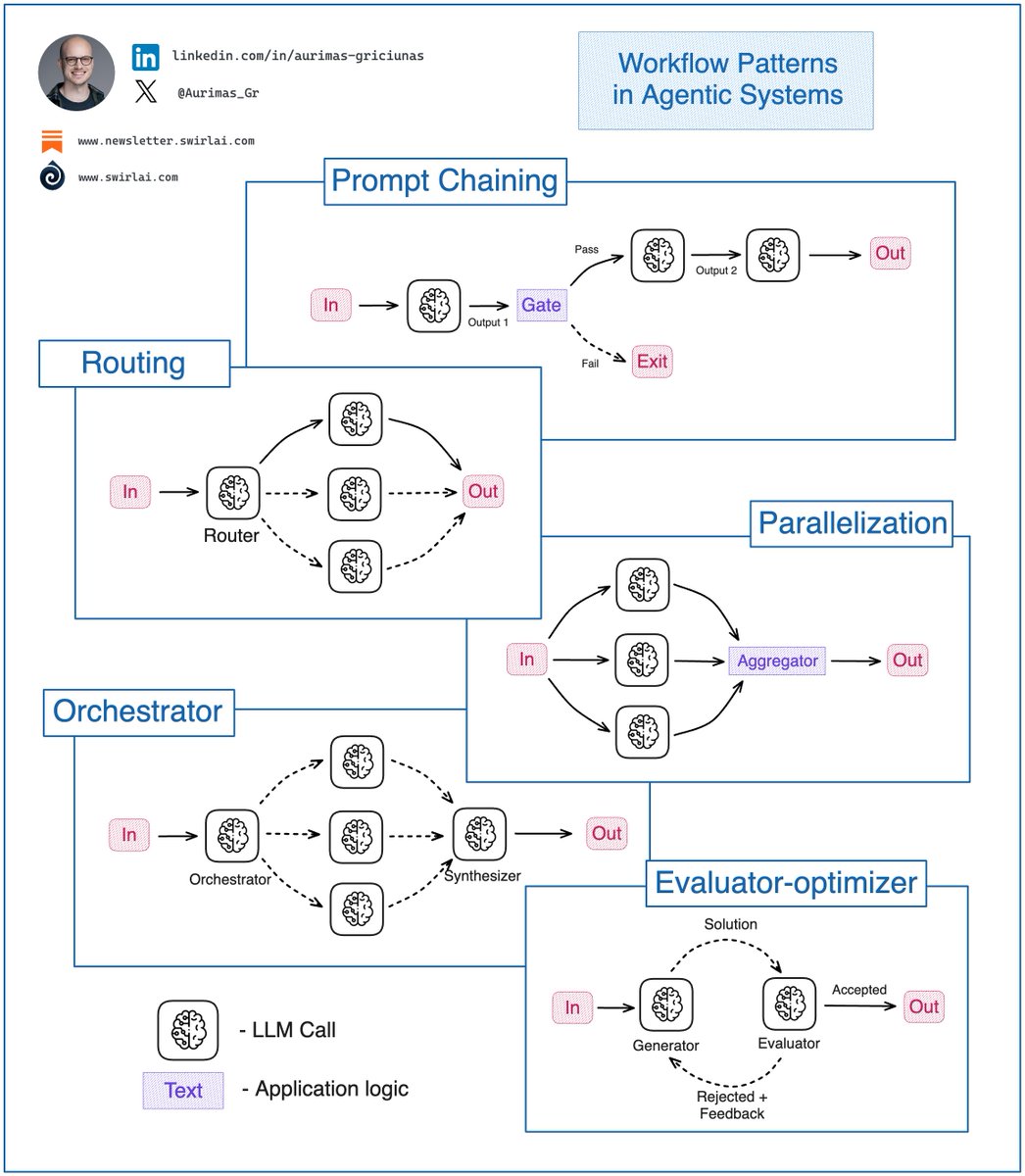
You must know these 𝗔𝗴𝗲𝗻𝘁𝗶𝗰 𝗦𝘆𝘀𝘁𝗲𝗺 𝗪𝗼𝗿𝗸𝗳𝗹𝗼𝘄 𝗣𝗮𝘁𝘁𝗲𝗿𝗻𝘀 as an 𝗔𝗜 𝗘𝗻𝗴𝗶𝗻𝗲���𝗿.
If you are building Agentic Systems in an Enterprise setting you will soon discover that the simplest workflow patterns work the best and bring the most business value.
At the end of last year Anthropic did a great job summarising the top patterns for these workflows and they still hold strong.
Let’s explore what they are and where each can be useful:
𝟭. 𝗣𝗿𝗼𝗺𝗽𝘁 𝗖𝗵𝗮𝗶𝗻𝗶𝗻𝗴: This pattern decomposes a complex task and tries to solve it in manageable pieces by chaining them together. Output of one LLM call becomes an output to another.
✅ In most cases such decomposition results in higher accuracy with sacrifice for latency.
ℹ️ In heavy production use cases Prompt Chaining would be combined with following patterns, a pattern replace an LLM Call node in Prompt Chaining pattern.
𝟮. 𝗥𝗼𝘂𝘁𝗶𝗻𝗴: In this pattern, the input is classified into multiple potential paths and the appropriate is taken.
✅ Useful when the workflow is complex and specific topology paths could be more efficiently solved by a specialized workflow.
ℹ️ Example: Agentic Chatbot - should I answer the question with RAG or should I perform some actions that a user has prompted for?
𝟯. 𝗣𝗮𝗿𝗮𝗹𝗹𝗲𝗹𝗶𝘇𝗮𝘁𝗶𝗼𝗻: Initial input is split into multiple queries to be passed to the LLM, then the answers are aggregated to produce the final answer.
✅ Useful when speed is important and multiple inputs can be processed in parallel without needing to wait for other outputs. Also, when additional accuracy is required.
ℹ️ Example 1: Query rewrite in Agentic RAG to produce multiple different queries for majority voting. Improves accuracy.
ℹ️ Example 2: Multiple items are extracted from an invoice, all of them can be processed further in parallel for better speed.
𝟰. 𝗢𝗿𝗰𝗵𝗲𝘀𝘁𝗿𝗮𝘁𝗼𝗿: An orchestrator LLM dynamically breaks down tasks and delegates to other LLMs or sub-workflows.
✅ Useful when the system is complex and there is no clear hardcoded topology path to achieve the final result.
ℹ️ Example: Choice of datasets to be used in Agentic RAG.
𝟱. 𝗘𝘃𝗮𝗹𝘂𝗮𝘁𝗼𝗿-𝗼𝗽𝘁𝗶𝗺𝗶𝘇𝗲𝗿: Generator LLM produces a result then Evaluator LLM evaluates it and provides feedback for further improvement if necessary.
✅ Useful for tasks that require continuous refinement.
ℹ️ Example: Deep Research Agent workflow when refinement of a report paragraph via continuous web search is required.
𝗧𝗶𝗽𝘀:
❗️ Before going for full fledged Agents you should always try to solve a problem with simpler Workflows described in the article.
What are the most complex workflows you have deployed to production? Let me know in the comments 👇
#LLM #AI #MachineLearning









![techNmak's tweet photo. I've been using 𝐀𝐩𝐚𝐜𝐡𝐞 𝐊𝐚𝐟𝐤𝐚 for years now and I absolutely love it. Let me explain the message/event flow in simple terms. Give it a read. 👇
𝐃𝐨 𝐲𝐨𝐮 𝐤𝐧𝐨𝐰 𝐰𝐡𝐚𝐭? 𝐀𝐩𝐚𝐜𝐡𝐞 𝐊𝐚𝐟𝐤𝐚 𝐰𝐚𝐬 𝐛𝐨𝐫𝐧 𝐨𝐮𝐭 𝐨𝐟 𝐚 𝐩𝐫𝐨𝐛𝐥𝐞𝐦. 😉
LinkedIn engineers => faced difficulties in tracking website metrics, activity streams and other operational data.
A team of engineers => led by Jay Kreps, Neha Narkhede and Jun Rao started developing a distributed publish-subscribe messaging system that could handle high-throughput, low-latency data streams.
This system eventually became Apache Kafka.
It was open sourced in early 2011.
The name 'Kafka' was chosen by Jay Kreps.
He named the system after the famous author 'Franz Kafka'. 😊
Kreps was an admirer of Franz Kafka's writing and found the name fitting for a system that dealt with the flow of information.
It's written in Java and Scala.
Later they founded => 'Confluent (
@confluentinc
)' (a company) in 2014 to provide commercial support and additional tools for Kafka users.
📌 𝐋𝐞𝐭'𝐬 𝐮𝐧𝐝𝐞𝐫𝐬𝐭𝐚𝐧𝐝 𝐭𝐡𝐞 𝐛𝐚𝐬𝐢𝐜 𝐟𝐥𝐨𝐰.
[1.] Producer sends a message
◾ An application acts as a producer, creating a message with data (payload) and optional key.
◾ The producer connects to a broker in the Kafka cluster and identifies the target topic.
◾ Kafka uses a partitioner to determine which partition within the topic should receive the message. This ensures load balancing and parallel processing.
◾ The message is delivered to the leader replica of the chosen partition.
[2.] Message storage and replication
◾ The leader replica appends the message to its log segment.
◾ The message receives a unique offset, serving as its position within the log.
◾ The leader replicates the message to follower replicas for fault tolerance.
[3.] Consumer fetches messages
◾ An application acts as a consumer, joining a consumer group.
◾ Consumers within the same group share offsets and coordinate consumption.
◾ Each consumer fetches messages from its assigned partitions based on its committed offset.
◾ The consumer receives batches of messages and processes them.
[4.] Acknowledging consumption
◾ Once processing is complete, the consumer commits its new offset.
◾ This tells Kafka which messages have been successfully consumed.
◾ Kafka tracks committed offsets for each consumer in the group.
[*.] Flow continues
◾ Producers continue sending messages and consumers keep fetching and processing them based on their latest offsets.
◾ This cycle ensures ordered delivery and reliable consumption even with failures or restarts.
Remember,
👉 Message flow is asynchronous. Producers don't wait for consumers to process messages.
👉 Consumers can lag behind producers if processing is slow.
👉 Kafka offers mechanisms for handling failures and ensuring at-least-once or exactly-once delivery semantics.
Topics => Partitions =>Log Segments
(Data is actually stored in log segments)
Follow @techNmak](https://pbs.twimg.com/media/G2d-I4SWkAAHhlr.jpg)