Some people get crazy results with thyroid hormone (T3)
~ Lost 50 lbs
~ Histamine issues resolved
~ Psoriasis disappeared
~ Oulation returned
~ Severe PMDD stopped
~ Raynaud’s disappeared
~ Off ADHD meds
~ No more post-nasal drip
~ Reversed calcification/sclerosis
~ Reversed myxedema
~ Body temperature up 2 degrees 🌡️🔥 https://t.co/u0eAxJVSKb
172 days ago the Stream team messaged me to complain about a snarky tweet I had made about their vault code.
This was the last message I sent them.
Obviously they did not listen and we are in fact worse off because of it.
Contrary to what many seem to feel, none of what happened came out of nowhere. As with any good bubble/blow up it has been slowly brewing and was simply a matter of time till it burst.
It took one conversation with their and 5 minutes of scrolling their Debank to realize that this was going to end poorly.
And while Stream was the most egregious, they are far from the only ones out there with bodies to hide.
So while I have my 15 minutes of CT's attention here are a few long, but hopefully final, thoughts on our latest saga.
First on Stream in particular.
Even I was surprised at the size of their loses, and while we wait to see what the official reason for the hole is, I think its pretty obvious you don't delegate 9 figures of user capital to "external managers". And the only way you loose that amount of money is leverage trading shitters.
Seems clear these kids started directionally trading with user capital while lying about it. This isn't a phenomenon unique to DeFi, it's a tale as old as time. And ironically one of the primary original selling points of the benefits of DeFi, to not allow this.
Nonetheless, I still don't think the market has fully grasped the extent of the insolvency. At time of writing this xUSD is trading at about $0.25 or 20% of its PPS of 1.27 and deUSD is at $0.99 still. So lets do some math.
If we look at the current state of Stream's assets their total DeBank bundle claims $138m and liabilities of their dashboard says $160m of user deposits.
However, seams safe to write off all of the value in 0x15 at this point, given its almost all xUSD and deUSD levered positions that they have no ability to ever unwind. And assume their new msig 0x14b is all of the returnable funds which is currently $63m.
Then we come to the liabilities, which is where the recursive looping and unbacked minting kicks everything up. Since they have no viable path to repay their xUSD loans we can assume that all will eventually end in liquidation in some capacity. Which given the limited on chain liquidity likely leads to lenders taking possession of the xUSD posted as collateral, which fully breaks their recursive accounting and causes a 2X+ of the outstanding xUSD liabilities and creditors that will be looking for repayment and redemptions.
My best estimate from Debank is they have a total of close to 300m xUSD currently leveraged across their wallets. At current PPS of 1.27 this increases their outstanding liabilities by about $380m to $540m.
Which would then give an expected redemption value of 63/540 for close to a 90% loss or $0.14 per xUSD.
Of course this also means deUSD will take at minimum 20-30% bad debt, assuming their 1:1 agreement won't hold up given Stream doesn't have enough to pay Elixir back in full even if they did abide by it.
And anything lent or backed against xUSD or deUSD takes on their equivalent amount of bad debt.
Fun thought experiment for the reader is how do you price the 6.2m deUSD 0x14 currently holds given its redemption price is dependent on xUSD's.
Now, I have no idea when or if these liquidations will actually occur. Given all the oracles are hardcoded, lenders only recourse is to wait till the interest accrual liquidates them.
Places like Elixir's Morpho market on Plume this is likely to happen soon given Morpho's adaptive IR curve the borrow rate is already 190%.
On Euler, especially Plasma, it could take months given the hardcoded caps on the IR curves.
While I would expect the redemption process to take weeks to months, it is also possible they keep these positions alive long enough to just serve withdraws to circulating shares and therefore all lenders to xUSD will take a 100% loss in order to reduce the losses for current xUSD holders.
This exact reason is why, regardless of their shitcoin trading practices, what they were doing with collateralizing the self looped shares was extra levels of retardio even for this industry.
And as always is another friendly reminder that leverage is a fickle bitch and magnifies in both directions.
_____________
While I will leave most of the pontificating about the long term effects to DeFi to the clearly ever so alert CT crowd, obviously we have some issues.
At Yearn we have been speaking about this for quite some time, but seams the rest of DeFi has now woken up.
While any new meta such as Curation or Vaults, will have people pile in and there are bound to be bad actors or those that cut corners.
This clearly goes far beyond that. Almost every major "risk manager" showed themselves to be baphoon's in some capacity far beyond just those that directly allocated to Stream assets. Due diligence is the primary slower of growth and therefore gets thrown out first.
Users see vaults labeled as Prime, Core, Horizon, High Yield, etc all with a Curator name that means nothing to them and just end up chasing yields inevitably pushing the industry up the risk curve.
We need standardization, we need proper transparency and due diligence, and we need to understand when you treat financial markets like a high growth SAAS tech play, things like this are bound to happen.
A risk managers job is to say NO. If you are not doing that, or just waiting till shit goes sideways to try and pull your funds faster than others. Your not a risk manager you're a clown.
Hopefully as the system absorbs nine figures of bad debt it makes those leading the charge think a bit harder before they list the next shiny new shitcoin.
Outside of improvements to curation my top personal hope is this makes all vault providers currently using the black box method of off chain pricing their shares to change course.
This is one of the most terrifying widespread adoptions of this cycle, in which multisig's are arbitrarily setting the PPS of their vaults based on undisclosed off chain pricing logic.
And to be clear Stream is not the exception here, this is now standard practice from almost every vault provider, including basically all of the largest players. If you are in a blah, blah USD or "Vault yada yada", "YieldCoin Whats its Nuts" or whatever, you are almost certainly subject this.
As the industry continuous to move to a less cypher punk value set, we should make sure there is a distinction between decentralization and transparency. Even in places where we move to more centralized/trusted systems, transparency should still exist in its full force. Otherwise we really are just banking but worse.
While events like this always remind me why I am embarrassed to tell people I work in crypto, so far there does seem to be a positive response and recognizing our shortfalls.
Though I am sure next cycle a new group of kids will come along claiming they've got the best risk adjusted yields around and we will run it back once again.
Our only hope is each time this happens a few more people learn to demand more out of those they trust their money to.
This is Dario Amodei.
He's the CEO behind Claude, one of the world's most advanced AIs.
Yesterday, in a 5.5 hour conversation with @lexfridman, he revealed our timeline to superintelligence.
Let me save you 5 hours: 🧵
A few days ago, I received some insider info from a $BTC whale who holds billions.
He bought 3300 $BTC in 2013 and kept accumulating until now.
I spent the whole day discussing the bullish factors with him.
Here's the shocking info he shared with me... 👇🧵
Introducing the Stars Lottery 💫🪩
Your hard-earned Stars will become valuable on Friday morning EST.
Each Star grants you a chance to win a share of the amazing lottery prize pool:
🟡 333K GOLD
⚡️ 50 ETH
🃏 Cards
✨ FAN pts
Get ready and join us during tomorrow's Fantasy Show to discover your prize!
The Risks of Restaking ⚠️ 🚨
Restaking seems to be positioned to be one of the main narratives driving 2024.
However, while many talk about how restaking works, and its benefits, it’s not all rosy.
This article aims to take a step back and analyze Restaking at a higher level, highlighting risks and answering the question: is it really worth it?
Let’s start with a quick intro to the subject: What is restaking? 🧱
Ethereum’s Proof of Stake (PoS) serves as a decentralized trust mechanism, where participants commit their stake to secure the Ethereum network.
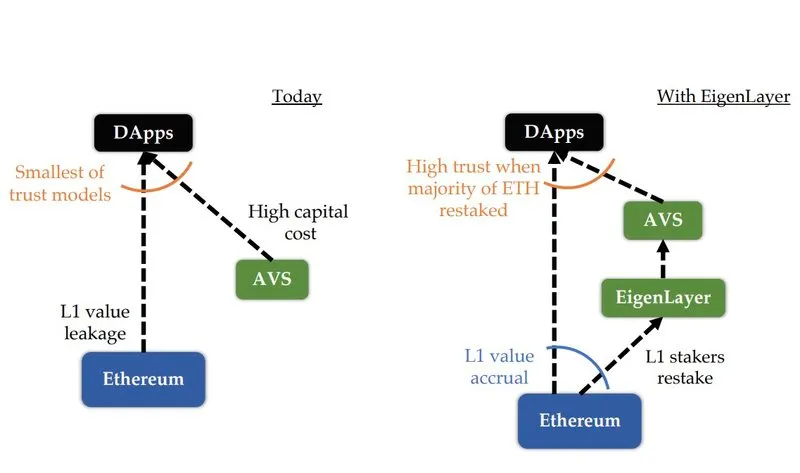
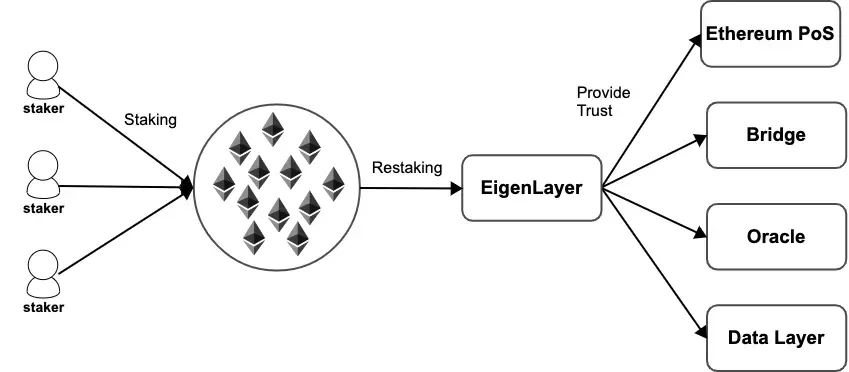
Restaking is the idea that the same stake used to secure the Ethereum PoS can now be used to secure many other networks.
EigenLayer is “modularizing” the decentralized trust of Ethereum so that AVS services can leverage it without the need to bootstrap their validator set, effectively lowering the barriers to entry in this market.
Typically, such modules require actively validated services that have their own distributed validation semantics to do verification. Usually, these actively validated services (“AVS”) are either secured by their own native token, or are permissioned in nature.
Why would anyone Restake? 💡
Simply put it, is because of economic incentives and yields. If Ethereum staking yields hover around 5% annually, restaking could offer an enticing additional yield.
However, this translates into additional risks for stakers.
Aside from the inherent risk of leveraging their staked ETH, when users opt-in to restake your tokens, they are essentially entrusting to the EigenLayer contracts the authority to slash their stake in case of errors, double signing, etc. on any of the AVS they secure.
As such, restaking adds a layer of risk, as restakers could get slashed on ETH, on the restaking layer, or both.
Is the extra yield worth restaking?
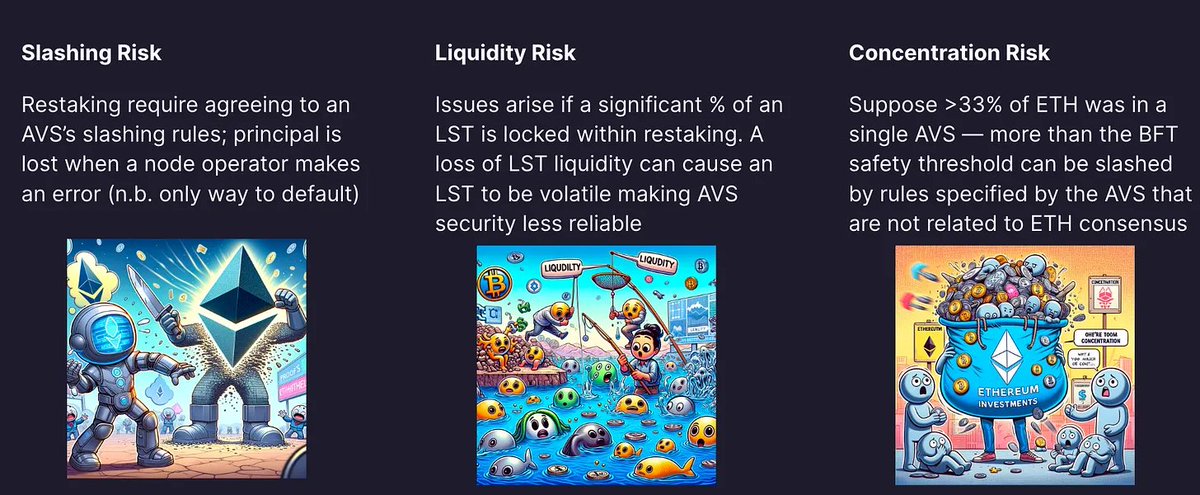
R(isk)-Staking 🚨 🚸 - Restaking adds some notable risks ⬇️
• ETH must be staked (or LSTs - hence not liquid)
• EigenLayer smart contract risk
• Protocol-specific Slashing conditions
• Liquidity risks
• Concentration risks
In the words of @ChainLinkGod "A liquid restaking token that is backed by liquid staking tokens deposited in a restaking protocol which rehypothecates staked ETH. This is getting pretty deep, can we add another layer of liquidity and risk here? I don't think we have enough"
De-facto, by restaking users are leveraging a token that is already exposed to risks (due to staking), and adding additional risks on top of it, ending up with layered risks looking like:
Also, any additional development of primitives on top of those would add even more complexity and additional risk.
Aside from the individual risk of restakers, the Ethereum Developer community has also raised issues concerning Restaking, notably in the famous Vitalik article about not overloading Ethereum consensus.
The issue with restaking is that it opens up new avenues of risk for staked Eth that secures the mainnet, it destines a part of it to secure other chains (as opted-in by stakers).
Consequently, if they misbehave according to other protocol rules (which could have bugs or weak security), their deposit gets slashed.
The debate is very actual with the devs and EigenLayer trying to find a way to coordinate efforts and make sure that Ethereum is not weakened by these technical advancements.
Repurposing the most important “layer”, securing Ethereum, is indeed not an easy feat. Furthermore, a key aspect in this regard is the level of risk management allowed for restakers.
Many Restaking projects give the whitelisting process for AVS into the hands of their DAOs.
However, as a restaker I would want to personally vet and decide which AVS to restake to, to avoid being slashed by malicious networks and reduce the possibilities of new vectors of attack! 🚨
All in all, restaking is an interesting new primitive worth researching.
Nonetheless, the concerns of Vitalik and others are not to be minimized.
When talking about restaking it’s important to bear in mind how this affects the security model of Ethereum mainnet: in fact, it is fair to contextualize restaking as offering an extra level of risk on top of one of the most important mechanisms securing Ethereum.
In the end, whether restaking is worth it or not is an individual choice.
Restaking for Institutionals 🏦 💸
Perhaps surprisingly, many institutions have signaled their interest in restaking as an additional reward on top of staked Eth.
Given the risk highlighted before, whether the highest interest for restaking will come from retail or institutions will be interesting.
An additional yield on top of the native Eth staking is appealing for those already involved in it but it’s not a life-changing yield for degens, given the risks.
This opens up new use cases for Ethereum as a financial instrument.
A particularly interesting comparison is made, comparing restaking applications to “corporate bonds”.
New networks want to get L1 security, similar to how companies or nation-states use their financial systems to create bonds and secure their assets.
In crypto, Ethereum is the widest and most liquid network and probably the only one that could sustain this type of market — and the most secure from a similar point of view of nations states in the TradFi economy.
Nonetheless, for now most interest in restaking seems to be driven by speculations on the @eigencloud airdrop, which might just be the biggest airdrop ever in the history of crypto.
How the dynamics will change after the airdrop? 🪂
Perhaps a practical r/r analysis might then push some to other avenues which might be more fruitful.
I would go as far as to argue that a high % of capital deposited in restaking is mercenary capital, which might then leave post-airdrop.
Separating the speculative component will be fundamental to assessing the real interest that users have in this new primitive.
Personally, the restaking narrative is a bit oversold IMHO, with very present risks that have to be evaluated carefully.
What can we do to mitigate these risks? 💡
Some of the solutions to mitigate the risks of restaking involve the optimization of the parameters of restaking (TVL caps, slashing amounts, fee distribution, min TVL, etc.) as well as ensuring the diversification of the funds across AVSs.
An immediate step that restaking protocols can take into consideration is to allow users to select different risk profiles when depositing for restaking.
Ideally, each user should be able to assess and select which AVS to restake to, without having to delegate the process to a DAO.
This needs to be the product of joint efforts across AVSs and EigenLayer, to make sure there is a roadmap in process to minimize those risks.
The EigenLayer team is already working with the Ethereum Foundation on further alignment and making sure that restaking does not add system risks to Ethereum, Liquid Staking Tokens, or AVSs leveraging it.
More on Restaking ⬇️
https://t.co/cWUy5k8tYk
https://t.co/X7TIw7T4Cd
https://t.co/oJ2mfxN6Ou
Restaking Researchers ⬇️ 🔍
@DefiIgnas@DeFi_Cheetah@TheDeFISaint@0xSalazar@rektdiomedes@Haylesdefi@Slappjakke@0xTindorr@stacy_muur@poopmandefi@Deebs_DeFi@Flowslikeosmo@CryptoKoryo@thedefiedge@TheDefiDog@wist_defi@DefiMoon@defi_mochi@DeFi_Made_Here