NEW: @The_DTCC is integrating Chainlink data and orchestration standards into the DTCC’s Collateral AppChain.
DTCC and Chainlink are advancing 24/7, near-real-time collateral workflows across global markets and blockchains.
Now that ZKEVMs are at alpha stage (production-quality performance, remaining work is safety) and PeerDAS is live on mainnet, it's time to talk more about what this combination means for Ethereum.
These are not minor improvements; they are shifting Ethereum into being a fundamentally new and more powerful kind of decentralized network.
To see why, let's look at the two major types of p2p network so far:
BitTorrent (2000): huge total bandwidth, highly decentralized, no consensus
Bitcoin (2009): highly decentralized, consensus, but low bandwidth - because it’s not “distributed” in the sense of work being split up, it’s *replicated*
Now, Ethereum with PeerDAS (2025) and ZK-EVMs (expect small portions of the network using it in 2026), we get: decentralized, consensus and high bandwidth
The trilemma has been solved - not on paper, but with live running code, of which one half (data availability sampling) is *on mainnet today*, and the other half (ZK-EVMs) is *production-quality on performance today* - safety is what remains.
This was a 10-year journey (see the first commit of my original post on DAS here: https://t.co/Fa0jKFgObW , and ZK-EVM attempts started in ~2020), but it's finally here.
Over the next ~4 years, expect to see the full extent of this vision roll out:
* In 2026, large non-ZKEVM-dependent gas limit increases due to BALs and ePBS, and we'll see the first opportunities to run a ZKEVM node
* In 2026-28, gas repricings, changes to state structure, exec payload going into blobs, and other adjustments to make higher gas limits safe
* In 2027-30, large further gas limit increases, as ZKEVM becomes the primary way to validate blocks on the network
A third piece of this is distributed block building.
A long-term ideal holy grail is to get to a future where the full block is *never* constituted in one single place. This will not be necessary for a long time, but IMO it is worth striving for us at least have the capability to do that.
Even before that point, we want the meaningful authority in block building to be as distributed as possible. This can be done either in-protocol (eg. maybe we figure out how to expand FOCIL to make it a primary channel for txs), or out-of-protocol with distributed builder marketplaces. This reduces risk of centralized interference with real-time transaction inclusion, AND it creates a better environment for geographical fairness.
Onward.
We’ve selected @chainlink CCIP as the exclusive bridge provider to bring Coinbase Wrapped Assets to new blockchains.
Together we’ll expand to new ecosystems using battle-hardened infrastructure.
Grayscale Chainlink Trust ETF (Ticker: $GLNK) - now available with 0% fees¹.
Gain exposure to the $LINK between crypto and traditional finance with $GLNK, available in your brokerage account now.
Grayscale Chainlink Trust ETF (Ticker: $GLNK) with 0% fees is now trading¹.
The first @chainlink ETP in the U.S. — from Grayscale, the world's largest crypto-focused asset manager².
Gain exposure to $LINK, the core infrastructure for connecting blockchains to the real world. It securely delivers data to smart contracts, automates execution, and enables assets and messages to move safely across chains.
RESERVE UPDATE
Today, the Chainlink Reserve has accumulated 89,079.05 LINK.
The Chainlink Reserve now holds a total of 973,752.70 LINK.
https://t.co/BJYimLa2Fv
The Chainlink Reserve is designed to support the long-term growth and sustainability of the Chainlink Network by accumulating LINK using offchain revenue from large enterprises adopting Chainlink and onchain revenue from service usage.
Lido, the leading liquid staking protocol and one of the largest DeFi protocols with $28B+ TVL, is upgrading to Chainlink CCIP as the official cross-chain infrastructure for wstETH, across all chains.
https://t.co/9NsDE7vbRY
With this upgrade, all cross-chain transfers of @LidoFinance's Wrapped Staked Ether (wstETH), the largest LST in the industry, will be secured by Chainlink CCIP by leveraging the Cross-Chain Token (CCT) standard.
Work is ongoing to upgrade wstETH across all 16 existing chains the token is currently deployed on. In addition, early expansions are already happening across @Plasma, @monad, @inkonchain, @0G_labs, and @Ronin_Network via CCIP.
This upgrade builds on Lido’s existing use of the Chainlink platform, including secure Data Feeds that facilitate the adoption of stETH/wstETH across DeFi and CCIP-powered Direct Staking rails that enables users to stake ETH directly from other networks and receive wstETH.
By upgrading to CCIP, the interoperability standard chosen by the world's largest financial institutions and leading DeFi protocols, Lido is enhancing the security, interoperability, and composability of wstETH across the multi-chain ecosystem, driving new opportunities for wstETH holders and DeFi protocols alike.
I’ll be there next week, speaking about why the next phase of digital finance won’t be driven by promises but by proof.
Proof that value can move safely.
Proof of compliance, reserves and trust.
The future belongs to those who can prove it works.
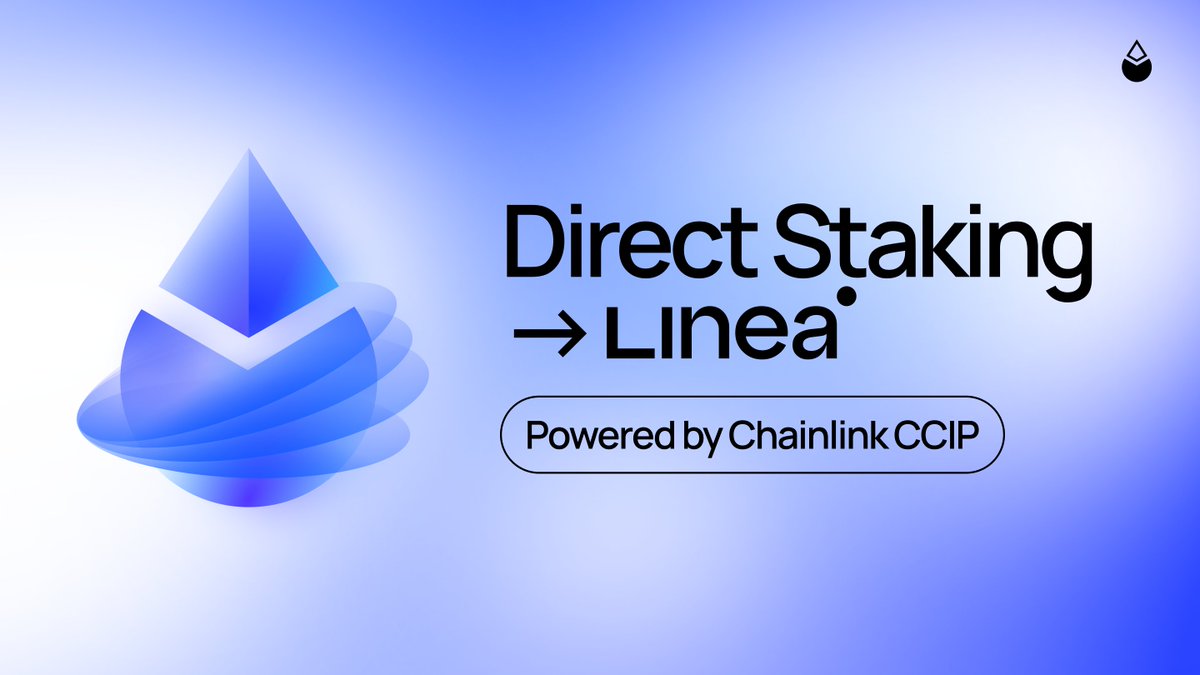
Presenting Direct Staking on Linea, powered by @Chainlink CCIP.
You can now stake your ETH directly on @LineaBuild.
A new step toward seamless, multi-chain Ethereum staking.
↓
We’re excited to announce that @SPGlobalRatings—the leading credit rating agency relied on by 95% of the top 20 global institutional investors—is collaborating with Chainlink to publish its Stablecoin Stability Assessments (SSAs) onchain for the first time via DataLink.
https://t.co/oIByU9CoD8
The launch comes at a pivotal moment in the evolution of digital assets. As of October 2025, the size of the stablecoin market exceeds $300 billion.
With the passage of the GENIUS Act in the United States, stablecoins are becoming a core financial primitive of global finance, underpinning payments, settlement, and trade.
However, to support institutions seeking to adopt stablecoins at scale, they require a standardized, reliable, and transparent onchain way to evaluate stablecoin risks.
S&P Global Ratings’ SSAs assess the stability and resilience of widely used stablecoins by evaluating credit, market, and custody risks to the overall asset quality, along with additional risk factors.
This data provides institutions and DeFi protocols alike critical information that can be used to evaluate a stablecoin's ability to maintain a stable value relative to its pegged fiat currency, enhancing risk management operations.
By securely making this data directly available to smart contracts via Chainlink’s institutional-grade DataLink publishing service, S&P Global Ratings and Chainlink are empowering 2,400+ financial institutions, protocols, and developers in the Chainlink ecosystem to confidently integrate stablecoins into next-generation financial products, strengthening risk management, enhancing market integrity, and unlocking innovation across the onchain economy.
"The launch of SSAs on-chain through Chainlink underscores our commitment to meeting our clients where they are. By making our SSAs available on-chain through Chainlink's proven oracle infrastructure, we're enabling market participants to access our assessments seamlessly using their existing DeFi infrastructure, enhancing transparency and informed decision-making across the DeFi landscape," said Chuck Mounts, Chief DeFi Officer at S&P Global.
The collaboration leverages Chainlink's infrastructure, which has powered the majority of the onchain economy for more than half a decade, enabling over $25 trillion in transaction value while actively securing nearly $100 billion in DeFi TVL.
As a turnkey service, DataLink empowers data owners like S&P Global Ratings to seamlessly publish data to blockchains in a secure and reliable manner—without the need to build or maintain new infrastructure.