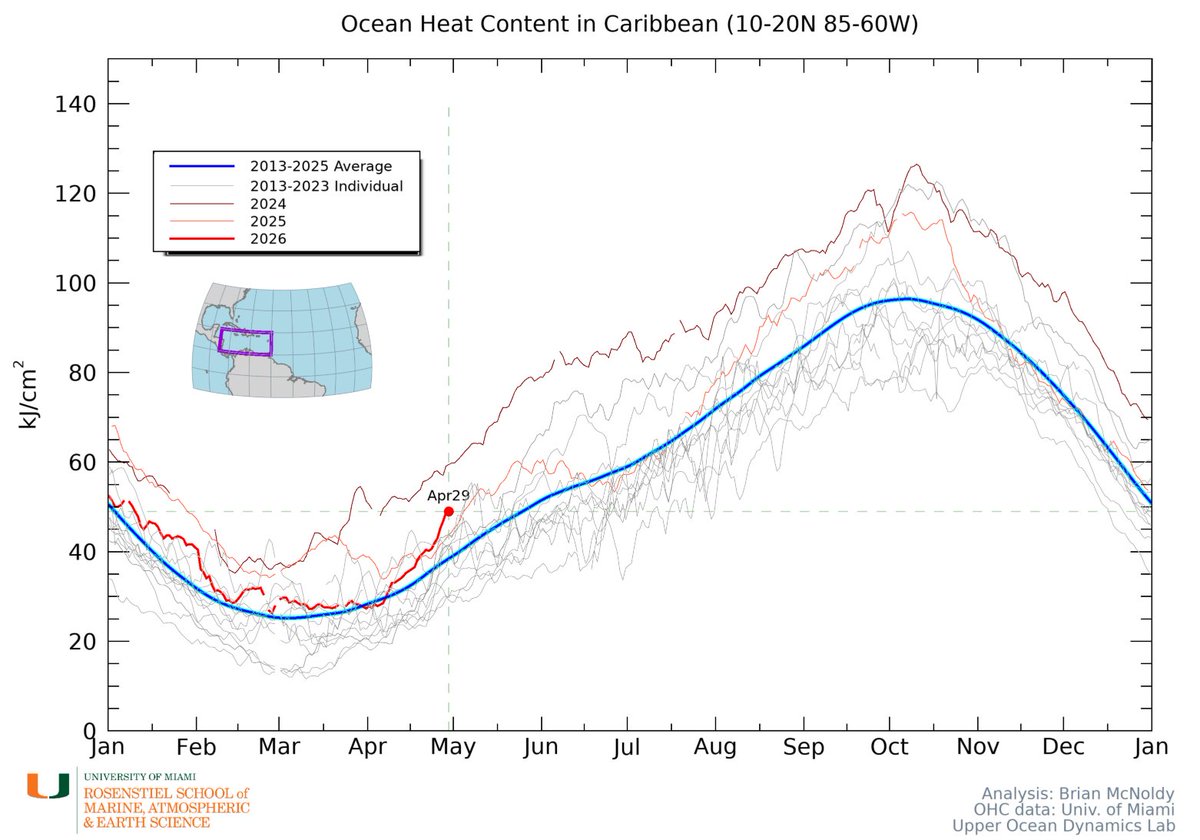
In 2023, many seeds still ended up as OTS, but the key point is that several favorable windows did emerge despite the hostile ENSO background. That is why I am hesitant to treat the classic strong El Niño analogs as a perfect blueprint. Since 2023, we have been dealing with an exceptionally warm Caribbean state, near levels that older analog seasons simply did not have underneath. In other words, outside of 2023, there are not many clean precedents for evaluating how a historically hot Caribbean may interact with a strongly sheared pattern. So while suppression is clearly the baseline expectation, I do not think the analog argument is as straightforward as just pointing to 2015 or 1997.
I agree that the projected ASO shear anomalies make the suppressive argument much stronger, and historically strong El Niño seasons do support the idea of a broadly hostile Caribbean baseline. My only hesitation is in applying analogs like 2015 too rigidly, because the Caribbean thermal background this year appears historically uncommon and likely warmer than what those classic El Niño suppression seasons had underneath. That obviously does not cancel out 10–15 kt of anomalous westerly shear if it verifies, but it does mean we may be observing this hostile atmospheric setup over a western basin with unusually high oceanic energy. So yes, the suppressive case currently has the upper hand. I just do not think the historical analog is perfectly one-to-one.
That is a fair point, and I agree that a strong El Niño background plus a reinforced Caribbean low-level jet can keep the basin quite hostile, especially early in the season. Stronger easterlies also raise the possibility of mixing/upwelling that could temper some of the current SST anomalies. However, I think it is still too early to conclude that the Caribbean will therefore become irrelevant altogether. A JJA CFS zonal wind signal mainly tells us that June–August may remain trade-dominated, not that the atmospheric state will be uniformly locked through the entire ASO peak. El Niño years often still exhibit intraseasonal shear fluctuations, and even a somewhat cooled Caribbean can remain thermodynamically supportive if temporary relaxations occur. So I agree the hostile case is stronger right now, but I do not think the basin can be written off as definitively non-contributive this early.
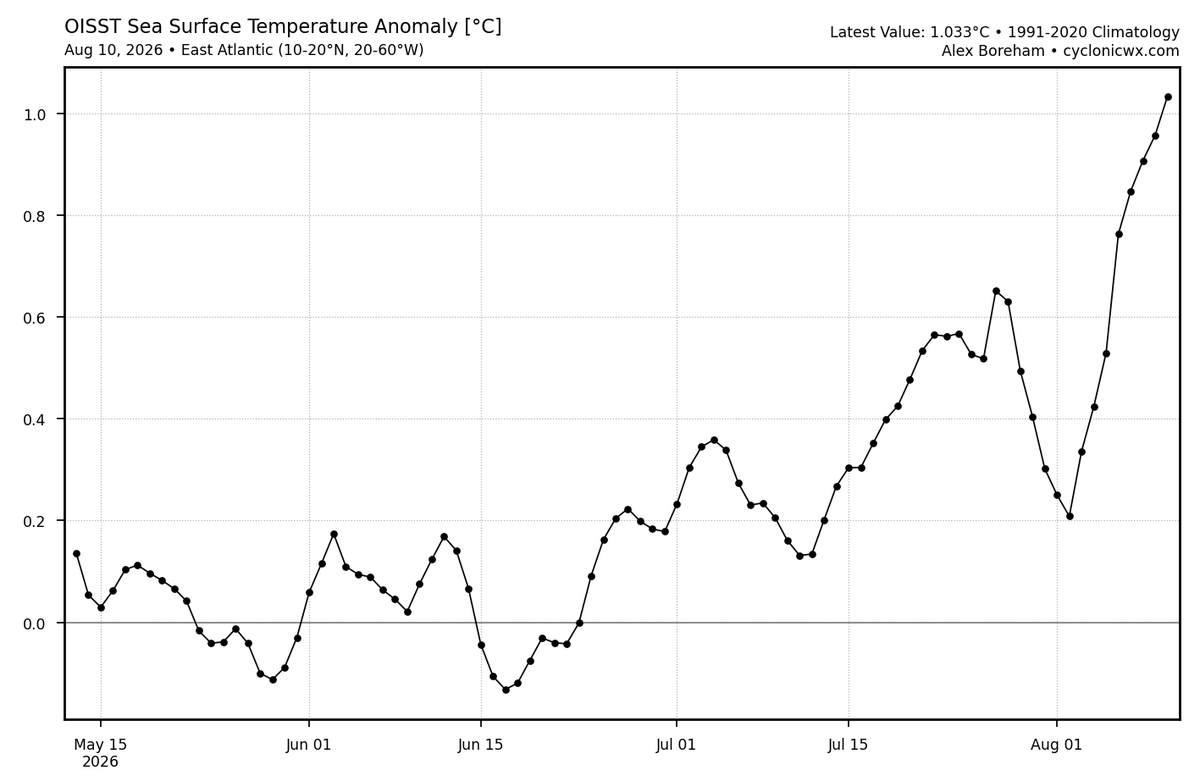
Correct, this is not the same basin-wide Atlantic configuration as 2023. The eastern MDR and waters near the Canary Current are noticeably less favorable, so I am not arguing for a full 2023 style Atlantic override. My point is narrower: the exceptionally warm Caribbean can still enhance the western basin response during temporary shear relaxations, making any surviving disturbances more efficient once they reach that region. In other words, it may not fully compensate for the broader hostile background, but it can still prevent the season from being as uniformly suppressed as a purely ENSO-based outlook would imply.
I’m not saying 2026 is a thermal copy of 2023; obviously the eastern MDR was warmer in 2023 and the northeastern Pacific was cooler. My point is different: 2023 proved that when the tropical Atlantic, and especially the Caribbean, reach exceptional anomalies, the atmospheric response to ENSO does not always translate into uniformly destructive shear. That oceanic heat can erode part of the hostility, increase moisture/convection, and create more productive intraseasonal windows. Shear is not a fixed wall from June through November. And if enough seeds do not coincide with those relaxed periods, the favorable windows get wasted, which is exactly what we saw several times in 2023.