🚨 New preprint out!
We reconstructed parental haplotypes in >440k individuals (UK & Estonian biobanks) to estimate assortative mating directly in the parental generation.
This reveals intensified assortment in recent generations.
🔗https://t.co/wnag6TiWWo
🚨 Our parent-of-origin study is out in @Nature ! 🧬
Maternal and paternal alleles can have distinct — even opposite — effects on human traits, revealing a hidden layer of genetic architecture that standard GWAS miss.
🔗https://t.co/OWW6vGxGYI
Highlights below!
🚨New preprint is out!
How do genetic effects on complex traits change with age?
In this work, we compare different approaches to obtain age-varying genetic effects, and show how design and modeling choices can impact the conclusions we draw.
https://t.co/XUK6PLkx12
A thread 🧵
Extremely proud of @Rbn_Hfmstr for his @eshgsociety Early Career Award received yesterday in Milan. A richly deserved recognition of his outstanding presentation and ingenious research on parent-of-origin effect inference! #ESHG2025
Happy to share our new study on genetic & environmental contributors to age-related decline in ~100K UK Biobank participants! @NatureComms
Here, we used simulation work + longitudinal GWAS to explore risks involved in cognitive/physical decline
(1/)🧵🧵
https://t.co/IYHDyDdz8w
🚨 Preprint update!
We expanded our study on parent-of-origin effects with new findings from the MoBa cohort, now leveraging up to 265,000 individuals!
Discover fresh insights into the genetic architecture of early growth!
Updated preprint: https://t.co/7NoVI2r9PY
FastOMA is out now in Nature Methods 🎉: https://t.co/6nNVfbCVqr A new orthology inference algorithm that scales linearly and is highly accurate. FastOMA can process all >2000 eukaryotic UniProt ref proteomes <24 hours 🚀. Try it out at https://t.co/QUPiRx33J9
Just out in @NatureHumBehav
👇🏼👇🏼
We focused on the causes & impact of self-report error in the UK Biobank. We found that reporting error does not occur at random, is not independent of other participation behaviours, and can complicate the interpretation of genome-wide findings
🚨 Our preprint on parent-of-origin effects (POEs) is out!
With our new method, we inferred the parental origin of >220,000 individuals, revealing new insights into the genetic architecture of complex traits.
👉 Read here: https://t.co/dm4limMAqM
👇 Highlights below!
Excited to share our recent work: expansions and contractions of DNA repeats have produced many genetic polymorphisms. We studied repeat instability among >700,000 biobank participants using new computational approaches to analyze DNA sequencing data. https://t.co/holxhkoWhI
Hello #ASHG24! Curious about how we can determine the parental origin of both transmitted and untransmitted alleles? Come check out my poster 4137 this afternoon!
Thrilled to be presenting at the Pharmacogenomics session at #ASHG24 today at 11am! Stop by if you're curious about exploring causal relationships between drugs, diseases, and proteins. See you there!
Just landed in Denver for #ASHG24 with the @zkutalik team (@A_van_der_graaf@SamuelMoix ) ! If you’re attending, don’t miss our group’s new research at poster boards 4137F and 4095T, and during a platform talk in the pharmacogenomics session on Friday at 11am.
Genome analysis adds to mounting evidence against the idea that Rapa Nui’s population collapsed owing to overexploitation of natural resources https://t.co/eBOBpvDZCK
Breaking down causes, consequences, and mediating effects of #telomere length variation on human health @GenomeBiology 🧬🧬
Thanks to @ Samuel Moix @zkutalik@CAuwerx et al.
https://t.co/t0VJsdD9Tu
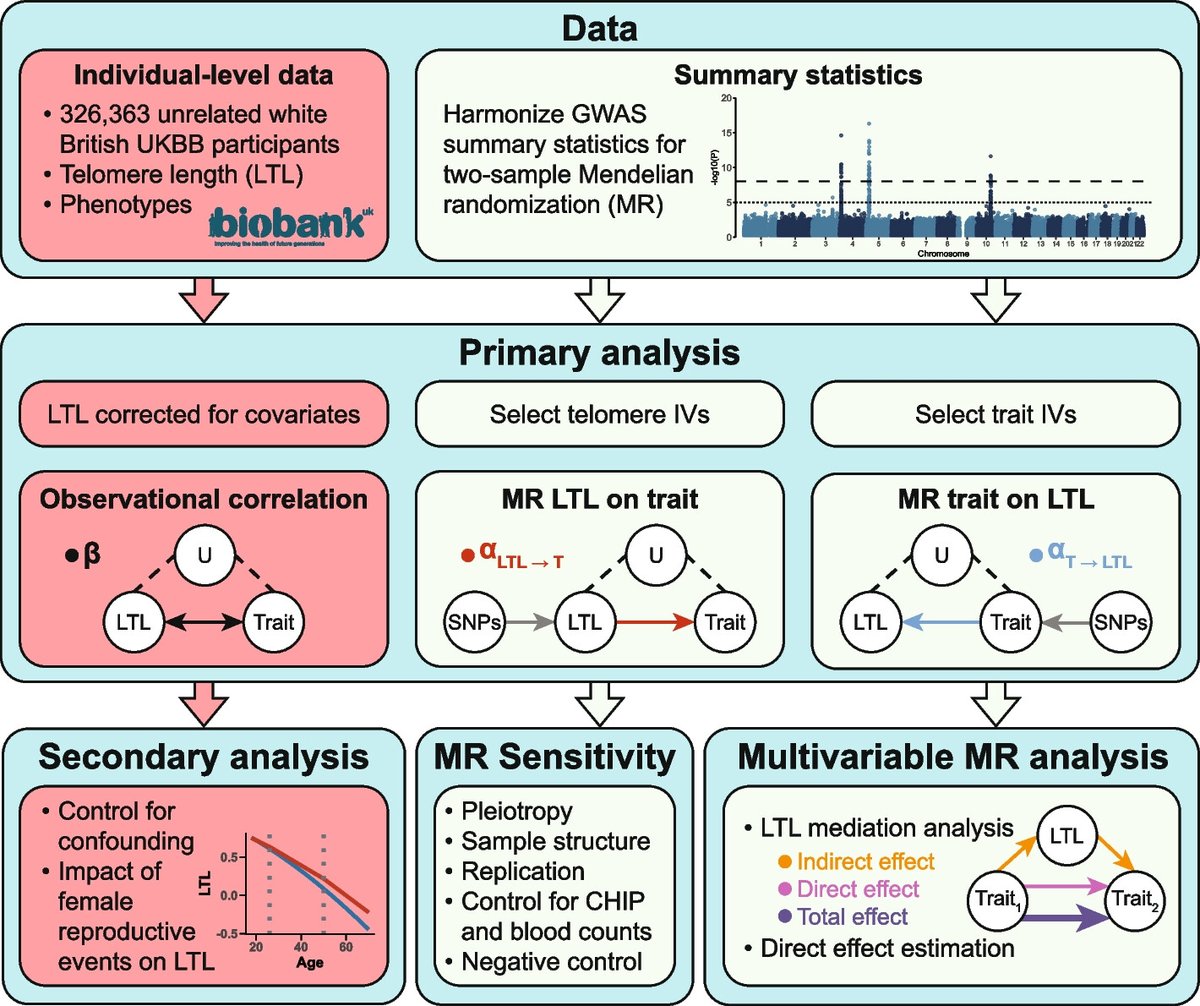
Here's the final schematic representation of the study workflow. For more details, check out the paper! 📃 Big thanks to @smarie_smarie, @zkutalik, and @CAuwerx for their efforts and work in getting this published, and gratitude to the entire #SGG team.
Thrilled to share my first paper as first author on telomere biology, now published in @GenomeBiology: https://t.co/SFY16vWG1T
Following reviewer feedback, the manuscript now includes extensive sensitivity analyses and replication with independent telomere length data 🧬