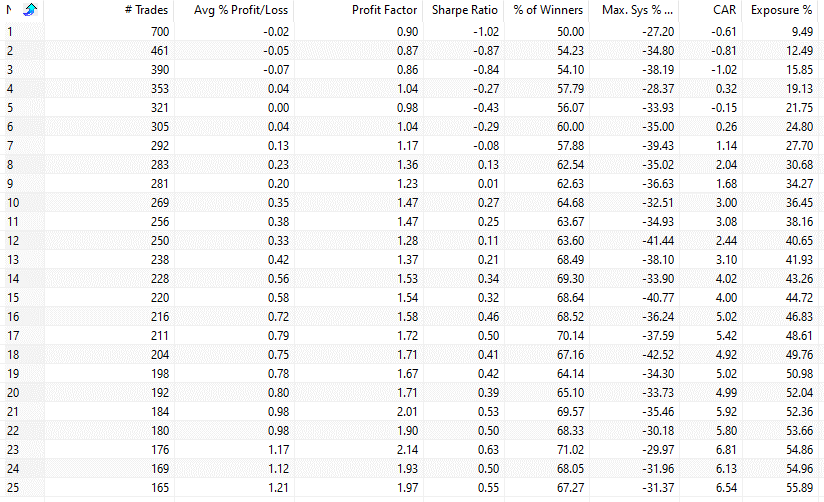
It’s easy to give up strategy (or trading overall).
To avoid this, make sure you:
- Understand the strategy (it makes it easier to follow)
- Have done proper backtesting
- Had the strategy (strategies) in incubation (live demo account)
- Traded it live with minimal size as a first step
- It should offer diversification from other strategies
- ….and finally trade it live with such a small size that you feel detachment to the monetary results.
The Power of Simplicity
Simple trading strategies, characterized by having few variables or parameters, trump complex strategies.
• Effectiveness and Robustness: Simple strategies are generally more effective, easier to implement, and less likely to fail or go wrong compared to complex counterparts. Simple systems are more robust because their rules work in a wider variety of circumstances.
• Solving Complexity with Simplicity: While markets are complex, it is counterintuitive but effective to solve complex problems using simplicity.
• The Role of Experience: Success in trading is not about building complex things, but about brainstorming many simple ideas. Experience is essential in finding ideas to test, and seasoned traders understand that once the minimum information needed to form a hypothesis is acquired, adding variables usually does not improve accuracy.
The Risks of Complexity
The sources emphasize that complexity introduces significant risks that undermine performance:
• Increased Risk of Overfitting: The primary danger of complexity is the increased risk of curve-fitting. Adding filters and variables exponentially increases the risk of curve-fitting results to the data set.
• Overconfidence and Error: Additional complexity leads to overconfidence bias, where the trader becomes overly confident in their ability to predict, even though the strategy may perform worse. Complex strategies are more prone to errors. If a strategy has multiple variables, a tiny change in just one can render the entire strategy worthless because the effects are multiplicative.
• Market Complexity and Uncertainty: Trading is inherently difficult because markets are complex and depend on an almost unlimited number of factors. This complexity makes trading susceptible to change and uncertainty.
The Psychological Bias Toward Adding Elements
A major challenge for traders is a cognitive or psychological bias toward complexity.
• The Tendency to Add: When faced with a problem, both traders and people in general tend to select solutions that involve adding new elements (features, variables, legislation) rather than taking existing components away. This is the natural inclination in most aspects of life.
• Perceived Value: Traders are inclined to add variables because they believe a more complex strategy will perform better than a simple one. Complexity tends to "sell better," as people often assume they get more value from a strategy with eight variables than one with two.
• Occam’s Razor Ignored: This tendency to add complexity is utterly opposite of Occam’s Razor, which suggests that the simplest of two competing theories should always be preferred.
The Solution: Removing Variables
The key insight for improving trading strategies is to focus on removing variables, not adding them.
• Better Solutions Through Subtraction: Removing elements can be a radical idea for many, but it often leads to better and more reliable solutions. By subtracting or removing variables, traders can improve results and simultaneously reduce the risk of overfitting.
• Building Strategies Simply: Traders should build many straightforward strategies that complement each other.
• Cautions for Backtesting: When forming a hypothesis and starting backtesting, traders should always start with the simplest variables. Complexity should only be added later by scrutinizing the trades that were removed from the backtest. When a strategy seems to stop working, the instinctive urge is to add a variable, but the correct course of action may be to do the opposite and remove one.
Overnight Trading Strategy: The 3-Day Down Setup.
A classic "Mean Reversion" strategy that exploits the "Overnight Effect," where the majority of S&P 500 returns historically occur between the close and the next day's open.
One simple rule.
The Strategy: 3-Days Down
✅Asset: $SPY
(S&P 500)
✅Trigger: Market closes lower 3 days in a row.
✅Entry: Buy at the 3rd day's close.
✅Exit: Sell at the next day's open.
Results (Since 1993):
✅ 643 Trades
✅ 65% Win Rate
✅ 8% Max Drawdown
The "Greed" Twist: If you hold until the next day's CLOSE instead of the open:
✅Average gain jumps to 0.24% per trade.
✅But... win rate drops and drawdown increases significantly.
Optimization:
By refining the entry/exit, our version hits ~0.35% per trade with lower volatility.
What Happens When A Stock Is Overbought?
Most traders think “overbought = sell.”
The data says something more subtle.
A backtest shows that when stocks become overbought (2-day RSI > 95), returns over the next few days are significantly weaker than average, but long-term returns revert back to normal.
Overbought predicts short-term softness, not crashes.
Below are the results for #spy after N-days when RSI(2)>95:
NR7 trading strategy for swing trading (with rules, logic, and backtest)
Most traders look for movement. NR7 teaches you to look for contraction.
The NR7 pattern, introduced by Tony Crabel in 1990, is based on a simple but powerful observation:
👉 Big moves often start when volatility contracts first.
An NR7 day occurs when today’s trading range (high − low) is the smallest of the last 7 trading days.
That’s it.
No complicated indicators. Just price behavior.
However, a lesser-known fact is that Crabel designed NR7 for volatility expansion forecasting, not as an entry.
Why does this work?
Markets move in cycles:
Expansion → contraction → expansion
When ranges shrink, energy builds beneath the surface.
It’s the classic “calm before the storm”?
Low volatility frequently precedes sharp directional moves - which is exactly what NR7 tries to capture.
We backtested NR7 (trading rules):
- The range, or volatility, is the difference between the High and the Low (each day).
- If today has the lowest range of the previous last 6 trading days, then we go long at the close.
- We exit at the close when today’s close is higher than yesterday’s high.
We’re not predicting direction.
Unlike many short-term strategies, it is NOT necessarily buying weakness (mean reversion).
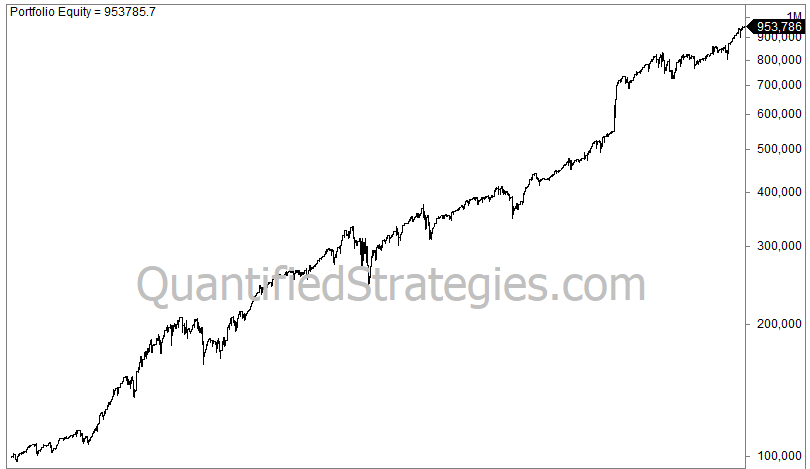
This is the equity curve for SPY since inception:
You are entering during quiet markets - often during stable or bullish environments - which makes it a strong complement to mean-reversion systems.
This diversification aspect is underrated.
Many portfolios are overloaded with the same type of edge.
NR7 behaves differently.
Backtests show something important:
✅ Reasonable long-term performance
✅ Moderate exposure time
✅ Many small gains instead of rare big wins
But also:
⚠️ Average trade can be small
⚠️ Needs exits and filters to improve robustness
In other words:
NR7 is more of a framework than a finished strategy.
However, edges don’t always come from complexity.
Absolutely. High win rates alone mean very little. Robustness and realistic assumptions matter more. We published this strategy many years ago, and the backtest itself covers roughly 15–20 years of market data. As always, verify everything yourself and see if you get similar results.
The best trading strategies are often surprisingly simple.
We tested a Triple RSI strategy that achieved a 91.03% win rate in our backtest.
In the video, we break down the entry and exit rules, the performance, and why testing ideas beats relying on opinions.
What just happened?
Last night, news emerged of a "trade deal" that has never happened before.
Nvidia and AMD agreed with Trump to provide the US with 15% of REVENUE from chip sales in China to remove export controls.
Corporations are panicking. Here's why.
(a thread)
"While the world fixates on Donald Trump’s populist cocktail of reciprocal tariffs and big, beautiful deficits, @JMilei is delivering a man-made miracle that should gladden the heart of every classical economist and quicken the pulse of all political libertarians." 1/5
“Unprecedented”?
Why y’all omitting the ‘Roman Warm Period’ and the ‘Medieval Warming Period’?
Is it because it was millennia before the Industrial Revolution and doesn’t fit the fabricated climate narrative? 🧐
Javier Milei har sänkt Argentinas månatliga inflation från 26 % till bara 1,5 %.
Ekonomin växte med 7,6 % under Q2 mot året innan.
Han har vänt en 100-år i fel riktning trend.
Men detta kommer ni aldrig få höra något om i mainstream media.
De kallar honom en farlig "högerextrem" galning som förstör sitt land.