My lab at ETH has an opening for a Scientist in Antibody & Nanobody Drug Discovery (workspace in Basel, Switzerland): https://t.co/mfm7PpHJEj Please apply if suitable or RT, thanks!
Do you want to take a leading role in shaping a research group on functional cancer microbiome work, including coordination of an @ERC_Research grant and national consortium? Join our @EMIL_DKFZ team in Heidelberg as Staff Scientist! Details: https://t.co/8YEoxtUrAM
Pls Retweet😀
How are cell-cell interactions governing successful metastatic colonization in the liver? Have a look at our new paper in @nature that introduces an in vivo proximity screen to functionally test cellular interactions in a high-throughput manner. https://t.co/oWFn3Hfj8M 🧵
Two personal announcements:
1. My PhD work was just published in Nat Comm (https://t.co/RSyGXGLCxT): a mosaic knockout tool with multicolor reporter readout. Big thanks to all the authors and colleagues at the VBC who contributed to the work & gave advice.
2. I started my postdoc in the Moor lab (@moorlab) at D-BSSE, Basel (after spending a year being home & in the Taiwanese army). I am very excited to work on multidisciplinary projects with everyone here - including genetic screens, single cells & spatial-omics.
We're at the cover of Cell Stem Cell.
We're at the cover of Cell Stem Cell.
We're a-
(I can barely believe it. 🤯)
We found out why some people are born without the main interhemispheric bridge. 🧠
👏 to @PhDexheimer for this beautiful illustration of the corpus callosum.
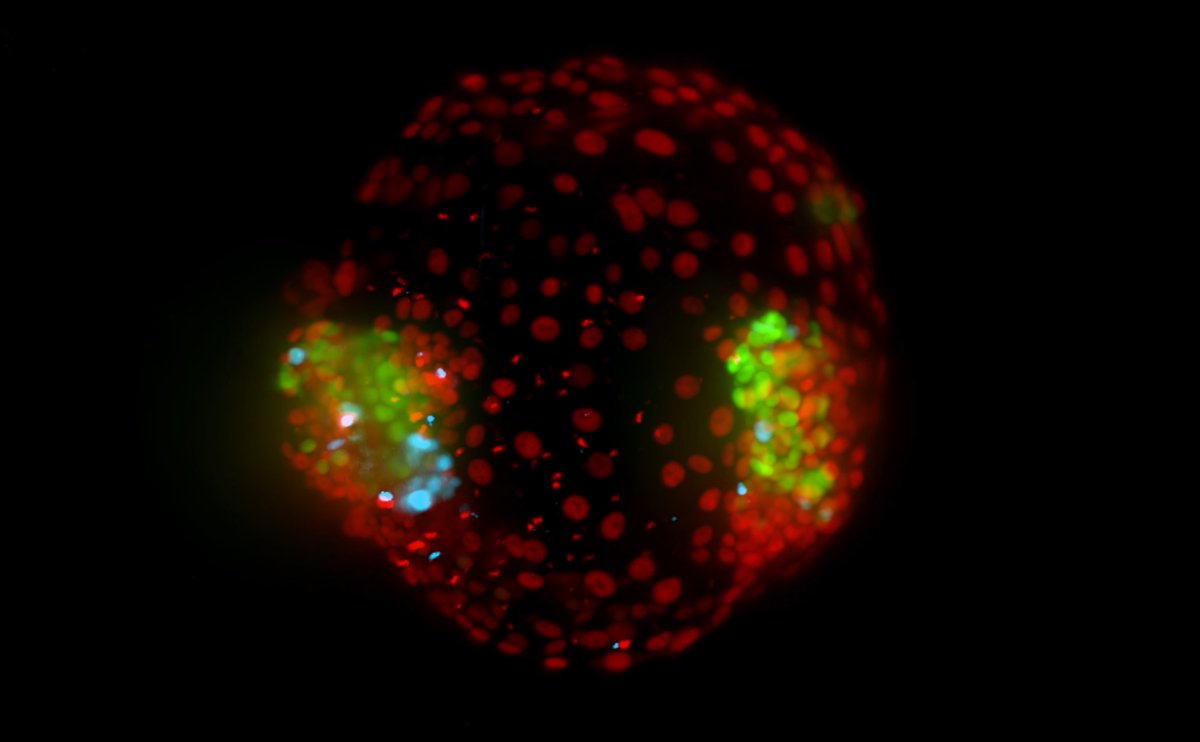
We are really excited to share our findings on monochorionic twinning in human blastoid embryo models https://t.co/6VUCshmitj, shedding light, finally, on the formation of identical twins. @MERLN_UM@Dorian_Luijkx https://t.co/x9jzpYjhci
I’m delighted that our paper on the Multicellularity Long Term Evolution Experiment (MuLTEE) has, at long last, been published. This paper establishes the foundations of what I’d like to work on for the rest of my career. 1/25
Free, full access link: https://t.co/lWh33eHQrf
😶🌫️🤩 It's out!
So happy to share a big piece of my PhD work with the world. 🧩
Using human neural #organoids, we investigated corpus callosum agenesis, a disconnection between the two #brain hemispheres. 🧠
What we found was surprising and exciting... Curious? 📃 👇
📣 Preprint alert!
Check out our latest story, led by @catarinacsmc.
The corpus callosum safeguards interhemispheric communication in the human brain.
𝘈𝘙𝘐𝘋1𝘉 mutations cause agenesis/absence of the CC.
We wanted to know why. 🤓
🧵1/9
https://t.co/RwkEOBpf31
Sam and I introduced the SCON method for easy conditional KO. He made a new conditional intron system, named ICON. When targeted to Leptin, we saw the ob/ob phenotype. ICON works in the opposite way of SCON, so initially KO that can be reverted to WT upon Cre activation.
#Koo_lab