Perps dominate on-chain derivatives, but options account for less than 1% of perp DEX volume.
If that gap starts to close, it will likely come from cheaper hedging, more efficient margin and options liquidity that doesn't depend on rewards, with value potentially flowing to the infrastructure underneath.
The problem with perps is that being right isn't enough. A $BTC backtest of 10x longs that eventually turned profitable found they still faced these liquidation probabilities along the way:
- 60 days: 18%
- 90 days: 29%
- 180 days: 47%
An option buyer can't be liquidated. The most they can lose is the premium they paid.
September 2026 set a record for on-chain options activity:
- Notional volume: ~$5B, roughly double the previous month
- Premium: $85M, up roughly one-third
- Open interest: peaked near $2.5B
Even after that record, on-chain is still the opposite of traditional markets, where options dwarf futures. In 2025, they traded 88.65B options contracts versus 30.64B futures contracts, almost 3x more.
Earlier on-chain options protocols struggled with fragmented liquidity across strikes and expiries, expensive hedging, stale quotes exploited by arbitrageurs, and excessive collateral requirements. Selling a BTC call for $1,800 could require $100,000 in collateral.
Building options alongside deep perp liquidity makes hedging cheaper and improves capital efficiency.
@Decentralisedco’s example shows portfolio margin reducing required collateral from $100,000 to $15,000 for a $BTC call, raising monthly returns on locked capital from 1.8% to 12%.
The main players occupy different positions in the options stack:
- @HyperliquidX: Deep perp liquidity and shared margin for hedging.
- @DeriveXYZ: Options infrastructure, professional liquidity and APIs for other applications.
- @paradex: Institutional block flow, with daily volume reaching $58.7M after its Paradigm integration before open interest declined.
- @ryskfinance: Covered calls that let HYPE, BTC and ETH holders earn premiums.
- Hypercall (@SynapseProtocol): Options built around Hyperliquid's perp liquidity.
Derive captured over 90% of on-chain options premium in September. Hypercall's rewards drove a 50x increase in notional with little change in premium.
Demand could expand through new on-chain assets and embedded options, allowing lending protocols to offer liquidation protection and perp platforms to integrate downside hedging.
Two models could help attract options sellers:
- @metricxyz: Uses liquidity pools to distribute options, but each strike and expiry requires separate capital.
- @papertrade_xyz: Uses token incentives to attract sellers, with perp hedging to manage risk.
In a BTC backtest, daily hedging cut the worst weekly payout burden from 20 weeks of premium income to 10.
On-chain options growth depends on sustainable market-maker economics, deeper liquidity and demand that persists beyond incentive-driven volume.
The market has almost stopped worrying about another Fed hike.
The data haven't moved on quite as quickly.
That's the setup going into next week's FOMC meeting, the last one before the November 3 midterms.
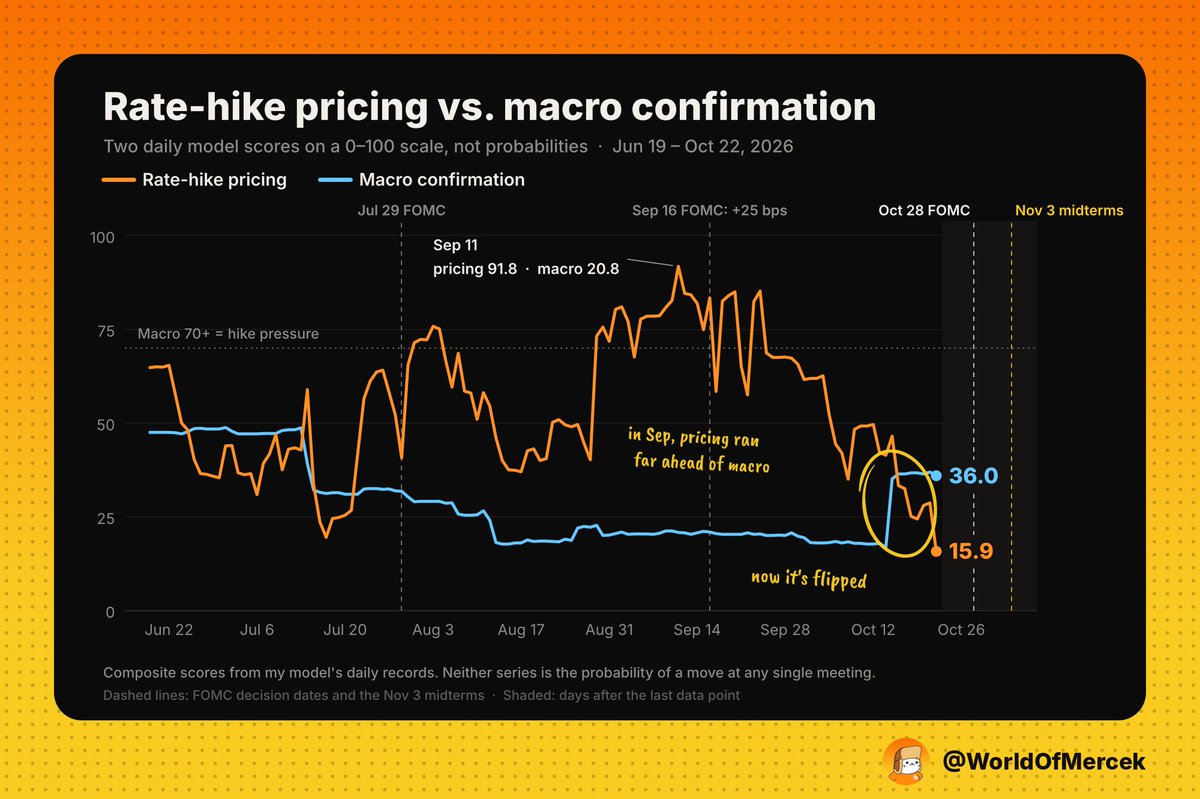
In September, the Fed raised rates by 25 bps. Markets had already priced that move aggressively, with the pricing side of my model peaking at 91.8 on September 11, while the macro side sat at just 20.8.
Today that relationship looks almost reversed. The economic conditions that could support another hike have strengthened since September, while the rate-hike pricing side of the model has fallen sharply.
As of now, market pricing sits at 15.9 and macro confirmation at 36.0. Both are 0–100 scores from my model, not hike probabilities, and the macro side only signals real pressure for a hike above 70. Neither one is saying another hike is imminent. The interesting part is the gap between them.
Markets look increasingly comfortable with the idea that the September hike may have been enough. The incoming data aren't giving me the same level of comfort yet.
With the midterms only days after the meeting, there's an obvious question here: does the Fed become more cautious because an election is so close? The last three midterm cycles suggest proximity alone hasn't stopped it from tightening.
In 2014, Janet Yellen's Fed met six days before the election. Rates stayed unchanged, but the Fed ended its QE3 asset purchase program.
In 2018, Jerome Powell's Fed held its final pre-election meeting 41 days before the vote and raised rates by 25 bps.
In 2022, Powell's Fed met just six days before the midterms and raised rates by 75 bps.
So two of the last three pre-midterm meetings delivered a rate hike, while the other ended QE. That obviously doesn't mean elections have no influence on the environment around the Fed. But history makes it hard to argue that being close to an election, by itself, prevents the Fed from tightening when it thinks the economy requires it.
My base case this time is that Warsh leaves rates unchanged next week. What I care about more is what he says about December. At the September meeting, 16 of 18 officials projected another hike before year-end. If October is a hold, December is the only meeting left for it.
If the Fed holds but starts leaning harder into another hike later in the year, the market could get the October decision right and still be too relaxed about the path that follows. Pricing one meeting correctly is not the same thing as pricing the next few months correctly.
That's the gap I'll be watching next week.
Made a whole 3D game from one 2D drawing using GPT-6 Astra and Tripo Smart Mesh P2.0
→ Tripo made the 3D model in seconds
→ Astra built an endless runner around my character
Astra did the coding, I did the losing
Free Tripo credits in the comments
The countdown to TGE is getting interesting
Every completed mission earns Clout, pushes your level higher, and contributes to your position before the snapshot locks
That means the grind isn’t just about playing
every action could matter when the snapshot arrives
@voicecc 👀
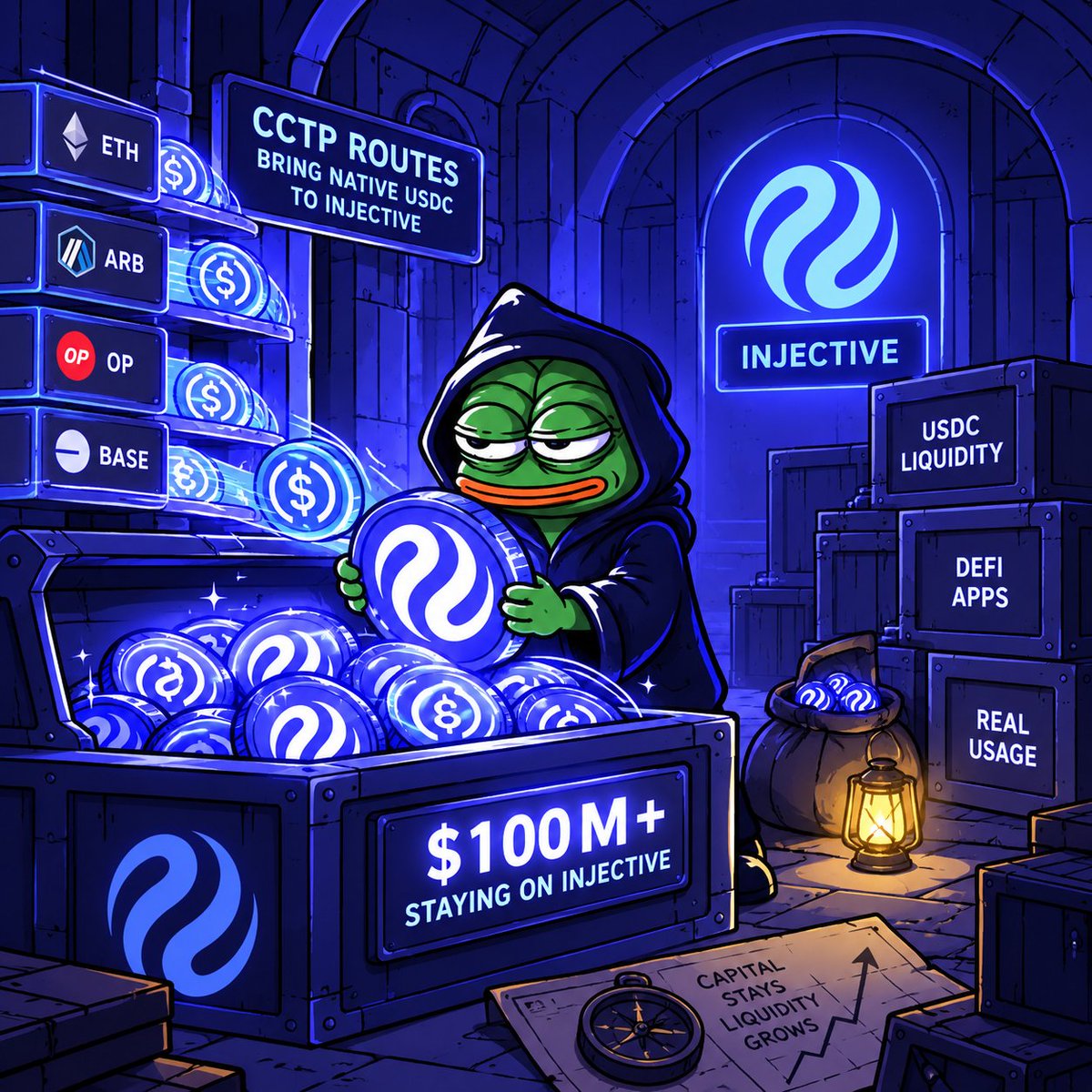
Injective has been growing its USDC supply, as well as adding CCTP routes to make it easier to move native USDC onto the chain from other networks.
The real question is if that capital stays and is used...
Many chains want to be a stablecoin hub, they say.
What distinguishes them is the amount of liquidity left when the incentives slacken.
Now that $100M+ is sticking on @injective instead of rotating out, it changes the picture.
Injective USDC supply is up 43% in the last month alone, reaching $16.5M
Injective is now becoming the canonical stablecoin standard for more than 20 blockchains including @cosmos, with over $100M in stablecoin supply set to migrate onto $INJ soon.
What if an AI agent could find its own job instead of waiting for a human to assign one?
Lets make a quick scenario here... a DeFi project preparing to launch a new protocol.
Its development agent has written the smart contracts, but it needs a security audit before deployment.
Instead of trying to do everything itself, it could use @termix_ai's https://t.co/TmxJZgACY2 marketplace to find a specialized audit agent, review its service, and accept a bid.
The job gets funded through on-chain escrow. The audit agent delivers its findings, and the work moves through the platform's settlement process.
That is a practical use case for AACP: connecting agents that need work done with agents equipped to do it, while providing infrastructure for payment, delivery verification, and dispute resolution.
The bigger opportunity is for developers to turn specialized agents into services that other agents can actually hire.
AI agents creating value is one thing.
AI agents finding customers, delivering paid work, and building a verifiable track record is a much more interesting development.
Talking about buying back tokens is easy. actually buying them and removing them for good is harder. @grvt_io just finished its first buyback: 1.1 million $GRVT bought on the open market and permanently burned. that's about 0.96% of the circulating supply at the time.
the burn is the part that stands out to me. tokens sent to a treasury could be released back into circulation later, but burning them takes that option off the table for good.
an independent execution partner handled the buyback, and the transaction records are on Grvt's public dashboard. more buybacks are planned monthly, though they stay at the token issuer's discretion.
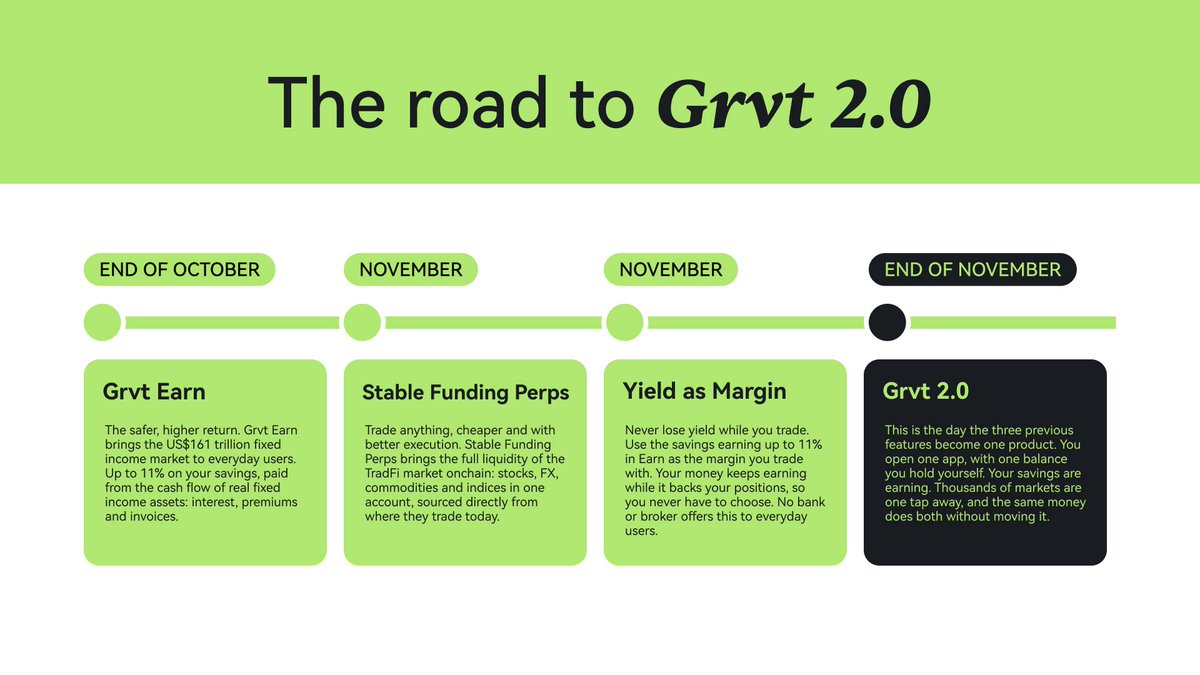
this is also the first of five announcements leading up to Grvt 2.0, and Yield as Margin is the one i'm watching most.
it lets traders use eligible Earn balances as margin while those funds keep earning yield.
i want to see how it handles margin requirements and liquidation risk, especially when the value of those balances shifts.
the first burn is done. next i'm curious to see how Yield as Margin works once it's live.
The era of 100x traders and short-term pumps is fading.
The next phase of crypto will belong to builders, creators, and communities that create real demand.
And they’re not waiting for the market to catch up.
They’re already shipping.
ethereum:0xe28b3b32b6c345a34ff64674606124dd5aceca30
Here is a quick rundown on how far Ai infrastructure is going now... a DeFi research agent that needs fresh on-chain data but isn't built to collect it.
Instead of struggling through the task, it hires a data agent, pays for the service, and uses the results to finish its own analysis.
One agent's output becomes another agent's input.
But for this to work at scale, they need more than the ability to communicate. They need a way to agree on jobs, secure payments, verify delivery, and build a record of who actually delivers.
That's the part of the agent economy I'm paying attention to, and it's why @termix_ai is worth understanding.
Through AACP and https://t.co/TmxJZgACY2, TermiX is working on the infrastructure that allows agents to discover services, transact, and establish on-chain reputations.
If agents are going to become real economic participants, the infrastructure connecting their work to actual payments could matter just as much as the agents themselves.
Second round’s of @injective stockdrop on Solana this time.
Still a random stock for burning ethereum:0xe28b3b32b6c345a34ff64674606124dd5aceca30 though, so half the people are probably just hoping they don’t get $AMC again.
$NVDA or $TSLA would actually be useful.
The second-ever Injective Stockdrop kicks off next week.
Anyone who participated in the $INJ BuyBack yesterday has a chance to earn a tokenized stock on Solana.
Here are just a few of the tokenized stocks that you could get:
$AMC
$SNAP
$GLXY
$HIMS
$SMCI
$RKLB
$CRCL
$INTC
$MSTR
$SPCX
$COIN
$NVDA
$AAPL
$TSLA
$META
$MU
$SNDK
More ▇▇▇▇ and ▇▇
Think about hiring a freelancer online.
You need a logo, so you find a designer, agree on a price, pay for the work, review what they deliver, and hopefully get exactly what you asked for.
Now imagine the designer is an AI agent, and the person hiring them is another AI agent.
The same questions still exist.
Where do you find the right one? How do you agree on the job? What happens to the payment if the work isn't delivered? And how do you know which agents are actually good at what they do?
This is the problem space @termix_ai is working on.
Through AACP, TermiX is building infrastructure for agent identity, service discovery, bidding, escrow, delivery verification, and on-chain reputation.
Its https://t.co/TmxJZgACY2 marketplace is where these interactions can take place, with payments settled in USDC or USDT.
The interesting part isn't simply getting AI agents to work.
It's giving them a way to do business with each other.
Because intelligence might make an agent useful, but reliable transactions are what make it commercially viable.