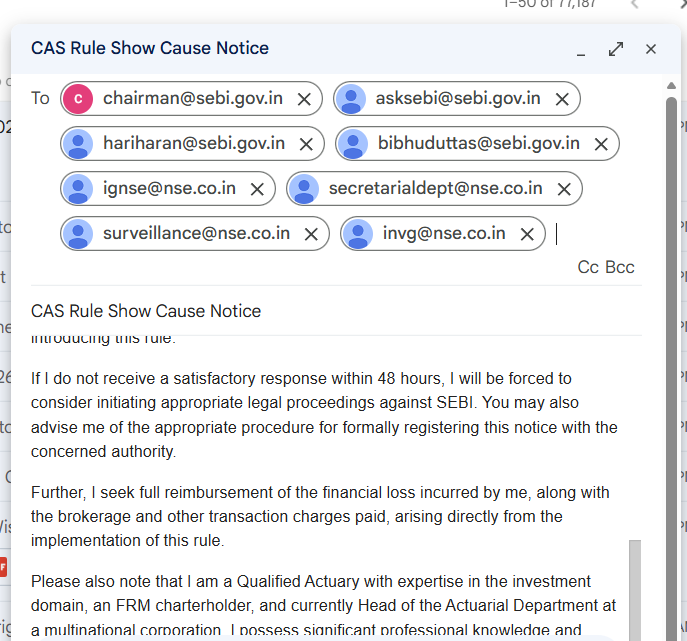
I have sent out a show cause notice to SEBI and NSE. I have given them 48 hours to respond.
At the same time, I am speaking to lawyers but yet to get a good one. Any good finance related lawyer in Mumbai reach out to me or please DM me the contact details
“ India’s Biggest Casino ”
India’s biggest casino now opens at 3:15 PM.
Not in Goa. Not in Sikkim.
At the NSE closing auction where a 0DTE option trader can watch the
“settlement value”
jump 150 points while the underlying cash basket is not trading continuously.
A thread 👇🏻
Today at 3:15 PM, Nifty was at 24,463.45.
Its official close: 24,614.90.
That is a 151.45-point auction jump on weekly expiry day.
Yesterday, Day 1 of CAS, the closing adjustment was roughly 200 points.
Fair and robust price discovery, apparently.
Here is the new game:
3:15–3:20: cash orders blocked; reference price calculated.
3:20–3:25: market + limit orders collected.
3:25–random close: only limit orders; market orders locked.
3:28–3:30: random close.
F&O keeps trading till 3:40.
On my terminal, the ATM straddle was near ₹100 at 3:15.
In five minutes it went ₹100 → ₹120 → ₹85 → ₹100, even though the cash index was effectively frozen.
At 3:20, the indicative auction value began moving and 0DTE derivatives had to chase it.
The market then priced possible closes around 24,500, 24,520, 24,545, 24,587 and 24,602.
By roughly 3:28–3:29, it stabilised near 24,615.
The official Nifty close was 24,614.90.
Great opportunity provided you enjoy betting on a moving, non-binding auction indication.
Let us call this what it was.
Not normal cash-futures arbitrage.
Before random close, the indicative price can change as orders enter, change or disappear. The cash basket cannot be continuously traded against it.
You are trading settlement jump risk not a locked arbitrage.
On expiry, this is far more dangerous.
The final Nifty close determines option settlement.
So a thin closing auction in heavyweight stocks can transfer large P&L across the expiring options book while traders cannot continuously hedge the underlying basket.
Today’s CAS turnover was reportedly ₹1,542.4 crore on NSE versus only ₹9.4 crore on BSE.
That is 99.4% of auction activity concentrated on NSE.
The two exchanges run separate auctions and can discover different closing prices.
What could possibly go wrong?
The absurdity:
The “actual” Nifty remains based on the last continuous cash prices.
The “indicative close” is based on tentative auction prices.
But expiring options trade on expectations of the second number.
One index. Two displayed realities. Ten minutes to settlement.
NSE says CAS promotes transparency and robust price discovery.
Yet its own framework allows:
• separate NSE/BSE closes
• market orders counted in equilibrium
• market orders locked after 3:25
• no MOC/LOC order type
• a random closing time
On weekly expiry. Brilliant.
Closing auctions are not the problem. Major markets use them.
The mistake is coupling a new, thin cash auction to 0DTE settlement while derivatives remain live and the underlying basket cannot be continuously hedged.
That turns price discovery into a lottery.
SEBI and NSE should urgently:
Pause CAS-based weekly-expiry settlement.
Publish real-time index and stock imbalances to everyone.
Add deviation collars and auction extensions.
Align cash finalisation with derivatives.
Until then: 3:15 PM = casino time 😞
@NSEIndia@BSEIndia@SEBI_India
Do like & share if you want to stop this casino
Comment with your thoughts
Why are brokers so silent on CAS (Closing Auction Session)?
@Nithin0dha@lkeshre@tejaskhoday
Today, traders are raising concerns. Tomorrow, when trading volumes dry up, brokers will also feel the impact.
A healthy market survives on participation, liquidity, and trader confidence—not uncertainty.
If this rule hurts retail participation, everyone in the ecosystem will eventually pay the price.
It's time for brokers to stand with traders and raise their voice. Silence today could become regret tomorrow.
#RollbackCAS #SaveIndianMarkets
🧵 THREAD: What is happening to India's retail traders?
Requesting leaders, journalists, and public voices like @RahulGandhi, @dhruv_rathee, @AnilSinghvi_, @_anujsinghal@Abhinavpinch@ShyamMeeraSingh@TheLallantop@PeekTV_in@UFbySamdishh@sundaysarthak and others to please look into the Closing Auction Session (CAS) issue affecting lakhs of market participants.
This isn't about profits or losses from trading.
This is about a structural market change that has disrupted the way India's derivatives market functions.
1/ Over the last two trading sessions, the implementation of CAS has created significant confusion around the market close. Many traders experienced unexpected big losses, abnormal price movements around the close, and difficulty managing their positions. For active traders, the closing minutes are critical.
2/ This isn't an isolated change. For years, traders have been forced to keep redesigning their businesses after repeated regulatory and structural changes.
- Investors saw Short-Term Capital Gains tax increase to 20%.
- Futures traders faced a sharp 2.5x increase in STT, making futures trading significantly more expensive.
- Bid-ask spreads in many futures contracts have widened, increasing trading costs further.
- STBT traders lost expiry-day margin benefits, making STBT trading with no sense
- And now CAS is affecting both intraday and positional traders.
3/ Every single change may have had its own objective, but together they have dramatically increased the cost and complexity of participating in Indian markets.
Retail traders are adapting again and again while their opportunities keep shrinking.
4/ If participation falls, the impact won't stop with traders.
Lower participation means:
• Lower liquidity
• Lower trading volumes
• Lower broker revenues
• Lower exchange turnover
• Lower STT collection for the government
• Impact on prop firms and the broader market ecosystem
5/ Retail traders are not asking for special treatment.
We are asking for consultation before major structural changes are implemented and for data showing that these changes actually achieve their stated objective.
6/ If this continues, India risks pushing active traders towards overseas markets and other asset classes, weakening the competitiveness of our own derivatives market.
7/ I request journalists, policymakers, market experts, and public representatives to cover this issue and ask the relevant questions.
A healthy market is built by listening to all stakeholders - not by repeatedly making structural changes without meaningful engagement.
Please raise your voice for India's trading community and reconsider the CAS framework.
#RollbackCAS #SaveRetailTraders #IndianStockMarket
Second day of CAS chaos as there is huge difference in rates of 3.15 and 3.30. It has severely impacted option prices and expiry trading. Should CAS be closed down?
#nifty#cas#nse#expiry#optiontrading@_anujsinghal
A High School teacher spells:-
January as JUNGU
February, she starts with M and then gives up.
She is a teacher for last 2 decades.
Baba Saheb's legacy.
PM @narendramodi has put this disastrous policy on steroids. @DrMohanBhagwat endorses this Social INjustice.
CREEPS.
I request @AnilSinghvi_ and @_anujsinghal sir to please raise the voice of traders on your shows and urge the authorities to reconsider the Closing Auction Session (CAS).
STBT trading has already been severely impacted. If CAS continues in its current form, 0 DTE trading could also become unviable.
Please help save our markets by advocating for a rollback of CAS.
If you agree, please retweet for wider reach and tag both the anchors so this issue reaches the right people.
#RollBackCAS
Dear @NSitharaman,
If share trading is someone’s only source of income and they make ₹8 lakh profit in a year through short term trading:
STCG tax: 20%
₹8,00,000 × 20% = ₹1,60,000
4% cess = ₹6,400
Total tax = ₹1,66,400
This feels unfair for people who depend only on trading.
A salaried person earning ₹12 lakh pay zero income tax, while a trader making just ₹8 lakh profit has to pay ₹1.66 lakh in tax.
WOWOWOW.
What the hell is happening to the Indian stock market?
Dear @SEBI_India & @NSEIndia@BSEIndia
How many times do you expect traders to rebuild their entire business?
> December 2020 – 50% leverage removed
> March 2021 – 75% leverage removed
>September 2021 – 100% leverage removed
We adapted.
Yes, leverage is a double-edged sword. But thousands of genuine traders with smaller capital were affected. Still, we adapted.
> September 2023 – Bank Nifty expiry was shifted from Thursday to Wednesday, while BSE launched Sensex weekly expiry on Friday. Suddenly, we had expiries almost every trading day.
Many traders, especially algo and 0-DTE traders, redesigned their entire systems.
We adapted.
> November 2024 – Weekly expiries of FinNifty, Bank Nifty and other indices were removed. Only Nifty and Sensex weekly expiries remained.
Again, thousands of traders had to change their strategies.
We adapted.
> February 2025 – Expiry-day margin benefit was removed.
STBT traders were hit badly.
We adapted.
> 1st September 2025 – Nifty expiry shifted from Thursday to Tuesday.
Again...
We adapted.
> Jane Street reportedly made billions of dollars from Indian markets over the years. Later, regulatory action was taken, and subsequently trading restrictions were lifted after payment of regulatory dues/settlement.
How exactly did all of this benefit Indian retailers?
Meanwhile...
- Option STT has increased massively over the last few years.
- Bid-ask spreads have widened.
- Slippage has increased.
- Global volatility has increased.
- Transaction costs keep rising.
We adapted to everything.
And now...
Closing Auction Session (CAS).
Seriously?
Every few months there's another structural change.
Every few months traders are forced to rebuild their systems.
Every few months liquidity takes another hit.
You say these changes are for retail investor protection.
Then please show us the data.
Can you show even one report proving that retail trading losses have actually reduced because of all these interventions?
If not, then what exactly are these constant changes achieving?
Instead of making markets more efficient, you're making trading more expensive, more complicated, and pushing serious traders towards crypto and international markets.
As a full-time trader, my inner soul genuinely cries today seeing the direction our markets are heading.
We survived leverage removal.
We survived daily expiries.
We survived removal of daily expiries.
We survived expiry changes.
We survived removal of expiry margin benefits.
We survived higher STT.
We survived wider spreads and slippage.
Now we are expected to survive CAS as well?
Enough is enough.
I request SEBI and the exchanges to reconsider this rule.
Before implementing such major structural changes, consult the trading community. There should be proper communication, public discussion, and representation from active traders.
I also request every trader to raise their voice through the proper channels. If you genuinely believe these changes are hurting market participants, please send your feedback or complaint to SEBI through its official grievance mechanism. And if anyone from the industry has a direct channel to the exchanges or regulators, please help convey the concerns of the trading community.
Please Retweet this so our voice reaches the right people.
Enough of silent adaptation. It's time the trading community is heard.
@AnilSinghvi_@_anujsinghal@SarangSood@PRAFULKULKARN18@adigitalblogger@iarjuntandon@JayneshKasliwal@sunilgurjar01@piyushchaudhry@SantoshPasi@RakeshPujara1@TanmayKurtkoti@justnottamomma@AshishGupta325
Booked a Tatkal Sleeper ticket today from kanpur central to New Delhi.
Filled every detail in seconds, but IRCTC kept showing- "We are experiencing high load."
Tried repeatedly, Then my ID got locked out. Minutes later, every seat was gone.
So the question is - who actually gets these Tatkal tickets?
Genuine passengers or a system designed to fail common people every morning?
If lakhs of users face the same "high load" issue daily, why has it still not fixed it?
Or is the chaos itself benefiting someone?
@IRCTCofficial@RailMinIndia@AshwiniVaishnaw
Count 100 achievements. Count 1,000.
But Modi ji will never be forgiven for these two decisions. 👇
1.Reversing the Supreme Court judgment on the SC/ST Act.
2.UGC Regulation Bill.
Without proper inquiry, you treated General category people as criminals by birth.
And then you speak about equality?
The Constitution promises equal rights to everyone, not selective justice, not vote-bank politics.
This was a blatant stabbing of your own core voters.
You took the people who stood with you unconditionally and made them disposable.
History remembers betrayal more than achievements.
केंद्र सरकार की बुद्धि भ्रष्ट हो चुकी है। जैसा कि -40 अंक में महामानव की सरकार में नंबरों से कोई फर्क नहीं पड़ेगा डॉक्टरों की गुणवत्ता में , तो देशभर में कॉम्पिटिटिव एग्जाम क्यों कराए जा रहे है ? पैसे कमाने के लिय,बंद करो। सबको एडमिशन दे दो जाति के अनुसार।
मोदी जी के शोषित वंचित पीड़ित दलित भाई ने OBC सज्जन की गर्भवती पत्नी को छेड़ा, पति ने विरोध किया, तो घर में घुस कर मारा, फिर को छेड़ने वाले मोदी जी के दलित भाई ने उल्टा उस पत्नी और उसके पति पर SC ST ACT में मुकदमा लिखवा दिया, पति जेल चला गया, पत्नी की देखभाल नहीं हो पायी और उसका बच्चा गर्भ में ही मर गया, अब मोदी जी का दलित भाई मुकदमा रफा दफा करवाने के एवज़ में 4 लाख रूपये मांग रहा है, 10 लाख मुकदमा लिखवाने के पहले ही मिल चुके होंगे, जय भीम नहीं बोलोगे मित्रों?
“मैं और मेरी पत्नी के ऊपर फ़र्ज़ी SC/ST लगा”
“वो लोग ठाकुर पंडितों की लड़की पर अभद्र टिप्पणी करते थे”
“पुलिस ने इन्हें कभी कुछ नहीं कहा”
रोते रोते इस आदमी ने अपनी दर्द भरी कहानी सुनाई। 🥲
-40 कटऑफ, केस में "केंद्र सरकार" ने सुप्रीम कोर्ट में कहा है कि:
"NEET PG के कटऑफ कम करने से डॉक्टर की गुणवत्ता पर कोई प्रभाव नहीं पड़ेगा, - केंद्र सरकार
केंद्र सरकार से मैं कहना चाहता हूं एग्जाम की जरूरत ही क्या है फिर इन बच्चों को,, इन्हें इनकी जाति के हिसाब से सीधे एंट्री दीजिए हमें कोई आपत्ति नहीं होगी..!!
सवर्णों सरकार से डरना नहीं लड़ना और सवाल पूछना सीखो…
अपने बच्चों के लियॆ कब सड़क पर उतारोगे ?
पंकज धवरैया 18 दिन से तुम्हारे लिए बैठा है ।
हमारी मांग साफ है-
UGC काला कानून वापस लो।✅
SC ST Act वापस करो। ✅
गऊ माता राष्ट्रमाता बनाओ।✅