@Franklin18Ben@BillAckman@NYCMayor The ones who don't understand economics need only one simple lesson - "Whatever you pay for you get more of, whatever you penalize you get less of." If NYC pays vagrants it will get more of them. If NYC penalizes the wealthy it will get less of them. Common sense and irrefutable.
The bond market is out of control.
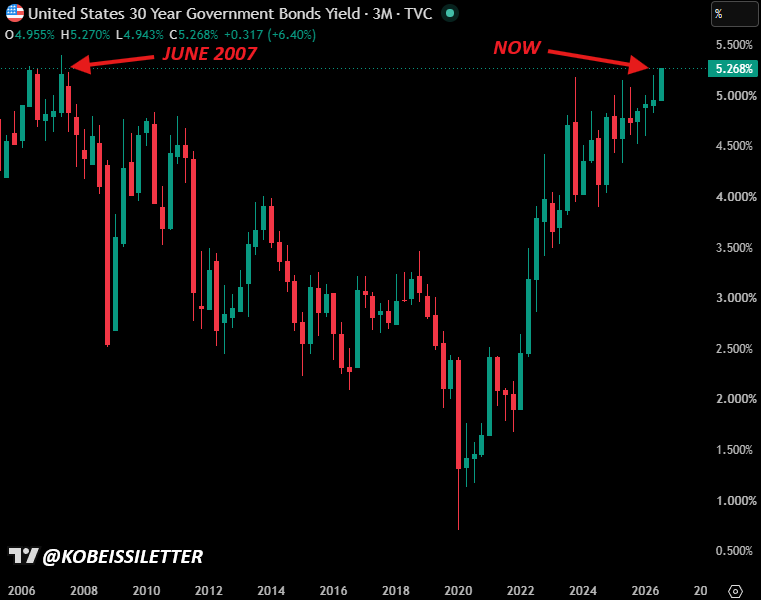
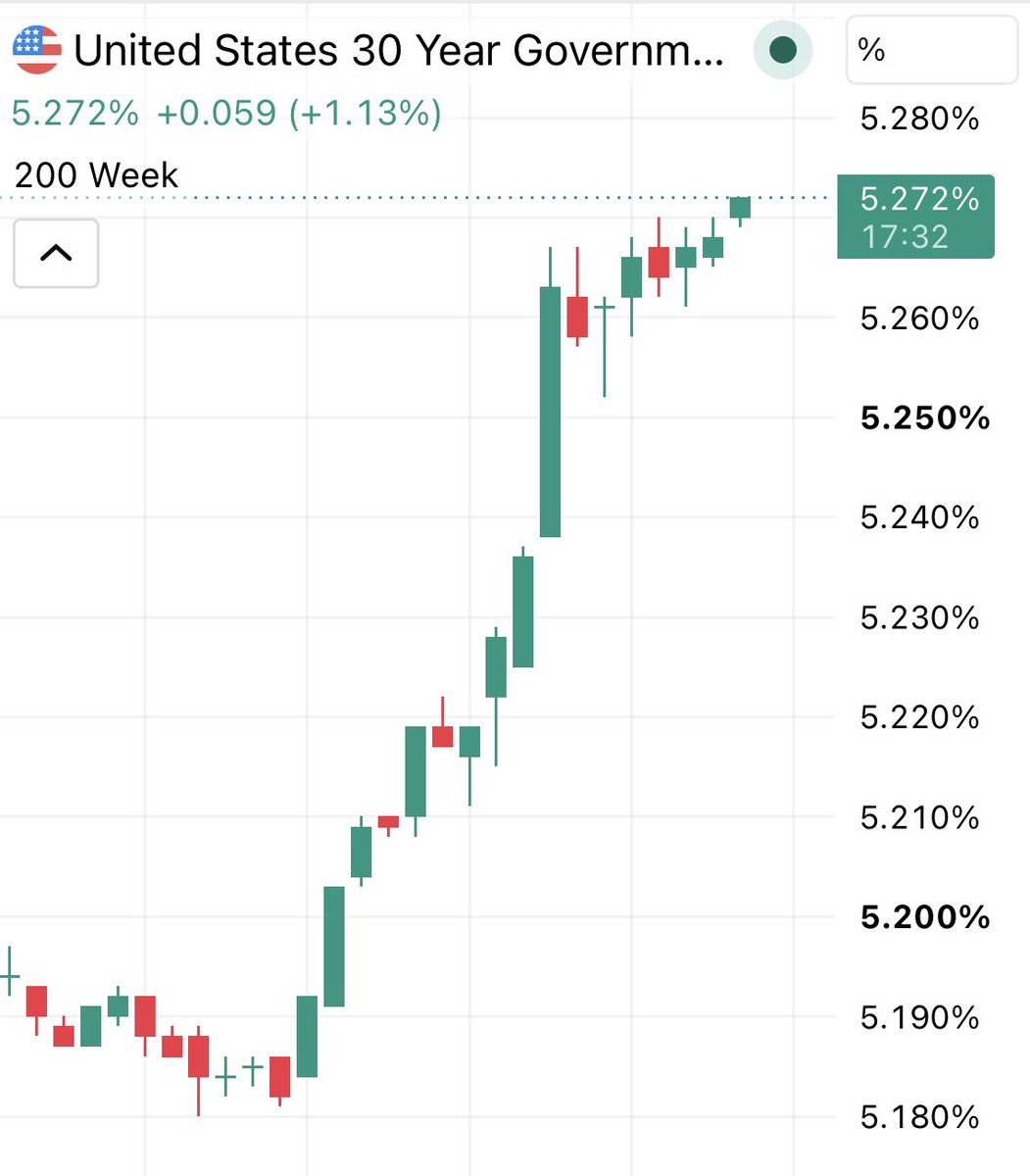
The US 30Y Note Yield is now up to 5.27%, its highest level since June 2007.
This officially marks a +450 basis point rally since the low seen in 2020.
At the current pace, we are on track to see US 30Y mortgage rates exceed 7.50% by year-end.
And to top it all off, Fed Chair Warsh is now adamant that the market should operate independently, without Fed guidance.
Even without rate hikes or Fed guidance, the market is sending rates higher; operating exactly how Fed Chair Warsh wants it to operate.
The bond market will soon be the most talked about component of global capital markets.
This simply is not sustainable.
Det er også verdt å huske på at president Trump for bare noen måneder siden sa at en «forutsetning�� for sin neste Fed-sjef var vilje til å kutte renten. 3/3.
Til sammenligning har nesten hvert eneste Fed-m��te siden mars 2020 gått inn i beslutningsdagen med rundt 99 % konsensus.
For å gjøre usikkerheten enda større har Fed-sjef Warsh i praksis fjernet all «forward guidance», noe som gir markedet lite retning før annonseringen. 2/3.
We are in the midst of the biggest technological revolution in modern history.
Alphabet, $GOOGL, just raised their full-year 2026 CapEx guidance to up to $205 billion.
This annual CapEx budget alone is larger than the market cap of all but 85 companies in the world.
The Magnificent 7 will soon spend over $1 trillion in combined annual CapEx.
This is a once-in-a-lifetime technological revolution.
@norskinvestor Hadde garantert tatt alt i global indeksfond istedenfor og med tiden tatt inn mer. Om du er ung, har du god tidshorisont. Sjekk opp i renters renteeffekt.
@norskinvestor Spørs helt hvor gammel du er , dermed hvor lang tidshorisont du har. JPM-ETF’en passer godt for dem med mye kapital og som ikke verdsetter vekst, men kun stabil cashflow. Et globalt indeksfond med 7-9% årlig + renters renteeffekt, gir høyere forventet avkastning over tid.
I think there’s a big misconception when it comes to large market moves. Many people take a theoretical view that “the market prices everything in.” But if you look at history, you’ll see that some of the largest market declines have come well after the catalyst was already widely known.
1.COVID-19: It’s called COVID-19 because it was identified in 2019. Yet markets didn’t fully digest the ramifications until mid-March, when economies were already shutting down.
2.GFC: Before the major collapse in Q3 and Q4 of 2008, it was already known in 2007 that cracks were forming. There were multiple warnings pointing to a potential mortgage crisis. Credit began to slowly reprice, and then it all unraveled at once.
3.Volmageddon: Prior to the February 2018 blowout, it was widely known among derivatives traders that these ETPs could fail. Portfolio managers were openly arguing with issuers at major derivatives conferences.
4.“Liberation Day”: Weeks before Trump announced tariffs, the market was aware he had a plan in place. In fact, markets initially rallied a few percent within seconds of the announcement, then went on to decline 20%.
My point is that there’s a cognitive bias that leads people to believe the market is all-knowing, smarter than everyone, and always prices everything in. But during major volatility events, it’s often only at the very end that the market fully accepts the fear. This is likely because humans naturally are optimistic creatures. It’s embedded into our DNA.
AI is reshaping how institutional investors work:
~52% of institutional investors now primarily use AI for research, according to a Barclays survey of 410 fixed-income investors.
This is followed by hedge funds, at ~44%, which primarily use AI to process and analyze large volumes of market data.
By comparison, ~27% of hedge funds use AI for modelling and risk analysis, versus ~22% of long-only managers and ~17% of asset owners.
Operations, compliance and reporting, and investment decisions each account for just 10% to 15% across these groups.
AI is changing how investment decisions are made.
If you buy into the $SPCX IPO, you’re paying for a future that doesn’t exist yet and might never exist.
It’s like paying $500k today for a house that MIGHT get built in the next 5-10 years.
Almost nobody actually understands this.
Absolutely incredible:
Over the last 6 years, the S&P 500 has risen +130% while US Consumer Sentiment has collapsed by -55%, to its lowest since data began in 1952.
We are witnessing the formation of the biggest wealth divide in modern history.