Our new publication in JAS (@ametsoc)
We introduce a reduced-order eddy-zonal flow feedback model that can describe the dominant variability of the entire SH atmospheric large-scale circulation into two ODEs for the leading EOFs (PODs). https://t.co/WGKTMs6PRA
How does tropical weather phenomenon exacerbate heat extremes & wildfire risks in the Pacific Northwest? Find out here https://t.co/qNDReZtQR9 where we present a detailed examination of historical data, mechanistic analysis and model experiments to investigate this connection.
Researchers from @PNNLab unveil how a summertime tropical weather phenomenon exacerbates heat waves and escalates fire risks across the Pacific Northwest region (Lubis et al., 2024). #heatwave#wildfires#PacificaNorthwest
https://t.co/4cP2W7ioVQ
Ninety-four students and early career scientists from 14 countries attended the US CLIVAR Workshop on Blocking and Extreme Weather in a Changing Climate this week in Boulder, CO, and virtually! Great discussions and knowledge gaps identified!
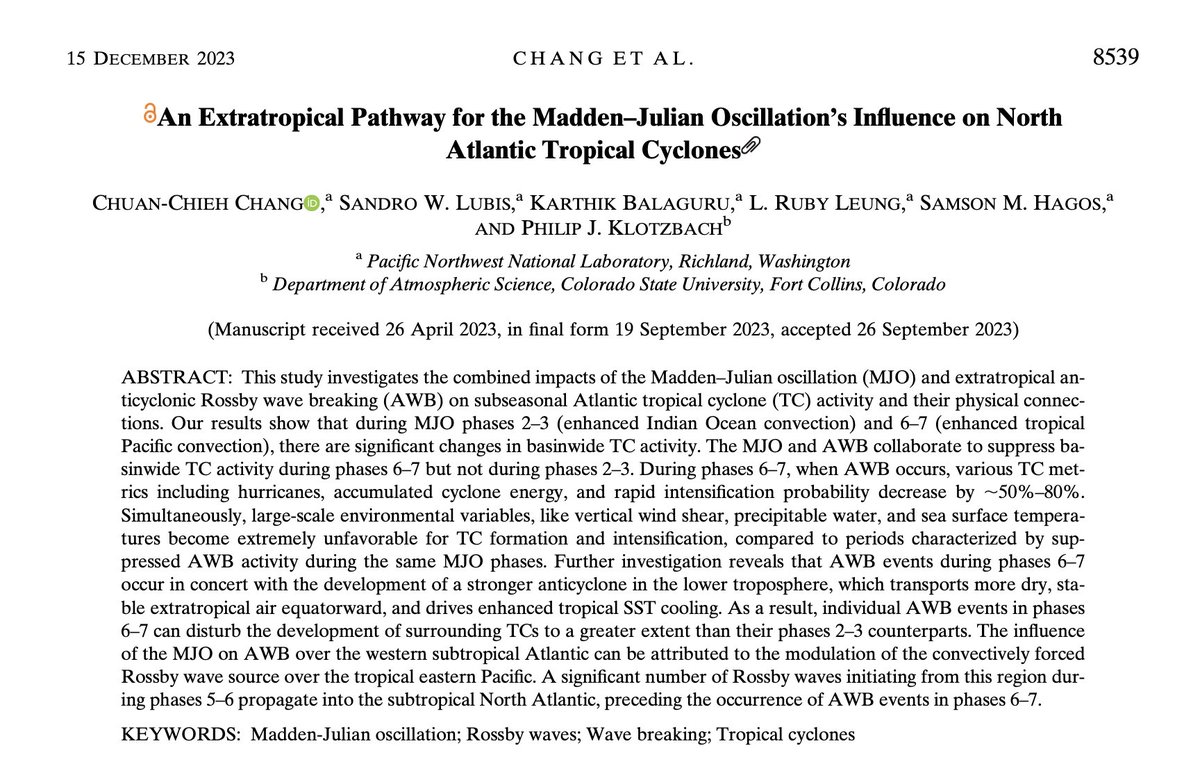
How does the MJO influence subseasonal Atlantic TC activity through midlatitude Rossby wave breaking? 🌀
A nice work led by @CChang68772 at @PNNLab. We provide an extratropical pathway for the influence of the MJO on North Atlantic TC. #JClim@ametsoc https://t.co/46lDpG5rWT
Nice work led by @ZimingChen22405 at @PNNLab. We show that projected El Niño-like warming pattern will enhance the heat-dome-like stationary waves circulation, thereby amplifying heat extremes across the Pacific Northwest region. https://t.co/A0JOTnombZ
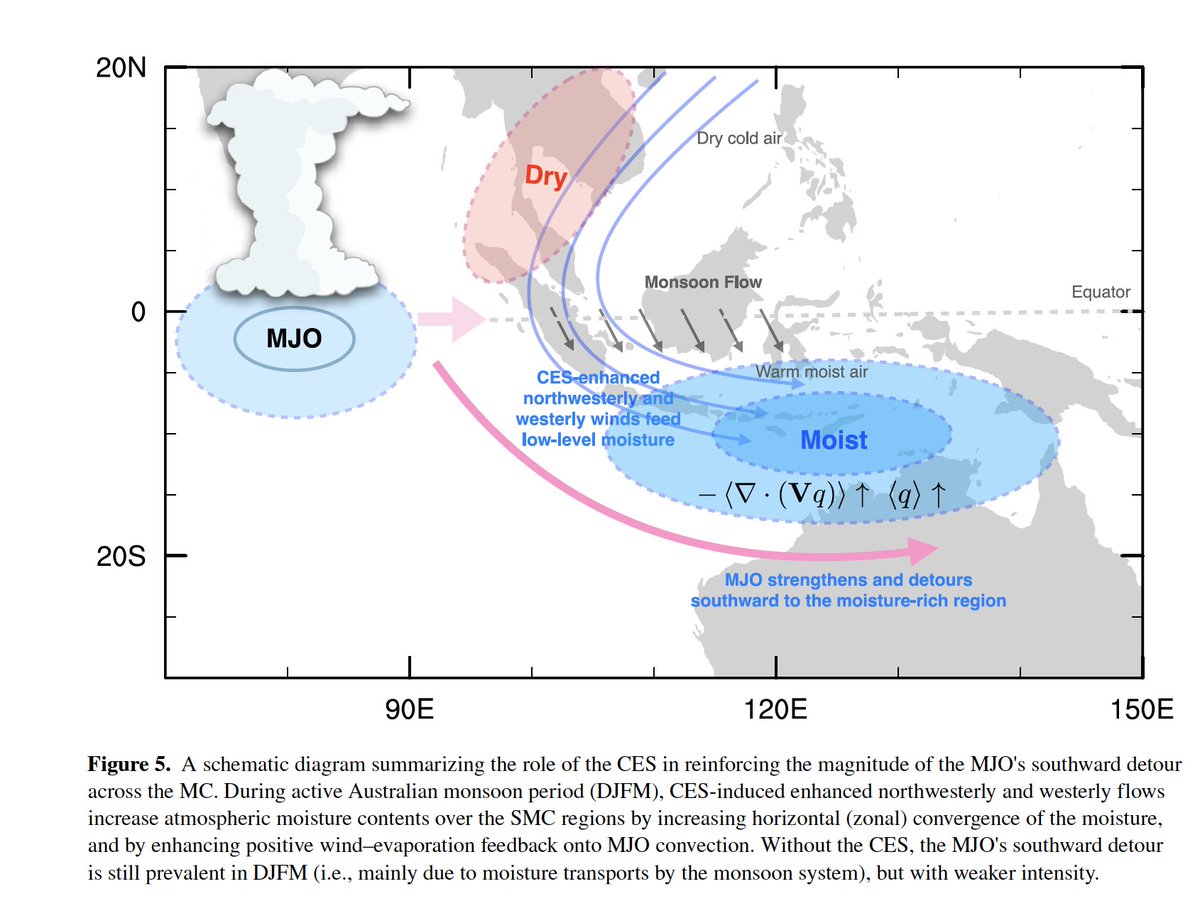
Our new work published in @AGU_Eos#GRL provides new insights into the dynamics that govern the intensity and southward detour of the MJO propagation over the MC, with an emphasis on the role of cross-equatorial northerly surge (CES). Lubis et al. (2023b) https://t.co/ruf6F4M4qL
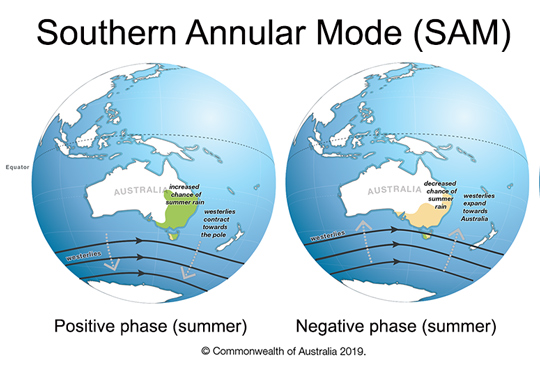
While the atmosphere seems chaotic, patterns do exist. Scientists @RiceUniversity & @PNNLab discovered a 150 day cycle in the shifts of the atmospheric pressure patterns that drive the westerly winds in the Southern Hemisphere & the Antarctic jet stream: https://t.co/Q1Bu0D2mR0
Order in chaos: Atmosphere’s Antarctic oscillation has natural cycle, published in @AguAdvances https://t.co/19v4L9w3tI with @turbulentjet. This is a snippet of the press release from @RiceUniversity.
@SandroWLubis & I found an internally generated 150-day periodicity in Southern H large-scale weather variability, SAM! Footprint shows up in winds, precipitation & ocean surface stress. SOA climate models have difficulty reproducing it, leading to biases https://t.co/N5ZX8TZ23p
My favorite topic in dynamical systems: Chaos!!!
This is what got me interested in applied math as an undergrad. The three body problem in planetary dynamics, the double pendulum, turbulence, and more!
https://t.co/t27TVcHJXS
It is usually assumed that all components of the midlatitude circulation shift together in response to climate change. In my recent paper it is shown that diabatic heating is associated with a decoupling between the eddy heat flux and jet latitudes:
https://t.co/nv1rkwL0C4
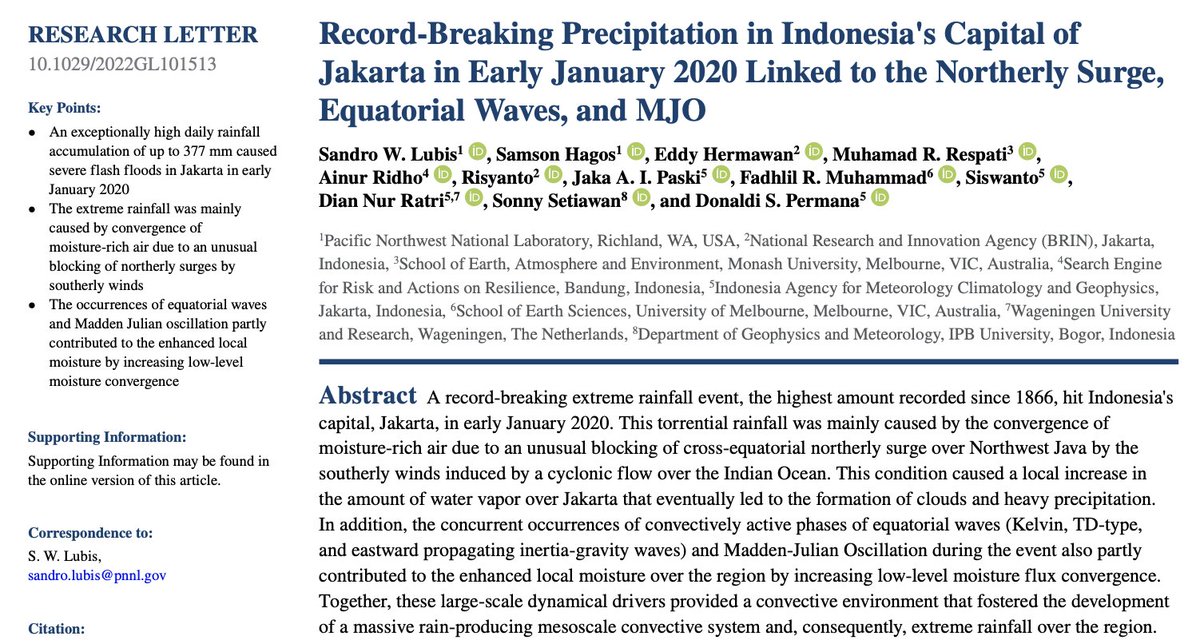
Thrilled that our paper, investigating atmospheric driving mechanisms of the "record-breaking" extreme rainfall event (since 1866) in Indonesia's capital of Jakarta, has been published in #GRL@theAGU https://t.co/j0xqQmAis1 @BMKGid@BNPB_Indonesia@CNNIndonesia@brin_indonesia
Check out our paper led by @EbNabizadeh (with @SandroWLubis) on analyzing the intrinsic predictability of summertime Pacific‐North American weather regimes and connections to NWP model skills using a dynamical-systems approach https://t.co/vH3xkj8J10