Saudi Wahabi Oil Lobby & Trump Administration
The Reliance–Aramco deal unable to go through was never just about mismatched valuations or any disagreements but it was about a larger shift in the balance of power in global energy markets and I see it as a turning point where India’s energy strategy collided with Saudi Arabia’s traditional dominance.
Reliance’s pivot toward Russian crude, combined with its green energy ambitions, broke the alignment that the Saudis had hoped would cement their grip over India’s refining future.
What Reliance did was simple but yet hurt Aramco: from 2022 onwards it aggressively bought discounted Russian Urals, securing barrels that were $6–$12 cheaper than Middle Eastern supplies, and ran them through the world’s largest refining complex at Jamnagar. The economics were unbeatable.
By 2025, Russian crude made up 36–50% of Reliance’s intake, compared to just 3–10% before 2022, and in the first half of 2025 alone Reliance exported over 21 million tonnes of refined fuels to Europe. These were volumes that Aramco once supplied, and as Indian cargoes docked in Europe, Saudi diesel was displaced. The Saudis lost contracts, lost market share.
This angered Riyadh, because for them this isn’t just about barrels it’s about prestige and power. India, once considered a steady customer, is now being accused of destabilizing crude markets. The timing made it worse: just as Saudi Arabia has been trying to recalibrate its ties with Washington, it finds that Indian refiners are undercutting it in Europe with Russian Oil.
The anger translates into geopolitics, because Riyadh’s deep ties with Washington’s power brokers give it leverage. Crown Prince Mohammed bin Salman has already promised the U.S. a trillion dollars in investments, and Aramco and the Saudi Public Investment Fund (PIF), led by Yasir Al-Rumayyan, have placed $2 billion in Jared Kushner’s private equity fund in 2021, buying influence at the very top of Trump’s orbit.
The Wahhabi oil lobby knows how to work the levers of Washington, and the pressure campaign against India’s Russian crude play is being dressed up as strategic necessity for both Aramco’s recovery and America’s desire to protect the dollar system.
Pakistan, predictably, is being recycled as a proxy in this pressure game. In 2023, the Saudis injected $2 billion into Pakistan’s central bank, enabling Islamabad to unlock an IMF bailout, and promised further investments in projects like the Reko Diq mine.
Pakistan’s noise about India’s refining of Russian crude, particularly attempts to demonize the Jamnagar refinery, isn’t organic. The idea is to squeeze India indirectly, making life uncomfortable for Indian Refiners & to signal that India’s growing dominance in refined exports won’t go unchallenged.
The Americans add another layer of irritation. It isn’t just about crude discounts it’s about the fact that a large part of India’s trade with Russia bypasses the dollar. Settlements in rupees, dirhams, or even yuan are chipping away at dollar hegemony.
For Washington, this is the unforgivable sin, and Trump, who is already annoyed by India’s sovereign trade postures, sees this as part of that defiance.
Still, I believe the ability of the U.S. or the Saudis to act directly against Reliance is limited. Jamnagar isn’t just India’s refinery; it is a critical node in global energy security, with BP and other stakeholders entangled in its ecosystem.
Europe, which depends heavily on Indian refined fuels after cutting Russian supplies, should resist any sanctions that undermine its energy balance. Though Trump is making efforts on Europe to stop buying Russian Oil. This is the GCC oil lobby speaking along with Big Oil & Shale in USA who seek to dominate European energy markets.
This makes outright punitive action unlikely, though whispers, targeted propaganda, and pressure campaigns will continue. The larger picture is that India is no longer bending to American bullying.
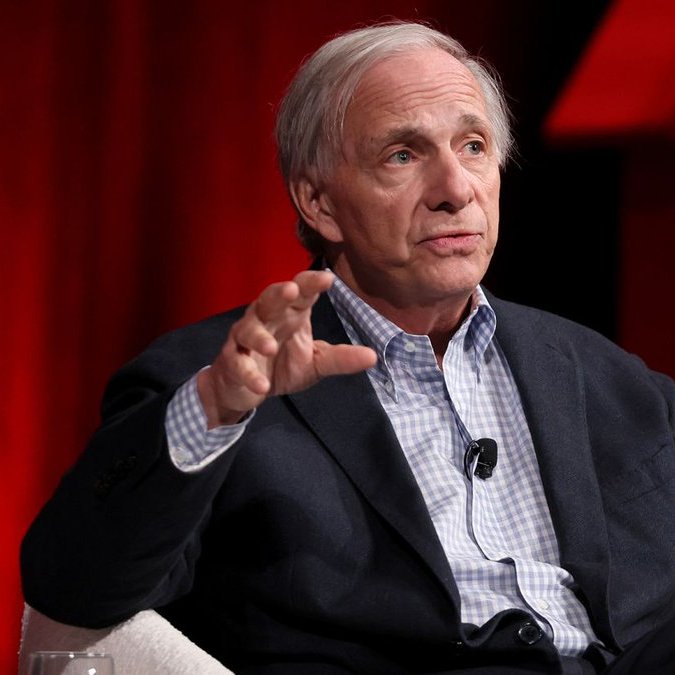
Ray Dalio sees the future.
He warned, "Something worse than a recession is coming."
It's already happening.
Gold prices are soaring while the USD index is collapsing.
What Ray Dalio sees coming next is disastrous: 🧵
DECOUPLING FROM DOLLARS
The US sends India billions in printed dollars for valuable goods. This is actually the US government ripping off India, like it does Vietnam, and everyone else, including its own citizens...not vice versa.
To be precise: last year India exported $87B of valuable goods to the US for $42B of goods plus $45B worth of increasingly worthless dollars:
That difference of $45B was, effectively, made up by money printing, which the Fed does at will:
The current administration incorrectly thinks this is a bad deal for America, because they haven’t fully thought through the fact that the US can print dollars. India was giving America something that's always valuable (namely goods) for something that America can just print out of thin air (namely US dollars):
So...who was really ripping off whom?
As mentioned, this is the same trade America had with Vietnam. Vietnam worked hard to send America shoes, while America sent Vietnam printed dollars. And it’s the same trade America had with many countries, before the trade war. The world sends the US valuable goods, and gets mere Federal Reserve database entries in return:
The only reason the US had the right to do that — to run the financial database of the world, to print trillions for itself, and to freeze and seize the funds of billions — is because it set up what we call the rules-based order, what is in reality the American Empire. And of course it profited from that empire tremendously, but so did most of the empire's participants.
But now MAGA is dismantling that empire. It’s cutting off trade, talent, and even tourism. It’s abandoning its military commitments and telling allies to fend for themselves. It’s cutting off foreign aid and domestic universities. It is, in short, becoming a country not an empire.
The reason is because MAGA is fundamentally confused. It romanticizes 1945 America (the manufacturing country) without fully admitting that 2025 America makes its money in a completely different way, by managing the hub of a global financial empire.
Because the US is in denial about what it is — a money printer, not a manufacturer — it's currently on track to lose both the money-printing and the manufacturing. For example, the tariffs target the entire world (thereby reducing demand for the dollar in global trade) while also cutting off machine tools and raw materials from US entrepreneurs (thereby inhibiting the buildout of domestic manufacturing).
Anyway, I won't linger on the outlook for the US. It's made its decision and will live with it. Perhaps it will indeed be a Golden Age of Reindustrialization. And perhaps the transition to a "republic, not an empire" will go much better than the similar imperial climbdown of the UK or the USSR.
What should countries like India and Vietnam do?
They should turn a necessity into a virtue. The trade war has provided a powerful Schelling Point for the entire world to simultaneously stop using the dollar at the same time. This is also what America says it wants, for foreigners to stop "exploiting" it by accepting its printed dollars for hard goods.
So: abide by America's wishes and stop trading goods with America for dollars. Instead, trade goods with each other for local currencies (rather than USDs) and use gold for storing value (rather than USTs). Because there is no global reserve currency issued by a single country, trade remains roughly balanced over time.
Singapore's former PM calls this "world minus one." It's the continuation of global capitalism, just without America, who has voluntarily taken itself out of the game. Yes, there's a short-term adaptation cost, but the quicker that a country can decouple from the dollar the better.
Start saving in hard money instead.
@AstroSharmistha Ma’am
What’s you’re view on September
Indian & worldwide
1. Climate
2. Markets
3. Geopolitical
4. Health & Relationship
Thankyou 🙂