🚀The era of autonomous multi-agent discovery is arriving! @karpathy
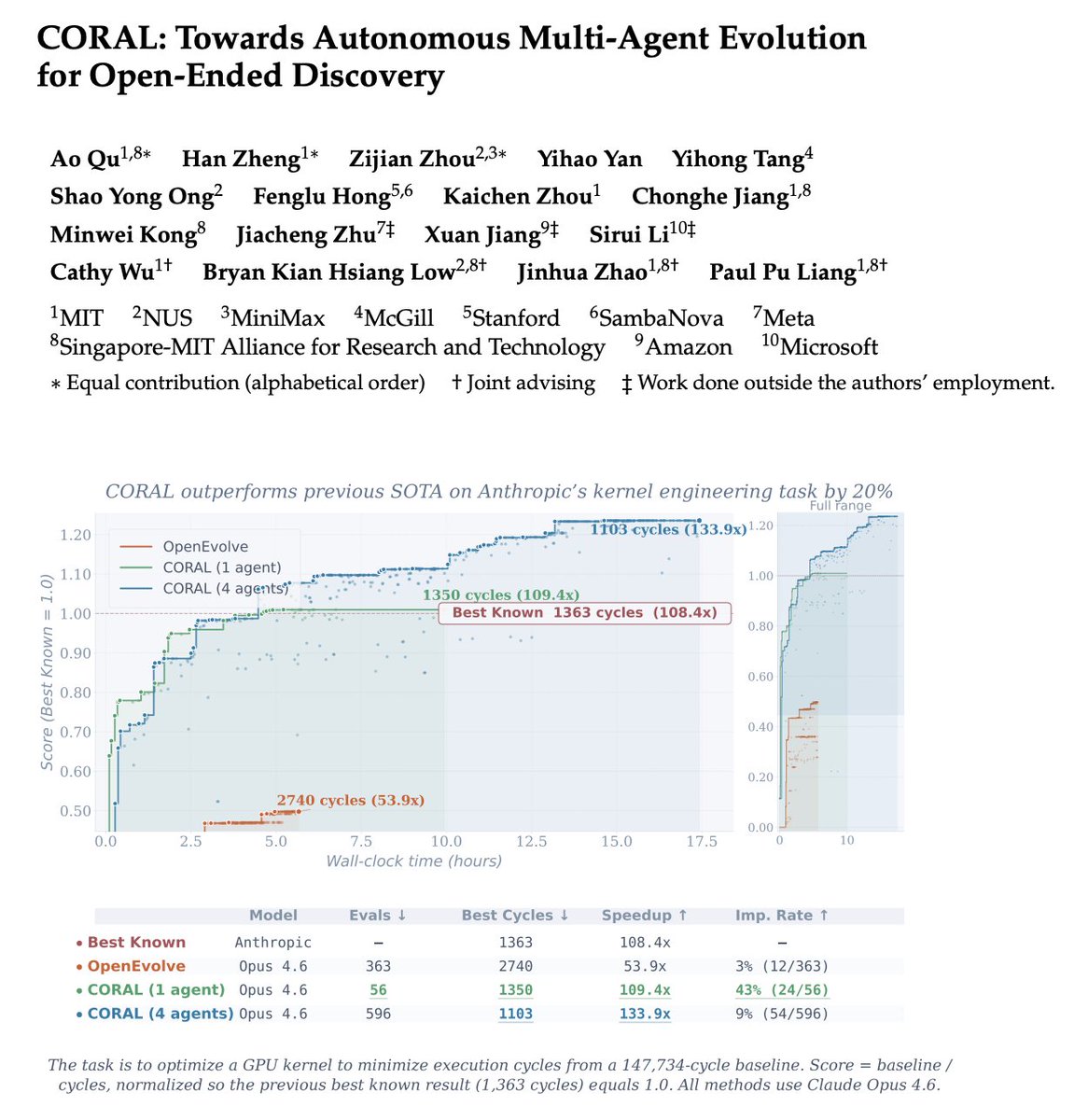
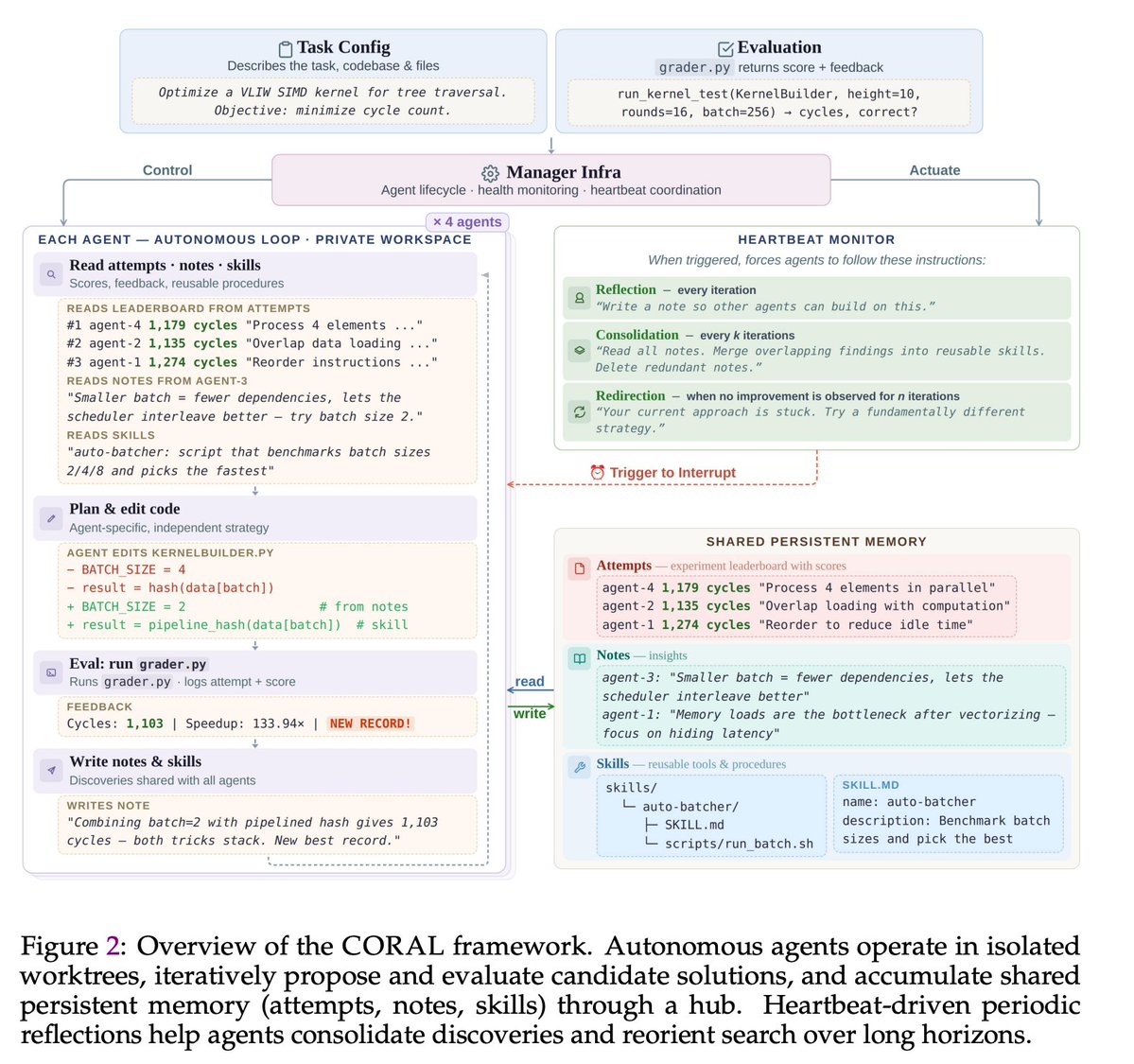
🪸Excited to share CORAL, our new work on autonomous multi-agent systems for open-ended scientific discovery.
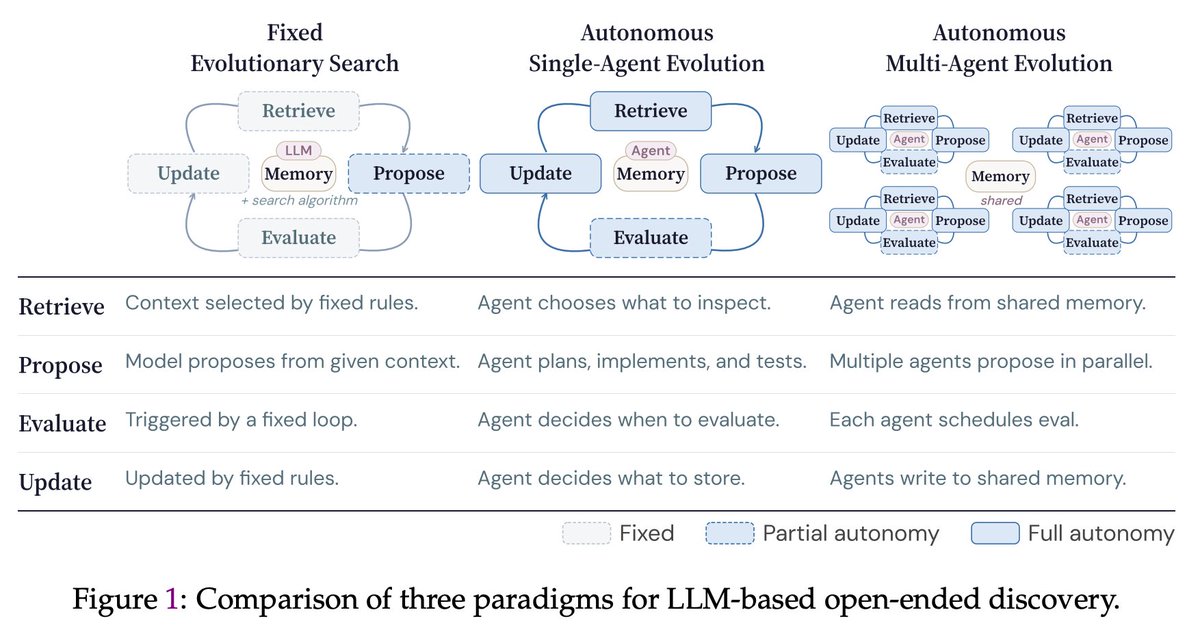
🙅♂️A key limitation of many current “self-evolving” frameworks is that agents still operate inside tightly constrained loops — they mutate solutions, but they do not truly decide how to explore.
In CORAL, we push toward genuine autonomy:
Agents decide
🔍 what to explore
🧠 what knowledge to store
♻️ which ideas to reuse
🧪 when to test hypotheses
🔥One of the most interesting findings:
A single autonomous agent already outperforms fixed evolutionary search, but the biggest gains emerge when multiple agents form a research community.
💪Over 50% of breakthroughs in multi-agent runs come from building on other agents’ discoveries. This suggests that knowledge reuse and collaboration are central to scalable automated discovery.
🏅Across 10+ difficult tasks in algorithmic discovery and system optimization, CORAL achieves state-of-the-art performance while improving efficiency by 3–10×.
📄 Paper: https://t.co/8ENJjgC5Xk
💻 Code: https://t.co/WjUJlG7B6p
💡AlphaXiv: https://t.co/TvheULeGgD
#agentic #llms #selfevolvingagent #multiagent #autoresearch #alphaevolve
Humanoids often look smart but don’t reason about the world.
Our method learns a world model from offline data and plans contact from ego-vision in real time.
Pixels in, contacts out...
Perception, interaction, autonomy - next agenda for humanoids.
We learn a multi-task humanoid world model from offline datasets and use MPC to plan contact-aware behaviors from ego-vision in the real-world.
Project and Code: https://t.co/4SRJ1qD196
The SPARK lab has 2 papers accepted at @NeurIPSConf 2025!
1) VGGT-SLAM pushes the scalability of feedforward transformer-based architectures for 3D reconstruction, while providing cool insights from traditional vision. Great work led by Dominic Maggio with Hyungtae Lim. [1/n]
🏓🤖 Our humanoid robot can now rally over 100 consecutive shots against a human in real table tennis — fully autonomous, sub-second reaction, human-like strikes.
Researchers from RAI Institute present Diffuse-CLoC, a new control policy that fuses kinematic motion diffusion models with physics-based control to produce motions that are both physically realistic and precisely controllable.
This breakthrough moves us closer to developing generalist policies that enable humanoid robots to perform diverse tasks, including dynamic locomotion and contact-rich manipulation, in a natural-looking and robust way.
Learn more at https://t.co/8fLD09ndYi
🚀 Gearing up for ICRA 2025 in Atlanta!
Our Lunar Lab @ Georgia Tech is bringing the heat:
🌟 MI-HGNN & MS-HGNN for legged robot dynamics
🤖 STATE-NAV for humanoid traversability and navigation
🎙️ Prof. Lu Gan @ganlumomo speaks at two workshops: Foundation Models and Neuro-Symbolic AI & Thermal Infrared in Robotics
🍻 Catch us Wed night @ IRIM @GTrobotics Party!
💡 Details and updates: https://t.co/ac0skZQNcl
We’re exploring symmetry and physics-informed robot learning, real-world intelligence, and beyond.
Come chat, connect, and shape the robotic future 🤖🌍
#ICRA2025 #GeorgiaTech #Robotics #LeggedRobots
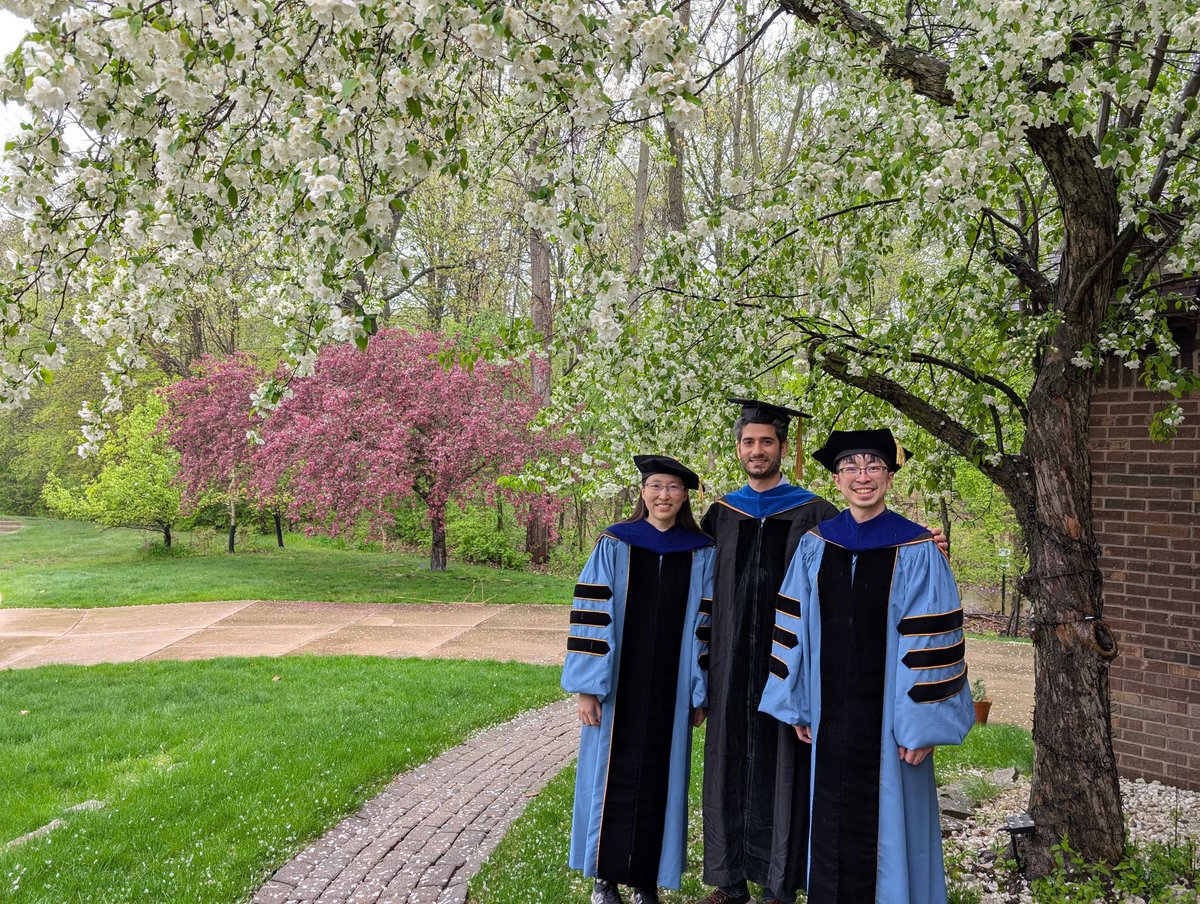
I graduated 6 PhD students since last year!
Ray Zhang -> Research Scientist at @ToyotaResearch@JustinTzuYuan -> Postdoc at MIT w/ @SangbaeMIT@CynthiaChienErh -> Applied Scientist at Amazon Robotics
Tribhi Kathuria -> Lecturer at @UMRobotics@SangliTeng -> Postdoc at UC Berkeley w/ Koushil Sreenath
Joey Wilson -> Research Scientist at @nuro
I'll try to post more about their contributions in the coming weeks.
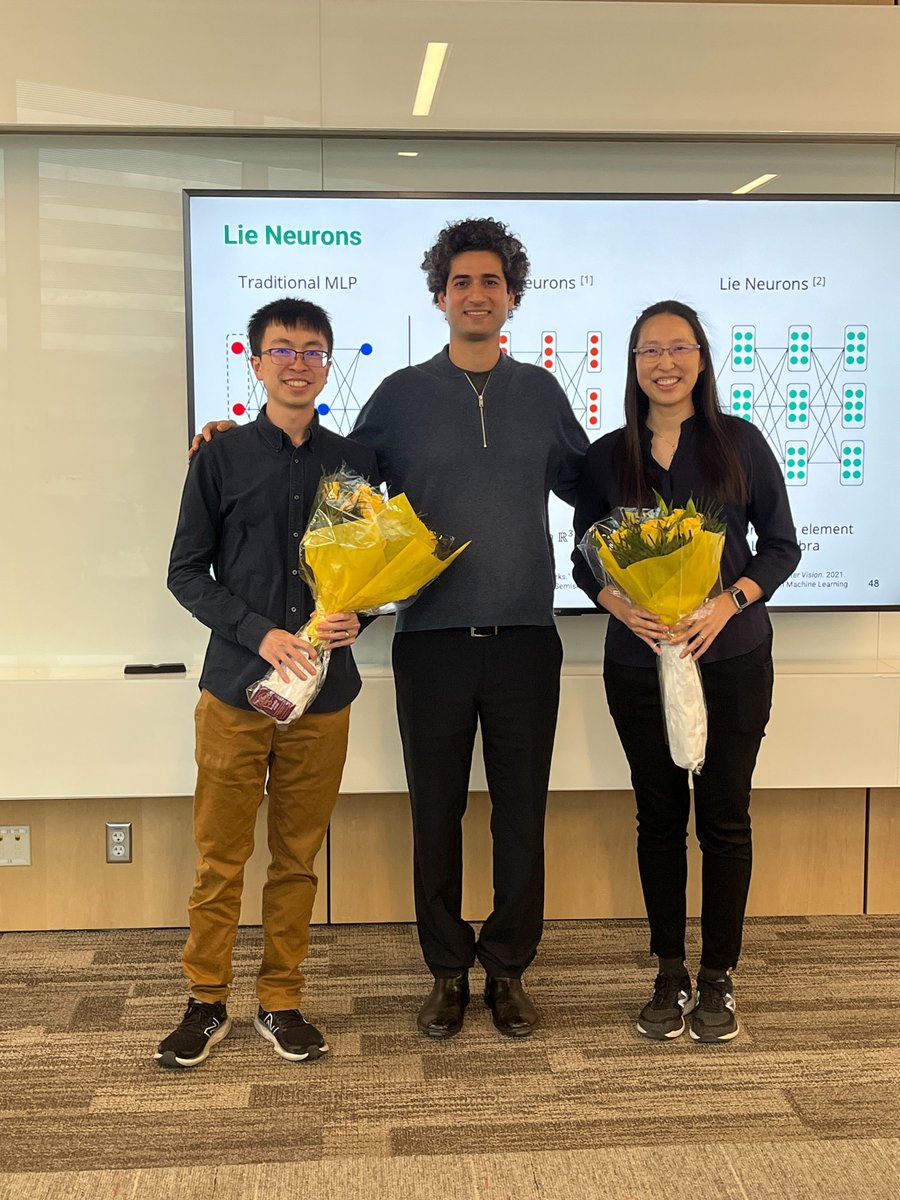
I graduated my first two PhD students as a solo advisor at once! It's a bittersweet moment. @CynthiaChienErh and @JustinTzuYuan helped me build the CURLY lab.
I'm proud of them and excited about their future achievements, and I hope our friendships last a lifetime.