Local players have war chests of public funds and will look upto sustaining share prices and continued funding from their SIP funded Institutional investors. Flip kart or Amazon as strategics may play long game with their funds. They could also do M&A!
Can’t understand this renewed interest around Food Delivery!
I wonder what’s a different proposition other than lower prices, that new entrants can offer?
Existing players have the restaurant eco system, gig workers and the user base.
Lower Price by competitors is the weakest of moats. With their cash balances, Zomato & Swiggy can erase it in less than a quarter.
Remember, when food delivery started, there were so many players (Scootsy, Food Panda etc)
Also, many large players didn’t succeed at scale. Amazon & Uber among others.
The current leaders have evolved and mutated through one cycle already.
Interesting times!
Was eating out last nite, Bira on the menu - asked for it, but no stock.
Bira founder's story is so hard to digest. Built a great product and a lively, energetic, youthful brand in such a tough, regulated market... only to get eventually forced out.
To think that the company's problems got triggered by a simple name change move (as per whatever info is available in the public domain)... very hard to fathom.
Tempted to ask - what role was played by the board, investors, VCs to avert this?
More insights... anyone?
Hope the new mgmt is able to resurrect the brand's fortunes!
Govt biz requires a lot of working capital, sometimes more than a year. And then L1 criteria, which sometimes gets set very low by non-serious players. This rules out small guys. As for VC backed players, they have to hype and get IPO funds to sustain till they hyperscale!
Without scalable breakthroughs, this could become a structural challenge. The deep-tech/defence/energy potential will take only if the government opens up projects in a significant way.
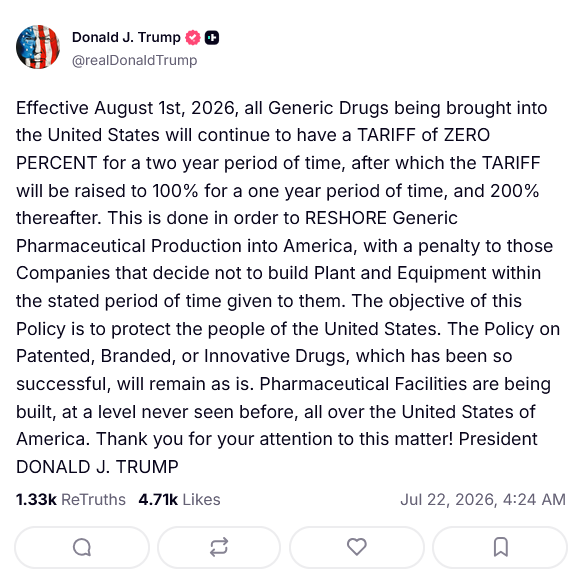
Perhaps Industry could invest their profits in Original Research & New Drug Discovery. The costs may disrupt interim profits, but lay foundation for more sustainable business model. They may also transition to 'Pharma' rather than'Generics'!
First IT services, now generics. For decades we sold the former as technology and latter as Pharma without investing in AI or drug discoveries. Low cost arbitrage models getting disrupted!
This is HUGE.
India sells massive amounts of generic drugs to the U.S., supplying roughly 40% to 47% of all generic prescriptions.
This is going to have grave implications.
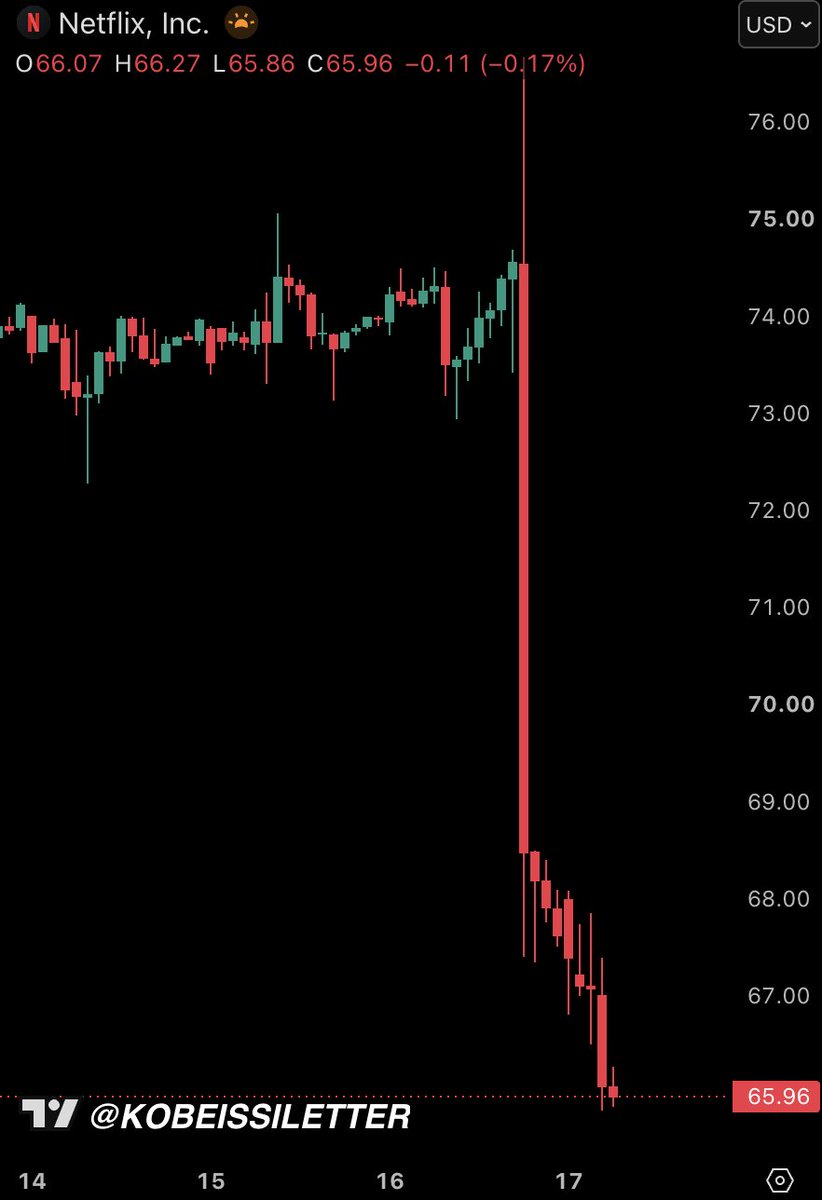
BREAKING: Netflix stock, $NFLX, extends losses to over -11% after reporting weaker than expected earnings.
The stock is now down -50% over the last 12 months and trading at its lowest level since August 2024.
🚨🚨 We are picking up from sources that Zepto may cut IPO size by 20% to $600-650 million as investor bids have been lower than what the company expected…@pranavmukul @ETtech
https://t.co/2KviH0czE3
#WATCH | ET NOW Exclusive : Advanta Enterprises, UPL's global seeds and post-harvest subsidiary, has put its IPO plans on hold, with sources saying the company has paused its investor roadshow until local equity market conditions improve
@anujosh_aj brings you the details
#UPL #IPO #Markets
Tokenisation can also unbundle the private assets held through funds. The allied services of real time diligence is being evolved through AI+blockchain solutions with privacy protection!
Something happened on Wall Street today that most retail investors will never hear about, but should.
DTCC, the clearing house that quietly settles almost every stock trade in America and holds over $114 trillion in custody, executed its first live trades of tokenized securities.
JPMorgan opened the day by converting QQQ into a token, and more than 50 firms including BlackRock, Goldman and Schwab are part of the effort ahead of a full launch in October.
I find this genuinely exciting, and not because of the blockchain angle. Tokenization of stocks is a big deal.
When a stock is converted to a token on a Blockchain with smart contracts, settlement that today takes a day (in India) or two (in US) can happen in seconds, which means funds from your stock sale can be available sooner. Markets no longer need to close, because tokens can trade and settle around the clock. And ownership becomes divisible by design, which means fractional ownership is possible. So stocks that were too expensive for many individuals can be bought in ticket sizes of a few hundred rupees rather than lakhs. Imagine a diversified basket of fractional stocks, available to anyone for as low as 100 rupees. This makes investing affordable for all.
What makes the DTCC version credible is that these tokens are not synthetic wrappers. The token is the security itself, carrying the same legal ownership, dividends and rights as the demat equivalent. This makes it different from other crypto exchanges that are already offering digital tokens of stocks.
India has led the world in capital market innovation from T+1 settlement, digitized KYC, UPI payments and more. Tokenized securities feel like the next chapter of that same story, and I would love to see India write it rather than read it.
https://t.co/BXvuz7CH7d
China able to replicate/improve latest tech advances in Space and perhaps AI. May see this from more people/nations with resolve. Tech monopolies and financial bets behind them difficult to sustain!
BREAKING: For 10 years the world believed there was one way to reuse a rocket: land it upright on its engines, the way SpaceX does. Today China refused to copy it, and pulled off something SpaceX never managed on a first flight. It caught the rocket instead.
The Long March 10B lifted off from Hainan, China this morning, and about 6 minutes later its first stage came back down toward a 25,000-ton ship at sea. It did not land.
Hooks on the falling booster snagged a net of tensioned steel wires strung across the deck, the wires riding robotic rails that slid into place to meet it. No landing legs. No touchdown. A rocket plucked out of its own descent by a moving net, on the maiden flight of a brand-new vehicle.
No one handed China this. SpaceX guards its rocket tech as “trade secrets”, not “patents”, precisely so it cannot be read and copied.
China watched a decade of public flights and then built an entirely different machine to reach the same prize, catching instead of landing, which sheds the heavy legs and spares the fuel a soft touchdown burns to hover.
And this was never about cheaper satellites, though it delivers those too, feeding the thousands of birds in China's Starlink rival.
Its deeper purpose is the Moon. That booster shares its core with the rocket meant to land Chinese astronauts on the lunar surface by 2030. In the same season, America's own Moon rocket, Starship, has flown 12 times and still has not shown the single maneuver its lunar plan depends on.
One flight does not dethrone SpaceX. It has landed hundreds. What ended today is not SpaceX's lead. It is Uncle Sam’s belief that it owns the only road to the Moon.
The piece works out which way of coming home actually wins.
🚨Xpressbees' Amitava Saha says Delhivery's 'three-player market' pitch is aimed at short-term stock gains, monopoly ambitions
With @Goenka_Tushar1
https://t.co/Fj7TQ8dFxp
#Business | India property developer K Raheja said to delay $700 million IPO
- K Raheja Corp. delayed IPO plans.
- IPO postponed by at least a year.
- Seeks greater scale for higher valuation.
Read More:
https://t.co/4yLtmWXVwU
Rapido co-founder @sankaaravind said that while a meal may cost Rs 80-120 at a restaurant, the same order often ends up costing Rs 250-300 when ordered online due to commissions, delivery charges & other fees. Narrowing that price gap will be key to the success of Ownly, @rapidobikeapp
Sanka said in an interview with @chandrarsrikant & @Goenka_Tushar1
https://t.co/vzUaEmy6FA