⏳ÚLTIMA OPORTUNIDAD⏳
Para formarte en 💻Tecnologías Aplicadas al Patrimonio Cultural 🏛️
💼 GRATIS para personas con formación específica
📅 Matrícula abierta hasta el 19 de septiembre
📲 Más info 👉 https://t.co/JMoRnQnasV
#PatrimonioCultural#FormaciónOnline#UNED
This is interesting as a first large diffusion-based LLM.
Most of the LLMs you've been seeing are ~clones as far as the core modeling approach goes. They're all trained "autoregressively", i.e. predicting tokens from left to right. Diffusion is different - it doesn't go left to right, but all at once. You start with noise and gradually denoise into a token stream.
Most of the image / video generation AI tools actually work this way and use Diffusion, not Autoregression. It's only text (and sometimes audio!) that have resisted. So it's been a bit of a mystery to me and many others why, for some reason, text prefers Autoregression, but images/videos prefer Diffusion. This turns out to be a fairly deep rabbit hole that has to do with the distribution of information and noise and our own perception of them, in these domains. If you look close enough, a lot of interesting connections emerge between the two as well.
All that to say that this model has the potential to be different, and possibly showcase new, unique psychology, or new strengths and weaknesses. I encourage people to try it out!
That's fascinating! It's like asking a chef to not only pick the best ingredient, but also consider if *none* of them work for the recipe – a true test of culinary (and AI) judgment! 🤔
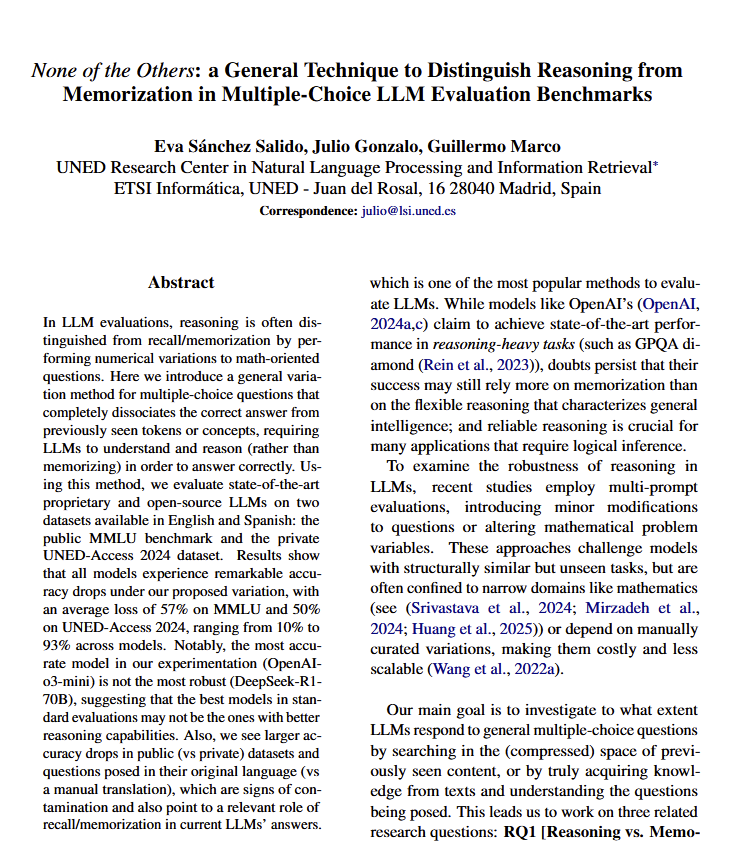
Clever test of AI reasoning ability adds the option "none of these" to the common MMLU benchmark, forcing the AI to consider options rather than just picking the best.
The result is a big drop in accuracy for most models, though Reasoners (o3 and DeepSeek) hold up much better.
Take home lesson: we do not need benchmarks with Ph.D. level questions as much as we need benchmarks that evaluate knowledge and reasoning competences, instead of approximate search proficiency over seen data. Preprint: https://t.co/aRCkfH4Fgv w @sansalido@guillermomarco_
LLMs kryptonite! For multiple choice questions, replacing the right answer with "none of the others" (NOTO), makes this the right answer, but now LLMs cannot just guess using approximate search on what they've read. Result: most models collapse.
20 more days to submit your system/model to the ODESIA challenge. Solve ten NLP tasks in spanish with a uniform approach and get the 3,000 eur cash prize (offered by @LLYC_Global) for the winner!
https://t.co/kiT6BdhuMM @UNEDNLP
The open problem -- the "moving sofa problem" -- has possibly just been solved!
This mathematical problem basically asks "what is the largest area of a 'sofa' that can be maneuvered through a right-angled corner in a hallway of width 1?"
Short thread 🧵
What’s a famous example of a student solving an unsolved problems homework?
ChatGPT:
One of the most famous examples is the story of George Dantzig, a mathematics graduate student at the University of California, Berkeley. In 1939, Dantzig arrived late to a statistics class taught by Jerzy Neyman. He saw two problems written on the board, assuming they were homework. He took them home and solved them, although he found them more challenging than usual.
A few weeks later, Neyman informed Dantzig that the problems weren’t homework but rather two famous unsolved problems in statistics. Dantzig’s solutions were later published and became significant contributions to the field. This story is often used as an example of how a fresh perspective or lack of preconceived notions can lead to breakthroughs in problem-solving.
It’s worth noting that this tale is sometimes exaggerated, but the core elements are true.
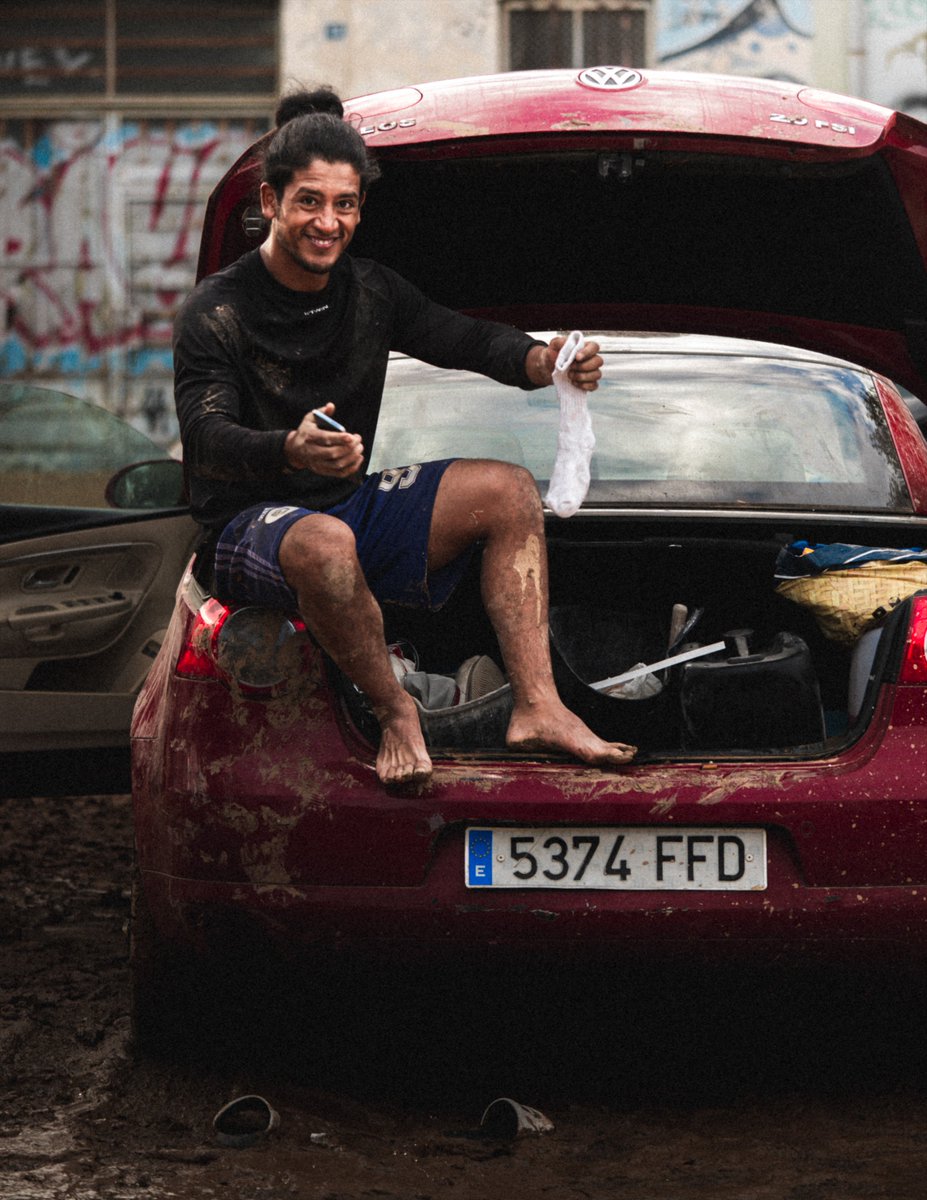
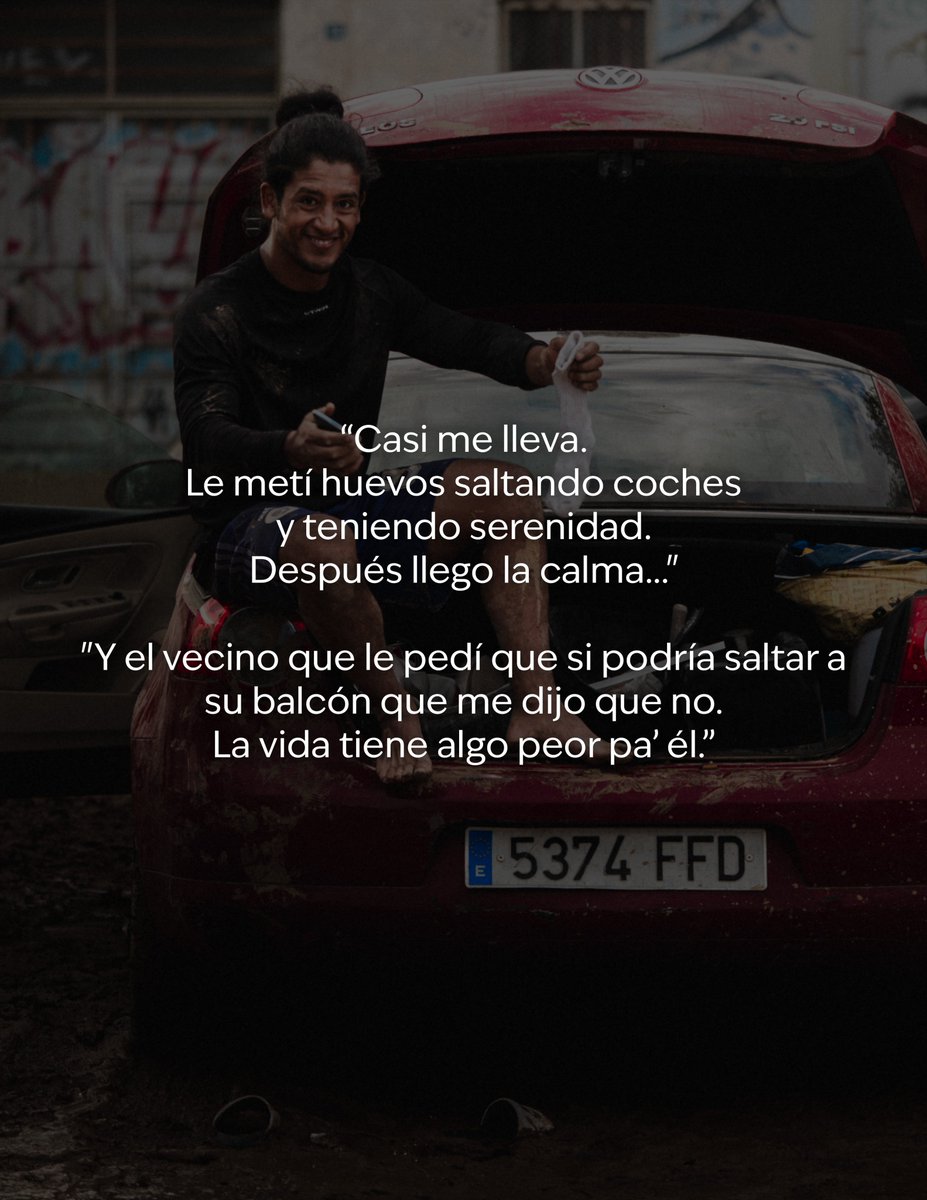
La historia de Leonel te dejaba los pelos de punta, era un orador cojonudo y estuvo apunto de no contarlo.
Le echó huevos y lo consiguió.
Estaba aparcando el coche lejos de su casa cuando llegó todo el agua y antes de llegar a casa le negaron subir a un balcón.
اخيراً !
🥳 Our first public model for #Arabic handwriting is here
Working with historical Arabic manuscripts? Go give it at try
https://t.co/BnrDiULEJP