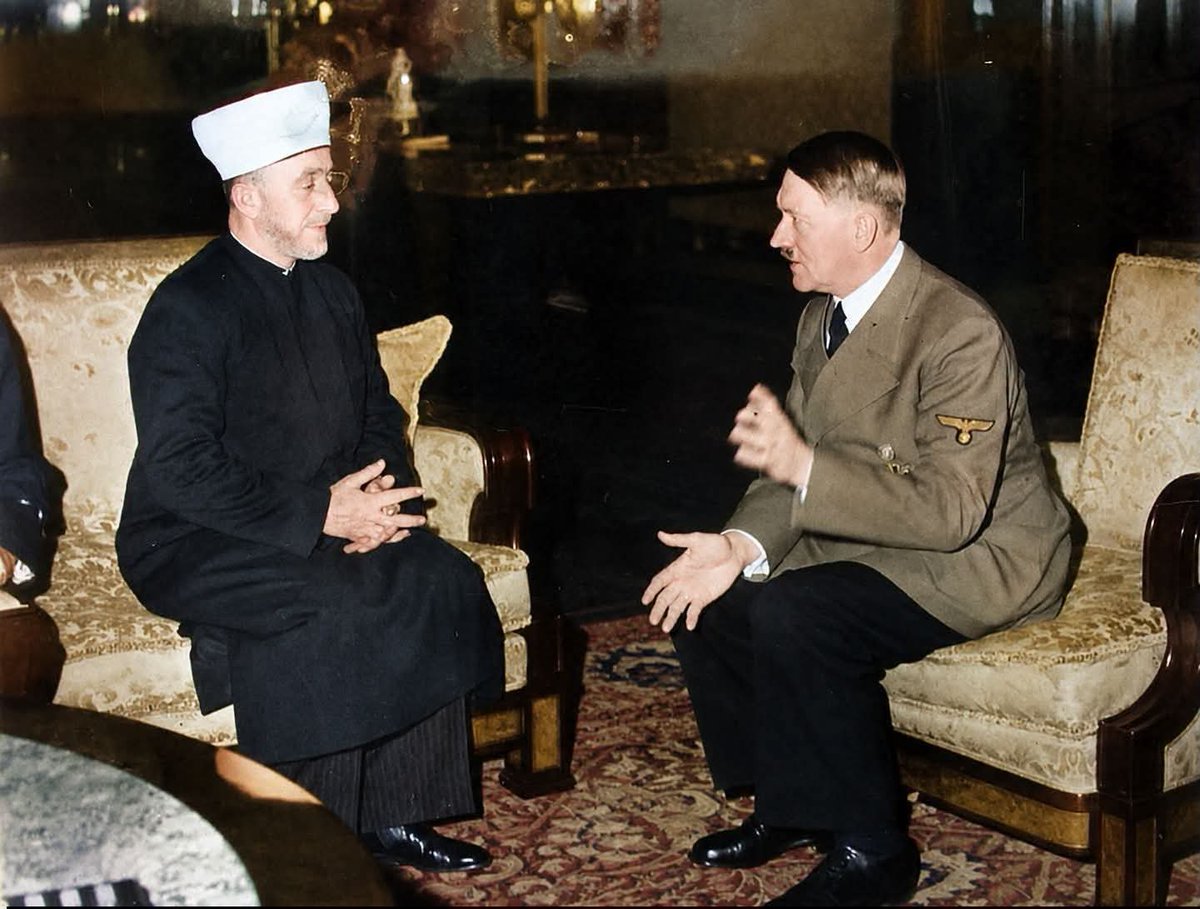
Adolf Hitler meeting with the Grand Mufti of Jerusalem, Haj Amin al-Husseini, in Berlin on November 28, 1941. The meeting took place at the Reich Chancellery, where they discussed geopolitical cooperation and shared opposition to British influence and a Jewish national home in Palestine...
Amin al-Husseini was born in Jerusalem near the turn of the 20th century, Husseini came from a prominent Palestinian family. In 1921, Palestine’s British rulers installed him as grand mufti of Jerusalem, a religious leadership position.
Husseini was an advocate for Arab nationalism, and in 1936 he joined with other Palestinian leaders in revolt against British. The revolt lasted until 1939, claimed thousands of lives, including hundreds of Jews and led British to seek an exit from the territory. In 1937, British removed Husseini from his position, prompting him to flee to Lebanon.
During WWII, Husseini supported an anti-British rebellion in Iraq and became rebels’ envoy to Germany and Italy. When rebellion was suppressed, he fled to Italy and continued his contacts with Axis powers from there, famously meeting with Adolf Hitler in November 1941. He continued to support Nazis in various ways throughout the war. After the war, Husseini escaped to Beirut, his influence diminished. He died there in 1974.
Husseini opposed any accommodation of a Jewish national home in what would become Israel. He opposed 1939 British White Paper, despite its ban on Jewish immigration to Palestine, because it set too long a timeline for an Arab state. And he opposed 1947 United Nations partition plan that sought to create neighboring Jewish and Palestinian states. Husseini also backed violence against Jews. In 1920, he organized an anti-British demonstration in Jerusalem that grew violent and was subsequently convicted of incitement.
In early 1940s Husseini was seeking German support for Arab independence from colonial rule, and records of the meeting show that Husseini focused his requests on a formal Nazi declaration of support for “the independence and unity of Palestine, Syria, and Iraq” under Arab rule. According to the British record, Husseini told Hitler, “The Arabs were Germany’s natural friends because they had the same enemies as had Germany, namely English, Jews and Communists.” He also thanked Hitler for supporting “the elimination of the Jewish national home.” The record does report that Hitler announced his intentions, noting that he planned to “ask one European nation after the other to solve its Jewish problem.”
According to some unverified sources, Hitler promised the Mufti of Jerusalem that he would also eliminate Jews in Palestine. With this, he wanted to torpedo the British partition plan for Mandate territory. This plan envisioned creating a "Jewish homeland" in part of Palestine. Mufti didn't want that, and neither did Hitler. Extermination of the Jews in Palestine was to be only the beginning. Once Russian campaign was over, all remaining Jews in Arab world would be annihilated, Hitler promised the Mufti. For the first time, envisioned Final Solution was to take place outside of Europe. Amin al-Husseini announced plans to form Muslim SS units in Balkans and North Africa. They were to support North African campaign led by Erwin Rommel, where Wehrmacht encountered fierce resistance from British army.
According to Maoz, Palestinians today see Husseini as one of their national fathers. But their admiration is mitigated, he said, because Husseini was so strongly pro-Nazi and was ineffective in advancing the Palestinian cause.
His stature among Palestinians, Maoz said, pales to that of Yasser Arafat, whose memory enjoys near universal reverence. But Palestinians tend not to criticize Husseini in public, Maoz said, because they want to display unity.
“Not a few Palestinians think he wasn’t so positive,” Maoz said. “He was very stubborn. But those who oppose him don’t emphasize it out of solidarity.”
(Colorized Photo)
#archaeohistories