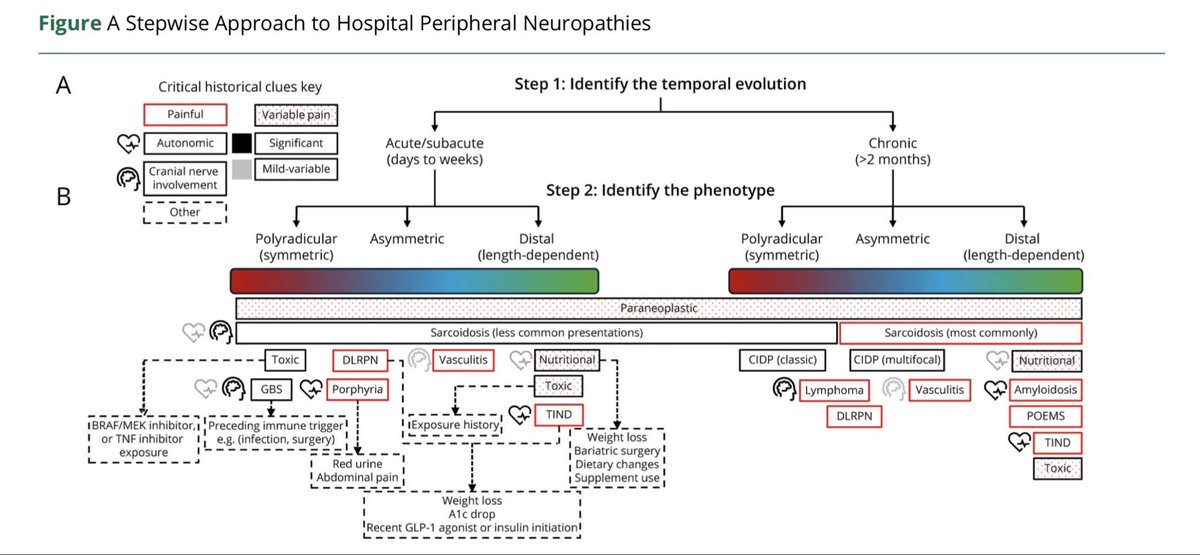
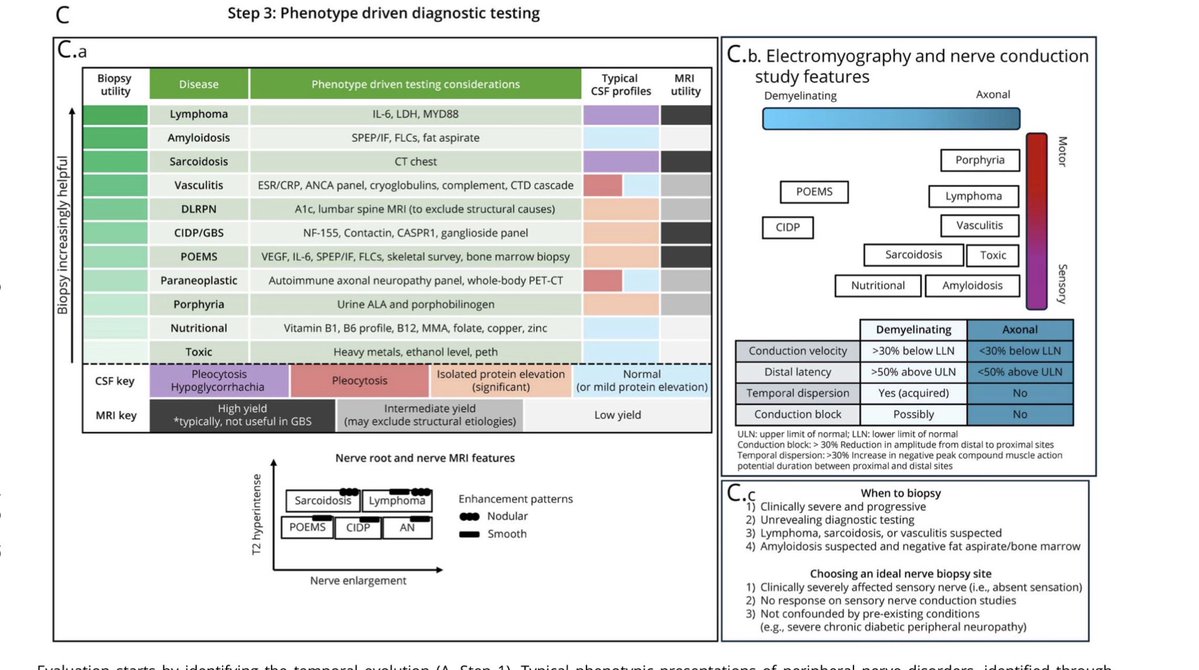
One of my missions is to make Peripheral Neuropathies more understandable for non-experts. Recognizing that physicians often find PNs challenging, especially in the hospital setting, I collaborated with @MayoClinicNeuro Neuromuscular hospitalists, @ReeceHass and @SantilliAshley, and my former NM co-fellow #JMartinezThompson to develop an engaging infographic that simplifies how to approach neuropathies leading to hospitalization. The incredible artistic skills and creativity of @ReeceHass truly brought this project to life, exceeding all expectations. We hope you find this helpful. https://t.co/HjEJbfOkqh
🔥 Hot off the press! Cases of #dysferlinopathy#LGMD presenting as asymptomatic/paucisymtomatic hyperCKemia without dystrophic pathology or fatty replacement on MRI, even in case >50 yo. Is this the most benign end of the dysferlinopathy spectrum? https://t.co/YoqzFYo3pP
…Dr. Engel always told me that he was still learning, even after all those years. He taught me that I need to keep an open mind, because there's always new things to learn and discover… #Myositis@MayoClinic@TheMyositisAssc
https://t.co/emfLzBOMtj
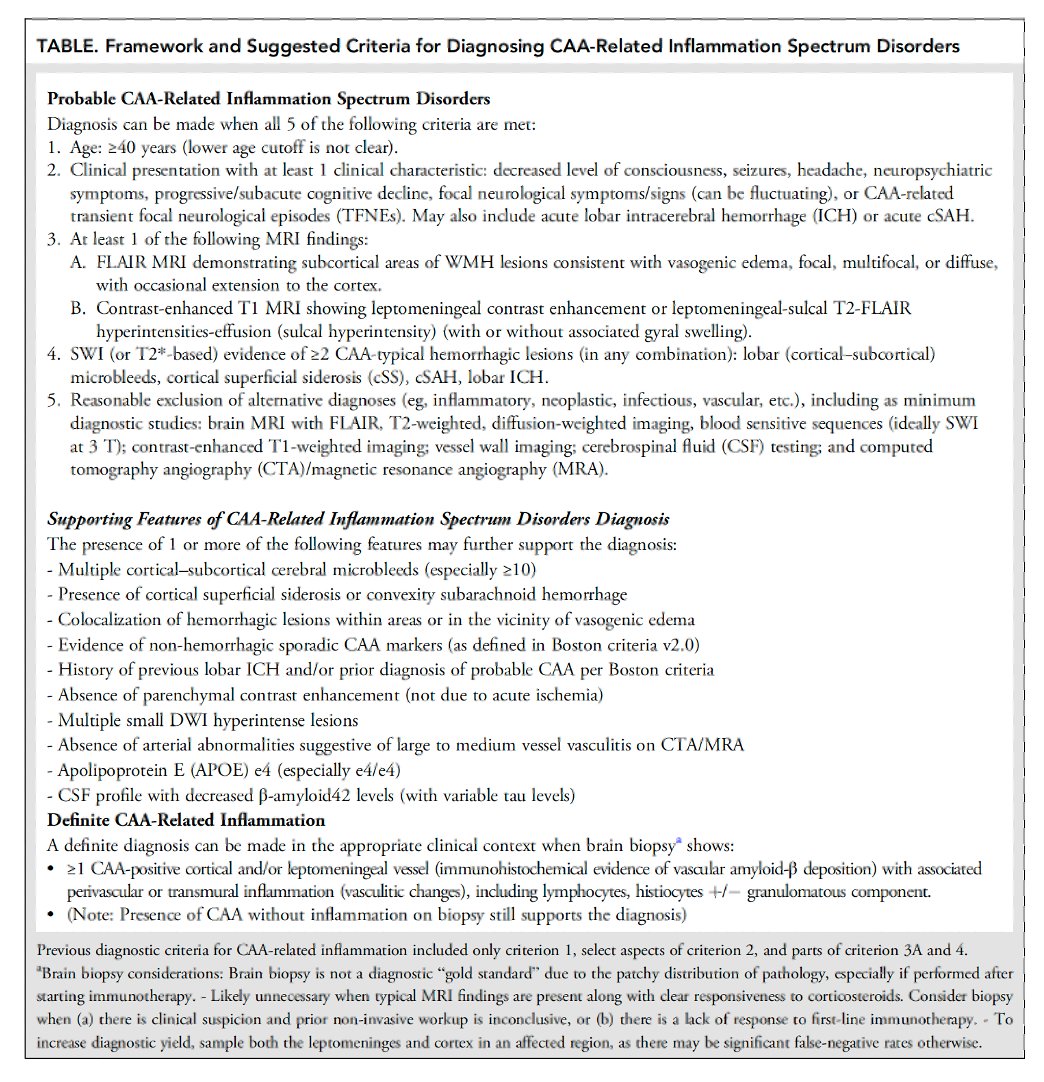
⚡️🩸🧠 Practical framework for diagnosing Cerebral Amyloid Angiopathy-related inflammation (CAA-ri)
We frequently discuss challenging CAA-ri cases with colleagues around the world. This framework summarizes key diagnostic features across the CAA-ri spectrum in a clinically useful manner.
via @ANA_journals@GreenJournal
#NeuroTwitter #stroke #Neurology #neuropath #stroke #dementia #Alzheimers #biomarker #brain #MedStudentTwitter #AmyloidAngiopathy #CAA #cSVD
Bortezomib, a proteasome inhibitor, is different from other chemotherapies in the sense that it can cause two types of peripheral neuropathy: a common garden-variety distal symmetric polyneuropathy (classic chemo neuropathy) and a rare autoimmune axonal neuropathy.
Bortezomib-induced autoimmune neuropathy is usually subacute, painful, asymmetric, motor-predominant, and has axonal features on nerve conduction studies. It can present as polyradiculoneuropathy, lumbosacral radiculoplexus neuropathy, and distal polyneuropathy and continues to progress after discontinuation of the drug. Nerve biopsy may show an active neuropathy with axonal degeneration, ischemic injury, and inflammation with microvasculitis. I often treat them as LRPN with a 12-week IV methylprednisolone trial.
What a neurosurgeon sees vs a non-medical person. To the trained eye, everything is compartmentalized and organized. To the average individual, it’s a random assortment of black and white set of squiggles and lines. #neurosurgery#neurosurgeon#radiology#medstudent#medschool #radiology #neuro #neuroanatomy #anatomy #anatomyandphysiology
The lumbosacral plexus plays a vital role in motor, sensory, and autonomic innervation of the lower limbs and pelvic region.
Lumbosacral plexopathies are not easy to diagnose, and below, I try to simplify how to approach them.
The main focus of this post is clinical features and diagnosis, but we will also touch on anatomy and treatment.
The temporal profile (TEMPO) is critical when assessing lumbosacral plexopathies. We divide them based on the time from symptom onset to nadir in hyperacute (< 24 hours), acute/subacute (1-30 days), and chronic (> 1 month). The hyperacute causes are usually traumatic or vascular, which could be ischemic or compressive, secondary to retroperitoneal hematoma. The acute/subacute causes are usually inflammatory (lumbosacral radiculoplexus neuropathies-LRPN) or infectious (syphilis, CMV, or VZV). The chronic etiologies are usually inflammatory, radiation-induced, or neoplastic.
The most common causes of lumbosacral plexopathies I see in my practice are LRPN and radiation-induced plexopathies. Given my very specialized clinic, I also see very rare causes, like paraneoplastic, focal CIDP, and neurolymphomatosis, so I approach all of them the same way.
1/x
Knowledge is contagious!
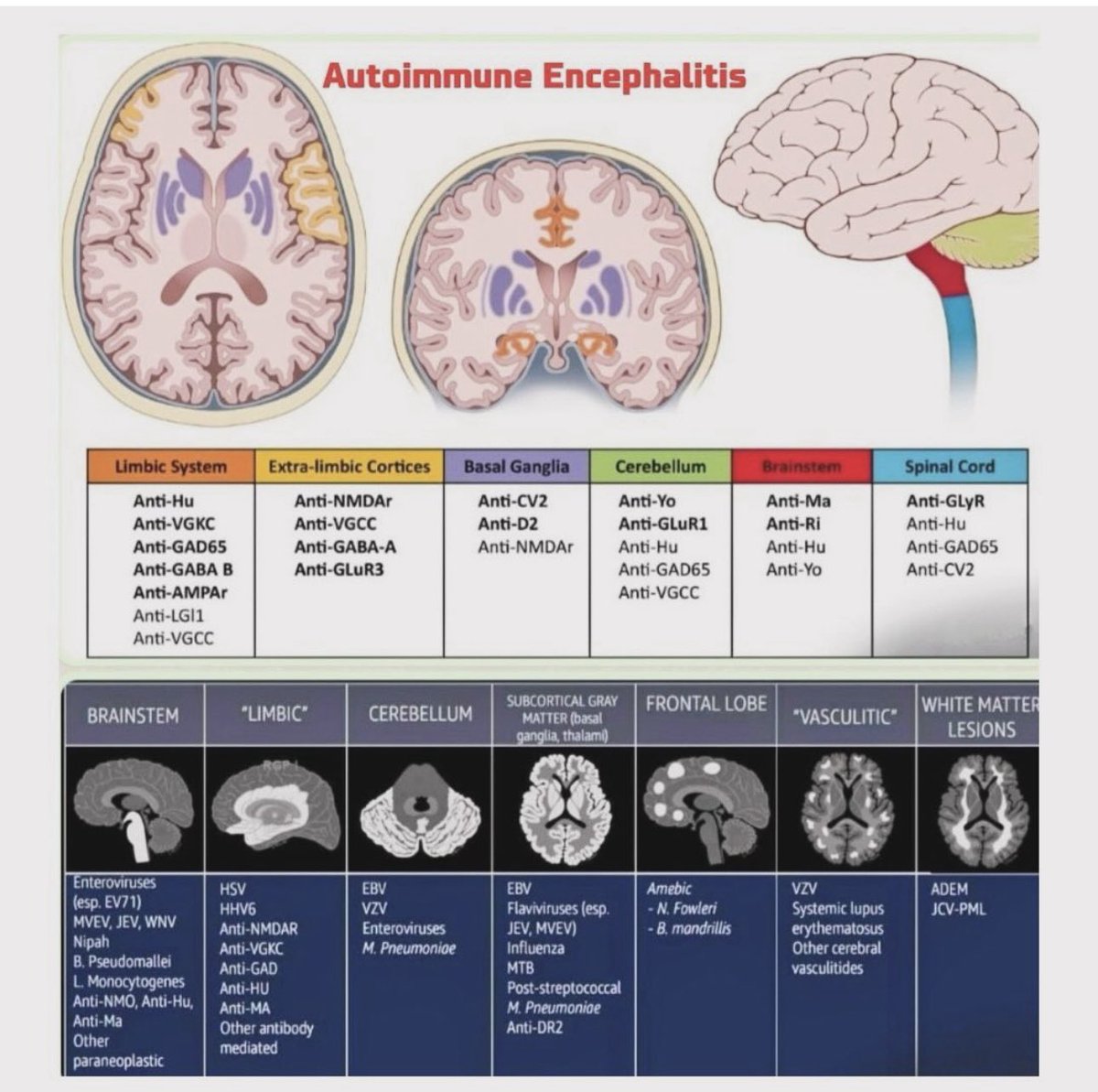
Infectious encephalitis can be a difficult diagnosis, but patterns on MRI can suggest an etiology.
Most know herpes & the temporal lobe
Do YOU know any more?
Here’s a figure to help you remember the most “common” encephalitis patterns for different organisms
Since CSF PCR studies take time, some imaging can provide helpful clues:
Temporal lobe: Although other infectious agents may involve the temporal lobe, statistically this is overwhelming HSV-1
Deep Gray: Think of flaviviruses such as Japanese encephalitis & West Nile encephalitis
Splenium: Think of common infections, especially infections kids get—rotavirus, influenza, COVID.
Brainstem: This is most commonly enteroviruses (hand, foot and mouth disease). Remember, all the motor for the hand, foot, & mouth meet in the brainstem, so this is where the encephalitis will be!
Infarcts: Think VZV. Varicella and Vasculitis both start with V!
White matter: Think of immunocompromised viruses (HIV, PML/JC virus)
Hopefully, you will have an infectious curiosity for the MR findings in encephalitis!
For those who want more details, I have written two reviews on neuromuscular amyloidosis (also included amyloid myopathies).
One with @TLiewluck and #JimDyck https://t.co/IPdFX3ttw0
One with my brother @PintoLFR https://t.co/OgdI3UCSGW
14/x
IVIG monotherapy can be an effective first-line treatment for HMGCR IMNM. Read this Editor Choice article, open access for 2 months. https://t.co/x4vnLDIxnI
When I have a new fellow or resident in our peripheral nerve clinic, I always teach them the importance of defining the neuropathy clinical syndrome. NCS/EMG are valuable, but the neurological exam is the most important (as it should be in neurology but many have forgotten).
This is the neuropathy clinical phenotype classification I find the most helpful:
- Isolated small fiber neuropathy
- Length-dependent peripheral neuropathy (or distal symmetric polyneuropathy)
- Multiple mononeuropathies
- Mononeuropathy
- Asymmetric neuropathy
- Polyradiculoneuropathy
- Plexopathy (brachial or lumbosacral, many times a radiculoplexus neuropathy)
- Sensory neuronopathy
- Motor neuronopathy
I always tell my trainees they don’t have to memorize the causes of each phenotype. If you define the syndrome correctly, you can ask Google or ChatGtp what are the most likely causes. 😊
Definitions 👇👇👇
#NeuropathyBites
1/x
Every physician caring for patients with Guillain-Barre Syndrome (GBS) should read this recent excellent review.
https://t.co/DsAghNYAeI
There are two important points that I believe are not emphasized enough in this paper:
1. We have shifted away from classifying patients as AIDP, AMSAN, or AMAM. This classification depended solely on nerve conduction studies, which are not widely available in hospital settings. Additionally, the biology of GBS is much more complex than previously understood, so the dichotomy axonal or demyelinating does not work well here. Moving forward, we should refer to all these conditions as GBS and classify the variants as shown in the figure and table below.
#NeuropathyBites
🔥GBS mimics Rapid-Fire🔥
Let’s see how many you nail!
Rash and fever: ???
Pain, and multifocal neuropathy: ???
Red urine and abdominal pain: ???
History of heavy alcohol use: ???
Pseudo-athethosis: ???
Nephrotic syndrome: ???
Asymmetric painful upper limbs only syndrome: ???
Asymmetric painful lower limbs only syndrome : ???
CSF cells 100/mm3 and enlarged axillary lymph nodes bilaterally : ???
Fixed anisocoria and severe oculobulbar weakness: ???
ANSWERS 👇👇👇
#NeuropathyBites
#NeuropathyRapidFire
#MedX
#MedTwitter
#Glycogen storage #myopathy is not always genetic!!! 3 patients with subacute proximal/axial weakness, stiffness, hyperCKemia, glycogen storage #pathology and IgGk #MGUS with (-) genetic testing responded to IVIG. VAMMGAS is a new MGUS-associated myopathy.
https://t.co/fwmJ3izv0Q
Many of my neurology colleagues feel uneasy when admitting a patient with severe, chronic (> 2 months) rapidly progressive peripheral neuropathy of uncertain etiology. While there are more than 100 causes of neuropathy, the most likely causes in this clinical setting can be narrowed down to the six below:
🔺 Chronic Inflammatory Demyelinating Polyradiculoneuropathy (CIDP), including autoimmune nodopathies
🔺 Amyloidosis
🔺 Paraneoplastic syndrome, including POEMS syndrome
🔺 Vasculitis, including radiculoplexus neuropathies
🔺 Lymphoma or carcinomatous meningitis
🔺 Nutritional deficiencies
#NeuropathyBites
#NeuroTwitter
#MedTwitter
#MedX
1/x