Introducing "codebase to course", a skill that turns any codebase into an interactive coding course
So that you can learn coding through your own projects, complete with visualization, plain-English code translations, metaphors, even quizzes...
I vibe code a lot but have no idea how the code works under the hood. This is how I think "learning to code" should be in the AI age: Build first, learn later
Link below
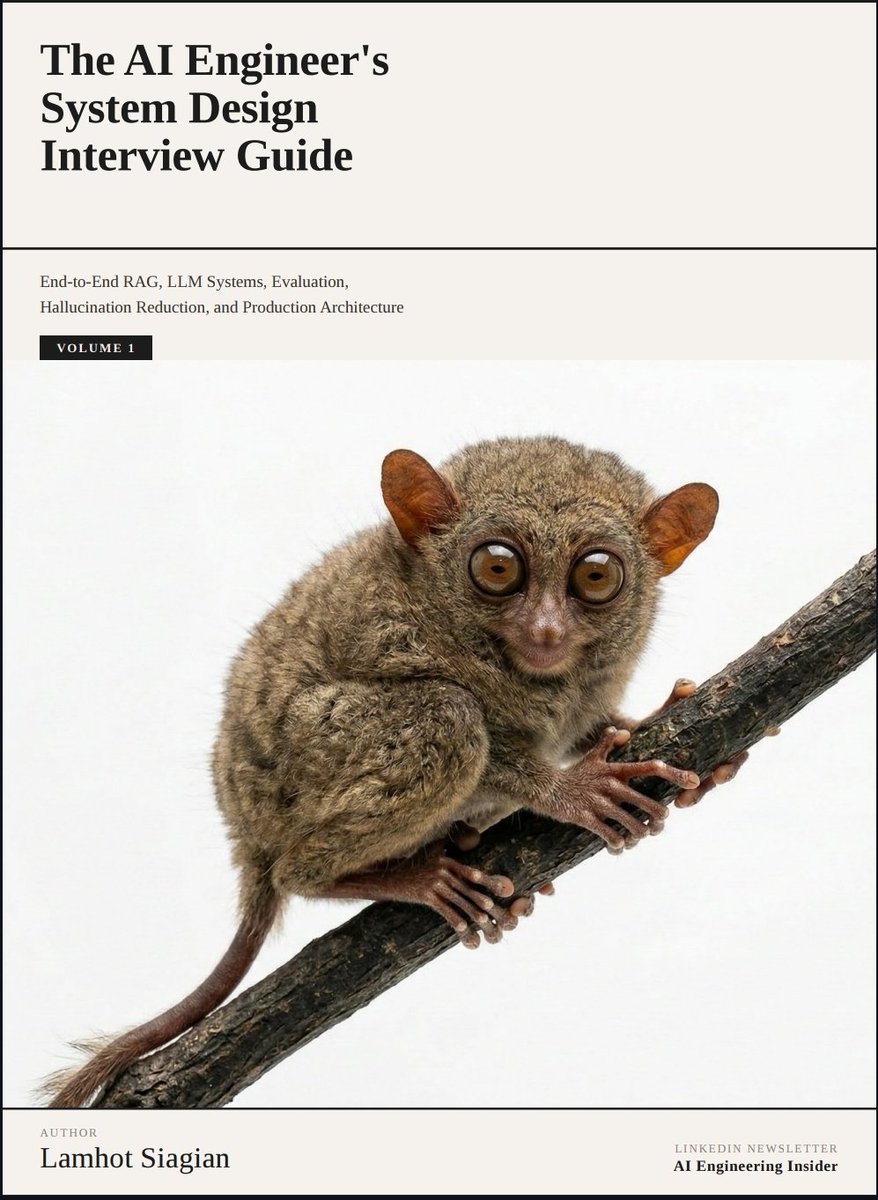
This AI System Design guide teaches RAG better than most courses.
And I'm giving it away for free (Only for First 4500)
Inside:
• RAG fundamentals & chunking strategies
• Hybrid retrieval (BM25 + vector search)
• Production-level RAG architecture
• Evaluation & RAGAS metrics
• Hallucination reduction techniques
• End-to-end LLM system design
How to get it:
• Follow me (must so I can DM)
• RT + Like
• Comment "book"
I'll dm you
🚀MIT Flow Matching and Diffusion Lecture 2026 Released (https://t.co/bKgs2wghvY)!
We just released our new MIT 2026 course on flow matching and diffusion models! We teach the full stack of modern AI image, video, protein generators - theory and practice. We include:
📺 Videos: Step-by-step derivations.
📝 Notes: Mathematically self-contained lecture notes
💻 Coding: Hands-on exercises for every component
We fully improved last years’ iteration and added new topics: latent spaces, diffusion transformers, building language models with discrete diffusion models.
Everything is available here: https://t.co/bKgs2wghvY
A huge thanks to Tommi Jaakkola for his support in making this class possible and Ashay Athalye (MIT SOUL) for the incredible production! Was fun to do this with @RShprints!
#MachineLearning #GenerativeAI #MIT #DiffusionModels #AI
Last year, Ravin Kumar, a researcher at Google DeepMind who works on the Gemma and Gemini models, and I put together 10 hours of free workshops on building AI products with state-of-the-art open-weight local models.
Every workshop comes with GitHub repositories and Colab notebooks. We put this post together so you’d have one place to find everything, whether you want to work through them in order or jump to a specific topic:
https://t.co/qj5opht5WI
I found a way to read a research paper the way academics actually read them.
A friend of mine at Cambridge showed me her Claude workflow.
I thought she was just fast. Then I watched her pull apart a methodology section in twenty minutes that her seminar group had spent a week discussing without fully understanding.
Here's exactly what she did:
First: she didn't ask Claude to summarise the paper.
That's what everyone does. They paste in a paper and ask for a summary. They get a clean paragraph. They feel like they've read it. They move on.
That's not reading. That's skimming with extra steps.
She did something completely different.
She read the paper herself first. All of it. Without Claude.
Then she asked:
"Based on the methodology and results sections alone, what can and cannot be legitimately concluded from this study? Now read the abstract and tell me where the authors overreach."
She wasn't asking Claude to read the paper for her.
She was using it to test whether the paper was actually saying what it claimed to be saying.
The gap between those two things is where most students get lost. They read what the authors claim and treat it as what the authors found. An experienced academic never does that. She learned not to in twenty minutes.
But the next part is what I keep thinking about.
She asked:
"What did this study not measure that would have significantly strengthened or weakened the central claim? What is the authors' methodology quietly assuming without ever stating it?"
Most students read a methodology section to understand what the researchers did.
She read it to find what they didn't do and what they hoped nobody would notice.
Those are completely different acts of reading. One produces a student who can describe a study. The other produces a researcher who can evaluate one.
Her seminar group spent a week on the same paper and never reached that question.
Then she did something most students never think to do.
She tested the paper against itself.
"If I tried to replicate this study with a different population in a different context, what would most likely change about the results? What does that tell me about how far the authors' conclusions actually travel?"
Most published claims are presented as general. Most are actually specific.
That question finds the line between the two every time. Once you see it you cannot read a paper without looking for it. It changes what you take from every study you ever read after that.
Then she mapped the paper's place in the conversation.
She asked:
"What debate is this paper entering? Who wrote the work this paper is responding to and what would those authors say back? Where does this paper sit in the argument that was already happening before it was written?"
She stopped reading papers as standalone objects that day.
Every paper is a reply to something. Most students never find out what. She found out in five minutes and it changed the way the paper meant something entirely.
A paper you understand in isolation is information.
A paper you understand inside its conversation is knowledge.
Then she ran the final check.
Before closing the paper she asked:
"What is the single most important citation missing from this paper that every serious researcher in this field would consider essential? What conversation is this author not in that they should be?"
She found a foundational paper the authors had never cited.
Not because they were careless. Because they came from a slightly different tradition and had a blind spot they weren't aware of. That blind spot explained a gap in their argument she hadn't been able to name until that moment.
She walked into the seminar and named it.
Her supervisor stopped the discussion and asked her to explain how she'd found it.
She told him she'd asked the right questions of the paper instead of just reading it.
He told her that was exactly what twenty years in academia teaches you to do.
She'd been doing it for three weeks.
Here is the actual workflow. Five questions. In order.
Question one: what can and cannot be legitimately concluded from the methodology and results alone? Where does the abstract overreach?
Question two: what did this study not measure that would have changed what it found? What is the methodology quietly assuming it never defends?
Question three: if you replicated this with a different population or context, what changes? How far do the conclusions actually travel?
Question four: what debate is this paper entering? Who is it responding to and what would those people say back?
Question five: what is the most important paper missing from the bibliography? What conversation is this author not in?
Most students spend three years at university reading papers from the outside.
Those five questions put you on the inside in twenty minutes.
Claude didn't read the paper for her.
It taught her the questions that experienced academics ask automatically after years in a field.
She just learned them earlier.
The papers didn't change.
The questions did.
Most students finish a paper feeling like they've understood it.
She finished a paper knowing exactly what it proved, what it didn't prove, where it sat in the field, and what it was quietly hoping nobody would ask.
That is not a faster way to read.
It's a completely different thing to do with a paper.
And almost nobody teaches it directly.
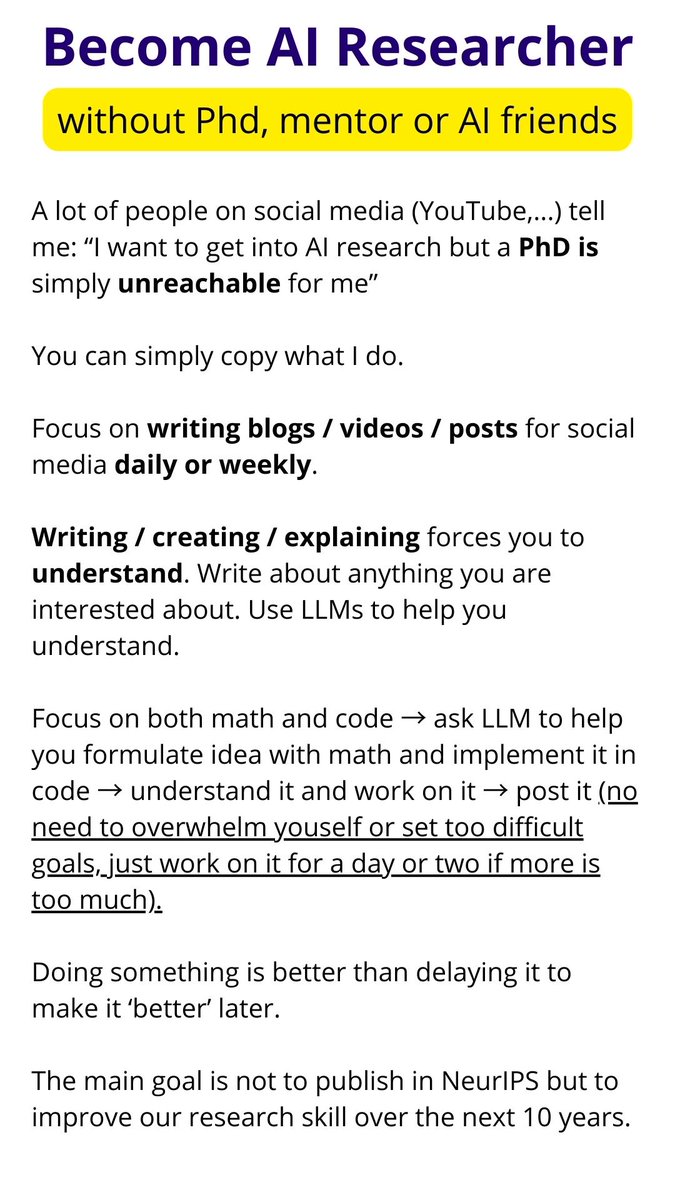
Become AI Researcher
(without Phd, mentor or AI friends)
A lot of people on social media (YouTube,...) tell me: “I want to get into AI research but a PhD is simply unreachable for me”
You can simply copy what I do.
Focus on writing blogs / videos / posts for social media daily or weekly.
Writing / creating / explaining forces you to understand. Write about anything you are interested about. Use LLMs to help you understand.
Focus on both math and code → ask LLM to help you formulate idea with math and implement it in code → understand it and work on it → post it (no need to overwhelm youself or set too difficult goals, just work on it for a day or two if more is too much).
Doing something is better than delaying it to make it ‘better’ later.
The main goal is not to publish in NeurIPS but to improve our research skill over the next 10 years.
Use AI to help you
My Gemini prompt to come up with mathematical theories for new AI ideas:
"""
You are a renowned top AI researcher. You are coming up with new original idea supported by math derivations and proofs to advance AI research field. You must explain your idea so undergrads can understand them, possibly use fewer technical jargon and keep it widely accessible for social media people who are reading, you goal is to spread AI research ideas for others.
Take the topics in this code and come up with a list of new ideas on how to improve it that was not done before. Choose some stuff and make a list, just show me possible ideas and I will choose ones I like for you to continue to do. Apply some areas of math to some of these concepts that has not been done before, think how you can solve and combine ideas.
Topic: attention mechanism
"""
Let AI code it
You can use OUR LLM that trains on 1 GPU:
github com/Open-Superintelligence-Lab/5-dollar-llm
(click it in tweet reply below)
Give me math theory to your LLM coding agent and let it code it.
If you have already finished repo like this, LLM will make fewer or hopefully no mistakes.
I will create more repos for JEPA, diffusion, RL and other research in the future so it’s easer for everyone.
Final note:
No “I’ll do it better later”,
No “I need to publish to NeurIPS or it doesn’t matter”
No “I need to spend 2 months on this paper to make it perfect because you will get overwhlemed and quit (PhD students do spend months though, I’d like to hear their opinion on this point in the comments)
No “I need to understand every detail of everything” → this yields diminishing returns on your research, Gemini can teach you how to approach this
It's just about setting the goal to 10-year skill improvement and doing a bit every day or as frequently as possible.
R.I.P. Google Scholar for literature reviews.
Perplexity reads 500+ papers in minutes and builds citation maps automatically.
Here are 8 prompts for PhD-level systematic reviews that actually work (Save for later):
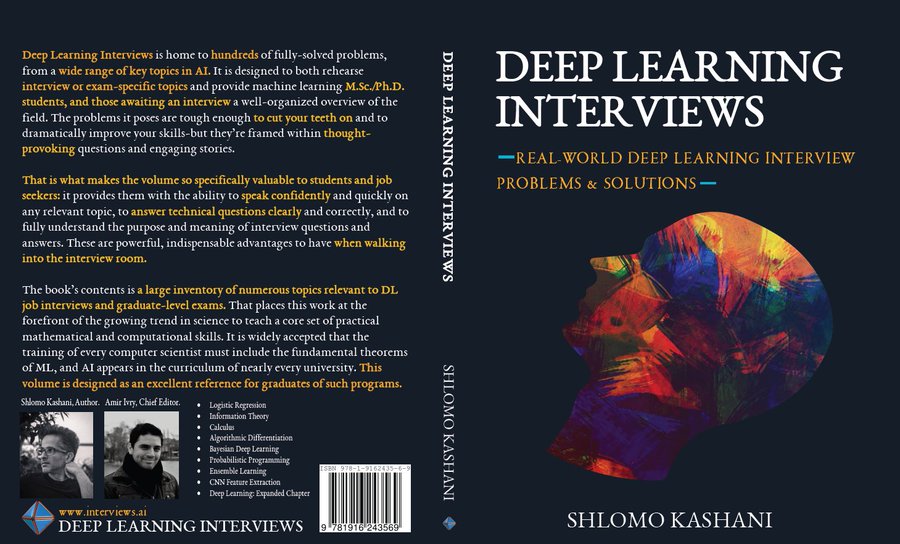
This book alone can change your ML interview game🙀
If you're serious about AI, ML, or landing top-tier roles... this book is DIFFERENT.
• Real-world deep learning interview problems
• Step-by-step solutions
• Covers ML math, probability, CNNs, Bayesian DL & more
• Designed for people who actually want to understand, not just memorize
This isn’t basic theory.
This is the kind of prep that makes you walk into interviews confident.
And I’m giving it FREE to first 4500
How to get it :
1️⃣ Follow me MUST (So i can dm you)
2️⃣ Like this post
3️⃣ Comment “DL”
4️⃣ RT to help others level up
If you’re preparing for ML interviews in 2026, this could literally change your trajectory.
No fluff. No gatekeeping.
Let’s build killers in AI. 🚀🔥
Announcing DreamDojo: our open-source, interactive world model that takes robot motor controls and generates the future in pixels. No engine, no meshes, no hand-authored dynamics. It's Simulation 2.0. Time for robotics to take the bitter lesson pill.
Real-world robot learning is bottlenecked by time, wear, safety, and resets. If we want Physical AI to move at pretraining speed, we need a simulator that adapts to pretraining scale with as little human engineering as possible.
Our key insights: (1) human egocentric videos are a scalable source of first-person physics; (2) latent actions make them "robot-readable" across different hardware; (3) real-time inference unlocks live teleop, policy eval, and test-time planning *inside* a dream.
We pre-train on 44K hours of human videos: cheap, abundant, and collected with zero robot-in-the-loop. Humans have already explored the combinatorics: we grasp, pour, fold, assemble, fail, retry—across cluttered scenes, shifting viewpoints, changing light, and hour-long task chains—at a scale no robot fleet could match. The missing piece: these videos have no action labels. So we introduce latent actions: a unified representation inferred directly from videos that captures "what changed between world states" without knowing the underlying hardware. This lets us train on any first-person video as if it came with motor commands attached.
As a result, DreamDojo generalizes zero-shot to objects and environments never seen in any robot training set, because humans saw them first.
Next, we post-train onto each robot to fit its specific hardware. Think of it as separating "how the world looks and behaves" from "how this particular robot actuates." The base model follows the general physical rules, then "snaps onto" the robot's unique mechanics. It's kind of like loading a new character and scene assets into Unreal Engine, but done through gradient descent and generalizes far beyond the post-training dataset.
A world simulator is only useful if it runs fast enough to close the loop. We train a real-time version of DreamDojo that runs at 10 FPS, stable for over a minute of continuous rollout. This unlocks exciting possibilities:
- Live teleoperation *inside* a dream. Connect a VR controller, stream actions into DreamDojo, and teleop a virtual robot in real time. We demo this on Unitree G1 with a PICO headset and one RTX 5090.
- Policy evaluation. You can benchmark a policy checkpoint in DreamDojo instead of the real world. The simulated success rates strongly correlate with real-world results - accurate enough to rank checkpoints without burning a single motor.
- Model-based planning. Sample multiple action proposals → simulate them all in parallel → pick the best future. Gains +17% real-world success out of the box on a fruit packing task.
We open-source everything!! Weights, code, post-training dataset, eval set, and whitepaper with tons of details to reproduce. DreamDojo is based on NVIDIA Cosmos, which is open-weight too.
2026 is the year of World Models for physical AI. We want you to build with us. Happy scaling!
Links in thread:
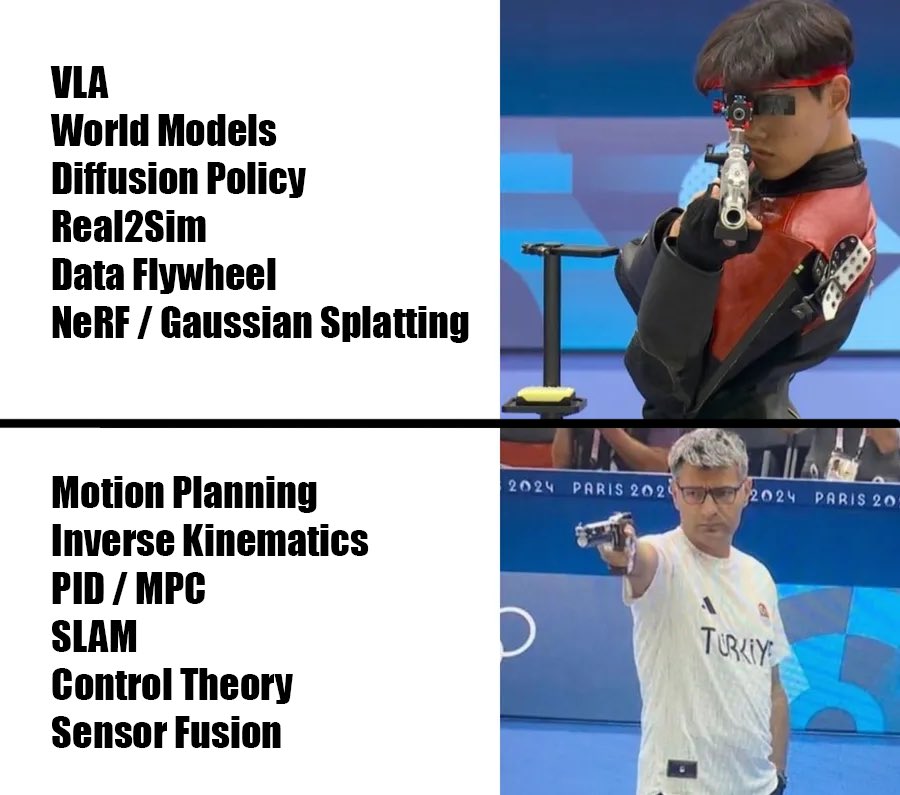
my advice for robot enthusiasts
don't go into the fancy stuff without the fundamentals
robots have been in the wild for roughly 60 years, there are many bitter lessons pilled in their classical operations
probrably most "AI" advocates can't recite what a pid loop is or have never touched sensor fusion
this knowledge defines whether you're just here for the hype or you're here for the actual long game
i.e. dynamics r crucial for implementing guardrails and safety procedures, mpc is actually used along with world models for sampling trajectories, sim2real requires realistic physics modeling and control modeling, etc
determinism and formalalities will be one of the biggest problems to solve in next gen robotics
and it won't come from folks who r just jumping the gun