To understand what it takes to build a humanoid robot with model-based control, we finetuned @physical_int 's (PI) Pi05 model for our custom use case and environment.
We incurred ~$10K in hardware costs, compared to the typical ~$20K set up (DROID/ALOHA).
Here are the lessons and challenges we faced building the first working prototype (shown in the video) in 3 months.
Part 1: Hardware, Software, Model Selection, Custom Embodiment, Inference, Embedded Hardware, Hierarchical Planner
Part 2: Model Evaluation, Data Collection, Model Training, Simulation and Teleoperation
We hope sharing our experience accelerates the learning of others who are in a similar starting point.
If you’re looking for XC330-T288-T servos to build active GELLOs, we recently bought some extras.
And can let them go at cost (as long as you're using them ;p)
Couldn’t wait for the usual 10 week lead time, or bear to pay the almost 2x markup.
We hunted down the OEM instead (super fun) and had a feeling others might need them too.
We’ll be pooling orders for parts going forward.
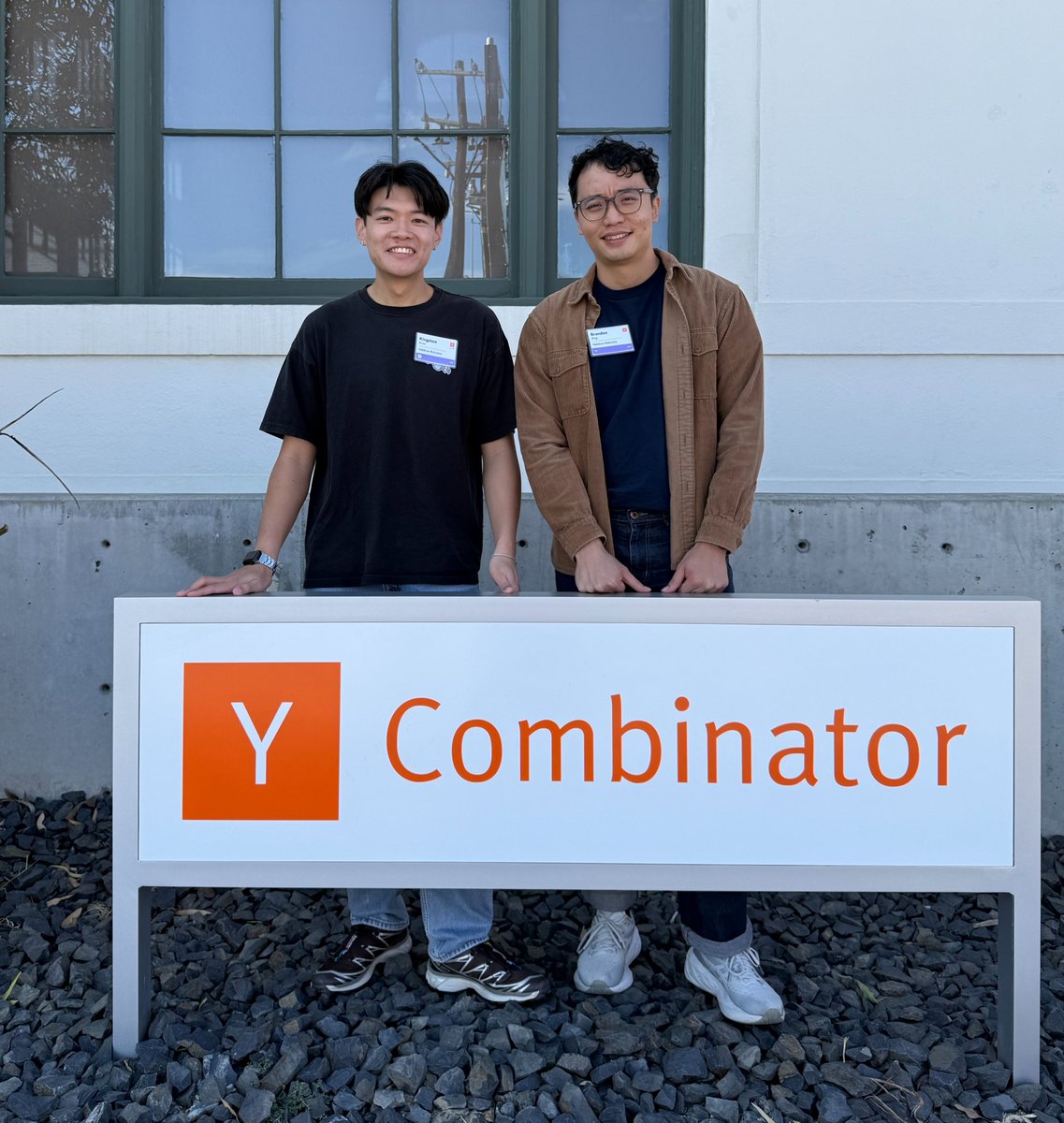
We’re joining the S26 batch at @ycombinator!
@kstonekuan and I started @hbr_pbc to develop humanlike robots that work alongside expert field teams to build, maintain, and repair the future infrastructure humanity will increasingly depend on.
YC will help us accelerate toward achieving that mission. Thanks @sdianahu for taking a chance on us.
There is still much to build, learn, and prove, but we’re excited for what’s next.
We’re grateful to be working with partners who share our mission to develop robots that extend what humanity can do, for the benefit of the communities they serve.
Hebbian Robotics has joined @ycombinator's S26 batch!
@bdono_ and I started @hbr_pbc because we believe the next generation of infrastructure will be built and maintained in places that are increasingly difficult for people to access safely and consistently: remote sites, subsea environments, orbit, and other demanding field conditions.
Our goal is to build human-like robots that can work alongside expert field teams to help construct, inspect, maintain, and repair the systems that communities and industries rely on.
YC will help us accelerate as we continue building toward that mission. Thanks @sdianahu for taking a chance on us!
We are grateful to the early believers who supported us when there was not much to show beyond conviction, early prototypes, and a lot of work ahead. Your trust, feedback, and encouragement have meant a lot.
There is still plenty to build, learn, and prove, but we are excited for what is ahead. We are grateful to be working with partners who share our mission in developing robotics to extend what humanity can do for the benefit of the communities they serve.
We’re open sourcing the agent skills we built to plan this demo.
Datacenter robotics tasks are full of hidden constraints: rack geometry, cable density, live equipment, etc.
These skills are an attempt to make those constraints explicit so AI agents can reason about them more reliably when producing robot task plans.
hey @sama, we'd love to walk the floors of OpenAI's GW data centers and see if our robots can address the bottlenecks behind compute delays.
just emailed you more details on what we're working on at @hebbyrobotics for YC S26
The scarce thing in a data center is not manpower, but instinct that only comes from years on the floor.
@kstonekuan and I spent the past month with data center operators and industrial robotics startups. Most robotics companies are focused on robots as a productivity amplifiers: 24/7 uptime, five days of work done in two. Few are focused on the potential of robots to change how people work altogether.
We want to show what it looks like to rethink human-robot collaboration, using AI so a shrinking pool of experts can meet the increasing demands of future infrastructure.
What most excites us is robots guiding where an expert's attention should go.
In the video, the robot checks the switches with a thermal camera, then makes a judgment on whether the increase in temperature is a real problem or a spurious reading.
This instinct requires an expert to synthesize all available background context and accumulated lessons from past failures.
This is where we want to double down, and show how human-robot collaboration places scarce expert attention exactly where it matters.
More to come.
The scarce thing in a data center is not manpower, but instinct that only comes from years on the floor.
@kstonekuan and I spent the past month with data center operators and industrial robotics startups. Most robotics companies are focused on robots as a productivity amplifiers: 24/7 uptime, five days of work done in two. Few are focused on the potential of robots to change how people work altogether.
We want to show what it looks like to rethink human-robot collaboration, using AI so a shrinking pool of experts can meet the increasing demands of future infrastructure.
Standard operating procedures (SOPs) are how critical infrastructure stays stable, and they're the work that scales worst.
The video shows one common procedure: clearing the cables a technician leaves behind after testing, and reconciling the rack to a stable state for the next test.
A robot that runs SOPs the same way every time, never skipping a step, keeps the system in a known, predictable state. This reduces the cognitive overhead on experts so they can solve harder problems.
Seeing a fair bit of interest in the Newton RJ45 example so wanted to share another video, directly from the @NVIDIARobotics blog post.
"Video 5. A RB-Y1 robot is performing a cable insertion task for refrigerator assembly, simulated with two-way coupled MuJoCo Warp and a VBD cable solver"
What's interesting here is the use of two coupled solvers for one task. This kind of solver composition is a first-class capability in a lower level framework like Newton.
NVIDIA showcased Newton at GTC again earlier this year.
If you are familiar with MuJoCo or Isaac Sim, Newton is a new open-source, GPU-accelerated physics engine aimed at robotics and contact-rich manipulation, built with DeepMind and Disney Research. It also runs as a physics backend inside the Isaac ecosystem.
I finally had time to dig through the examples, and the RJ45 plug simulation (example_contacts_rj45_plug.py) caught my attention. The latch deflects and clicks, and the cable behaves like a real 1D deformable. We've been working on cables, connectors, and other contact-heavy interactions, so seeing this as a first-class example was a pleasant surprise.
I extended it to test insertion and removal, with and without pressing the latch, and visualized the result in Rerun. Pull without pressing the tab, and the latch holds the plug in place; press it, and the plug comes free.
It also interested me how code-first the examples feel. We've spent real time trying to drive both MuJoCo and Isaac Sim with coding agents, and the recurring friction is being able to reason spatially to modify the simulation setup.
It feels like there's real potential here. I'm curious if Newton might be better suited for agent-generated robotics simulations.
If you're looking for something like this too, Newton is definitely worth a try.
“don’t train your own model” is common ai advice. it's wrong. your token bill's the proof.
today, we’re excited to launch castform into open preview. castform is the easiest way for you to train your own model, on your own data.
open-weights models are performant and much cheaper. when trained on your task & proprietary data, they beat closed models. the thing standing between you and that was weeks of plumbing & years of ml expertise.
with castform, model training is as simple as prompt engineering. @castformai
bring your agent traces or raw corpora. castform turns it into training data, picks the right algorithmic recipes, manages gpus, and gives you an ide to watch and chat with your model as it learns.
see what you can build with castform👇
“don’t train your own model” is common ai advice. it's wrong. your token bill's the proof.
today, we’re excited to launch castform into open preview. castform is the easiest way for you to train your own model, on your own data.
open-weights models are performant and much cheaper. when trained on your task & proprietary data, they beat closed models. the thing standing between you and that was weeks of plumbing & years of ml expertise.
with castform, model training is as simple as prompt engineering. @castformai
bring your agent traces or raw corpora. castform turns it into training data, picks the right algorithmic recipes, manages gpus, and gives you an ide to watch and chat with your model as it learns.
see what you can build with castform👇