A short list of today's miracles:
The pilot opened the cockpit door moments before collapsing
The heroes, Yaniv, Assaf, and Tzvika, happened to be at the front of the plane.
British pilots happened to be on the flight
Yaniv had watched the “Air Crash Investigation” docuseries and pushed the controls forward.
Without every single one of them, tonight we’d be searching for wreckage in the deserts of Saudi Arabia—and even that only if the prince allowed it.
For the first time in over 20 years, someone has tried to hijack a plane bound for Israel. Miraculously, the attacker, an Omani pilot, was overpowered before he could complete his mission.
How a dramatic hijacking was foiled by the bravery of everyday Israelis.
All in today's special edition of It's Noon in Israel.
https://t.co/fzUtLv5Nwf
Authorities are investigating whether one of the pilots stabbed the other pilot.
Another plane is expected to be sent from Dubai to Saudi Arabia to pick up the passengers and continue on to Israel.
Israeli Prime Minister Netanyahu is currently holding consultations with top security officials. Israel is treating the incident as a potential kidnapping.
Sequence of events:
When the plane was an hour and a half away from landing in Israel, it issued a general distress call.
It then transmitted code 7500 for “unlawful interference,” the code used to indicate a hijacking.
No contact has been established with the aircraft since.
Israeli authorities have been aware of the incident for about half an hour.
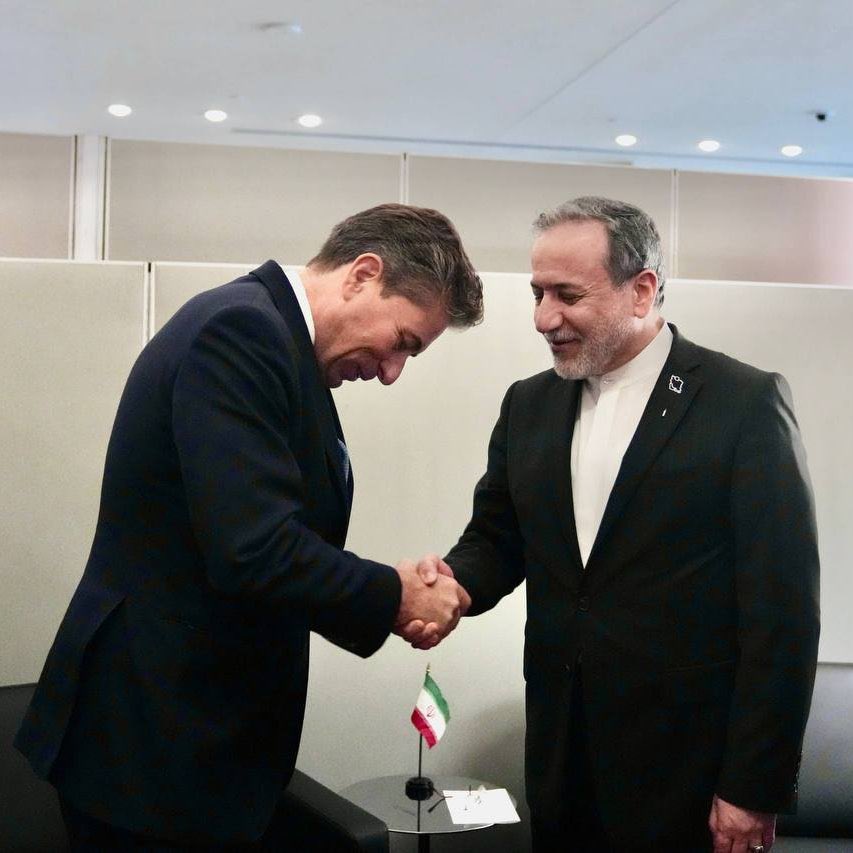
What a shameful bow, Mr. Fletcher!
In January, the Iranian regime massacred thousands of my people. Today you, the UN's humanitarian chief, bow to their killers. This is not diplomacy. It is surrender to murderers.
Are you the world's humanitarian representative, or the host of January's killers?
@TomFletcher@UN_OCHA
Rattled by Operation Rising Lion and Midnight Hammer last June, Saudi Arabia went looking for a deterrent. Pakistan, still bruised from its May 2025 confrontation with India, was looking for the same thing. The arrangement was mutually beneficial: Islamabad acquired a wealthy patron, Riyadh signaled it could diversify away from Washington, and Pakistan’s defense minister declared that his country’s nuclear program would be made available to the kingdom if needed.
Then came February 2026, and Iranian missiles and drones began landing throughout the kingdom. Riyadh invoked the pact. Islamabad sent a foreign minister to deliver a stern warning to Tehran and flew a squadron of fighters to a Saudi air base. The lesson was not subtle. Pakistan would not be the new guarantor, and a nuclear guarantee secured by diplomacy is a considerably weaker deterrent than one whose button sits under your own finger.
That is the context for today’s Wall Street Journal report that Trump has approved a 30-year agreement providing Saudi Arabia with a civilian nuclear program and potentially opening the door to uranium enrichment on Saudi soil.
The obvious truth is that Saudi Arabia needs nuclear power like a drowning man needs water. But Mohammed bin Salman revealed the real game in 2018: If Tehran got a bomb, the kingdom would follow as soon as possible. Throughout its long campaign for nuclear power, Saudi Arabia conceded nothing to the industry’s “gold standard,” a binding commitment not to enrich uranium or reprocess spent nuclear fuel domestically.
The nuclear campaign is a symptom, not a cause. Riyadh concluded years ago that the American security guarantee is unreliable, regardless of who holds the White House. On September 14, 2019, cruise missiles and drones took roughly half of Saudi production offline in a single morning. Washington attributed the attack to Iran, moved some air defense assets into the kingdom, and did nothing further. Biden completed the lesson from the opposite direction. On February 4, 2021, in his first major foreign policy address, he ended American support for the coalition’s offensive operations in Yemen, including arms sales, and the following day the State Department moved to delist the Houthis.
In the Middle East that existed before October 7, 2023, Biden’s team pursued an agreement they saw as a signature achievement: a Strategic Alliance Agreement obliging the United States to defend the kingdom against external attack, bundled with Saudi demands for acceptance of a civilian nuclear program, advanced American weaponry, and—as the crown jewel for Riyadh’s domestic audience—normalization. The framework required Senate ratification, and negotiations seemed nearly complete. Then came October 7.
The Saudis then sought the same arrangement without the normalization component, hoping to separate the security guarantee from the Palestinian question. They ran into the late great Senator Lindsey Graham, the arrangement’s most energetic Republican champion, who did the arithmetic out loud in May 2024: If there is a mutual defense agreement negotiated in the form of a treaty, it needs 67 votes in the Senate to become binding. Without normalizing the Israeli-Saudi relationship, “there would be very few votes for a mutual defense agreement between the U.S. and Saudi Arabia.” In short: no Israel means no deal.
All that changed with Trump. He detached the nuclear file from normalization entirely, having already signed an executive order in May 2025 directing the State Department to promote nuclear exports. In November 2025, Washington and Riyadh signed a Joint Declaration on the Completion of Negotiations on Civil Nuclear Cooperation, alongside an F-35 package. Now they have an agreement for U.S. firms to construct a uranium enrichment facility in Saudi Arabia if a joint American-Saudi study concludes that such a project is justified.
This is a sly middle finger to the UAE, which was forced into accepting complete enrichment restrictions in its own nuclear cooperation agreement with Washington before constructing the Barakah nuclear power plant—not to mention that it was a stalwart ally in the recent war while Saudi Arabia ended Project Freedom by refusing to allow the U.S. to operate from its territory.
Trump is a compartmental thinker. It has served Israel before—the Abraham Accords worked precisely because he declined to treat the Palestinian question as the gate through which everything else must pass. It has also cost Israel. In May 2025, he asked Syrian President Ahmed al-Sharaa to normalize relations with Jerusalem in exchange for sanctions relief, then lifted the sanctions anyway, squandering the leverage and ending the Israeli-Syrian talks that were ongoing.
The upside of the same habit is that this deal may not represent his hedge on a nuclear Middle East. Trump is not reconciled to Iran getting the bomb. This is not the nuclear equivalent of his statements last month about it being “unfair” to deny Iran ballistic missiles if Saudi Arabia has them. He is simply doing a deal he thinks is good for the United States—American vendors, American reactors, Russian and Chinese competitors locked out of the market.
Nor is all hope lost for normalization. Israel still has much to offer Saudi Arabia, but taking one of the largest carrots off the table does make an agreement significantly more difficult. In the future, one would hope the dealmaker in chief remembers the value of leverage.
Trump: The civilian nuclear agreement with Saudi Arabia will be approved on the condition that it joins the Abraham Accords.
Dramatic, and again demonstrates to everyone — don’t be quick to pass judgment on the matter of Trump–Israel relations.
@laurnorman
First public statement by a cabinet minister against the Saudi nuclear program
Avi Dichter: “A civilian nuclear program from the U.S. to Saudi Arabia is not something Israel wants to see, but it seems we have no ability to prevent it.”
Approximately 175 activists from more than 20 boats of the condom flotilla are now making their way peacefully to Israel.
In the video: the activists enjoying themselves aboard Israeli vessels
🚨 BREAKING:
🇺🇸🇮🇷 Trump: "THE U.S. WILL WORK CLOSELY WITH IRAN"
- The U.S. will work closely with Iran after what he calls a “very productive Regime Change”
- No uranium enrichment allowed
- U.S. and Iran will together dig up and remove all deeply buried nuclear “Dust”
- Everything remains under heavy Space Force satellite surveillance
- Nothing has been touched since the attack
- U.S. will discuss tariff and sanctions relief with Iran
Many of the 15 points already agreed
President Donald Trump said on Wednesday the United States would impose tariffs on any country supplying military weapons to Iran.
“A country supplying military weapons to Iran will be immediately tariffed … 50%,” Trump said in a post on Truth Social, adding there would be “no exclusions or exemptions.”
Despite agreeing to a ceasefire, Iran launched 94 drones and 23 missiles at Gulf Arab countries this morning, according to Saudi Al-Arabiya.
Kuwait said its forces engaged an intense wave of 28 Iranian drones, with some hitting vital oil facilities and power stations in the south of the country, resulting in significant damage to oil infrastructure facilities, power stations, and water desalination plants.
The UAE’s Defense Ministry said its forces intercepted today 17 Iranian ballistic missiles and 35 drones. The Habshan gas complex was hit by fallen debris, causing fires and minor injuries to three people.
Bahrain said its forces intercepted 6 Iranian missiles and 31 drones since this morning, causing damage to several houses in the Sitra area as a result of fallen shrapnel.
US Vice President JD Vance described a temporary ceasefire agreement with the Islamic Republic as “fragile” and said President Donald Trump had instructed US representatives set to negotiate with Tehran to enter the talks in good faith, while warning that Trump was impatient for progress.
Israeli historian Yuval Harari said at the World Economic Forum that artificial intelligence will eventually take over all religious texts.
He predicts that AI will control every major world religion, including Christianity, Islam, and Judaism.
Harari pointed out that Judaism defines itself as the religion of the book, granting ultimate authority to words rather than to people.
“What happens when the greatest expert on the holy book is an AI?”
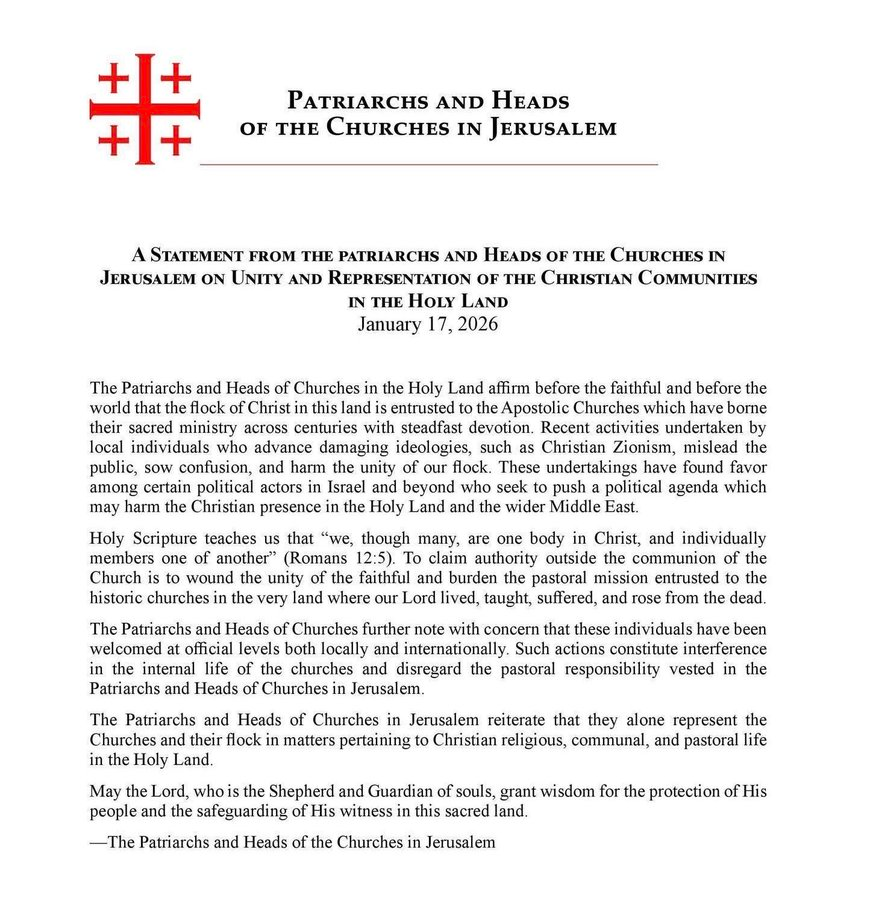
In response to the statement of non-evangelical churches in Israel, I issued the following. I hope you will read prayerfully.
I love my brothers and sisters in Christ from traditional, liturgical churches and respect their views, but I do not feel any sect of the Christian faith should claim exclusivity in speaking for Christians worldwide or assume there is only one viewpoint regarding faith in the Holy Land. Personally I’m part of a global and growing evangelical tradition that believes the authority of Scripture and the faithfulness of God in keeping His covenants. That includes His covenant with Abraham and the Jewish people. My Christian faith is built on the foundation of Judaism and without it, Christianity would not exist. Without the Judeo-Christian worldview, there would be no Western Civilization, and without Western Civilization, there would be no America. The thought that God is even capable of breaking a covenant is anathema to those of us who embrace Holy Scripture as the authority of the church. If God can or would break His covenant with the Jews, then what hope would Christians have that He would keep His covenant with us? Labels such as “Christian Zionism” are too often used in a pejorative manner to disparage free-church believers, of which there are millions across the planet. Christians are followers of Christ and a Zionist simply accepts that the Jewish people have a right to live in their ancient, indigenous, and Biblical homeland. It’s hard for me to understand why every one who takes on the moniker “Christian” would not also be a Zionist. It’s not a commitment to a particular government or government policy, but to the Biblical revelation as given to Abraham, Isaac, and Jacob. In my faith, there is certainly room for those who “butter their bread” differently than me, and I would hope that there would be room in the hearts of other church bodies for me. We need to unite in those truths that should be agreed upon, such as the sanctity of life, the sacred act of marriage, the autonomy of the individual, the desire to lift up every human and alleviate human suffering, and the belief that grace is God’s gift to us all. Please share with others and "Pray for the peace of Jerusalem!"
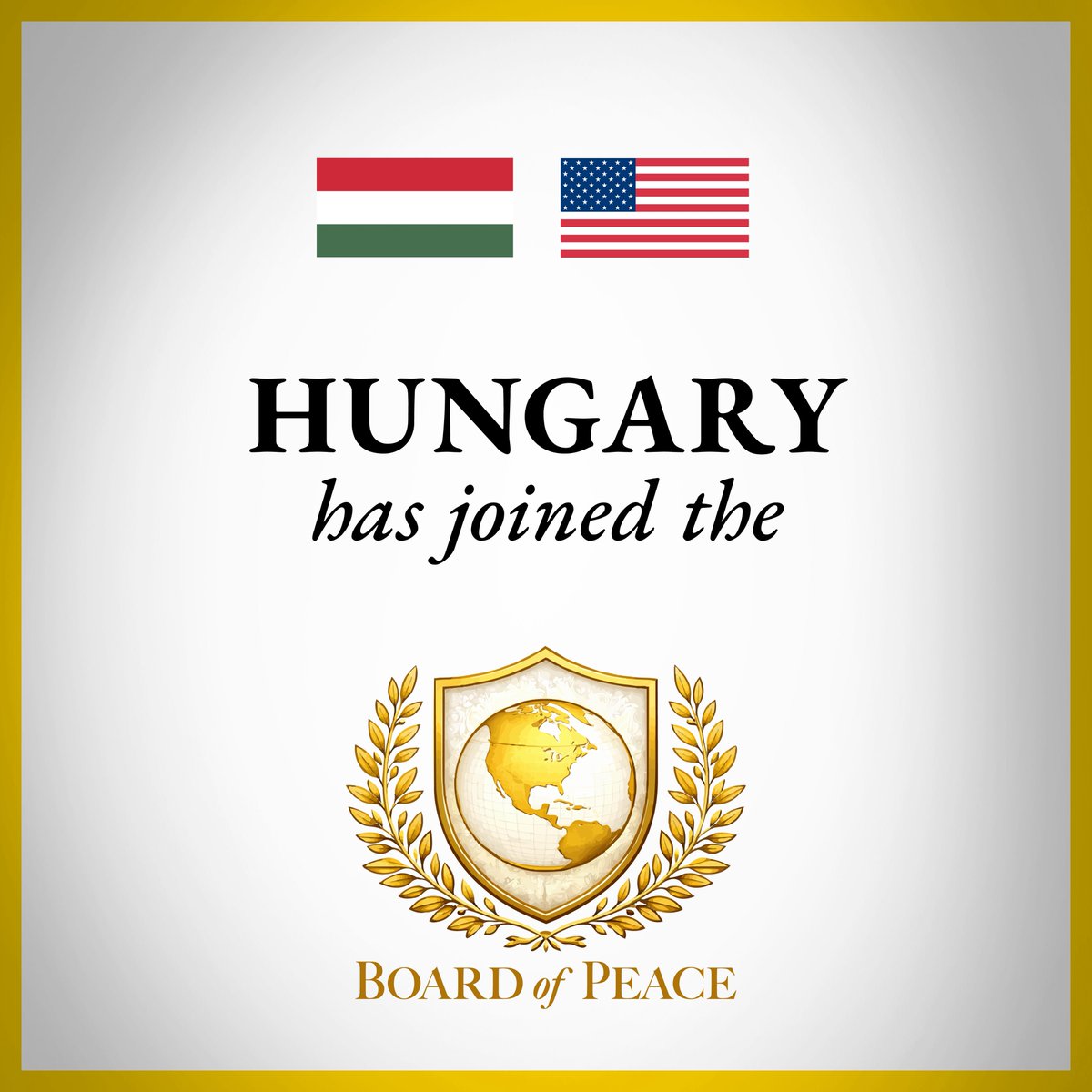
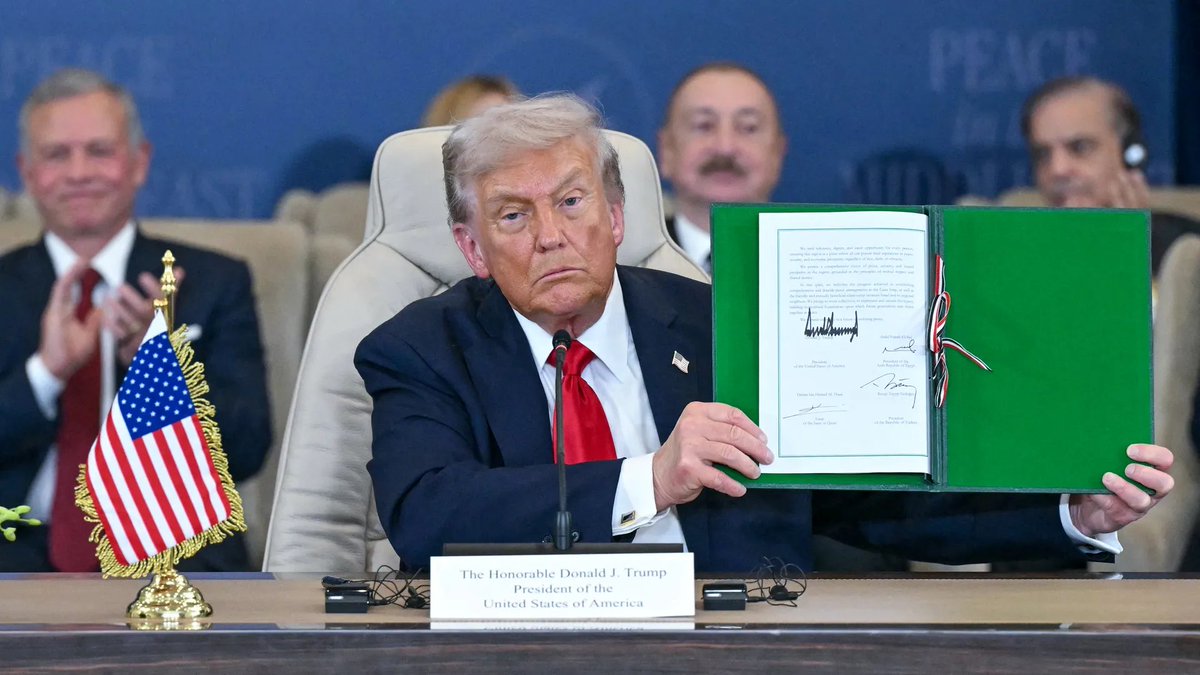
🇺🇸🇺🇳 TRUMP WANTS SIGNING CEREMONY THURSDAY IN DAVOS FOR NEW “BOARD OF PEACE”
Trump’s trying to launch a new international body to replace the UN in handling global conflicts, and he wants world leaders to show up and sign.
Thing is… most of them are confused, annoyed, or both.
He’s asking for $1B from each country to join, wants full control over decisions, and even invited Putin and Lukashenko.
Source: Bloomberg