Modern datacenters use less water than a typical golf course.
At some point we should have a discussion about which is more important for all of us:
What is more important to the quality of our life?
AI infrastructure that will improve everything we do?
Or a game?
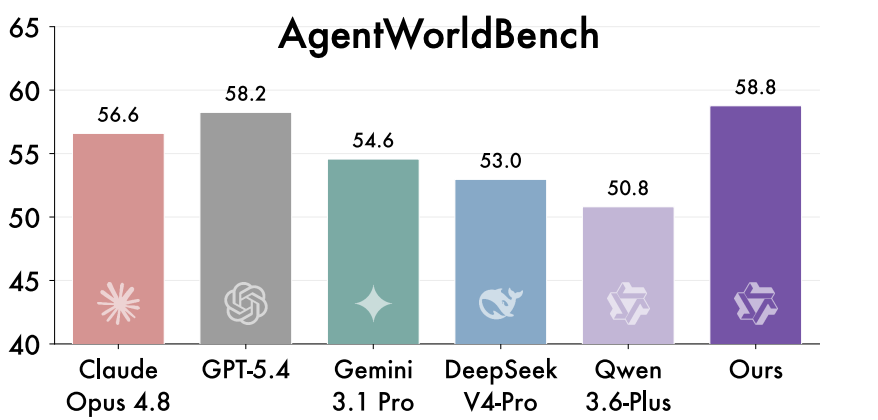
Agents-A1, a 35B Mixture-of-Experts Agentic Model that reaches trillion-parameterlevel performance by scaling the agent horizon.
Paper: https://t.co/nRimynuKju
Code: https://t.co/ALWJ34Q9BM
Qwen-AgentWorld: a language world model that simulates seven agentic environments : MCP, Search, Terminal, SWE, Android, Web, and OS by predicting how each one responds to an agent's actions. Trained on 10M+ interaction trajectories with a three-stage CPT→SFT→RL recipe, it serves two roles: a controllable simulator for scaling agentic RL, and a warm-up that lifts downstream agent performance across tasks. The broader point is treating world modeling, not just policy learning, as a core part of building general agents.
Paper:https://t.co/XRFvjimTD2
Code:https://t.co/wil9aFWxF2
Model: https://t.co/gH6cEg0Edx
Counting down to the M5 Ultra Mac Studio so I can self-host 100B models right on my desk. No cloud, no API bills, no data leaving the room just local AI. Apple going to sell this like iPhone's. mark my word.
Introducing Sakana Fugu: A full multi-agent orchestration system accessible via a single model API.
Our ‘Fugu Ultra’ model matches the performance of Fable and Mythos, delivering frontier capability without the risk of export controls.
Try it: https://t.co/hhO6qTawgb 🐡
Human in the loop design for users;
(AI runs the process, a person reviews or approves)
AI in the loop design for makers;
(the human drives and the AI sits inside their workflow as an assistant. its more deterministic).
Generate and evaluate agent skills based on traces with agents. Create skills with teacher models (expensive/slow) that student models (cheap/fast) can use to perform harder tasks reliably.
Your cheapest AI model can now beat your most expensive one.
That's the wild claim behind Upskill, out today from HKUDS — and the benchmarks back it up.
The trick: when your coding agent fails a task, Upskill captures the failure, has a strong "teacher" model write a fix, then loops that fix against the weak "student" model until the student can actually pull it off. Not generic best practices — only advice the cheap model has proven it can follow. Those validated skills get auto-injected into every future session.
The result on Terminal-Bench 2.0:
→ Flash + Upskill — 51.6% pass at $0.04/task
→ Pro model alone — 50.0% pass at $0.06/task
The cheap model won. At 41% lower cost. The student surpassed the teacher that trained it.
One command drops it into Claude Code. Flash price. Pro performance.
https://t.co/FuY1Or9k7G
Someone developed 3-billion-parameter dense reasoning model which performs near frontier models 😊
Code: https://t.co/z8u6NQslV5
Paper: https://t.co/3amXGCON4h
100% agreed on @paulg . . . you can get rich without cheating anyone. Just build something people love so much they tell their friends. Then your company grows a little each month, and over a few years that small growth turns into a lot of money. The best idea is something you and your friends actually want. So it's not about hurting people, it's about helping them. this strategy was not possible few decades ago.
https://t.co/zXqP1kHKmH
Coding agents have a stale memory problem.
You leave your keys on the table. Someone moves them. You come back and look on the table. Wrong — the world changed behind your back.
Agents do the same with code. They read a file at step 3, then tests run, scripts change things, packages get installed — and at step 30 they edit the file from old memory.
The good news: the best agents already fixed this for files. Claude Code, for example, remembers when it last read a file. If the file changed after that (by you, or by a formatter), it refuses to edit and reads the file again first.
The bad news: the check stops at files. Most agents still don't ask:
- Are my test results still valid after that last edit?
- Did installing that package change my environment?
- Is the API response I saw 50 steps ago still true?
The fix is the same idea, just bigger: keep a small list of facts ("I saw X at step N"), know which actions make a fact stale, and re-check before acting on it.
Trust what you last saw — until something could have changed it. Then look again.
AI turned a startup slogan from
Demand-first thinking — "Make something people want."
TO
Vision-first thinking — "Dream something people don't know they need yet."
#ycombinator
We're watching agent skills move from the prompt into the weights - and it quietly changes the economics of building LLM agents.
Today, most agent systems store "skills" (reusable task procedures, tool-use patterns, recovery heuristics) as text and inject them into the prompt at every step. It works, but it's expensive: the same skill text gets re-read on every decision, inflating context cost. And it sits in plaintext, exposing proprietary procedures to anyone who can read the prompt.
A new approach - LatentSkill — points to where this is heading: compile each textual skill into a small LoRA adapter using a trained hypernetwork, then mount it on a frozen model. The skill lives in weight space, not context.
Why this matters:
→ Zero skill tokens in the prompt - one report shows ~64% fewer prefill tokens alongside higher task success
→ Skills stay modular - load, swap, scale, or compose them without retraining the base model
→ Less exposure - the procedure isn't sitting in readable text anymore
The deeper shift: a skill stops being a paragraph you paste and becomes a component you mount. That's a different mental model for how we package and ship agent capabilities.
The open question I'm watching: how reversible do we want this? Fully fine-tuning skills into a model is efficient but permanent. Modular weight-space skills try to keep the efficiency without losing the ability to update and recombine.
Curious how others are thinking about packaging agent skills.
paper: https://t.co/qzV910QPxU
AI transformation. AI-native company. Agentic company, Agentic Software . . .
I come across these terms a dozen times a day, and I'll be honest, a lot of it reads like an ad or marketing label.
Can someone who actually works in this explain, in plain language, what each one means and where the real differences are?
Just trying to understand the words everyone keeps using . . .