This track record is insane:
> 55B EA deal, the largest LBO in history
> $1.8B Fifth Avenue deal at 26
> Brokered the Abraham Accords
> Brokered the 2025 Gaza ceasefire deal
I think history will look back on Kushner’s model as a unique form of dealmaking.
The Affinity model has more in common with the great merchant-banking houses than with a plain-vanilla PE fund.
Acutaas Chemicals: Inside the Semiconductor Story
Most people know the companies that make chips. Very few know about the chemicals that help make those chips.
Acutaas Chemicals is building a business in this lesser-known part of the semiconductor supply chain. 🧵👇
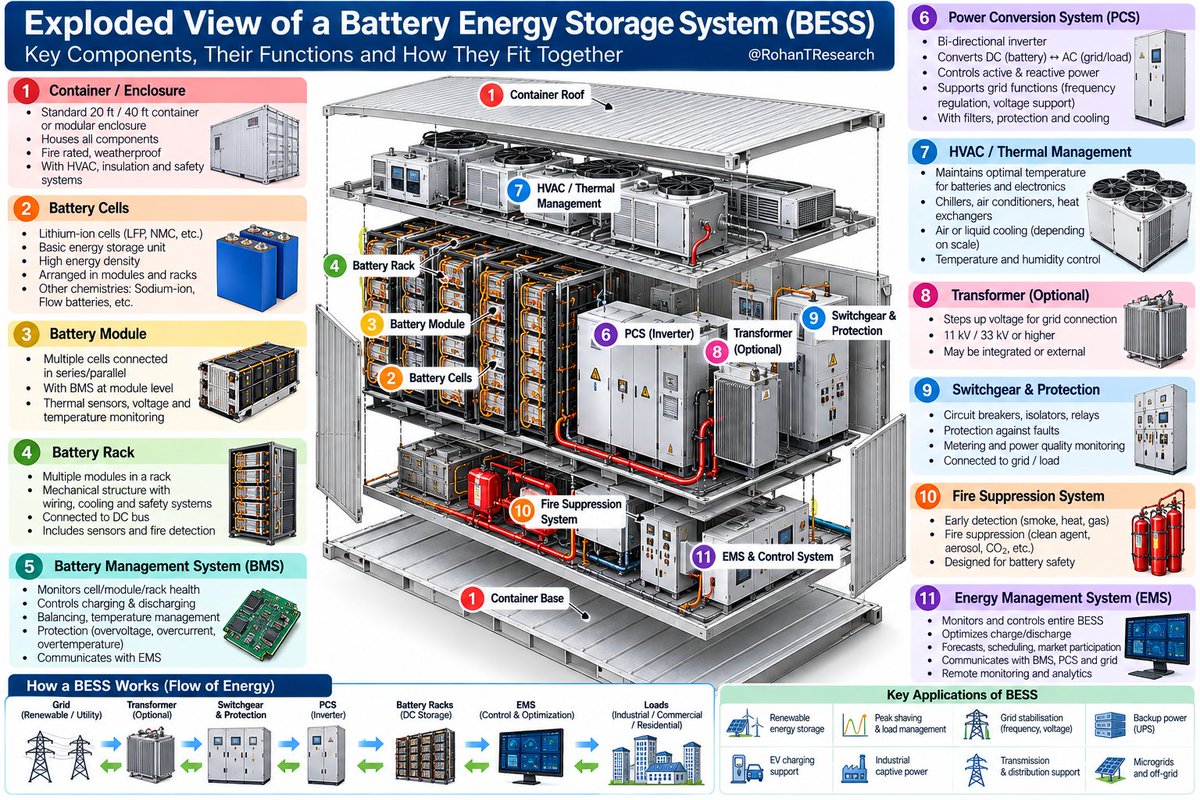
India's next big manufacturing opportunity may be batteries - but BESS is much better
👉 Most people see BESS as:
→ Battery
→ Container
→ Inverter
👉 But the real opportunity is a much larger ecosystem: Raw materials → Cells → BMS → PCS → Cooling → Transformer → Switchgear → EMS → Grid
Here’s the Indian listed BESS value chain 👇
@DhawalDoshi5@Dynamicinvstr@Sharad9Dubey@TrendSpark420
@CMOTamilnadu Instead of giving gold rings to every newborn in government hospitals, why not give them to families who have 3 children?South India’s fertility rate is already around 1.9,below replacement level. As India becomes richer,we could end up with a much older population
Kalyan Jewellers opened their 1st ATM store in Chennai last month
My initial reaction was the same as yours when I read the headline: WTF is an ATM store?
ATM stands for Akshaya Thanga Maligai (அக்ஷயா தங்க மாளிகை) which translates to “The Palace of Gold” in Tamil
Kalyan has committed ₹300 crore to build 5 ATM stores in TN to take on the ₹16,000 crore regional giant Thangamayil
Kalyan has a great reason for doing so ⤵️
India’s Construction Equipment Industry Is Quietly Becoming a Global Export Hub
For years, the Indian construction equipment story was largely linked to one thing: domestic infrastructure spending.
Roads, railways, metros, mining and real estate.
But a second growth engine is now emerging; exports.
India’s construction & infrastructure equipment exports are projected to reach 20,701 units in FY27, compared with:
🔹FY24: 11,990 units
🔹FY25: 13,230 units
🔹FY26: 17,396 units
🔹FY27E: 20,701 units
That means exports could rise more than 70% in just three years.
What makes this trend interesting is that FY26 domestic CE sales fell 6.7%, while exports jumped nearly 32% YoY, suggesting export growth is becoming independent of the domestic cycle.
The key trigger is CEV Stage V, which has made Indian equipment more compatible with developed markets such as Europe, the US and Australia. FTAs and tariff benefits are adding further support.
India already has scale as the world’s 3rd-largest CE market. The industry, worth ₹97,500 Cr in FY25, is expected to reach ₹2.28 lakh Cr by FY30.
At the same time, nearly ₹45,000 Cr of equipment/components remain import-dependent, creating a second opportunity through localisation.
So the opportunity is now two-sided:
Global sourcing shifting to India → Export growth
Imported components getting localised → Import substitution
JCB India’s plan to nearly double capacity from 85,000 to 1.7 lakh machines by 2030, while targeting 15–20% export growth, shows how global OEMs are positioning for this shift.
And recent management commentary supports this trend.
🔹 Action Construction Equipment
ACE management believes exports and inorganic growth could become two of its biggest growth drivers over the coming years.
Exports contributed only 3% in Q1 FY27 due to delayed Middle East shipments, but management expects this to reach 6–7% of FY27 revenue.
Its JV with Japan’s KATO Works could further strengthen this opportunity.
ACE plans to manufacture Japanese-designed heavy cranes in India for domestic as well as export markets, targeting around 50–60% localisation in export-oriented models.
KATO can also source components from India through ACE; potentially making India part of its broader global supply chain.
Management also believes backhoe loaders could become one of ACE’s fastest-growing segments, supported by both domestic and export demand.
🔹 Escorts Kubota
The domestic CE cycle is also showing improvement.
Escorts Kubota’s construction-equipment volumes grew 27.4% YoY in Q1 FY27, while segment revenue increased 39.2% YoY.
Management expects the overall CE industry to grow around 12–15% in FY27, with relatively stronger growth in cranes and mini excavators.
Demand is being supported by faster infrastructure execution, metro projects, solar projects and renewed construction activity across states.
The interesting part is that India’s construction-equipment opportunity is now developing on two fronts at the same time:
Domestic infrastructure demand + Rising global export opportunity.
📌Disclaimer: For educational and informational purposes only. Not a Buy/Sell recommendation.
What separates a promoter who creates wealth from one who destroys it?
While putting together our latest study, “Promoter Edge,” we came across some fascinating patterns in Indian wealth creation.
Promoter-led companies have historically compounded better—but skin in the game alone is not enough.
A few observations stood out:
• Many exceptional wealth creators emerged when promoters were in the 40–55 age bracket — experience behind them, ambition ahead.
• A powerful model has been Owner Mindset + Professional Execution.
• And perhaps most importantly: what does a promoter do with every ₹100 the business earns? The “retained rupee” and how it is allocated can determine decades of compounding.
But ownership can cut both ways. Poor governance and capital allocation have also destroyed enormous shareholder wealth.
Which brings us to the central thought behind our latest IKIGAI study:
Promoter-led is not an investment thesis.
Promoter quality is.
We don’t invest in promoters.
We invest alongside the right promoters.
Ownership is visible. Stewardship is the edge.
Sharing our latest presentation — “Promoter Edge: Backing the Right Promoters is an Art for Wealth Creation.”
Would love to hear your views: What is the single most important quality you look for in a promoter?
Link for presentation:
https://t.co/LJjx4cJfLZ
#Investing #WealthCreation #CapitalAllocation #CorporateGovernance #LongTermInvesting #IKIGAI
India’s manufacturing problem is not that China makes better products.
China spent 30 years building a system that made manufacturing cheap, fast and scalable.
India made very different choices.
Here’s what happened:🧵👇🏻
India’s Semiconductor Opportunity Is Much Bigger Than Fabs.
Semicon 2.0 has already attracted nearly ₹1 lakh crore of investment interest.
The bigger opportunity lies across the entire value chain.
A detailed thread 🧵👇
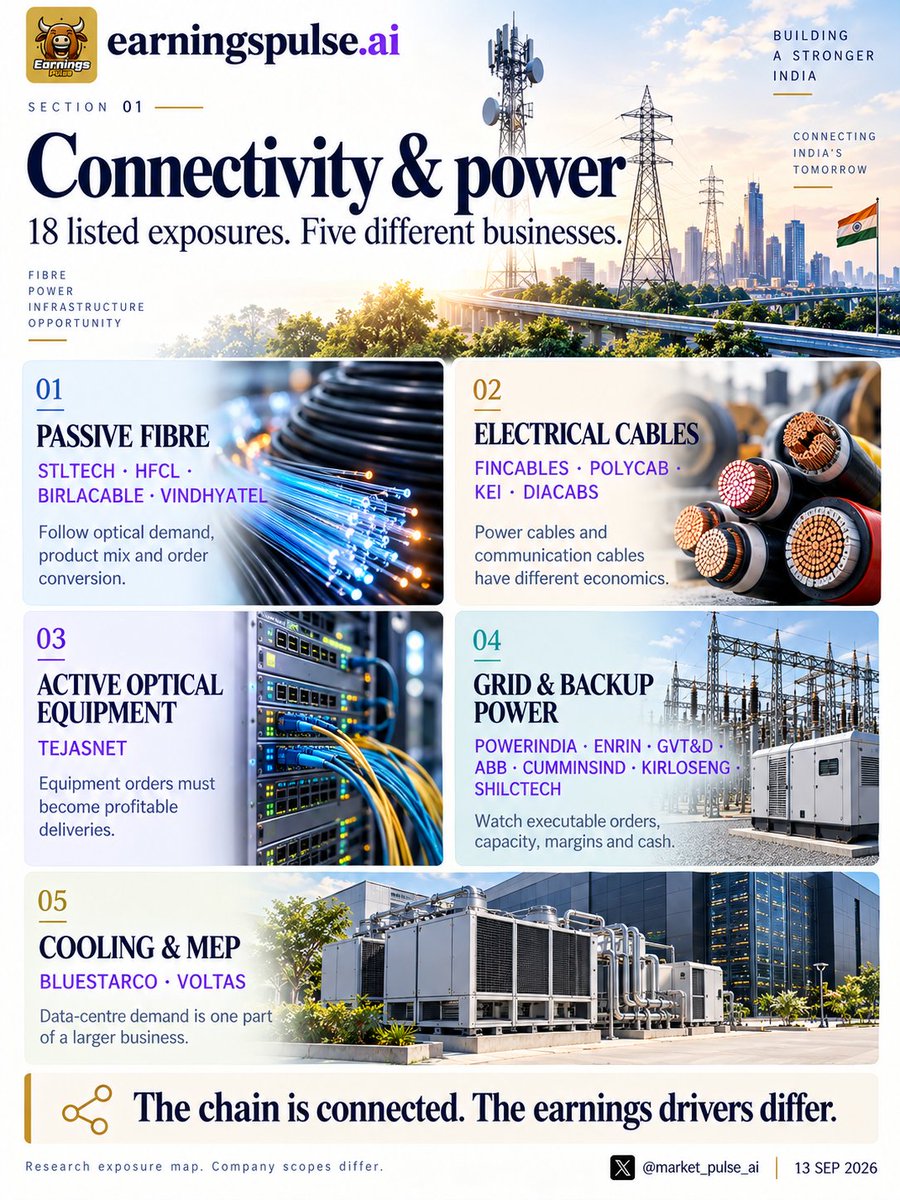
Four visuals connecting India’s next growth chapter.
Inspired by #Jefferies thesis, we mapped 57 listed companies across 14 themes into 4 sections.
1/4 🧵
Leopold Aschenbrenner was born in 2002 in Germany. He graduated valedictorian from Columbia University at 19 years old. As an undergraduate, he won a grant from Emergent Ventures and helped found Columbia's Effective Altruism chapter.
India’s Next Industrial Revolution Has Already Started.
The next manufacturing wave is being built across:
Space → Semiconductors → Data Centers → Electronics → Solar → Aerospace
Jefferies just mapped the opportunity across all 6 sectors.
Here’s the complete overview. 👇🧵
Tesla Cybercabs are all over Austin right now.
Two years ago they showed this on a closed track. Most people called it vaporware.
Today they're on every corner in downtown Austin. No steering wheel. No pedals. No human behind the wheel. The car sees through cameras. AI makes every decision.
Mass production is underway.
September 3, 2026. The first day fully autonomous vehicles launched in a city without a steering wheel, without manual controls, driven entirely by neural networks running on camera data alone.
@Tesla@elonmusk