Zoe Saldaña says she's still "asking a lot of questions" about the Paramount-Warner Bros. merger, cautioning people against listening to "the trolling noise" before feeling "educated enough to make a judgment" and amplifying "a very negative message that can actually become harmful":
"I am in a position right now of curiosity and asking a lot of questions. I do know a lot of people in all sides of the industry and all sides of this merger that I really respect. And before I make a judgment, I would first want to know their stance on it and how they see it. I do believe that not everything is as it may appear, and it's always good to reserve judgment until you feel educated enough to make a judgment. If a lot of us felt that way, we would be trolling a little less. If there's noise to not listen to, it's the trolling noise. It's doing the research on your own and trying to educate yourself and understand why something works and why it doesn't before we jump on on a headline or a sound bite and we amplify a very negative message that can actually become harmful."
You ever notice that the "dawah bro" phenomenon is an exclusively Sunni one? I've never met a dawah bro who belonged to any of the minority sects (Twelver Shi'i, Isma'ili, Ahmadi, Qur'ani, etc.).
Call me woke or whatever, but I don't think it's even vaguely reasonable to expect the literal mayor of NYC to be prohibited from attending a 9/11 memorial just because a handful of folks affected by it grew up to be malignant racists.
First trailer for Paul Greengrass' ‘THE UPRISING’, starring Andrew Garfield.
The film follows a man who forms a rebellion in England against the tyranny of King Richard II.
In theaters on September 11.
“I think a large part of this Bollywood caving in has got to do with fear.”
Indian journalist @SreenivasanJain and @mehdirhasan discuss why Bollywood stars are spineless when it comes to standing up to Modi.
"All the books in the world,
all the calculations, mind games,
and pages of words,
cannot replace the place of love.
You will learn by reading,
but understand by loving."
~ Shams -i Tabrizi
Be quiet in your mind,
quiet in your senses,
and also quiet in your body.
Then, when all these are quiet,
don't do anything.
In that state,
truth will reveal itself to you.
~Kabir
Your brain peaked musically somewhere around age 16. Everything since then has been a dopamine echo.
Between the ages of 12 and 22, the mesolimbic dopamine pathway, the same circuit that processes cocaine and sex, fires at levels in response to sound that it will never reach again for the rest of your life. A 2011 McGill study used PET scans and fMRI simultaneously and found that music triggers dopamine release in the striatum at peak emotional arousal. The caudate nucleus lights up during anticipation of the good part. The nucleus accumbens lights up when it hits. Your brain is treating a guitar riff with the same reward architecture it uses for food-seeking and pair bonding.
During adolescence, that response is dramatically amplified. Pubertal hormones are flooding the system. The prefrontal cortex is still wiring itself. Memories formed during this window get encoded with a density of emotional tagging that nothing in your 30s or 40s can replicate. Researchers at the University of Leeds identified this as the “reminiscence bump”: the period when your sense of self is forming, and the music playing during that formation becomes structurally integrated into your identity.
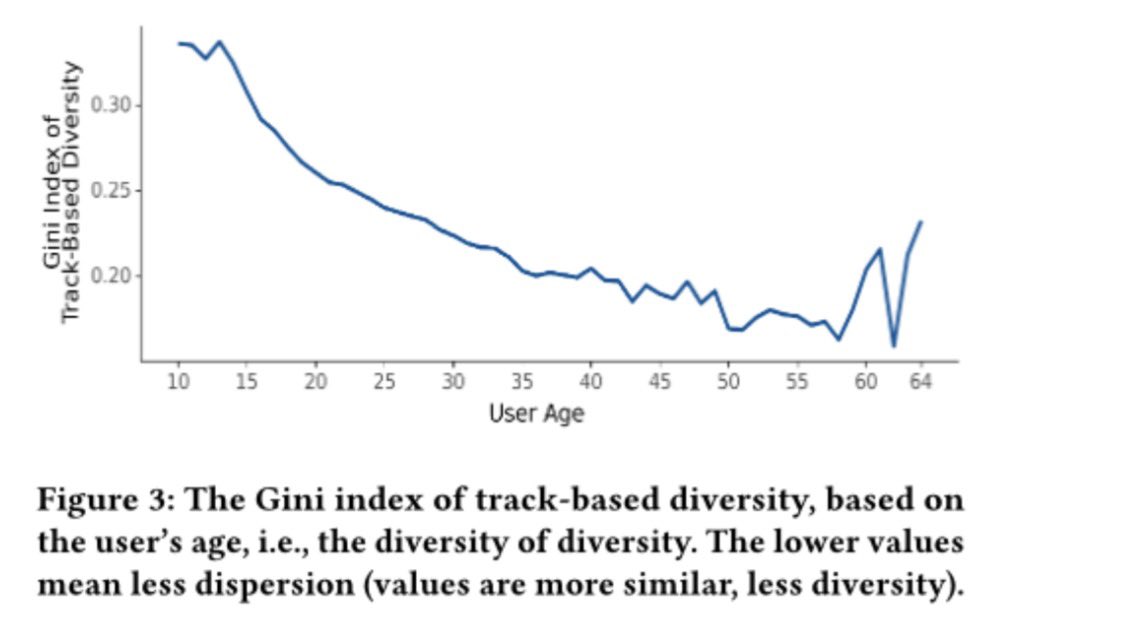
A 2025 longitudinal study from the University of Gothenburg analyzed 40,000 users’ streaming data across 15 years. Younger listeners explored broadly across genres. Older listeners collapsed into increasingly narrow loops, almost entirely anchored to music from their teens and early twenties.
Your brain stopped losing interest in new music years ago. It’s running a cost-benefit analysis. Familiar songs deliver guaranteed dopamine with zero processing cost. New songs require pattern recognition, expectation-building, and repeated exposure before the reward circuit kicks in. Past 25, most people stop paying that tax.
The one variable that predicts whether someone keeps exploring: the personality trait “openness to experience.” Score high, you keep seeking. Score average, you default to the familiar forever.
The fix, if you want one: deliberate exposure. Three listens minimum before your auditory cortex builds enough predictive models to generate a reward response. One passive listen on a playlist will never get there. Your brain needs repetition to find the pattern, and it needs the pattern to release dopamine.