A delivery truck breaks down mid-route. Nobody's in the office. The package still arrives on time, the replacement driver gets paid, and the books balance, start to finish, run by an AI agent.
This is HermesRoutiq: a last-mile delivery company with no ops team. An autonomous Hermes agent watches the fleet, reasons over incidents, and actually runs the business, routing trucks, dispatching drivers, and moving real money.
In the video:
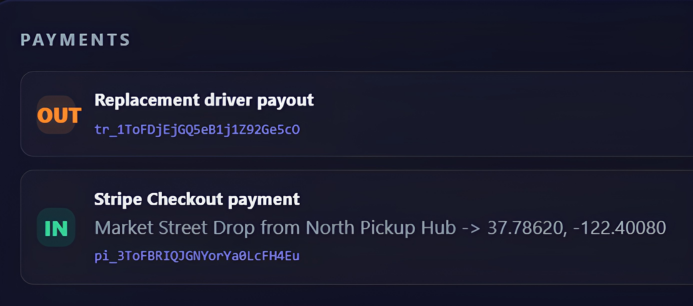
Money IN. A customer orders "Market Street Drop" and pays $9 via @stripe Checkout (pi_…). Hermes prices it within policy and dispatches a driver.
The breakdown. Mid-delivery a truck fails. Hermes detects it instantly, freezes the vehicle, opens an incident, no human alerted it.
The decision. Live in the reasoning feed, Hermes compares recovery options (one replacement vs. split vs. wait), checks its spending policy, approves a budget, and decides, autonomously.
Money OUT. It dispatches a replacement, reroutes around the breakdown, and pays the driver a $4 stripe Connect payout (tr_…, "incident payout for driver-2") — under a hard limit.
Delivered + full receipt. 1/1 in 146s, with the complete incident P&L: revenue protected $9, emergency spend $9, refunds avoided $4, churn avoided $3, 0 human interventions, 0 policy violations.
It learned. Hermes didn't solve from scratch, it reused a recovery skill it learned from a past incident. Every disruption makes the next fix faster.
Hermes works through 24 typed tools (sense → decide → dispatch → pay → provision → learn) and a growing library of skills (breakdown, congestion, payment-decline recovery) it reuses across incidents, all policy-gated through the MCP server.
The full stack, and where each piece lives:
Hermes agent, the operator brain, @nvidia Nemotron 3 Ultra (via OpenRouter) the reasoning model,
NVIDIA NemoClaw + OpenShell sandbox (WSL) securely runs the agent, reached via a Hermes Bridge.
MCP server the agent's typed tools + policy enforcement • Routing service (FastAPI) → NVIDIA cuOpt = assignment & recovery optimization (who drives what, in what order) + OSRM = road geometry & drive-time cost matrix (the real streets)
stripe Checkout (money in) + Connect (payouts out) + Projects (agent-provisioned services)
Supabase Postgres, orders, ledger, decisions, Redis, live sim state , Ambient city simulator, traffic, signals, congestion, Next.js control-room dashboard
Earn → decide → spend → recover → learn..
Fully autonomous.. Thanks to @NousResearch🫶
I built AgentFlow, a dapp that demonstrates a real
"pay-per-task" model for AI agents using Circle x402
on @arc Testnet.
How it works:
1. Connect your wallet and switch to Arc Testnet
2. Get test USDC from the faucet and deposit into Circle Gateway
3. Enter any research task you want
4. An orchestrator pays three AI agents in sequence:
Research Agent ($0.005 USDC) gathers raw data
Analyst Agent ($0.003 USDC) extracts insights
Writer Agent ($0.008 USDC) produces the final report
5. You get a full markdown report and a payment receipt with a settlement ID for every agent call.
The AI brain behind every agent is Hermes by @NousResearch, one of the most capable open
source models available..
Each agent has its own system prompt and role..
Research agent gets live data from CoinGecko and DuckDuckGo injected into the prompt before calling Hermes..
Analyst and writer get the previous agent outputs passed in sequence..
The payment model:
Only the initial deposit touches the chain (~$0.01 gas)
All agent payments are gasless via Circle x402 batching..
Total cost per run: $0.016 USDC, $0.000 gas..
This is a working proof-of-concept for a multi-party
agent marketplace where any developer could host their own agent, set a price, and get paid automatically in USDC whenever someone uses it.
Try it yourself:
https://t.co/sJJdkN82Jj
#ArcTestnet #Circle #x402 #NousResearch #Hermes #Hackathon
Wallet Mood Ring is a Base Mini App on Farcaster that reads your last 7 days of onchain activity on Base and turns it into a wallet mood you can mint and share
It connects your wallet and analyzes real onchain actions like swaps, approvals, NFT mints, bridges and contract interactions
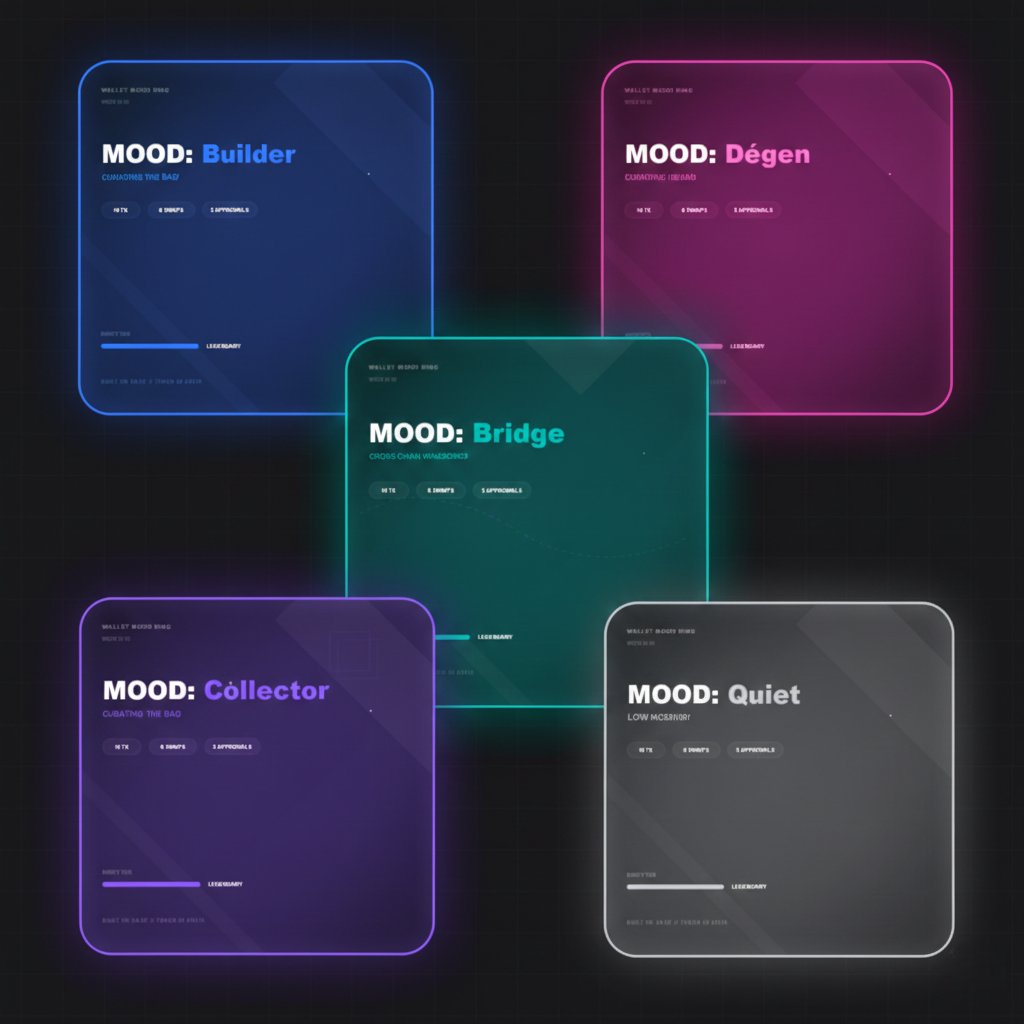
Based on that activity, your wallet gets one of five moods
- Builder Mode for wallets interacting with many contracts
- Degen Mode for high-risk behaviour and lots of approvals
- Collector Mode for NFT mints and marketplace usage
- Bridge Tourist for frequent bridge activity
- Quiet Mode for low or no recent activity
The analysis only looks at the last 7 days, so your mood updates weekly based on what you actually do on Base
Once your mood is ready, you can mint a weekly Mood Badge NFT
Each badge stores your mood rarity and activity stats fully onchain as an ERC721 NFT
Gasless minting is available for Coinbase Smart Wallet users..
Other wallets pay very low gas on Base
Try the Base Mini App on Farcaster
https://t.co/3lw9MJaYH0
Not on Farcaster?
Use the web
https://t.co/B5cAlxyiYH
Built with💙on @base@jessepollak #BuildOnBase #Baseposting
Konnex uses stablecoins for payments so robot jobs stay predictable.
You deposit stablecoins, escrow holds them, and payout is released only after proof is verified.
If proof does not pass, escrow can refund and apply penalties. KNX is used for staking and fees. @konnex_world
Konnex makes robot jobs auditable end to end: broadcast the task, collect bids, run execution.
submit proof, then release payout. libp2p + QUIC moves data, signed packet hashes lock everything into a JobID
Stablecoins pay, KNX secures, ScoreRoot drives rewards @konnex_world
Konnex Ingest is live: an offchain onboarding phase before the onchain testnet later this year.
Submit robotics models, run fixed tasks, collect telemetry video, humans grade safety and success, then RLHF improves models.
Next: Runtime Zero and Preflight sim @konnex_world
4 of 4
Stablecoins keep payouts predictable and KNX supports network fees staking and governance aligning incentives so better policies and honest verification win as the network scales
1 of 4
Robotic work needs trustless coordination and payment this network turns real world tasks into onchain jobs funded by stablecoin escrow you set goal deadline safety constraints and success criteria then sensor evidence is verified before rewards release @konnex_world
3 of 4
After execution the robot returns evidence like video GPS IMU and telemetry validators confirm proof of physical work and proof of physical execution then escrow releases rewards or applies penalties